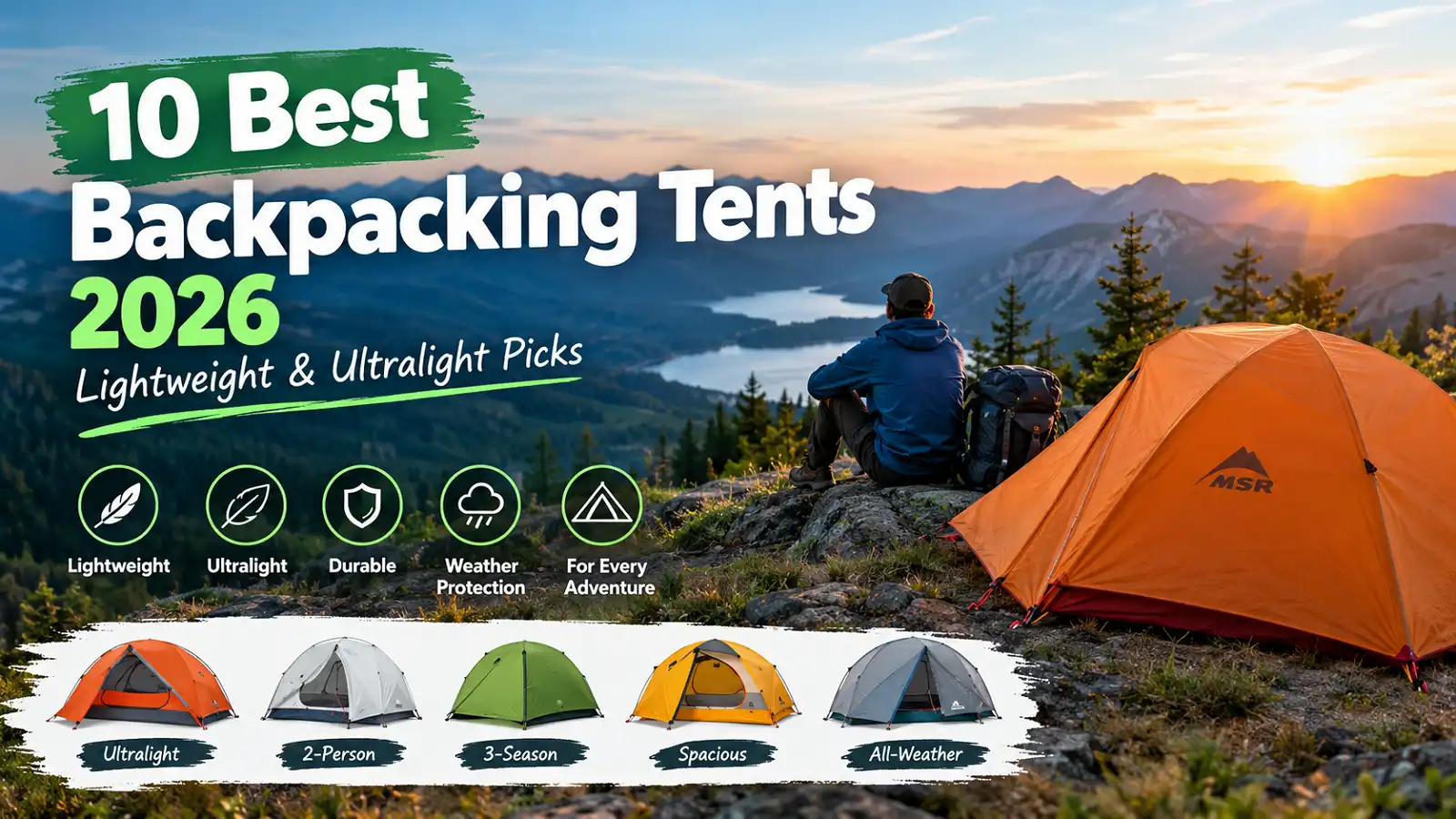
10 Best Backpacking Tents 2026: Lightweight & Ultralight Picks
If you spend enough time backpacking, you eventually learn that a tent is more than just a place to sleep.
It is your shelter when the forecast changes, your dry place when the trail gets soaked, and sometimes the only comfortable space you have after a long day with a heavy pack. That makes choosing among the many backpacking tents on the market a little harder than simply looking at weight or price.
I have been hiking and camping since 2018, out of Bakersfield, California. What started as weekend trips turned into a habit I plan my year around. Along the way, I made every rookie mistake: wrong boots, a pack that was too heavy, no plan for the weather, and I learned from all of them.
That experience has changed how I look at outdoor gear. Lighter is not automatically better. A few ounces saved are not always worth giving up useful interior space, easier setup, durability, or better weather protection.
Outdoor Mystery is my personal blog, not a company. I write the guides myself. When I recommend gear, it is either kit I have used out on the trail or something I have researched carefully. If I have not tried it, I tell you.
For this guide, I researched current 2026 backpacking tents and compared the things that matter most on real trips: weight, packed size, livability, weather protection, setup, durability, and overall practicality.
If you are looking for a lightweight shelter for weekend trips, a comfortable two-person tent for longer adventures, or an ultralight option for a thru-hike, these are 10 backpacking tents worth putting on your shortlist.
Quick Look: The Best Backpacking Tents for 2026
| TentBest ForApprox. Weight\*Style | |||
|---|---|---|---|
| Big Agnes Copper Spur UL2 | Best all-around balance | \~3 lb | Freestanding |
| NEMO Dagger OSMO 2 | Comfort + backpacking | \~3.8 lb | Freestanding |
| MSR Hubba Hubba LT 2 | Lightweight versatility | \~3.3 lb | Freestanding |
| NEMO Hornet OSMO 2 | Ultralight backpacking | \~2.5 lb | Semi-freestanding |
| Big Agnes Tiger Wall UL2 | Low weight + comfort | \~2.5 lb | Semi-freestanding |
| The North Face Stormbreak 2 | Value + durability | \~4 lb+ | Freestanding |
| MSR FreeLite 2 | Lightweight traditional design | \~2.5 lb | Semi-freestanding |
| Mountain Hardwear Nimbus UL 2 | Lightweight traditional tent | \~2.5–3 lb | Freestanding |
| Kelty Late Start 2 | Simple setup + value | \~4 lb | Freestanding |
| REI Co-op Half Dome 2 Plus | Spacious budget-friendly option | \~4 lb+ | Freestanding |
\*Weights can vary by generation, size, included accessories, and manufacturer specifications. Always check the current listing before buying.
1. Big Agnes Copper Spur UL2
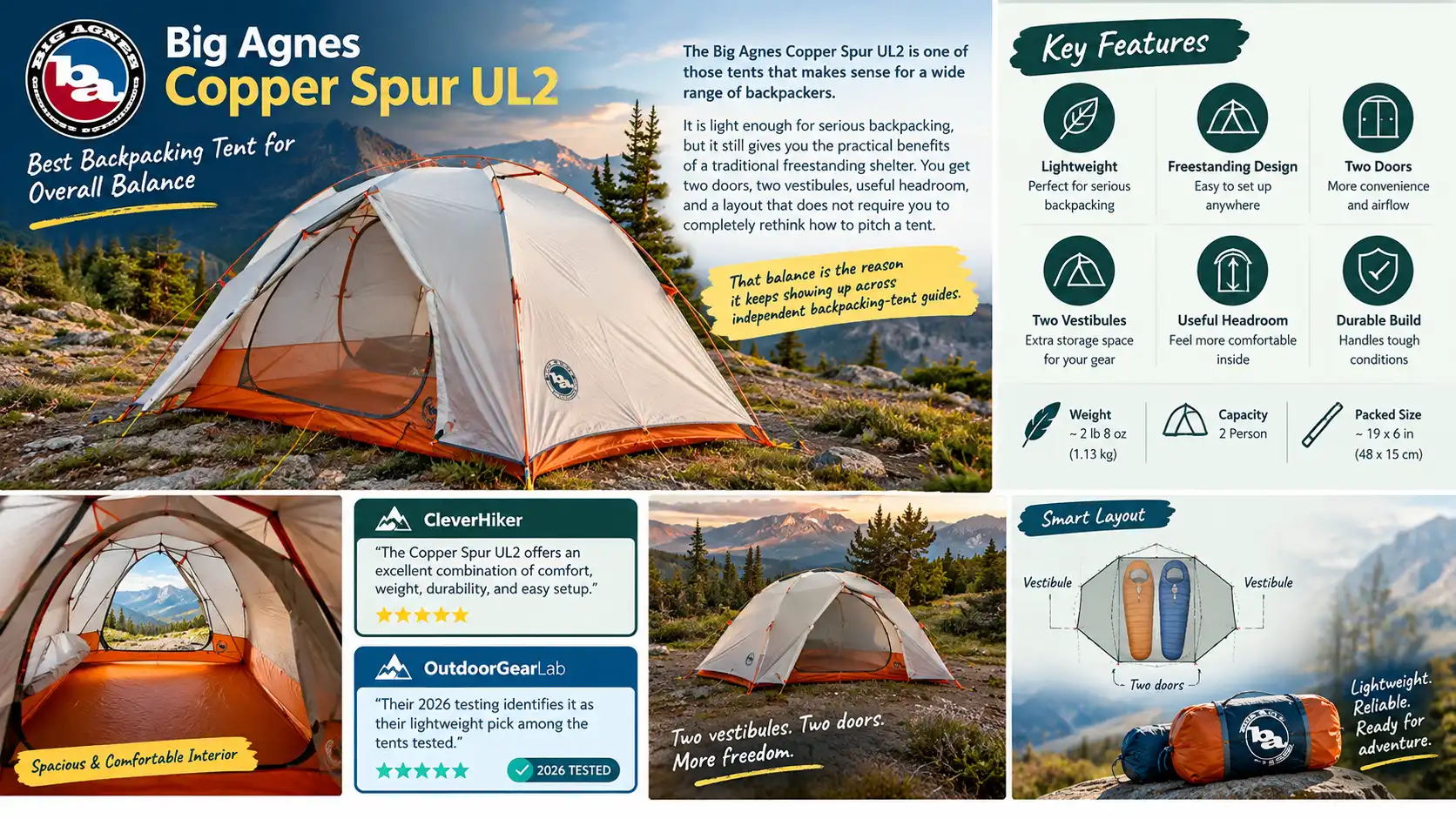
Big Agnes Copper Spur UL2: lightweight comfort and practical backpacking design.
Best Backpacking Tent for Overall Balance
The Big Agnes Copper Spur UL2 is one of those tents that makes sense for a wide range of backpackers.
It is light enough for serious backpacking, but it still gives you the practical benefits of a traditional freestanding shelter. You get two doors, two vestibules, useful headroom, and a layout that does not require you to completely rethink how you pitch a tent.
That balance is the reason it keeps showing up across independent backpacking-tent guides.
CleverHiker currently highlights the Copper Spur UL2 for its combination of comfort, weight, durability, and easy setup, while OutdoorGearLab’s 2026 testing identifies it as its lightweight pick among the tents tested.
Why I Like the Idea
For me, the important thing is balance.
An ultralight shelter can be fantastic when every ounce matters, but if you are carrying it for several days and dealing with rain, condensation, awkward campsites, or a tired body, livability starts to matter a lot more.
The Copper Spur UL2 sits in that middle ground.
Pros
- Lightweight for a freestanding tent
- Two doors and two vestibules
- Easy, familiar setup
- Good interior space for one or two people
- Packs relatively small
Cons
- Premium price
- Lightweight materials need reasonable care
- Two people with lots of gear may find the interior tight
Best For
Backpackers who want one lightweight tent that can handle a wide range of three-season trips.
2. NEMO Dagger OSMO 2
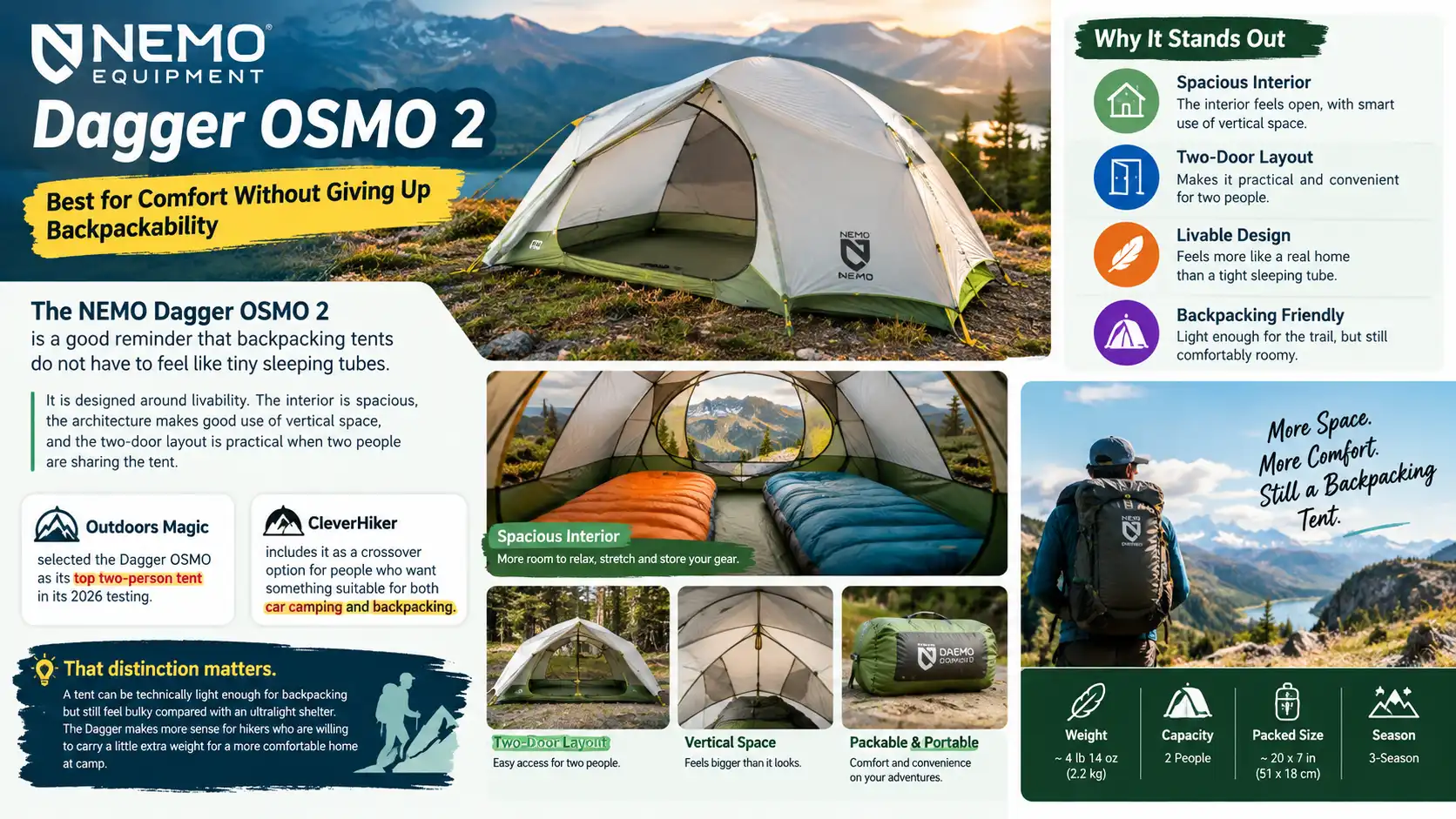
NEMO Dagger OSMO 2 combines comfort with backpacking portability.
Best for Comfort Without Giving Up Backpackability
The NEMO Dagger OSMO 2 is a good reminder that backpacking tents do not have to feel like tiny sleeping tubes.
It is designed around livability. The interior is spacious, the architecture makes good use of vertical space, and the two-door layout is practical when two people are sharing the tent.
Outdoors Magic selected the Dagger OSMO as its top two-person tent in its 2026 testing, while CleverHiker includes it as a crossover option for people who want something suitable for both car camping and backpacking.
That distinction matters.
A tent can be technically light enough for backpacking but still feel bulky compared with an ultralight shelter. The Dagger makes more sense for hikers who are willing to carry a little extra weight for a more comfortable home at camp.
Pros
- Spacious interior
- Comfortable for two
- Two doors and vestibules
- Good choice for longer trips
- Versatile design
Cons
- Heavier than the lightest alternatives
- Premium price
- Not the choice for extreme ounce counting
Best For
Backpackers who prioritize comfort and usable living space.
3. MSR Hubba Hubba LT 2
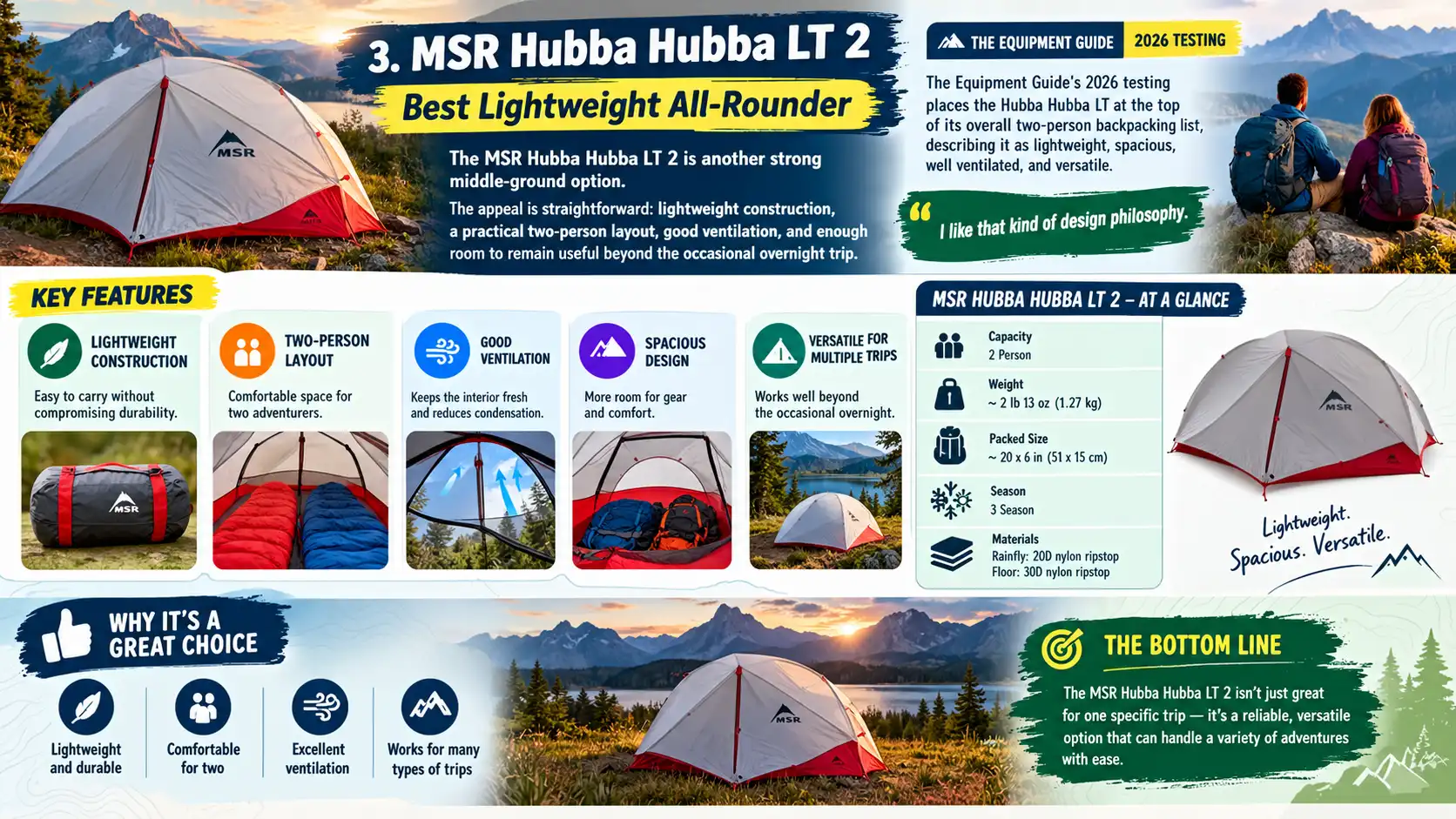
MSR Hubba Hubba LT 2 offers lightweight comfort, ventilation, and versatile two-person camping.
Best Lightweight All-Rounder
The MSR Hubba Hubba LT 2 is another strong middle-ground option.
The appeal is straightforward: lightweight construction, a practical two-person layout, good ventilation, and enough room to remain useful beyond the occasional overnight trip.
The Equipment Guide’s 2026 testing places the Hubba Hubba LT at the top of its overall two-person backpacking list, describing it as lightweight, spacious, well ventilated, and versatile.
I like that kind of design philosophy.
When I am looking at gear, I would rather have something that works across several types of trips than something that is perfect for only one narrow situation.
Pros
- Good weight-to-space balance
- Two-person design
- Good ventilation
- Practical for three-season trips
- Compact packed size
Cons
- Expensive
- Not the absolute lightest option
- Premium materials deserve careful handling
Best For
Hikers who want a lightweight tent without going all-in on an ultralight shelter.
4. NEMO Hornet OSMO 2
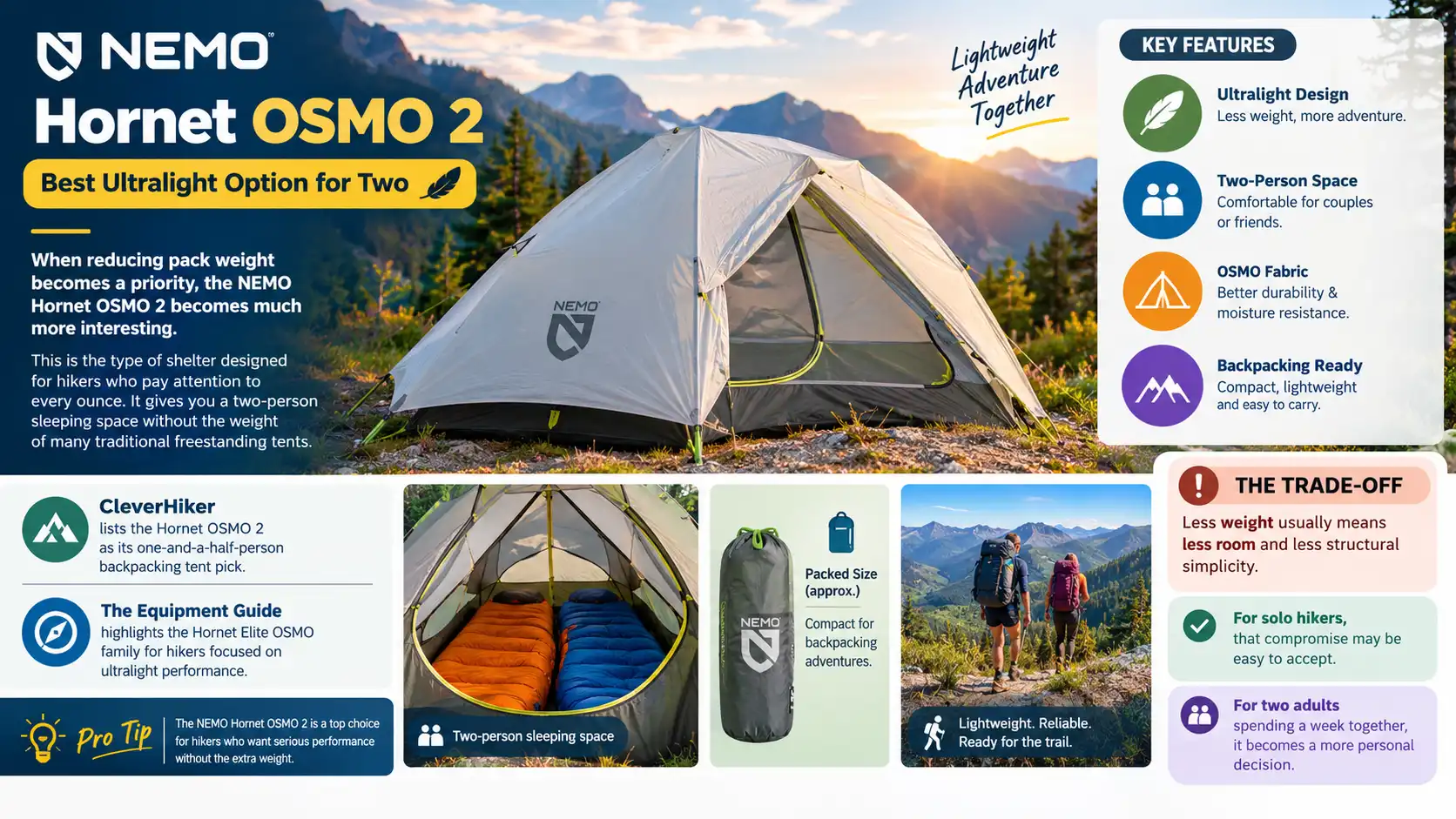
NEMO Hornet OSMO 2 offers lightweight two-person shelter for backpacking.
Best Ultralight Option for Two
When reducing pack weight becomes a priority, the NEMO Hornet OSMO 2 becomes much more interesting.
This is the type of shelter designed for hikers who pay attention to every ounce. It gives you a two-person sleeping space without the weight of many traditional freestanding tents.
CleverHiker lists the Hornet OSMO 2 as its one-and-a-half-person backpacking tent pick, while The Equipment Guide highlights the Hornet Elite OSMO family for hikers focused on ultralight performance.
The trade-off is simple: less weight usually means less room and less structural simplicity.
For solo hikers, that compromise may be easy to accept. For two adults spending a week together, it becomes a more personal decision.
Pros
- Very low weight
- Compact packed size
- Good choice for long-distance hiking
- Two-door configuration
- Efficient use of materials
Cons
- Less spacious than traditional two-person tents
- Semi-freestanding design requires more attention during setup
- Lightweight materials need care
Best For
Solo hikers or lightweight-minded pairs who want to reduce shelter weight.
5. Big Agnes Tiger Wall UL2
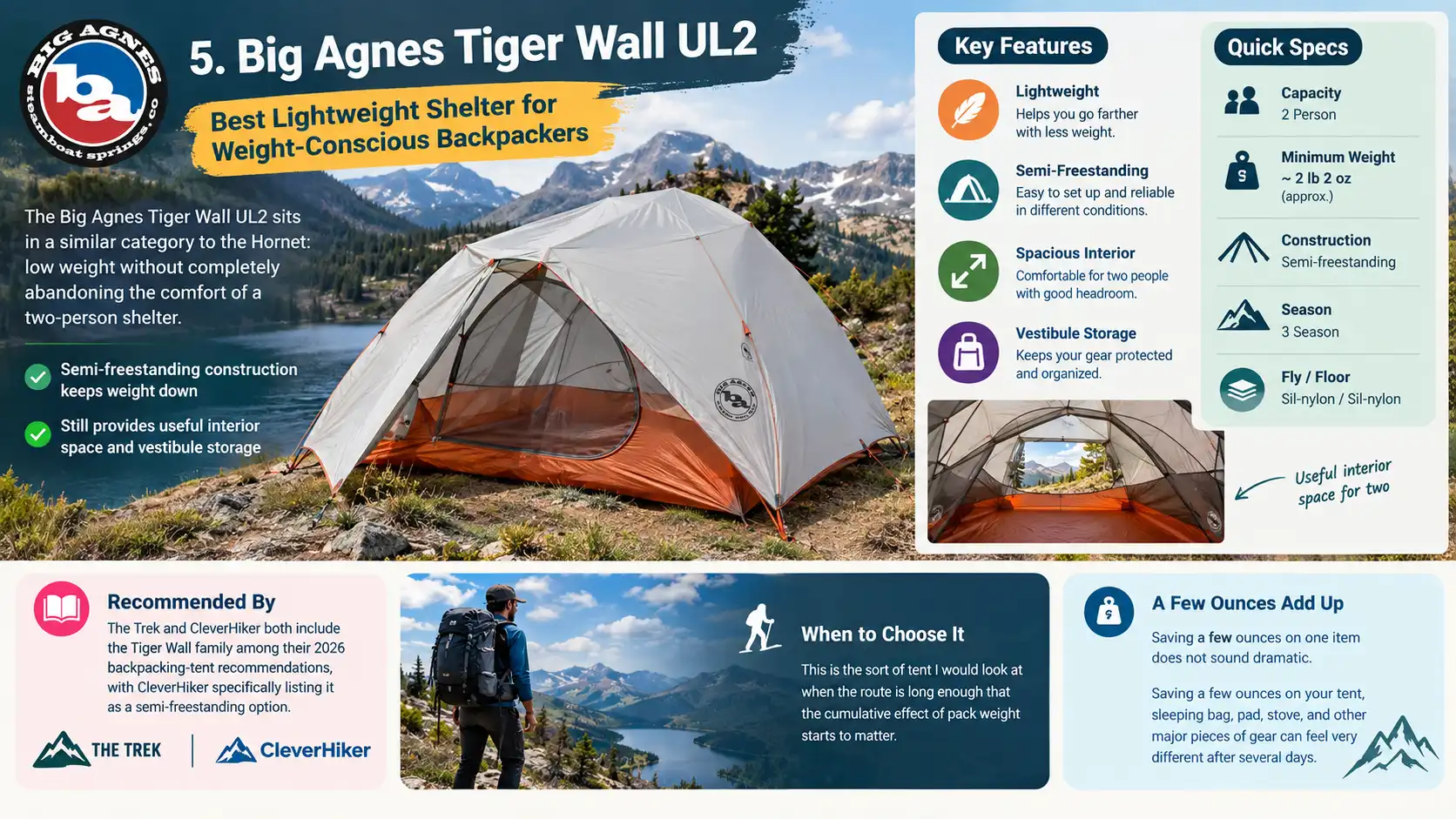
Big Agnes Tiger Wall UL2 offers lightweight two-person shelter for long backpacking trips.
Best Lightweight Shelter for Weight-Conscious Backpackers
The Big Agnes Tiger Wall UL2 sits in a similar category to the Hornet: low weight without completely abandoning the comfort of a two-person shelter.
Its semi-freestanding construction helps keep weight down, while the design still provides useful interior space and vestibule storage.
The Trek and CleverHiker both include the Tiger Wall family among their 2026 backpacking-tent recommendations, with CleverHiker specifically listing it as a semi-freestanding option.
This is the sort of tent I would look at when the route is long enough that the cumulative effect of pack weight starts to matter.
Saving a few ounces on one item does not sound dramatic.
Saving a few ounces on your tent, sleeping bag, pad, stove, and other major pieces of gear can feel very different after several days.
Pros
- Lightweight
- Compact
- Good space-to-weight ratio
- Useful vestibules
- Well suited to long-distance trips
Cons
- Semi-freestanding design
- Less forgiving than heavier traditional tents
- Lightweight fabrics require care
Best For
Backpackers who want low weight without moving all the way into minimalist shelter designs.
6. The North Face Stormbreak 2
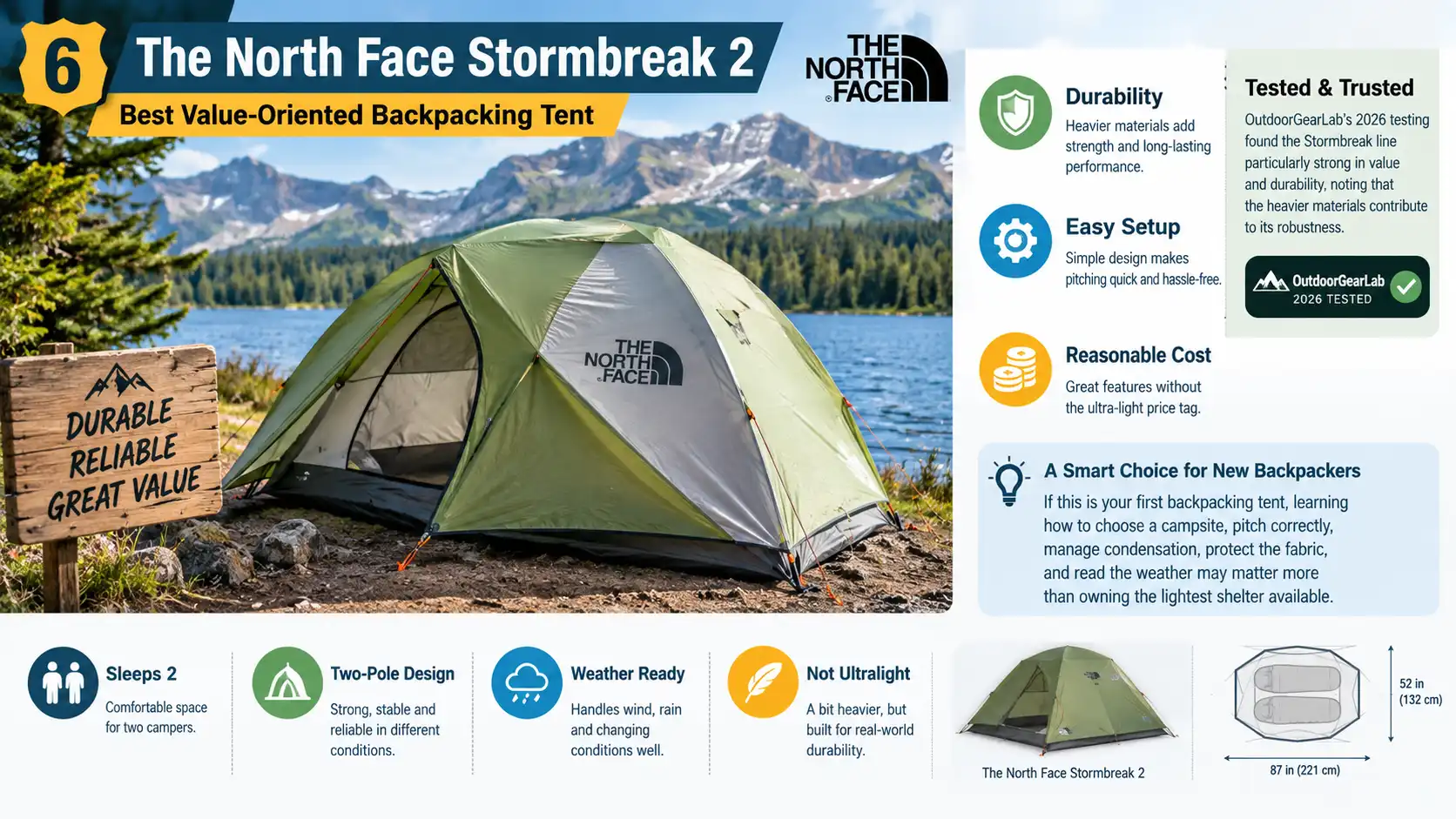
The North Face Stormbreak 2 offers durable, value-focused backpacking shelter.
Best Value-Oriented Backpacking Tent
Not everyone needs a two-pound tent.
That is worth saying because the ultralight market can make it feel as though anything heavier is automatically a bad choice.
The The North Face Stormbreak 2 makes more sense for someone who values durability, straightforward setup, and reasonable cost over shaving every possible ounce.
OutdoorGearLab’s 2026 testing found the Stormbreak line particularly strong in value and durability, noting that the heavier materials contribute to its robustness.
For a newer backpacker, that can be a very reasonable trade.
If this is your first backpacking tent, learning how to choose a campsite, pitch correctly, manage condensation, protect the fabric, and read the weather may matter more than owning the lightest shelter available.
Pros
- Durable construction
- Straightforward setup
- Generally more approachable price
- Good weather protection
- Comfortable for one or two people
Cons
- Heavy compared with ultralight tents
- Larger packed size
- Not ideal for strict ounce counters
Best For
Beginners and budget-conscious backpackers who want a straightforward shelter.
7. MSR FreeLite 2
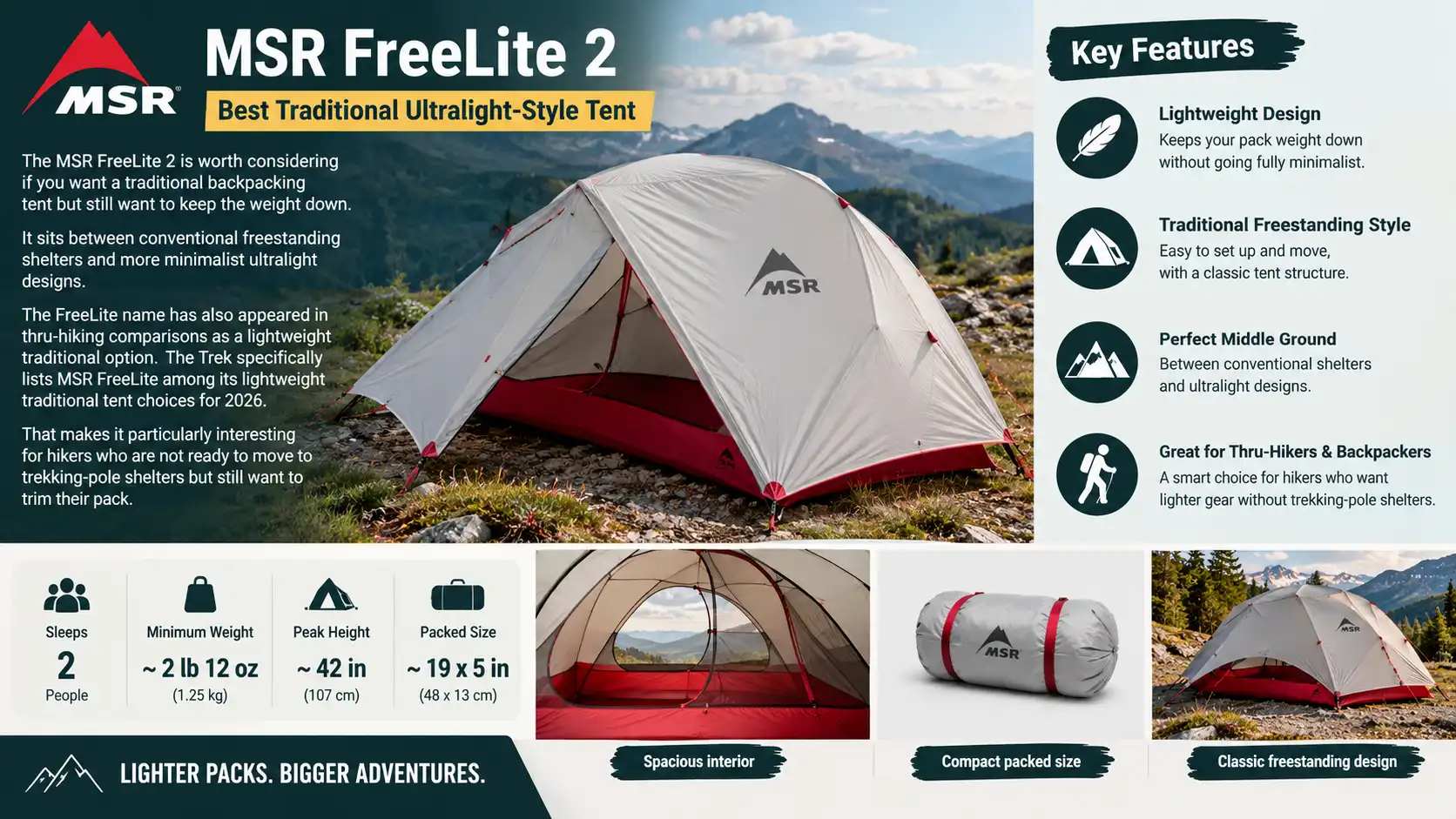
MSR FreeLite 2 – a lightweight traditional backpacking tent.
Best Traditional Ultralight-Style Tent
The MSR FreeLite 2 is worth considering if you want a traditional backpacking tent but still want to keep the weight down.
It sits between conventional freestanding shelters and more minimalist ultralight designs.
The FreeLite name has also appeared in thru-hiking comparisons as a lightweight traditional option. The Trek specifically lists MSR FreeLite among its lightweight traditional tent choices for 2026.
That makes it particularly interesting for hikers who are not ready to move to trekking-pole shelters but still want to trim their pack.
Pros
- Lightweight
- Traditional tent feel
- Compact
- Good option for long-distance hiking
- Practical for solo or two-person use depending on the model
Cons
- Less spacious than heavier tents
- Semi-freestanding setup
- Premium materials require care
Best For
Hikers who want a lightweight traditional-style backpacking tent.
8. Mountain Hardwear Nimbus UL 2
NEMO Dagger OSMO 2 combines comfort with backpacking portability.
Best Lightweight Alternative
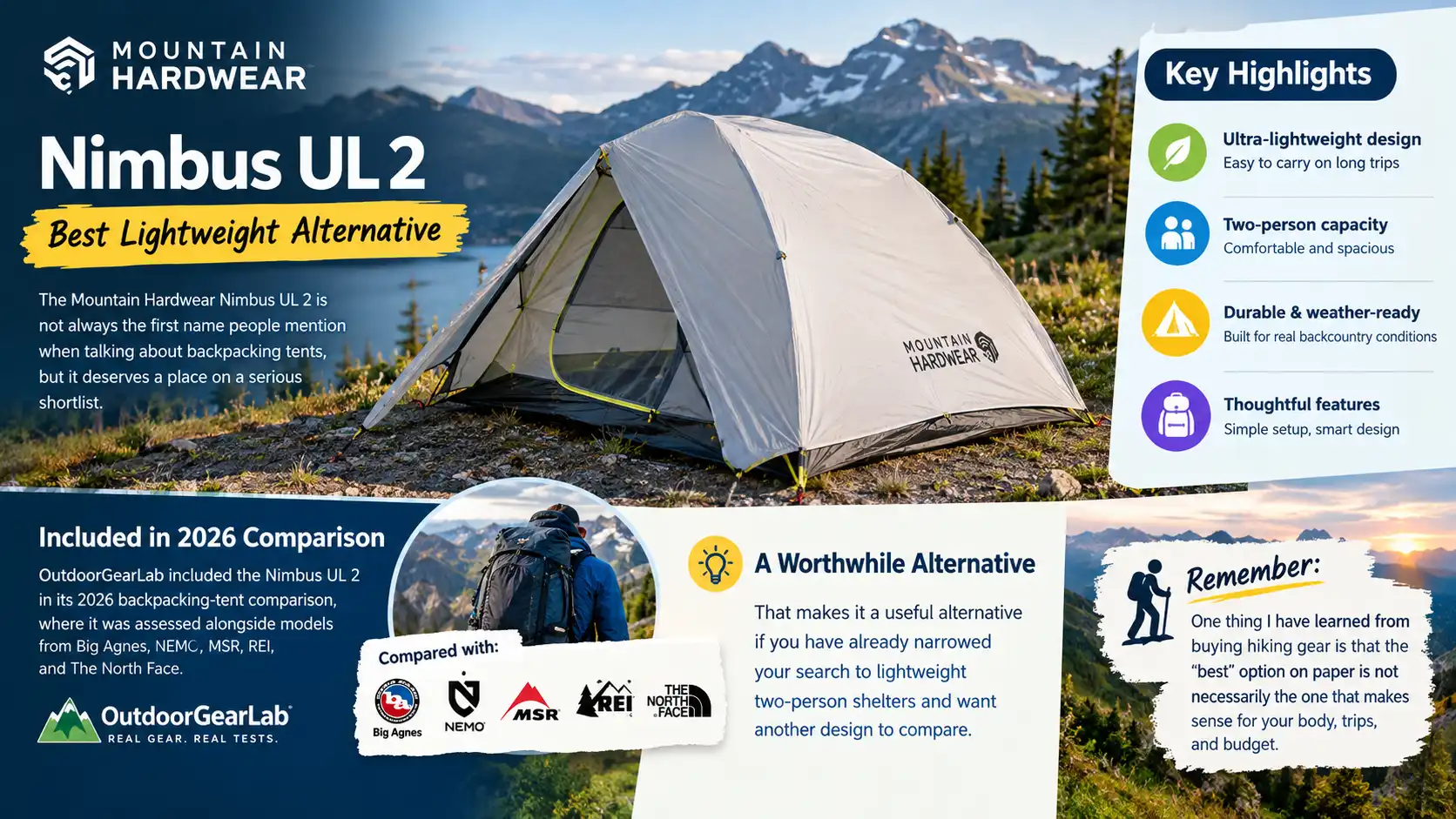
The Mountain Hardwear Nimbus UL 2 is not always the first name people mention when talking about backpacking tents, but it deserves a place on a serious shortlist.
OutdoorGearLab included the Nimbus UL 2 in its 2026 backpacking-tent comparison, where it was assessed alongside models from Big Agnes, NEMO, MSR, REI, and The North Face.
That makes it a useful alternative if you have already narrowed your search to lightweight two-person shelters and want another design to compare.
One thing I have learned from buying hiking gear is that the “best” option on paper is not necessarily the one that makes sense for your body, trips, and budget.
Sometimes the alternative is worth a closer look.
Pros
- Lightweight design
- Two-person configuration
- Backpacking-focused construction
- Compact compared with heavier tents
Cons
- Less widely discussed than the biggest competitors
- Premium lightweight materials need care
- Availability can vary
Best For
Hikers looking for a lightweight two-person alternative outside the usual shortlist.
9. Kelty Late Start 2
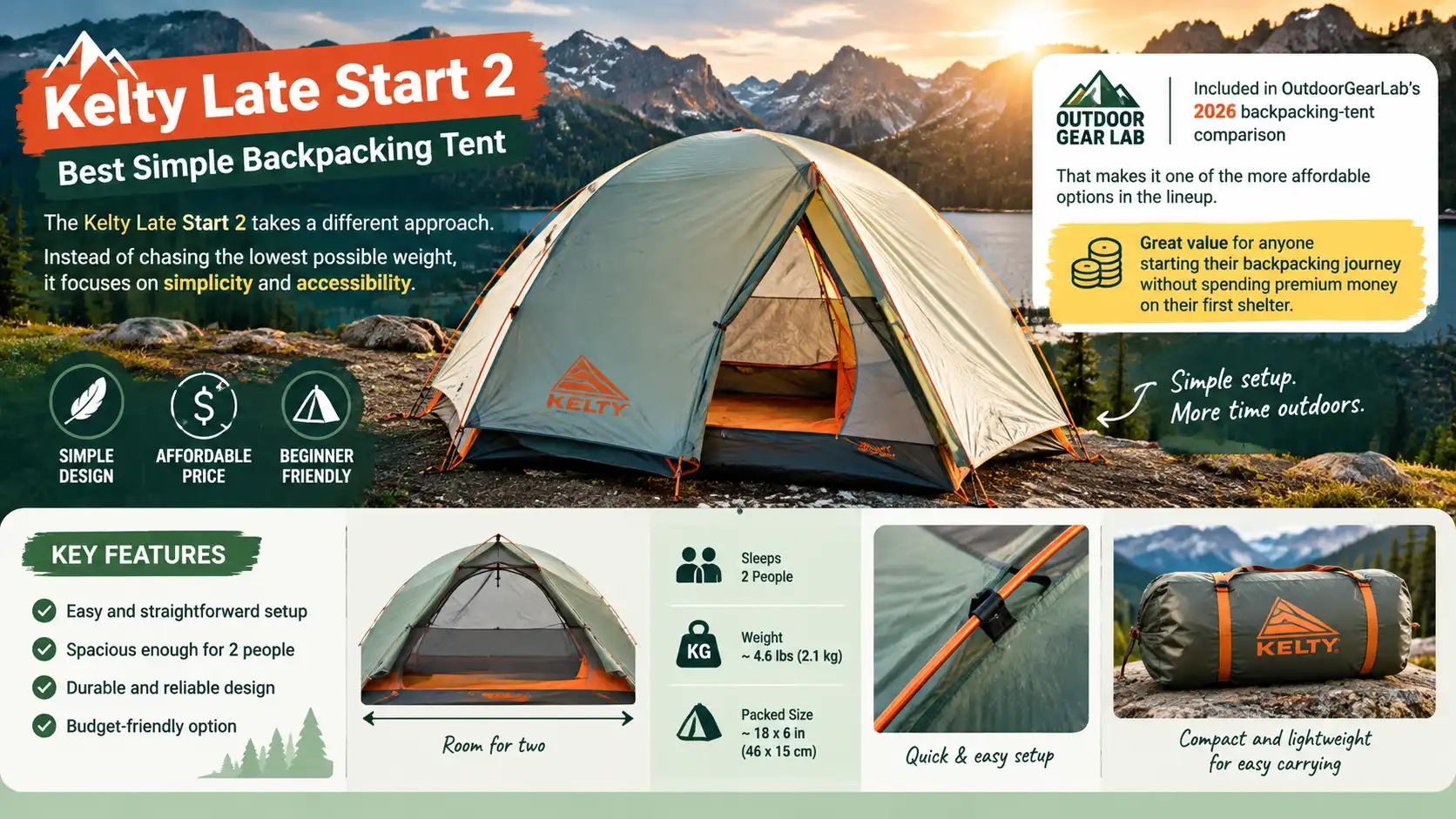
Kelty Late Start 2 — a simple, accessible backpacking tent.
Best Simple Backpacking Tent
The Kelty Late Start 2 takes a different approach.
Instead of chasing the lowest possible weight, it focuses on simplicity and accessibility.
OutdoorGearLab includes the Late Start 2 in its 2026 backpacking-tent comparison, making it one of the more affordable options in the lineup.
That makes it worth considering if you are getting into backpacking and do not want to spend premium money on your first shelter.
There is also something to be said for a tent that you can pitch without turning the process into an engineering project.
Pros
- Simple design
- Easy to understand
- Generally accessible price
- Suitable for newer backpackers
- Freestanding setup
Cons
- Heavier than ultralight competitors
- Bulkier packed size
- Not aimed at serious ounce counters
Best For
New backpackers who want simplicity over extreme weight savings.
10. REI Co-op Half Dome 2 Plus
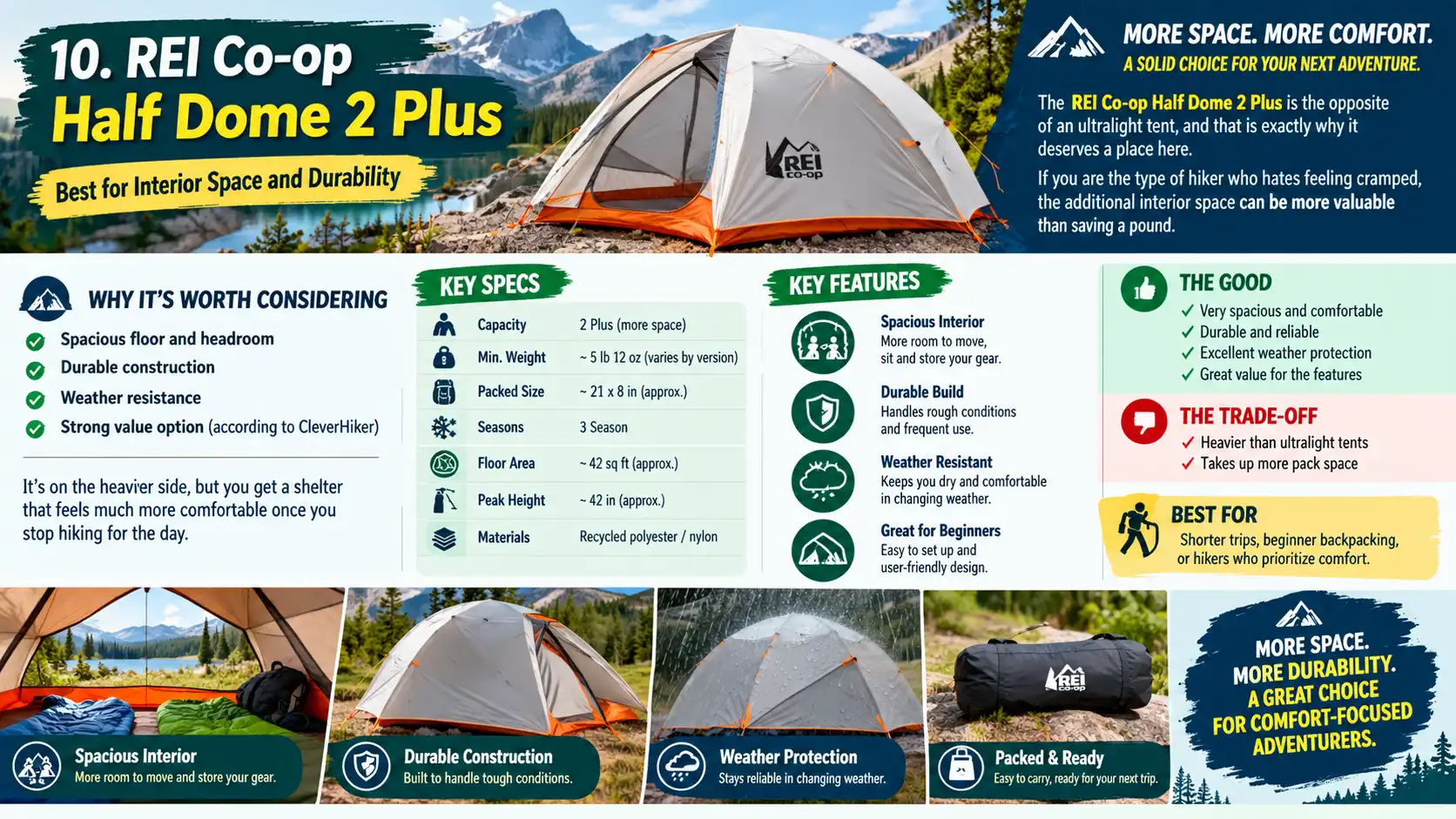
REI Half Dome 2 Plus offers spacious comfort, durability, and weather protection.
Best for Interior Space and Durability
The REI Co-op Half Dome 2 Plus is the opposite of an ultralight tent, and that is exactly why it deserves a place here.
If you are the type of hiker who hates feeling cramped, the additional interior space can be more valuable than saving a pound.
CleverHiker specifically highlights the Half Dome 2 Plus as a strong value option because of its spacious floor, headroom, durability, and weather resistance, while noting that it is on the heavier side.
That is the trade-off.
You carry more, but you get a shelter that feels much more comfortable once you stop hiking for the day.
For shorter trips, beginner backpacking, or hikers who prioritize comfort, that can be a very reasonable decision.
Pros
- Spacious interior
- Good headroom
- Durable materials
- Strong value
- Comfortable for two
Cons
- Heavy compared with ultralight tents
- Larger packed size
- Not the right choice for aggressive weight reduction
Best For
Backpackers who prioritize space, comfort, and durability over minimum weight.
How to Choose the Right Backpacking Tent
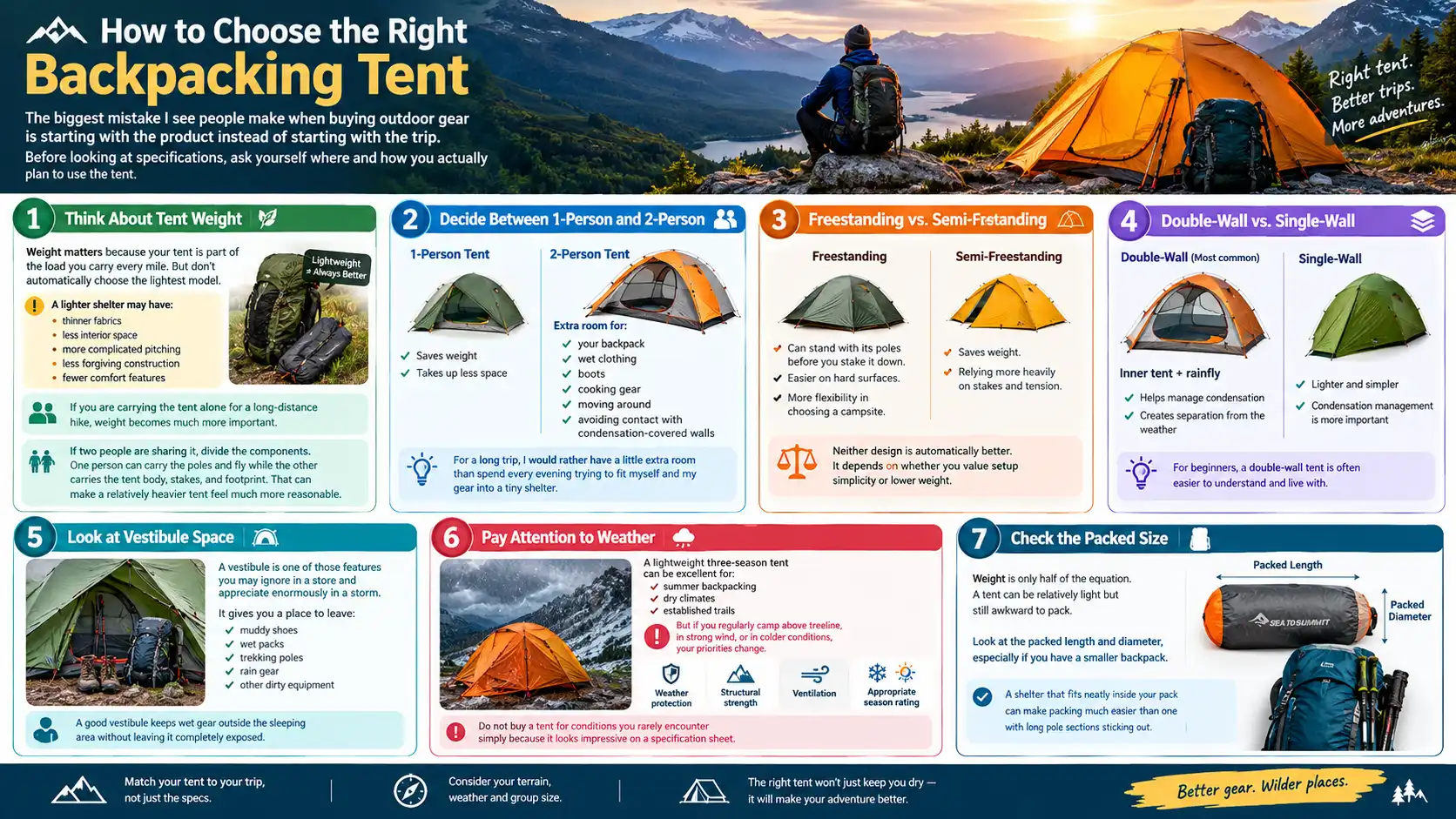
How to choose the right backpacking tent
The biggest mistake I see people make when buying outdoor gear is starting with the product instead of starting with the trip.
Before looking at specifications, ask yourself where and how you actually plan to use the tent.
1. Think About Tent Weight
Weight matters because your tent is part of the load you carry every mile.
But don’t automatically choose the lightest model.
A lighter shelter may have:
- thinner fabrics
- less interior space
- more complicated pitching
- less forgiving construction
- fewer comfort features
If you are carrying the tent alone for a long-distance hike, weight becomes much more important.
If two people are sharing it, divide the components.
One person can carry the poles and fly while the other carries the tent body, stakes, and footprint.
That can make a relatively heavier tent feel much more reasonable.
2. Decide Between 1-Person and 2-Person
A one-person tent saves weight and space.
But a two-person tent can be a surprisingly good choice for solo hikers.
You get extra room for:
- your backpack
- wet clothing
- boots
- cooking gear
- moving around
- avoiding contact with condensation-covered walls
For a long trip, I would rather have a little extra room than spend every evening trying to fit myself and my gear into a tiny shelter.
3. Freestanding vs. Semi-Freestanding
A freestanding tent can stand with its poles before you stake it down.
That makes pitching easier on hard surfaces and gives you more flexibility when choosing a campsite.
A semi-freestanding tent saves weight by relying more heavily on stakes and tension.
Neither design is automatically better.
It depends on whether you value setup simplicity or lower weight.
4. Double-Wall vs. Single-Wall
Most traditional backpacking tents use a double-wall system:
inner tent + rainfly
This can help manage condensation and creates a useful separation between you and the weather.
Single-wall shelters can be lighter and simpler, but condensation management becomes more important.
For beginners, a double-wall tent is often easier to understand and live with.
5. Look at Vestibule Space
A vestibule is one of those features you may ignore in a store and appreciate enormously in a storm.
It gives you a place to leave:
- muddy shoes
- wet packs
- trekking poles
- rain gear
- other dirty equipment
A good vestibule keeps wet gear outside the sleeping area without leaving it completely exposed.
6. Pay Attention to Weather
Think about the conditions where you actually hike.
A lightweight three-season tent can be excellent for summer backpacking, dry climates, and established trails.
But if you regularly camp above treeline, in strong wind, or in colder conditions, your priorities change.
Weather protection, structural strength, ventilation, and appropriate season rating become much more important.
Do not buy a tent for conditions you rarely encounter simply because it looks impressive on a specification sheet.
7. Check the Packed Size
Weight is only half of the equation.
A tent can be relatively light but still awkward to pack.
Look at the packed length and diameter, especially if you have a smaller backpack.
A shelter that fits neatly inside your pack can make packing much easier than one with long pole sections sticking out.
What Weight Should a Backpacking Tent Be?
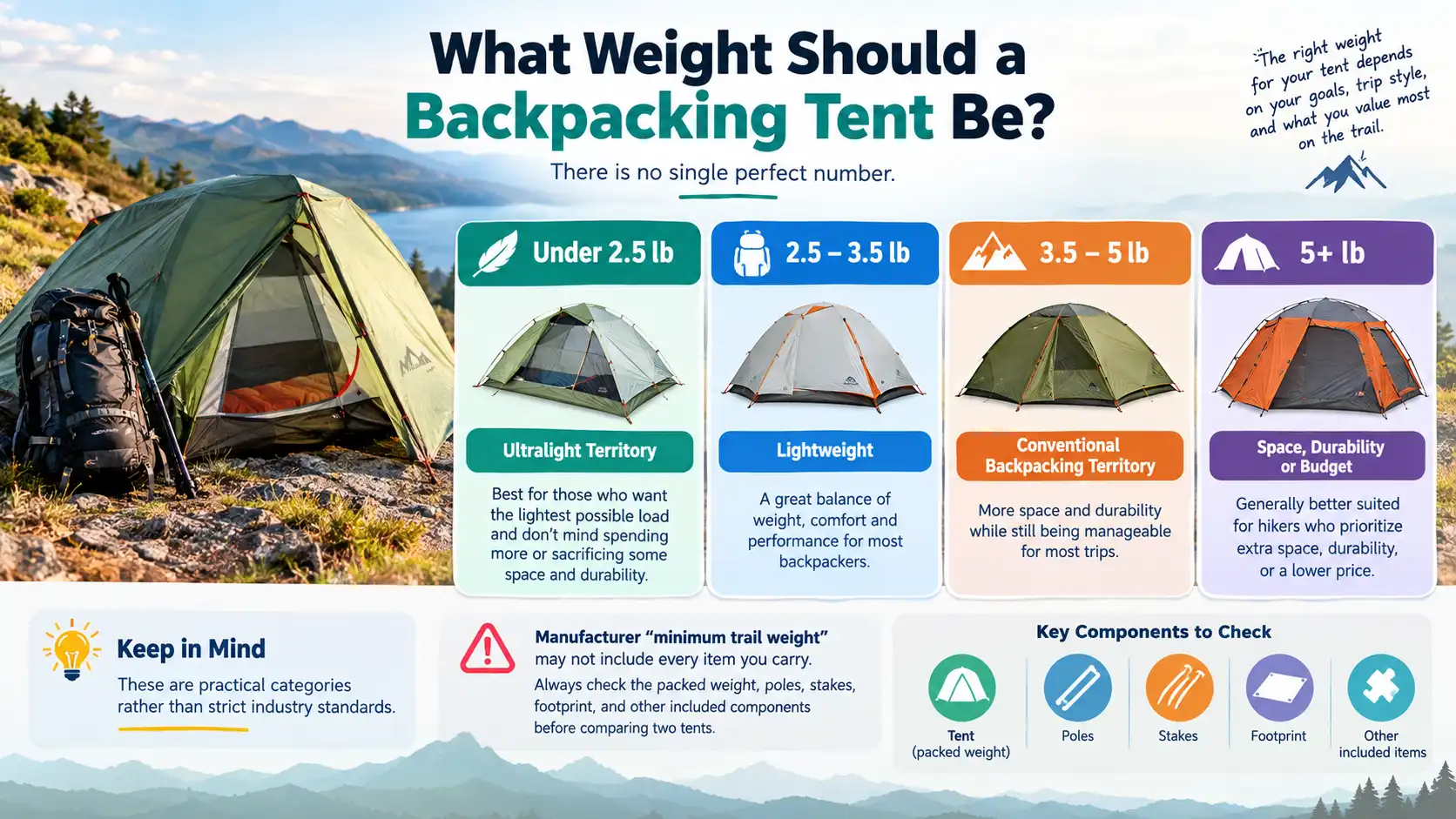
Backpacking tent weights compared from ultralight to conventional options.
There is no single perfect number.
For a two-person shelter, roughly:
- Under 2.5 lb: ultralight territory
- 2.5–3.5 lb: lightweight
- 3.5–5 lb: conventional backpacking territory
- 5+ lb: generally better suited to hikers prioritizing space, durability, or budget
These are practical categories rather than strict industry standards.
And remember that manufacturer “minimum trail weight” may not include every item you carry.
Always check the packed weight, poles, stakes, footprint, and other included components before comparing two tents.
Do You Really Need an Ultralight Backpacking Tent?
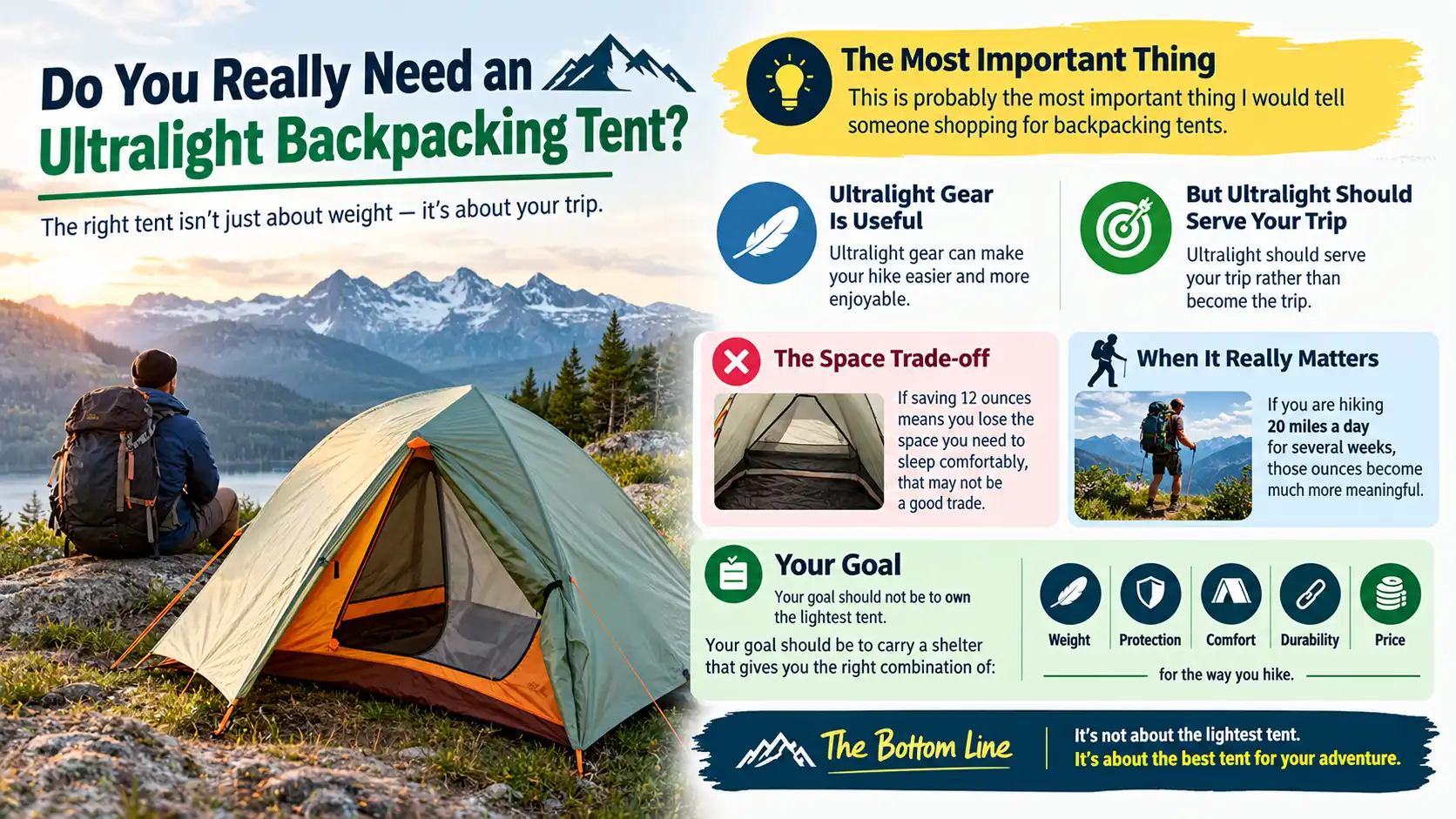
Choosing the right balance of weight, comfort, and protection.
This is probably the most important thing I would tell someone shopping for backpacking tents.
Ultralight gear is useful.
But ultralight should serve your trip rather than become the trip.
If saving 12 ounces means you lose the space you need to sleep comfortably, that may not be a good trade.
If you are hiking 20 miles a day for several weeks, those ounces become much more meaningful.
Your goal should not be to own the lightest tent.
Your goal should be to carry a shelter that gives you the right combination of weight, protection, comfort, durability, and price for the way you hike.
How I Would Narrow the List
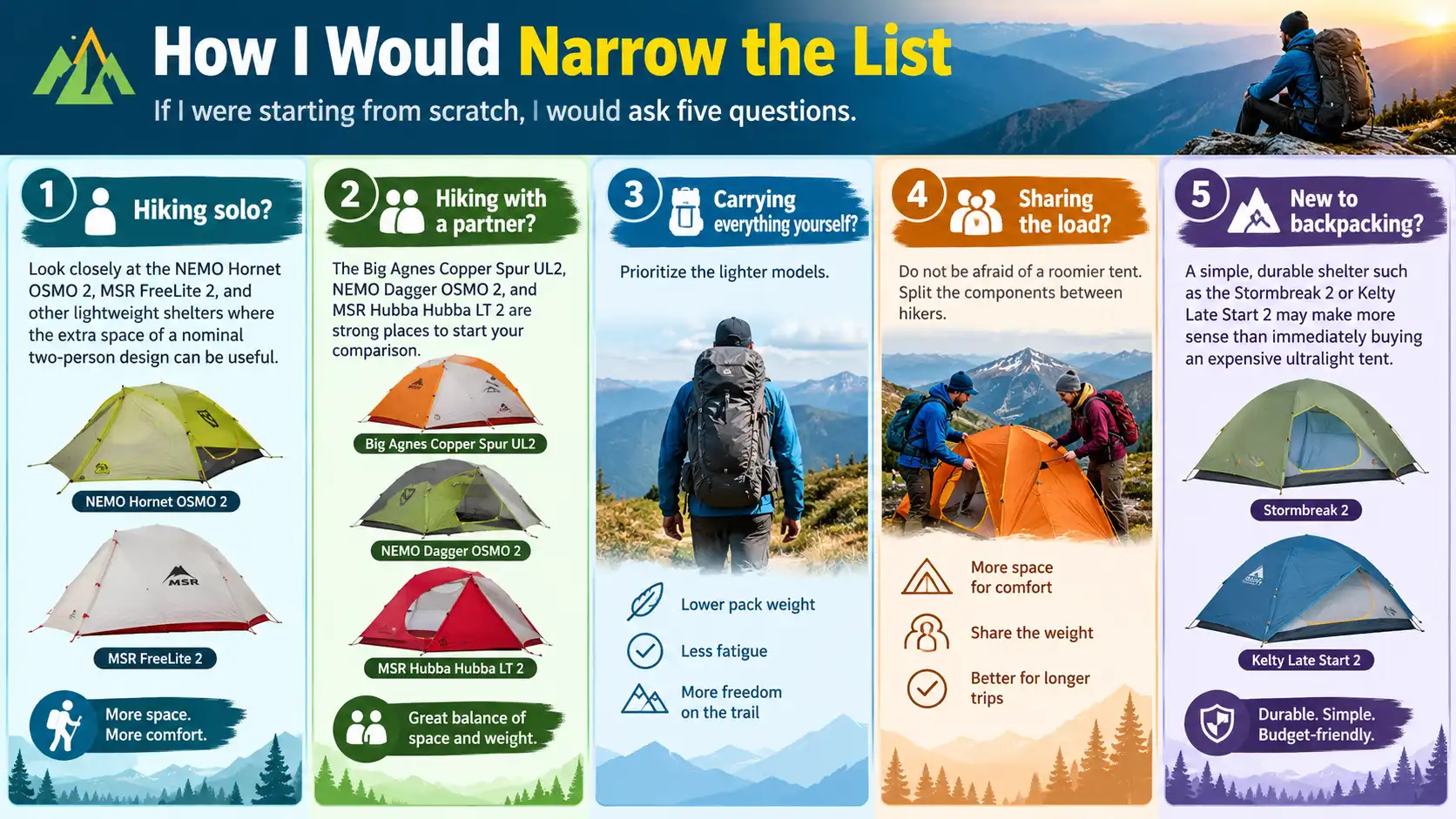
Five questions to help narrow down the right backpacking tent.
If I were starting from scratch, I would ask five questions.
Hiking solo?
Look closely at the NEMO Hornet OSMO 2, MSR FreeLite 2, and other lightweight shelters where the extra space of a nominal two-person design can be useful.
Hiking with a partner?
The Big Agnes Copper Spur UL2, NEMO Dagger OSMO 2, and MSR Hubba Hubba LT 2 are strong places to start your comparison.
Carrying everything yourself?
Prioritize the lighter models.
Sharing the load?
Do not be afraid of a roomier tent. Split the components between hikers.
New to backpacking?
A simple, durable shelter such as the Stormbreak 2 or Kelty Late Start 2 may make more sense than immediately buying an expensive ultralight tent.
A Note on Tent Footprints
A footprint is not automatically necessary for every backpacking tent.
Its main job is to protect the tent floor from rough ground and moisture.
The downside is simple: it adds weight and another item to pack.
If you use one, make sure it does not extend beyond the tent floor. An exposed footprint can collect rainwater underneath the tent.
For lightweight trips, many experienced hikers choose not to carry one, while others prefer the extra protection.
There is no universal answer.
Backpacking Tent Setup Tips
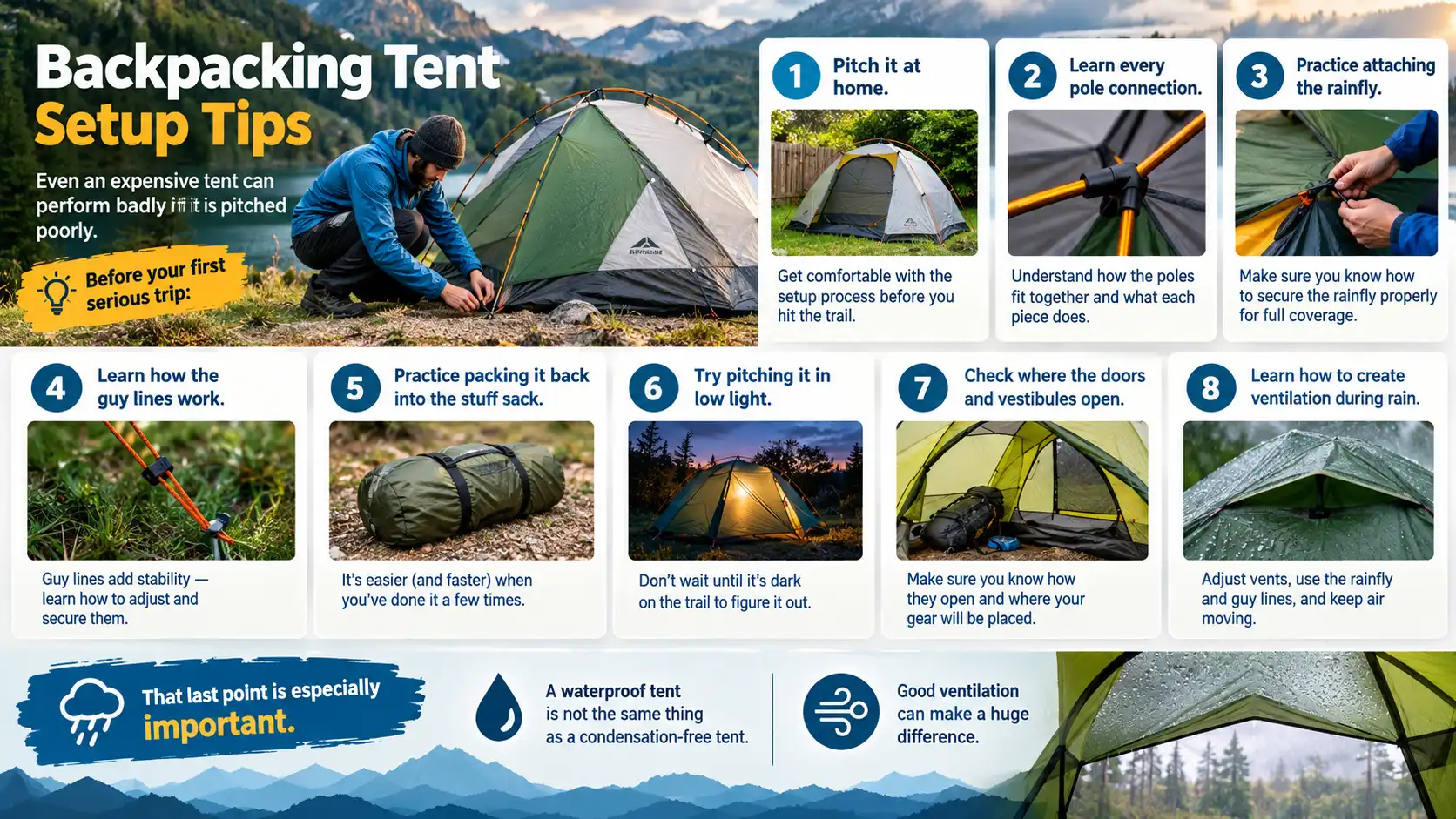
Essential tips for setting up a backpacking tent.
Even an expensive tent can perform badly if it is pitched poorly.
Before your first serious trip:
- Pitch it at home.
- Learn every pole connection.
- Practice attaching the rainfly.
- Learn how the guy lines work.
- Practice packing it back into the stuff sack.
- Try pitching it in low light.
- Check where the doors and vestibules open.
- Learn how to create ventilation during rain.
That last point is especially important.
A waterproof tent is not the same thing as a condensation-free tent.
Good ventilation can make a huge difference.
Choosing the Right Tent for Your Next Adventure
I have been hiking and camping since 2018, and one of the biggest lessons I have learned is that gear decisions become easier once you stop asking what everyone else is carrying.
I made the mistake of chasing gear before I understood what I actually needed. I carried a pack that was too heavy. I bought things because they looked useful. I learned the hard way that every extra item eventually has to come up the mountain with me.
That is how I approach backpacking tents now.
I do not think the lightest tent is automatically the right tent. I also do not think a heavier tent is automatically a bad choice.
If I wanted a strong all-around balance of weight, comfort, and practicality, I would start my research with the Big Agnes Copper Spur UL2.
If comfort for two matters more, I would spend time comparing the NEMO Dagger OSMO 2 and MSR Hubba Hubba LT 2.
If I were focused heavily on reducing pack weight, the NEMO Hornet OSMO 2, Big Agnes Tiger Wall UL2, and MSR FreeLite 2 would be worth a closer look.
And if I were just getting started and wanted something straightforward without immediately spending ultralight money, I would look at options such as the The North Face Stormbreak 2 or Kelty Late Start 2.
The important part is matching the tent to the trail.
A good backpacking tent should disappear into the background once you are using it. It should protect you when the weather turns, give you enough room to sleep properly, and not make you regret every uphill mile.
That is what I look for in outdoor gear now.
Not the flashiest specification.
Not the lowest number on the scale.
Just gear that earns its place in the pack.
Related Outdoor Mystery Guides
If you are building your complete backpacking setup, you may also want to read the backpacking gear guides, especially before adding more weight to your pack.
For footwear decisions, see the hiking boots and footwear guides.
And if you are new to backpacking, the beginner hiking guide is a useful place to start before planning a longer trip.
Outdoor Mystery is a personal hiking blog. Some links may be affiliate links, but the goal is simple: recommend gear based on useful research and real outdoor experience, not because a product is the most expensive thing on the shelf.
FAQs
What is the best backpacking tent for 2026?
There is no single tent that fits every backpacker. Current 2026 testing consistently highlights models such as the Big Agnes Copper Spur UL2, NEMO Dagger OSMO 2, MSR Hubba Hubba LT, NEMO Hornet OSMO 2, and other lightweight shelters for different priorities.
The right choice depends on whether you prioritize weight, interior space, durability, price, or ease of setup.
What is a good weight for a backpacking tent?
For many backpackers, a two-person tent between roughly 2.5 and 3.5 pounds offers a useful balance between weight and livability. Ultralight hikers may prefer shelters under 2.5 pounds, while comfort-focused backpackers may happily carry more.
The important thing is to compare the complete packed weight rather than looking only at minimum trail weight.
Is a 2-person tent big enough for two people?
Usually, yes, but “2-person” does not mean every two-person tent feels equally spacious.
If two adults are carrying larger packs or spending several nights together, look closely at floor dimensions, peak height, door size, and vestibule space.
Some couples may prefer a lightweight three-person tent for the additional room.
Are ultralight backpacking tents durable?
They can be, but ultralight construction usually requires more care.
Manufacturers save weight by using lighter fabrics and smaller components. That can reduce the margin for rough handling.
An ultralight tent is not necessarily fragile, but you should be more careful about campsite selection, sharp rocks, branches, zippers, and excessive tension.
Do I need a footprint for my backpacking tent?
Not necessarily.
A footprint can protect the floor from abrasion, but it also adds weight and bulk. Many backpackers choose to go without one, particularly when trying to keep their pack light.
If you use a footprint, make sure it fits properly and does not extend beyond the tent floor.