Can I Bring Hiking Pole On Plane? The Real Rules By Country And Airline
Yes, you can bring hiking pole on plane trips, but where it rides depends on three separate layers of rules stacked on top of each other. TSA (or your country’s version of it) decides what passes the checkpoint. Your airline decides what fits in the cabin. And the individual officer at the gate that day makes the final call. Here’s how each layer actually works.
Can I Bring Hiking Pole On Plane?
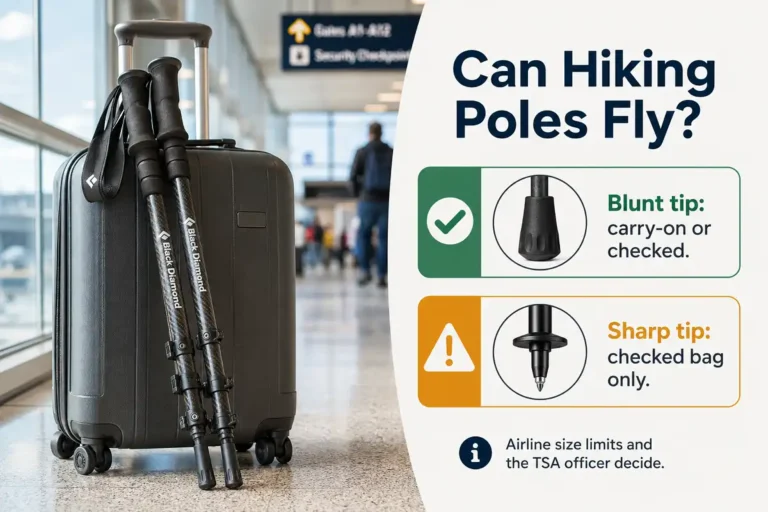
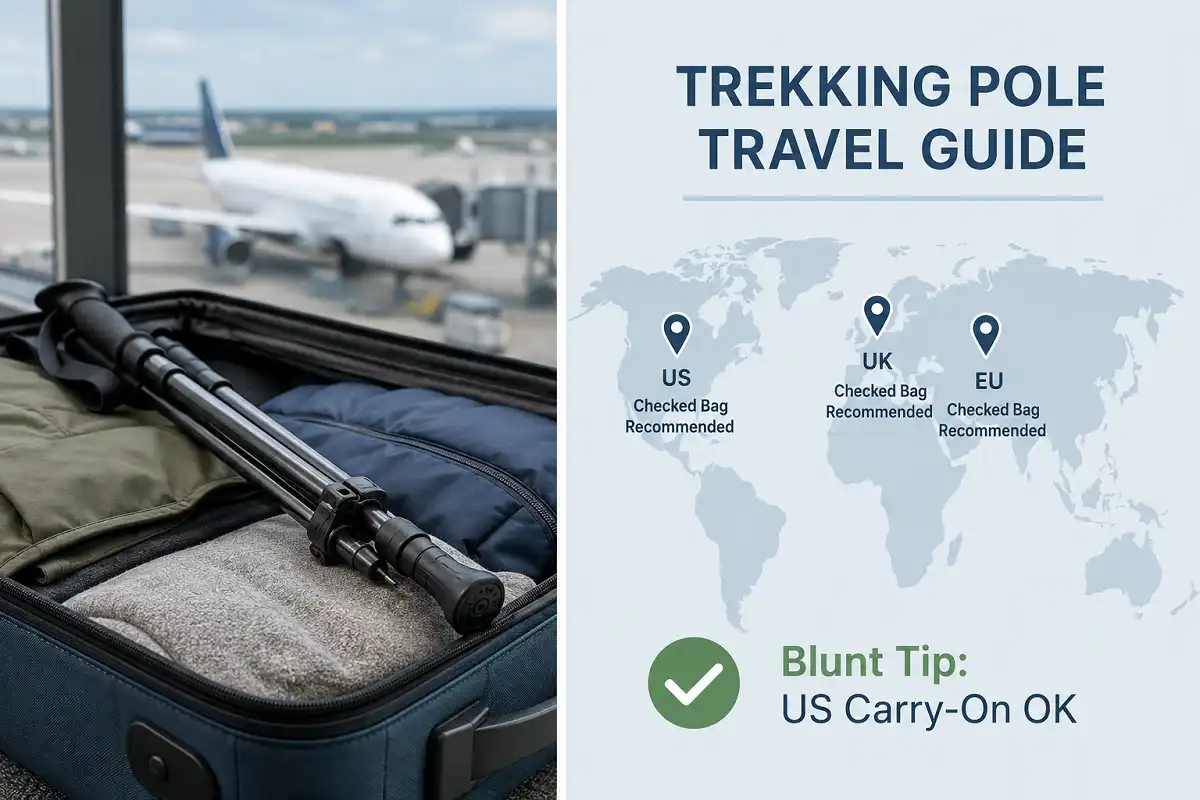
In the US, blunt-tipped hiking poles are generally allowed in carry-on bags, while sharp-tipped poles should go in checked luggage. Outside the US, many airports and airlines are stricter, so checking your poles is often the safest option.
Controls what can pass through US airport security.
Controls cabin baggage and its size restrictions.
Blunt tips are treated differently from sharp metal tips.
International airports can apply different security rules.
The security officer can make the final decision at screening.
Can I Bring Hiking Pole On Plane Through US Security?
Yes, if the tips are blunt. TSA’s published guidance says blunt-tipped hiking poles are allowed in carry-on or checked bags, while sharp-tipped poles are checked-bag only. Most trekking poles ship with a bare carbide point, so you’ll want rubber tip covers on before you leave home if you’re hoping for carry-on approval.
Even then, the officer makes the final decision, not the printed rule. I’ve talked to hikers who got waved through with rubber tips on, and others who got stopped anyway because the officer judged the metal underneath as still sharp. Carry-on approval is a possibility, not a promise.
Can I Bring Hiking Pole On Plane In Checked Luggage No Matter What?
Yes. Checked baggage is the one place tip type stops mattering. Blunt or sharp, poles travel fine in the hold. If your flight includes any leg where rules are murky or an airline you’ve never flown before, checking your poles from the start removes the guesswork entirely.
Does The Answer Change Outside The US?
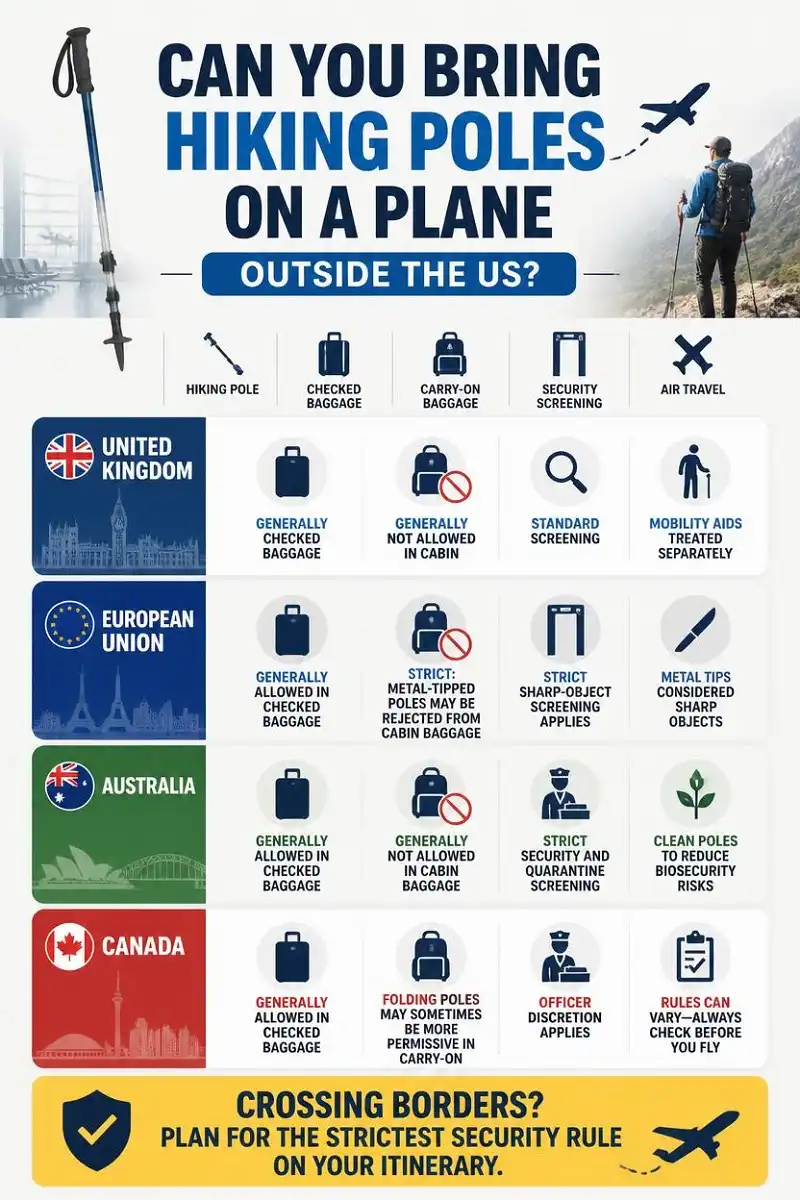
It does, and this is where a lot of hikers get caught off guard. Every country runs its own aviation security agency, and each one draws the line a little differently.
From what I’ve read on UK government travel guidance, hiking poles and trekking poles are generally expected to travel in checked baggage, similar to the US approach. Genuine mobility aids get treated separately from recreational poles.
Spanish, French, and most EU security checkpoints follow a similar sharp-object standard to the US. A metal-tipped trekking pole reads as a potential weapon to a screener, checked bag or nothing.
Based on what I’ve gathered from Australian aviation security guidance, hiking poles are treated much like the US and UK stance, generally fine in the hold, generally not fine in the cabin.
Canadian screening has historically been a bit more permissive with folding poles in carry-on than European checkpoints, though this still comes down to the individual officer.
If any leg of your trip crosses one of these borders, plan around the strictest country on your itinerary rather than hoping the most relaxed one applies the whole way.
Checked baggage removes much of the uncertainty created by different airport security policies.
Airline Rules Sit On Top Of Whatever The Airport Requires
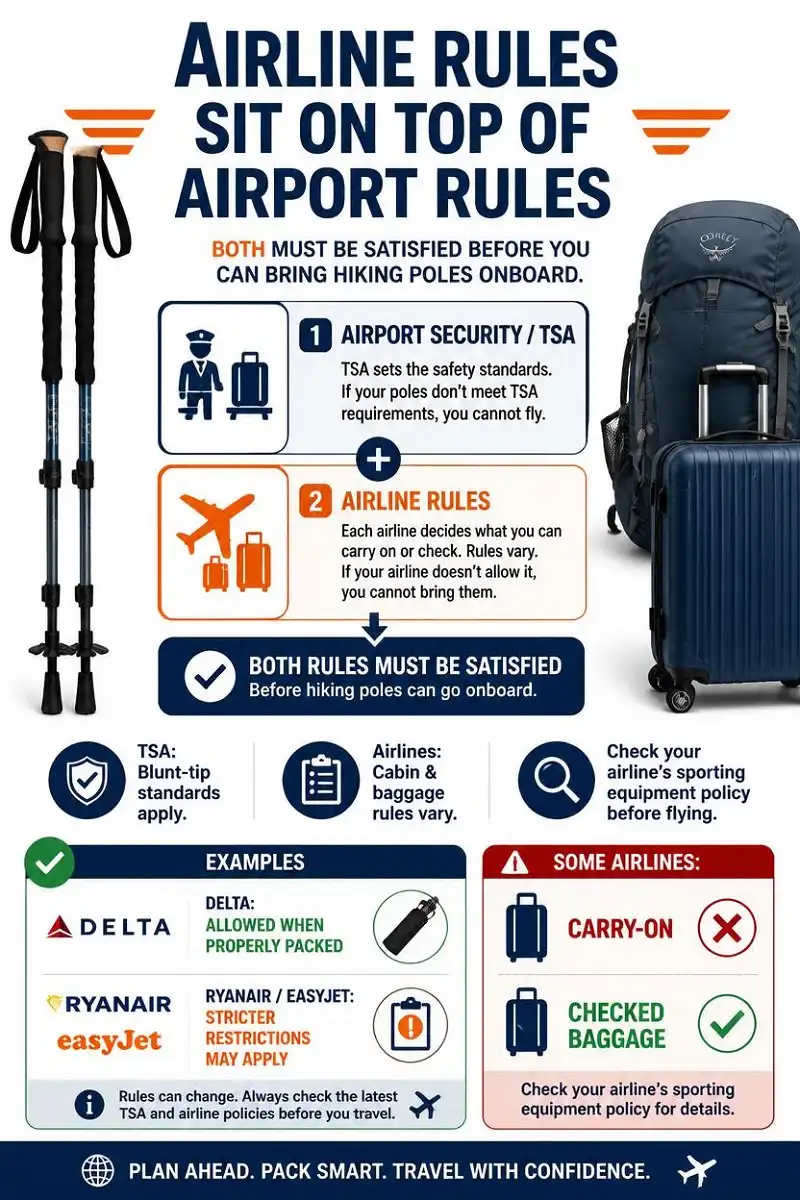
TSA (or its overseas equivalent) controls the checkpoint. Your airline controls the cabin and your baggage allowance, and those are two different approvals you need at once.
Delta’s published baggage policy lists hiking and trekking poles as allowed when properly packed and within standard carry-on or checked-bag size limits, which lines up with TSA’s blunt-tip standard. Several budget European carriers take a stricter stance regardless of tip type. Ryanair explicitly bans ski poles and trekking poles from carry-on luggage on their restricted items list, and EasyJet takes a similar checked-bag-only position.
So even a perfectly blunt pole that TSA would clear can still get bounced to the hold purely because of the airline you booked. The smart move is checking your specific airline’s sporting equipment page before your trip, especially if you’re flying a budget European carrier or connecting through multiple countries.
Security Rules
- Controls what reaches the checkpoint.
- Looks at the pole and its tip.
- Security officers make the final call.
Cabin Rules
- Controls cabin baggage.
- Applies size and baggage restrictions.
- Can require poles to be checked.
How To Pack So You Can Bring Hiking Pole On Plane Without Damage
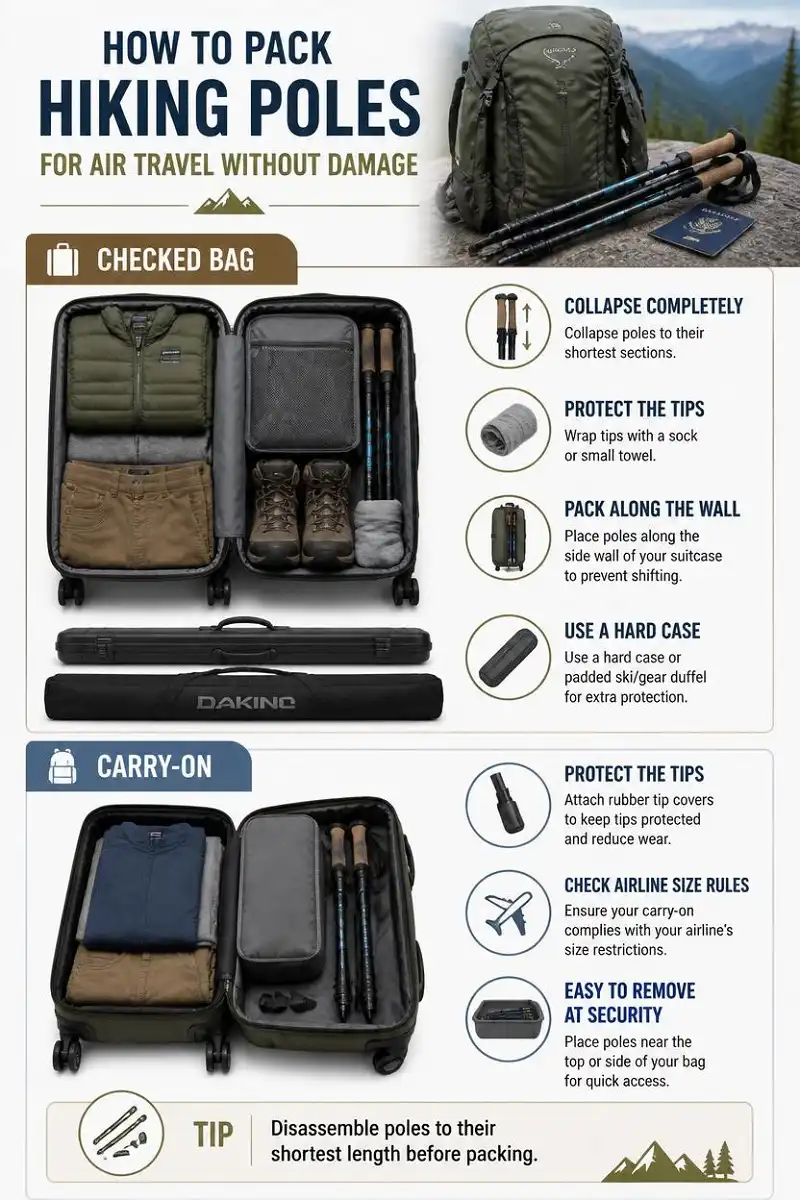
Once you know where your poles are headed, packing matters as much as the rule itself.
Checked Bag
Collapse The Poles
Collapse or take apart your poles completely. Most fold into two or three sections.
Protect The Tips
Wrap the tips in a sock or small towel so they don’t tear through your bag or gear.
Pack Along The Wall
Pack them along the suitcase wall instead of loose in the middle, so a heavy item doesn’t bend the shaft in transit.
Use A Protective Case
If you’re checking a lot of gear, a dedicated hard case or long duffel protects poles far better than tucking them between clothes.
Carry-On
Confirm the collapsed length fits your airline’s carry-on size, generally around 22 by 14 by 9 inches for a standard bag.
Keep rubber tip covers on through screening if you’re attempting carry-on travel.
Position them so an officer can pull them out easily to check the tips.
Keep your poles accessible instead of burying them beneath other equipment.
My Packing Habit
I disassemble mine into their shortest form every time now. It takes half a minute and means they lie flat instead of poking a hole through my duffel.
What If You Don’t Want To Check Your Poles At All?

A few workarounds exist if checking a bag feels like a hassle for a short trip.
Ship Them Ahead
If you have a fixed hotel address at your destination, mailing poles ahead avoids the airport question completely. It costs money and adds a small risk of delay, so build in extra time.
Rent Or Buy At Your Destination
Plenty of outfitters near popular trailheads rent poles by the day, and gear shops near trail towns often sell budget pairs. This solves the flight problem entirely, though you lose your own poles’ fit and feel.
Check Only The Poles
Pack them in a slim, sturdy box or a padded pole sleeve and check that single item while keeping your main bag as carry-on. This works well if your poles are the only reason you’d otherwise check a bag.
Each option trades a little money or convenience for certainty, which is often worth it compared to rolling the dice at the checkpoint.
What Happens If TSA Stops You At The Checkpoint
Head back to the ticket counter and check the bag, which costs time and sometimes a fee.
If you’re too far past that point to go back, you may have to leave the poles behind at the checkpoint.
Neither is a good outcome, so deciding ahead of time beats hoping for the best at security.
My Own Experience Flying With Poles
I’ve flown to trailheads all over the country with my poles, from short regional flights to longer cross-country trips. My rule now is simple. Poles go in the checked bag, wrapped in a spare fleece, tucked along the suitcase wall.
A friend of mine had a pair confiscated on a domestic flight over a borderline tip call, and that was enough to convince me checking them is worth the extra ten minutes at baggage claim.
That said, on short domestic flights with just a daypack, blunt-tipped poles in carry-on have worked fine for me more than once. I just don’t count on it every single time, and I never risk it internationally.
Planning A Cold-Weather Trip?
If you’re gearing up for a colder trip where poles matter even more for stability, check out the layering guide for freezing trail conditions .
Is A Pole Even Worth The Hassle For Your Trip?

Before you build your whole packing plan around this question, it’s worth stepping back and asking if poles earn their spot in your bag at all.
I break down the real case for and against them in my full look at whether trekking poles actually help . If your trip involves serious climbing, that answer often leans toward yes, and I’ve also written about what actually counts as a steep, demanding climb if you want a gut check before deciding.
Ask One Simple Question
Will the stability, balance, and support your poles provide on the trail be worth the extra baggage planning for your particular trip?
The Bottom Line
Can I bring hiking pole on plane. In the US, yes, blunt tips generally clear carry-on and any pole clears checked baggage. Outside the US, and on several budget carriers, checked baggage is often your only real option regardless of the tip.
Pack your poles smart, check your specific airline before you fly, and you’ll get them to the trailhead without a fight at the gate.
For more on how trekking poles are built and why the tip design matters so much, the Wikipedia page on trekking poles covers the basics well.
FAQs About Hiking Poles On Planes
Can I bring hiking pole on plane if it’s a collapsible model?
Yes. Folding it down smaller doesn’t change the tip rule. Blunt tips still generally clear carry-on, sharp tips still go in the checked bag regardless of how compact the pole collapses.
Can I use my hiking pole as a mobility aid to skip the checked bag rule?
No. Screeners and airlines treat genuine mobility canes differently from recreational trekking poles, and labeling a pole as medical equipment when it isn’t will not change how it’s handled.
Do European budget airlines really ban poles from carry-on?
Based on their published policies, yes. Ryanair and EasyJet both list hiking or ski poles among items that must be checked, regardless of whether the tips are blunt.
Is it safer to just check my poles every time?
For international trips or connections through multiple airports, yes. It removes every layer of uncertainty at once.