Best Hiking Backpacks for Men in 2026: 10 Top Picks for Every Trail & Budget
I’ve been hiking and camping since 2018, mostly heading out from Bakersfield, California, and what started as a few weekend trips has turned into something I plan my year around. Over the years, I’ve learned that the gear you take on the trail can either make a trip much more enjoyable or make you wonder why you brought it in the first place.
I’ve made plenty of rookie mistakes myself. I’ve worn the wrong boots, carried a pack that was simply too heavy, and headed out without giving the weather enough thought. Those mistakes weren’t always fun at the time, but they taught me what to pay attention to when choosing outdoor gear.
That’s especially true with hiking backpacks. A pack can look great online, have all the features you think you need, and still feel completely wrong after a few miles on the trail. The right one should fit your body, carry your gear comfortably, and match the kind of hiking you actually do.
For this guide, I looked at 10 of the best hiking backpacks for men in 2026, focusing on things that matter when you’re actually outside: comfort, weight, capacity, organization, durability, fit, and overall value. Some are better for long-distance trips, some make more sense for weekend adventures, and others are ideal when you want to keep your load as light as possible.
I’ve included the details I’d want to know before buying one myself, so you can compare them more easily and find a pack that makes sense for your own trails and camping style.
Quick Look: 10 Best Hiking Backpacks for Men
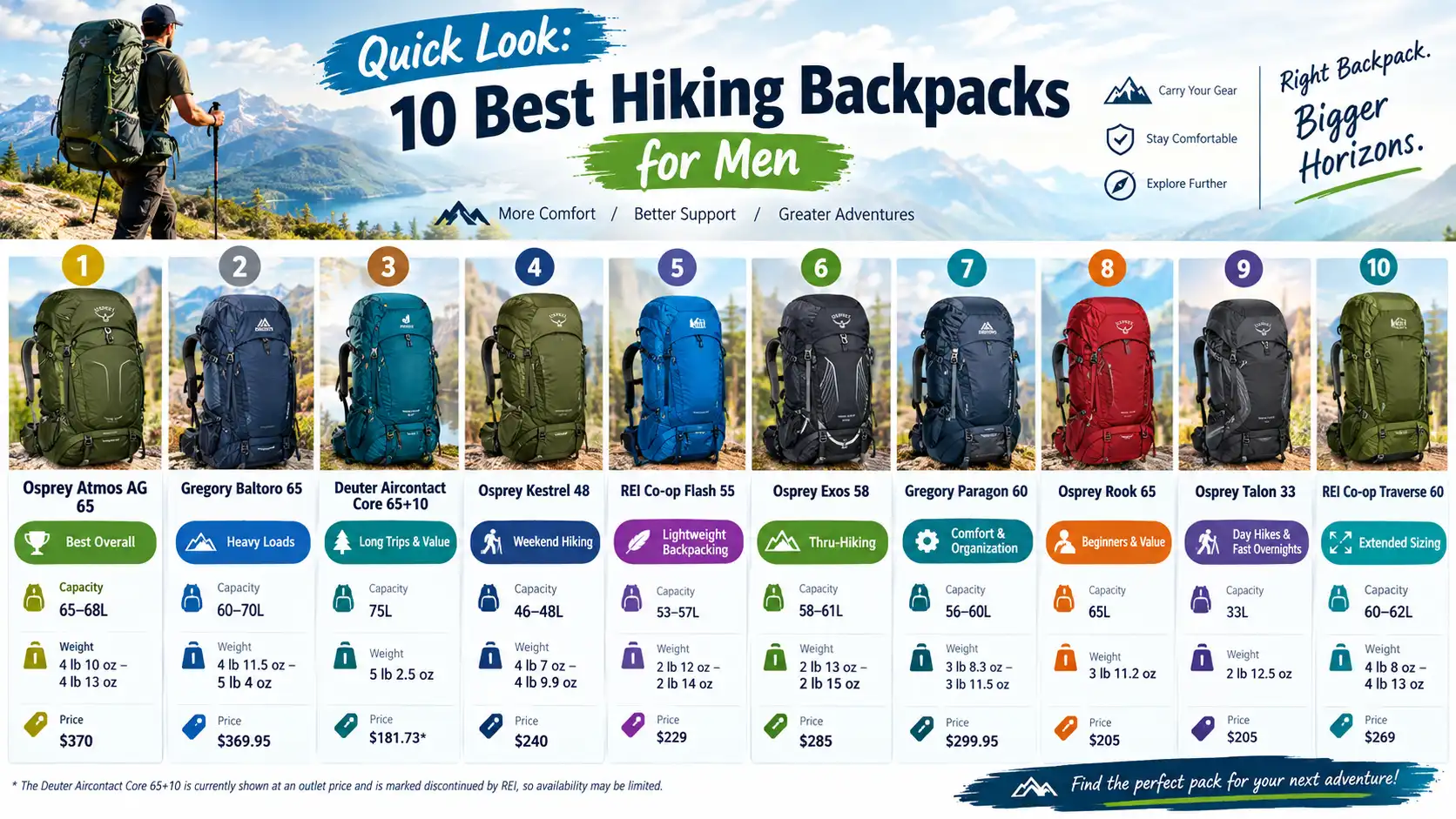
Quick look at 10 top hiking backpacks for men.
| Rank | Backpack | Best For | Capacity | Weight | Price |
|---|---|---|---|---|---|
| 2 | Gregory Baltoro 65 | Heavy Loads | 60–70L | 4 lb 11.5 oz–5 lb 4 oz | $369.95 |
| 3 | Deuter Aircontact Core 65+10 | Long Trips & Value | 75L | 5 lb 2.5 oz | $181.73\* |
| 4 | Osprey Kestrel 48 | Weekend Hiking | 46–48L | 4 lb 7 oz–4 lb 9.9 oz | $240 |
| 5 | REI Co-op Flash 55 | Lightweight Backpacking | 53–57L | 2 lb 12 oz–2 lb 14 oz | $229 |
| 6 | Osprey Exos 58 | Thru-Hiking | 58–61L | 2 lb 13 oz–2 lb 15 oz | $285 |
| 7 | Gregory Paragon 60 | Comfort & Organization | 56–60L | 3 lb 8.3 oz–3 lb 11.5 oz | $299.95 |
| 8 | Osprey Rook 65 | Beginners & Value | 65L | 3 lb 11.2 oz | $205 |
| 9 | Osprey Talon 33 | Day Hikes & Fast Overnights | 33L | 2 lb 12.5 oz | $205 |
| 10 | REI Co-op Traverse 60 | Extended Sizing | 60–62L | 4 lb 8 oz–4 lb 13 oz | $269 |
Osprey Talon 33 — best for day hikes and fast overnights.
\*The Deuter Aircontact Core 65+10 is currently shown at an outlet price and is marked discontinued by REI, so availability may be limited.
1. Osprey Atmos AG 65 — Best Overall Hiking Backpack
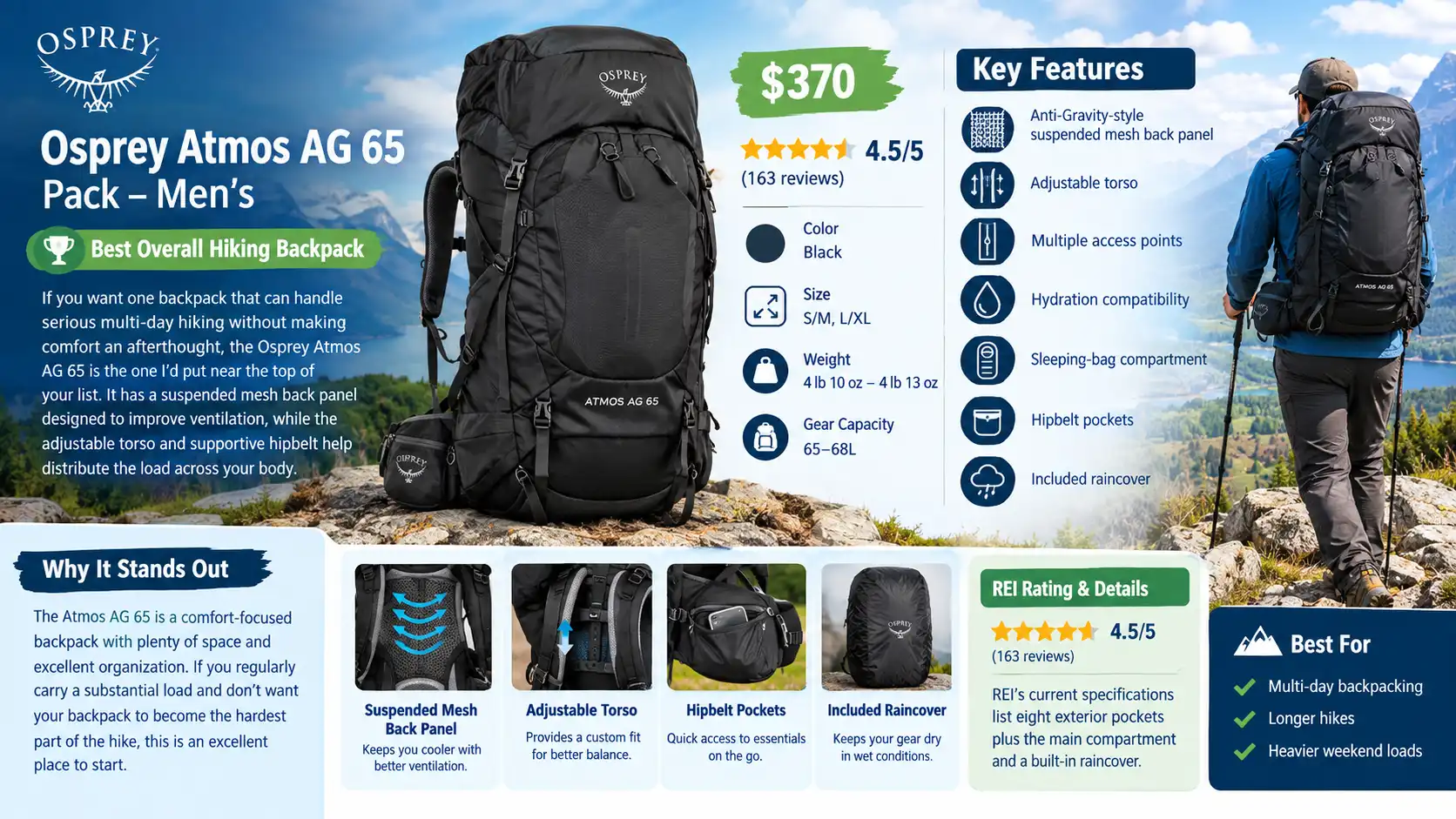
Osprey Atmos AG 65 — Best Overall Hiking Backpack
If you want one backpack that can handle serious multi-day hiking without making comfort an afterthought, the Osprey Atmos AG 65 is the one I’d put near the top of your list.
It has a suspended mesh back panel designed to improve ventilation, while the adjustable torso and supportive hipbelt help distribute the load across your body. That becomes especially useful when you’re carrying camping equipment, food, clothing, and several days of supplies.
REI currently lists the Atmos AG 65 with a 4.5/5 rating from 163 reviews. The S/M version provides 65 liters of capacity, while the L/XL version provides 68 liters.
The Atmos AG 65 is a comfort-focused backpack with plenty of space and excellent organization. If you regularly carry a substantial load and don’t want your backpack to become the hardest part of the hike, this is an excellent place to start. REI’s current specifications list eight exterior pockets plus the main compartment and a built-in raincover.
2. Gregory Baltoro 65 — Best for Heavy Loads
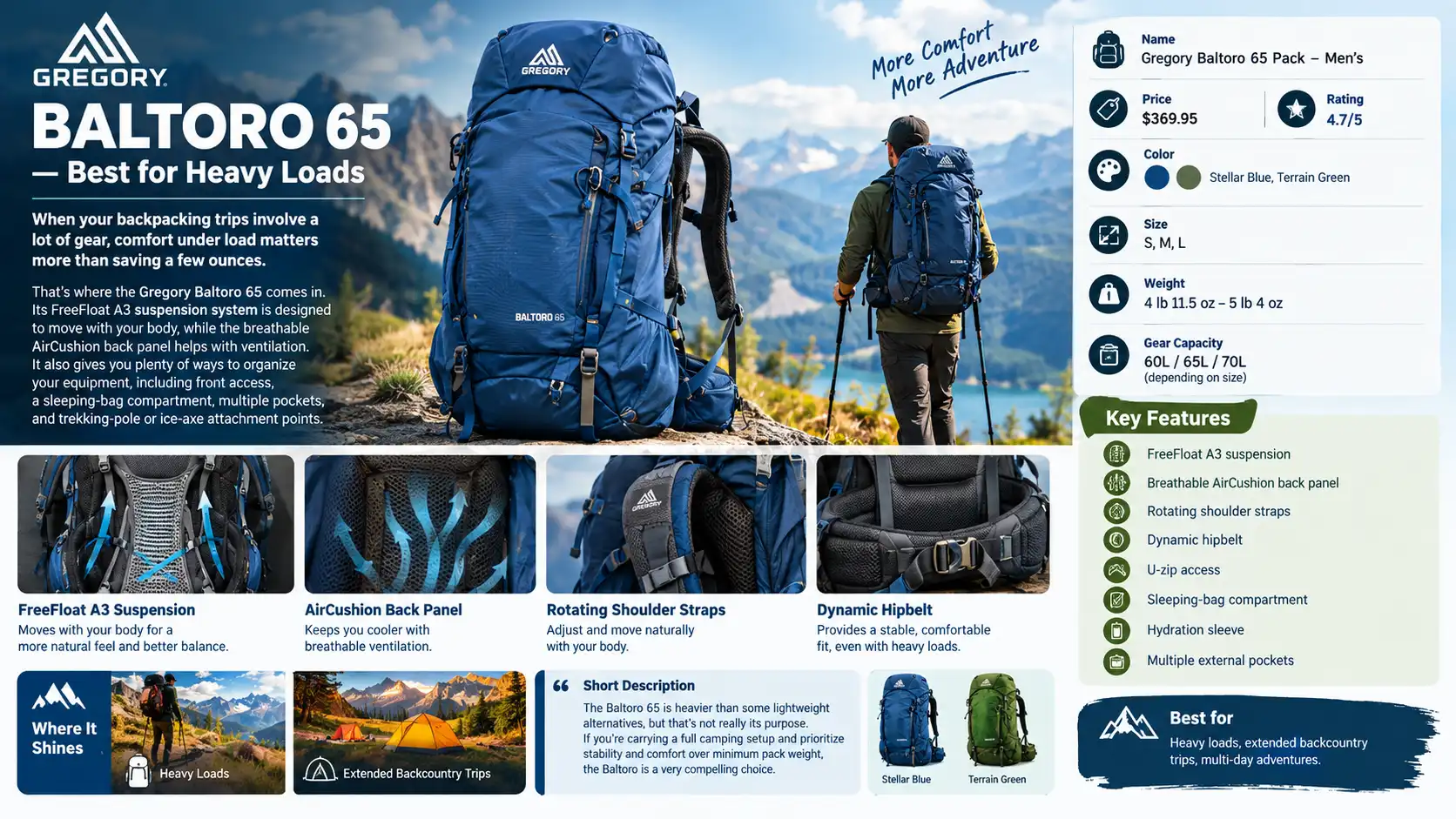
Gregory Baltoro 65 — Best for Heavy Loads
When your backpacking trips involve a lot of gear, comfort under load matters more than saving a few ounces.
That’s where the Gregory Baltoro 65 comes in. Its FreeFloat A3 suspension system is designed to move with your body, while the breathable AirCushion back panel helps with ventilation. It also gives you plenty of ways to organize your equipment, including front access, a sleeping-bag compartment, multiple pockets, and trekking-pole or ice-axe attachment points.
The Baltoro 65 is heavier than some lightweight alternatives, but that’s not really its purpose. If you’re carrying a full camping setup and prioritize stability and comfort over minimum pack weight, the Baltoro is a very compelling choice.
3. Deuter Aircontact Core 65+10 — Best for Long Trips and Extra Capacity
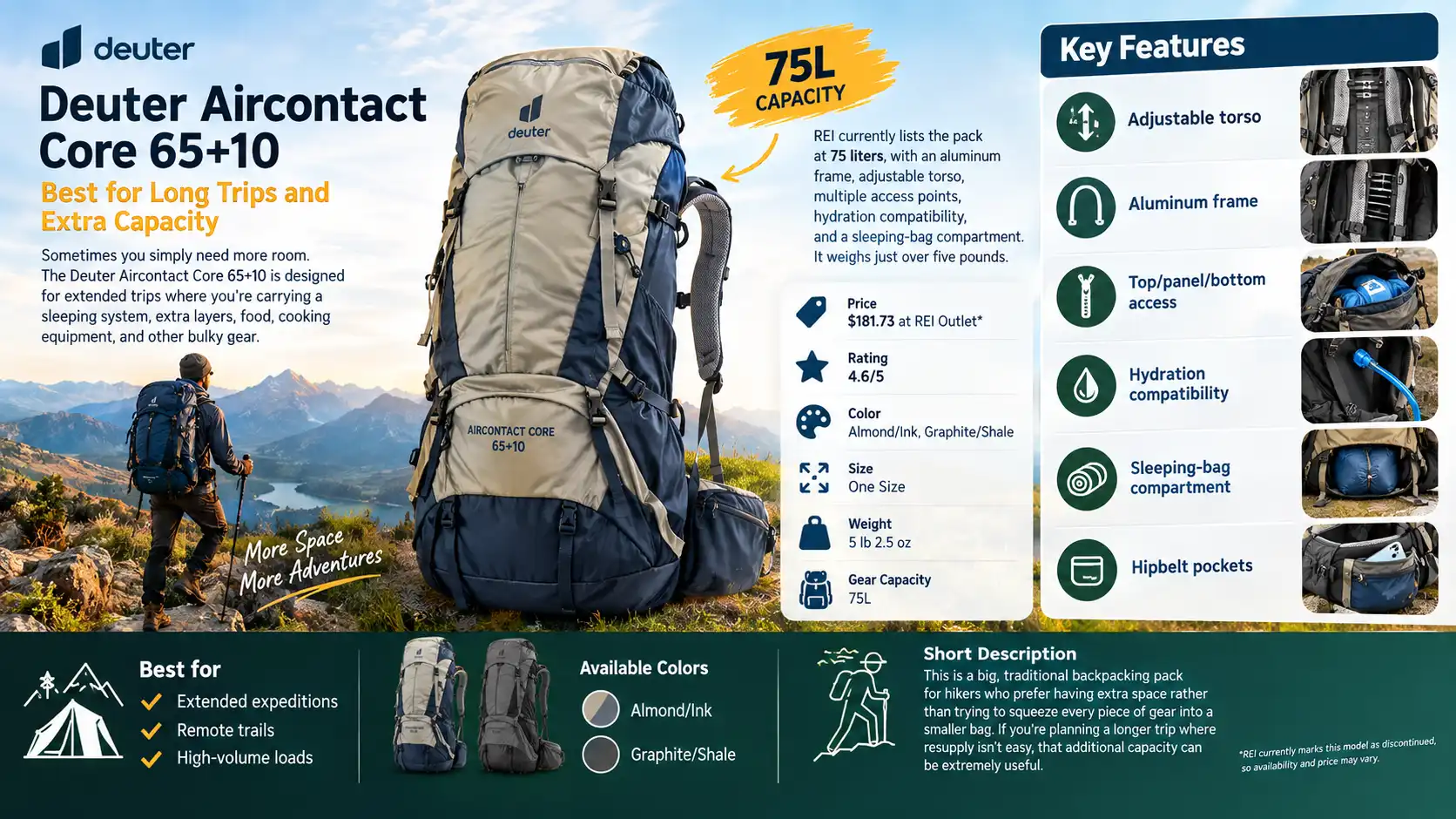
Deuter Aircontact Core 65+10 — best for long trips and extra capacity.
Sometimes you simply need more room.
The Deuter Aircontact Core 65+10 is designed for extended trips where you’re carrying a sleeping system, extra layers, food, cooking equipment, and other bulky gear. Its expandable design gives you additional room when you need it.
REI currently lists the pack at 75 liters, with an aluminum frame, adjustable torso, multiple access points, hydration compatibility, and a sleeping-bag compartment. It weighs just over five pounds.
This is a big, traditional backpacking pack for hikers who prefer having extra space rather than trying to squeeze every piece of gear into a smaller bag. If you’re planning a longer trip where resupply isn’t easy, that additional capacity can be extremely useful.
\*REI currently marks this model as discontinued, so availability and price may vary.
4. Osprey Kestrel 48 — Best for Weekend Hiking
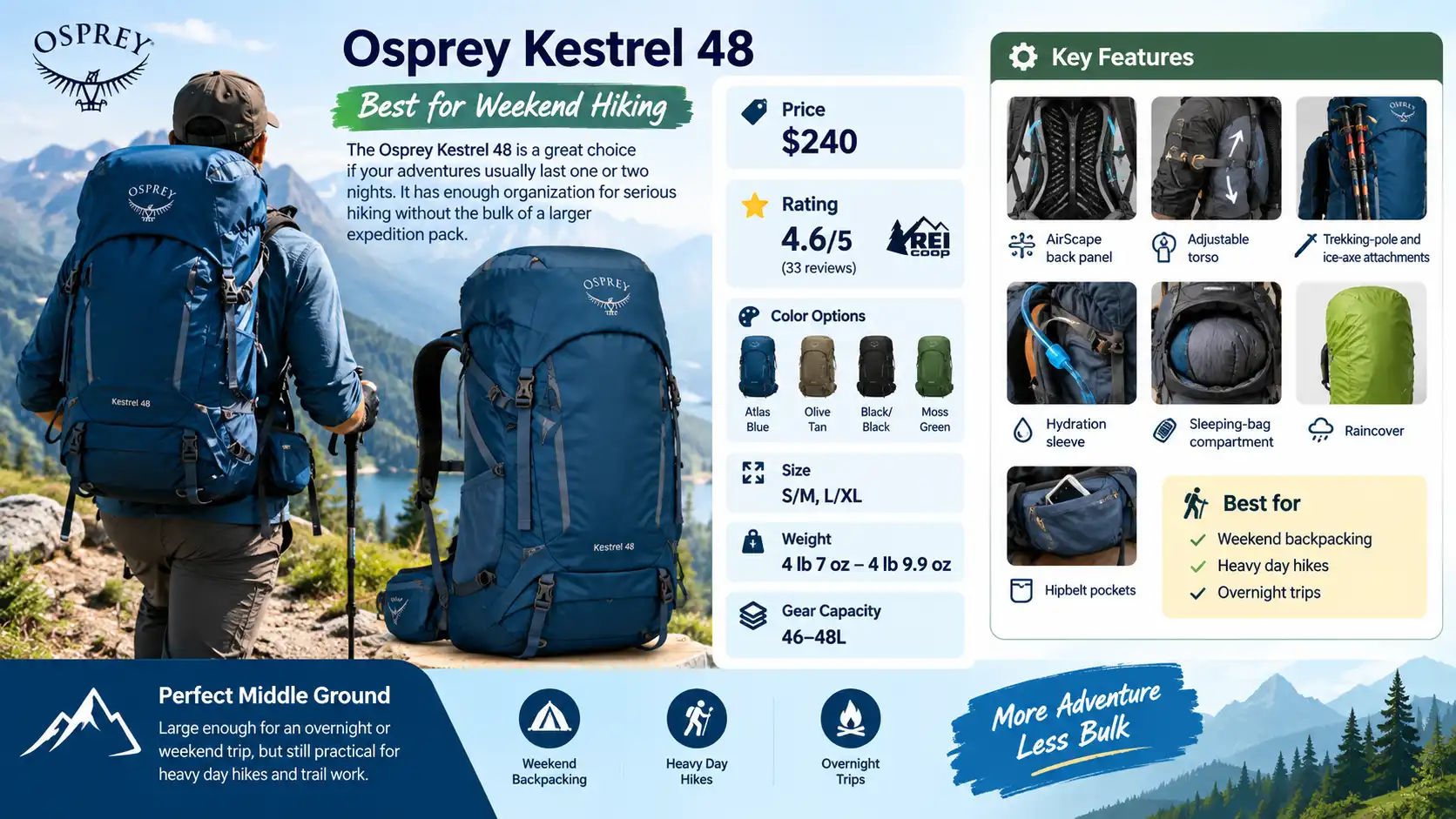
Osprey Kestrel 48 — a versatile 46–48L pack for weekend hiking and overnight trips.
For weekend backpacking trips, you may not need a massive 65-liter pack.
The Osprey Kestrel 48 sits in a useful middle ground. It’s large enough for an overnight or weekend trip but still practical for heavy day hikes and trail work.
REI lists the men’s Kestrel 48 with a 4.6/5 rating from 33 reviews. It offers 46 liters in S/M and 48 liters in L/XL, along with an adjustable torso, internal frame, raincover, hydration compatibility, and both top and bottom access.
The Kestrel 48 is a great choice if your adventures usually last one or two nights. It has enough organization for serious hiking without the bulk of a larger expedition pack.
5. REI Co-op Flash 55 — Best Lightweight Value
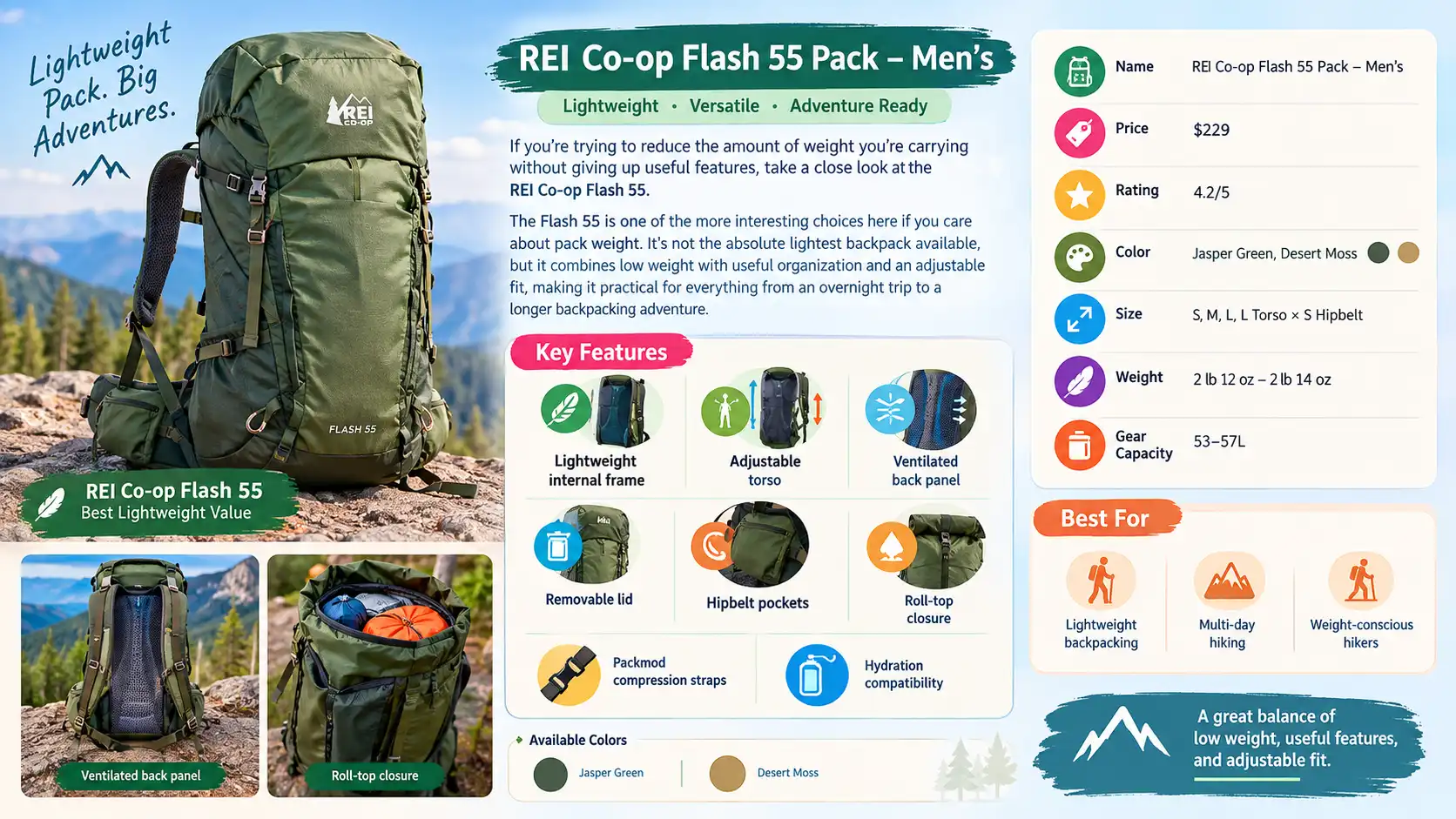
REI Co-op Flash 55 — Best Lightweight Value
If you’re trying to reduce the amount of weight you’re carrying without giving up useful features, take a close look at the REI Co-op Flash 55.
The current men’s version weighs between roughly 2 lb 12 oz and 2 lb 14 oz depending on size, while providing 53–57 liters of storage. It also has an adjustable torso, ventilated back panel, removable lid, hipbelt pockets, and a roll-top closure.
The Flash 55 is one of the more interesting choices here if you care about pack weight. It’s not the absolute lightest backpack available, but it combines low weight with useful organization and an adjustable fit, making it practical for everything from an overnight trip to a longer backpacking adventure.
6. Osprey Exos 58 — Best for Thru-Hiking
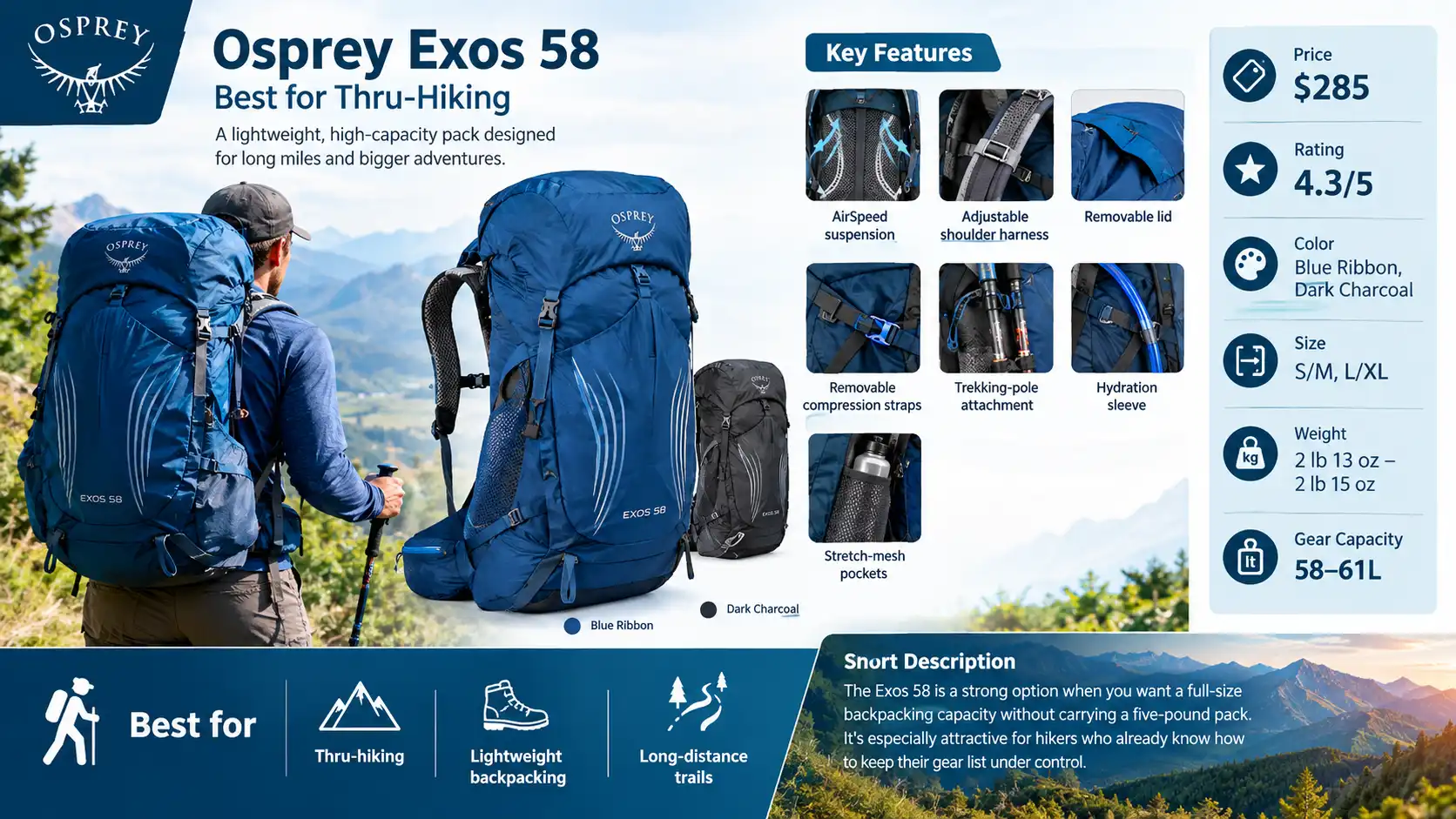
Osprey Exos 58 — Best for Thru-Hiking
For hikers who are counting ounces, the Osprey Exos 58 deserves serious attention.
It provides 58 liters of capacity in S/M and 61 liters in L/XL while staying under three pounds. The AirSpeed suspension is designed to improve airflow, and several components can be removed when you want to reduce weight further.
The Exos 58 is a strong option when you want a full-size backpacking capacity without carrying a five-pound pack. It’s especially attractive for hikers who already know how to keep their gear list under control.
7. Gregory Paragon 60 — Best for Comfort and Organization
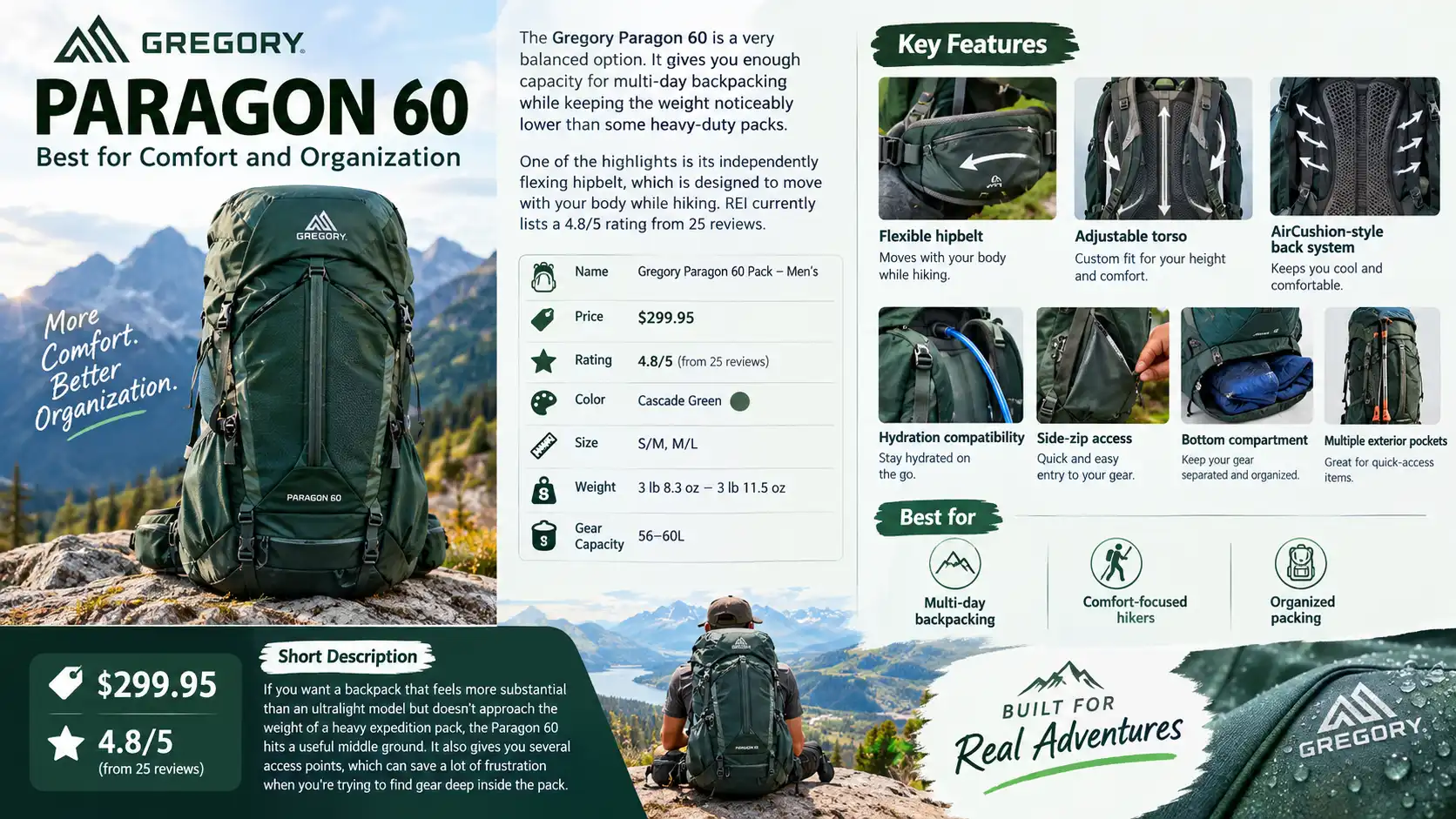
Gregory Paragon 60 – Comfort and organization for multi-day backpacking.
The Gregory Paragon 60 is a very balanced option. It gives you enough capacity for multi-day backpacking while keeping the weight noticeably lower than some heavy-duty packs.
One of the highlights is its independently flexing hipbelt, which is designed to move with your body while hiking. REI currently lists a 4.8/5 rating from 25 reviews.
If you want a backpack that feels more substantial than an ultralight model but doesn’t approach the weight of a heavy expedition pack, the Paragon 60 hits a useful middle ground. It also gives you several access points, which can save a lot of frustration when you’re trying to find gear deep inside the pack.
8. Osprey Rook 65 — Best Value for Beginners
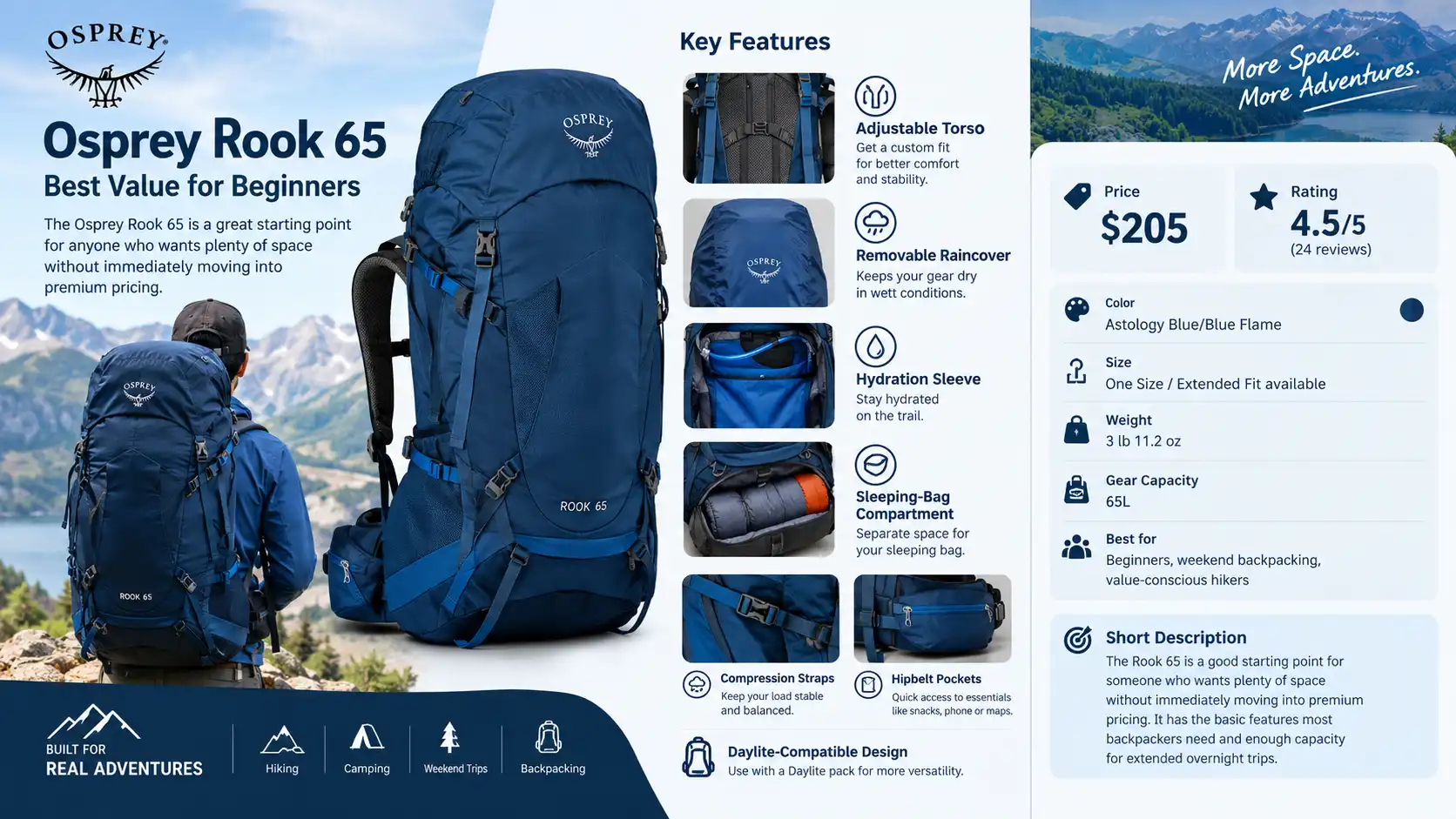
Osprey Rook 65 — Best Value for Beginners
If you’re buying your first serious backpacking backpack, you may not want to spend $350 or more immediately.
The Osprey Rook 65 is a more approachable option. It offers 65 liters of capacity, an adjustable torso, internal frame, raincover, hydration sleeve, sleeping-bag compartment, and several compression points.
REI currently lists it at $205 with a 4.5/5 rating from 24 reviews.
The Rook 65 is a good starting point for someone who wants plenty of space without immediately moving into premium pricing. It has the basic features most backpackers need and enough capacity for extended overnight trips.
9. Osprey Talon 33 — Best for Day Hikes and Fast Overnights
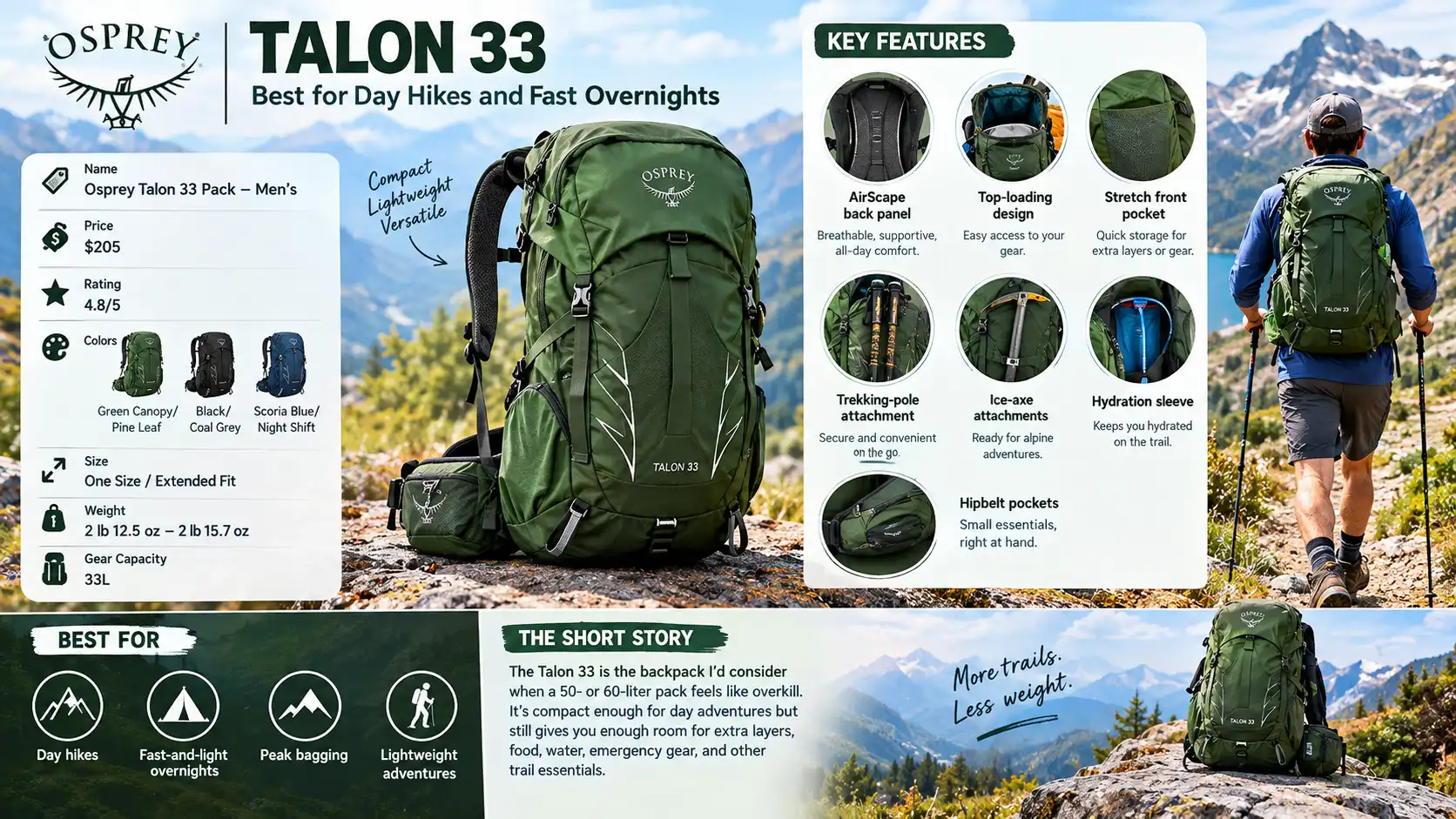
Osprey Talon 33 — best for day hikes and fast overnights.
Not every hike requires a giant backpack.
For long day hikes, peak-bagging, or a lightweight overnight trip, the Osprey Talon 33 is much more appropriate. Its 33-liter capacity keeps the pack compact, while the AirScape back panel, trekking-pole attachment, hipbelt pockets, and hydration sleeve give you the features you’d expect from a larger hiking pack.
The Talon 33 is the backpack I’d consider when a 50- or 60-liter pack feels like overkill. It’s compact enough for day adventures but still gives you enough room for extra layers, food, water, emergency gear, and other trail essentials.
10. REI Co-op Traverse 60 — Best for a Wide Range of Body Types
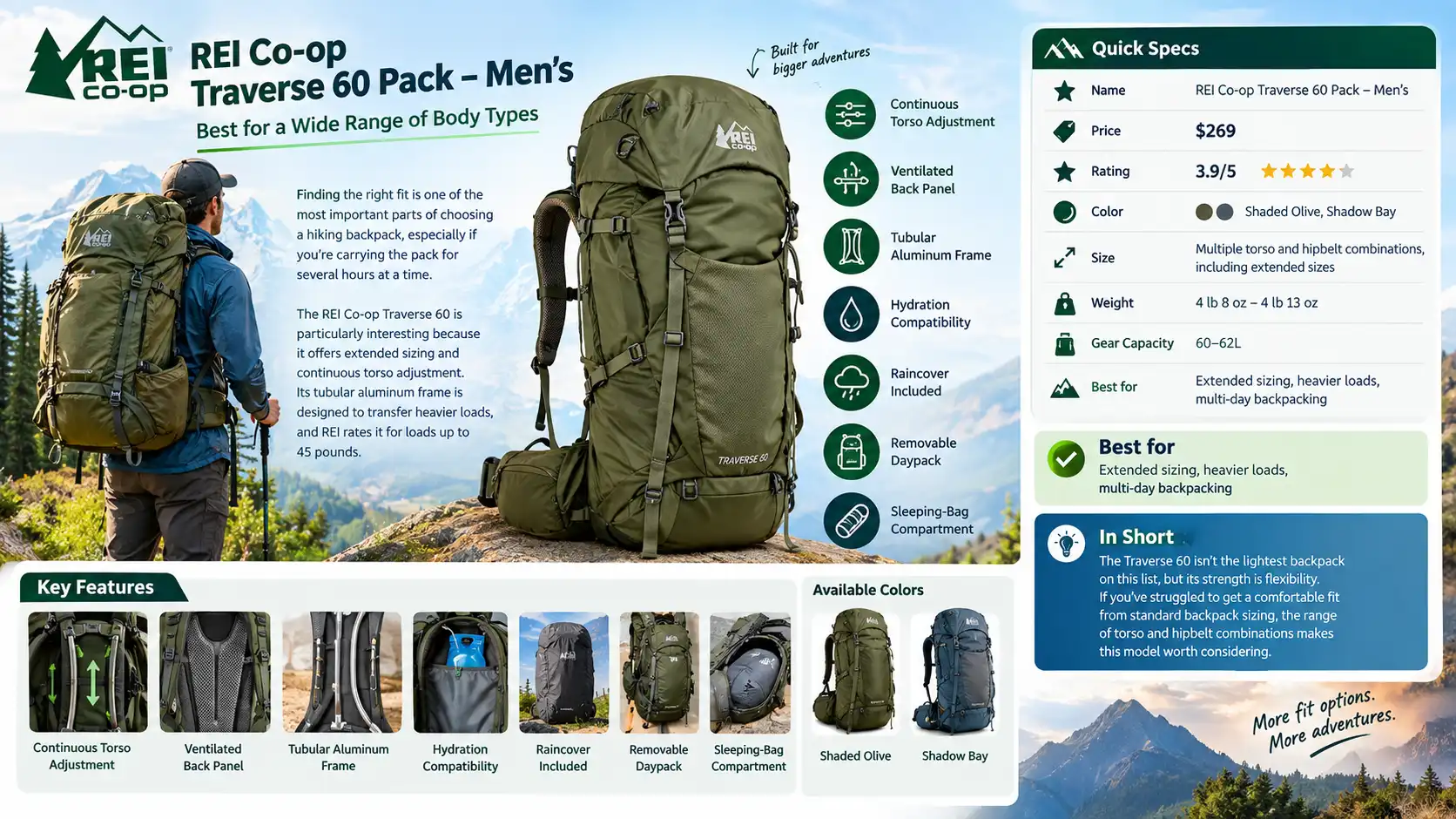
REI Traverse 60 offers flexible sizing and strong load support.
Finding the right fit is one of the most important parts of choosing a hiking backpack, especially if you’re carrying the pack for several hours at a time.
The REI Co-op Traverse 60 is particularly interesting because it offers extended sizing and continuous torso adjustment. Its tubular aluminum frame is designed to transfer heavier loads, and REI rates it for loads up to 45 pounds.
The Traverse 60 isn’t the lightest backpack on this list, but its strength is flexibility. If you’ve struggled to get a comfortable fit from standard backpack sizing, the range of torso and hipbelt combinations makes this model worth considering.
How to Choose the Best Hiking Backpack for Men
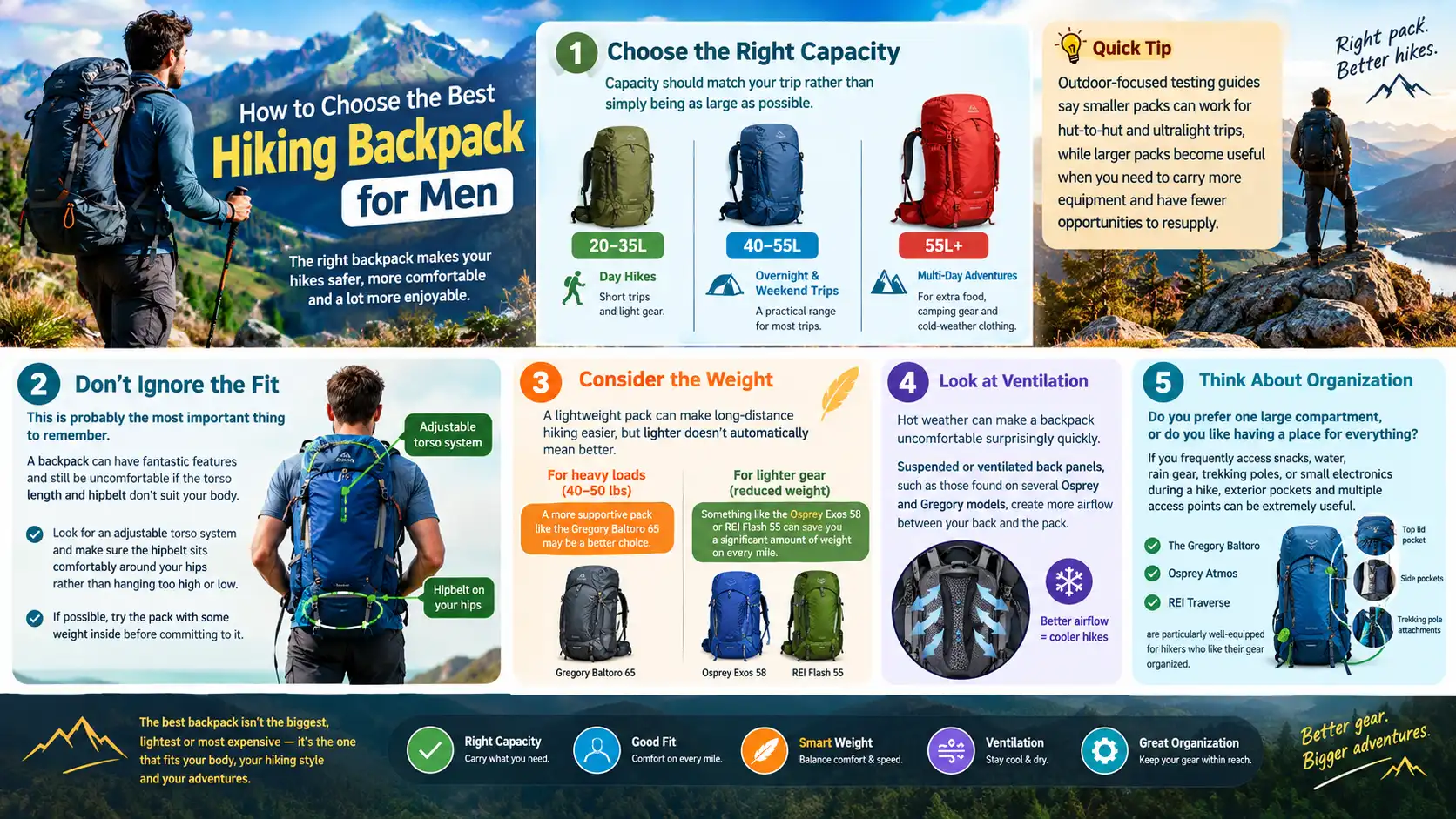
How to Choose the Best Hiking Backpack for Men
Before buying one of these packs, think about the kind of hiking you actually do.
Choose the right capacity
Capacity should match your trip rather than simply being as large as possible.
For short day hikes, around 20–35 liters can be enough. For overnight and weekend trips, 40–55 liters is often a practical range. Once you’re carrying several days of food, camping equipment, and cold-weather clothing, 55 liters or more starts making much more sense.
Outdoor-focused testing guides make a similar point: smaller packs can work for hut-to-hut and ultralight trips, while larger packs become useful when you need to carry more equipment and have fewer opportunities to resupply.
Don’t ignore the fit
This is probably the most important thing to remember.
A backpack can have fantastic features and still be uncomfortable if the torso length and hipbelt don’t suit your body. Look for an adjustable torso system and make sure the hipbelt sits comfortably around your hips rather than hanging too high or low.
If possible, try the pack with some weight inside before committing to it.
Consider the weight
A lightweight pack can make long-distance hiking easier, but lighter doesn’t automatically mean better.
If you’re carrying 40–50 pounds of equipment, a more supportive pack such as the Gregory Baltoro 65 may be a better choice than an ultralight model. On the other hand, if you’ve carefully reduced your gear weight, something like the Osprey Exos 58 or REI Flash 55 can save you a significant amount of weight on every mile.
Look at ventilation
Hot weather can make a backpack uncomfortable surprisingly quickly.
Suspended or ventilated back panels, such as those found on several Osprey and Gregory models, create more airflow between your back and the pack. That can be especially helpful on steep climbs and warm-weather hikes.
Think about organization
Do you prefer one large compartment, or do you like having a place for everything?
If you frequently access snacks, water, rain gear, trekking poles, or small electronics during a hike, exterior pockets and multiple access points can be extremely useful. The Gregory Baltoro, Osprey Atmos, and REI Traverse are particularly well-equipped for hikers who like their gear organized.
Which Hiking Backpack Should You Buy?
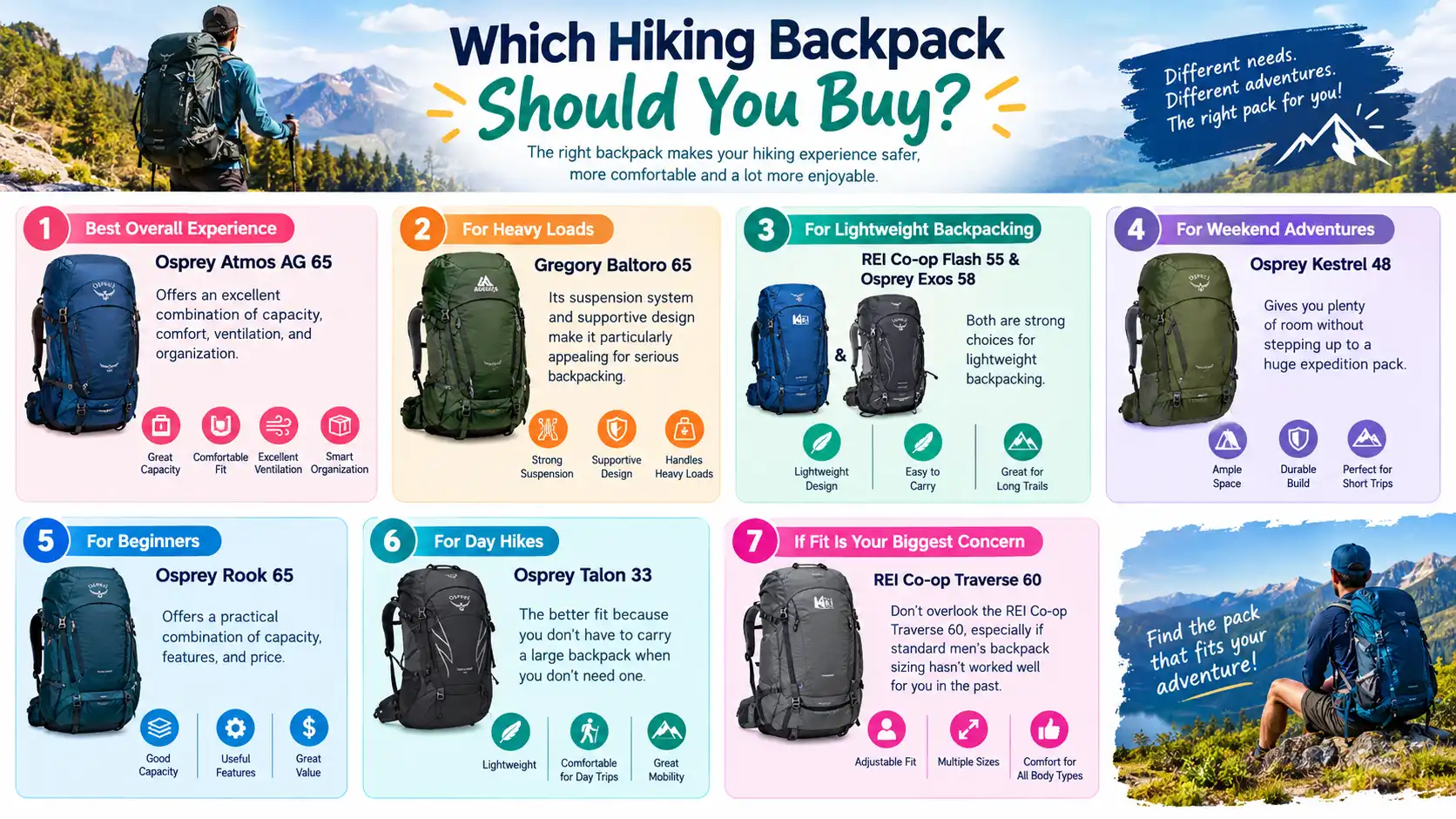
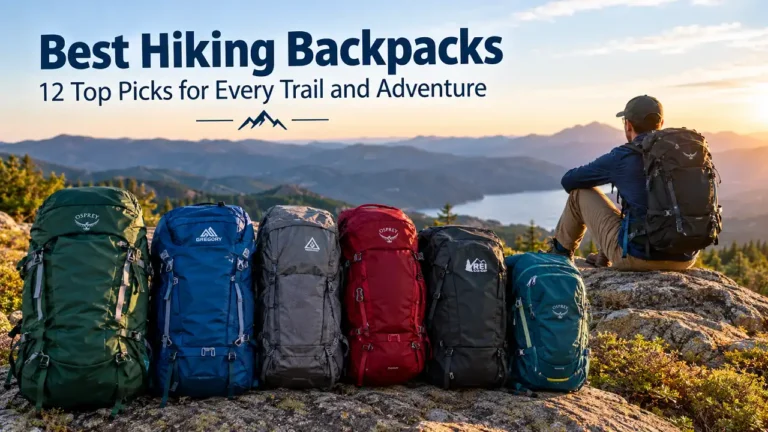
Best hiking backpacks for different adventures
After comparing these 10 options, my choices would be fairly simple.
For the best overall experience: go with the Osprey Atmos AG 65. It offers an excellent combination of capacity, comfort, ventilation, and organization.
For heavy loads: choose the Gregory Baltoro 65. Its suspension system and supportive design make it particularly appealing for serious backpacking.
For lightweight backpacking: the REI Co-op Flash 55 and Osprey Exos 58 are both strong choices.
For weekend adventures: the Osprey Kestrel 48 gives you plenty of room without stepping up to a huge expedition pack.
For beginners: the Osprey Rook 65 offers a practical combination of capacity, features, and price.
For day hikes: the Osprey Talon 33 is the better fit because you don’t have to carry a large backpack when you don’t need one.
And if fit is your biggest concern, don’t overlook the REI Co-op Traverse 60, especially if standard men’s backpack sizing hasn’t worked well for you in the past.
What I’d Choose for My Next Trail
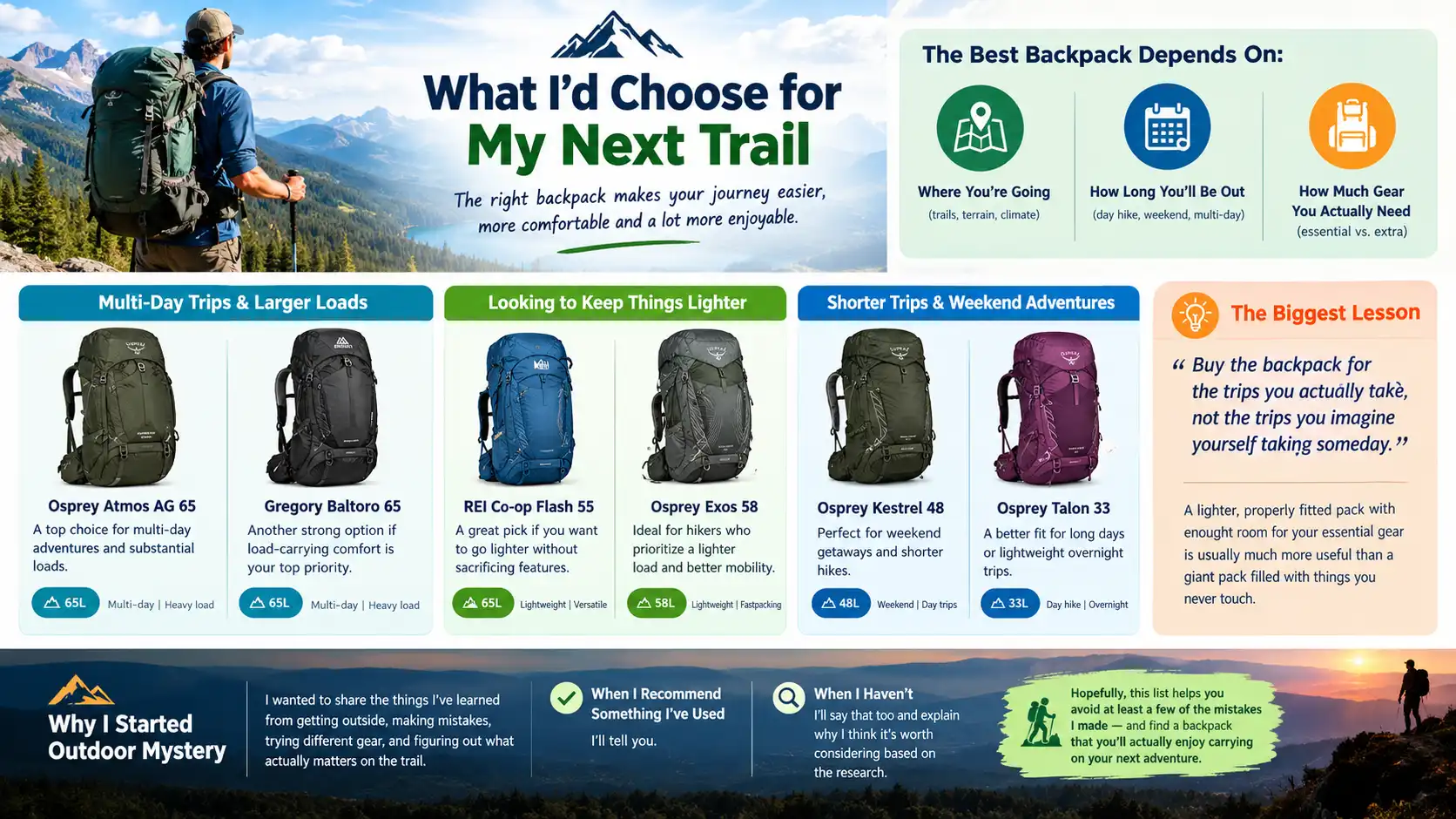
Choosing the right backpack for your next hiking adventure.
After years of hiking and camping, I’ve learned that there’s no single backpack that will be perfect for everyone. The best hiking backpack for you depends on where you’re going, how long you’ll be out, and—probably most importantly—how much gear you actually need to carry.
If you’re planning multi-day trips and usually carry a substantial load, the Osprey Atmos AG 65 would be one of my first choices from this list. The Gregory Baltoro 65 is another strong option if load-carrying comfort is high on your priority list. If you’re trying to keep things lighter, I’d look closely at the REI Co-op Flash 55 or Osprey Exos 58.
For shorter trips, there’s no reason to carry a huge pack just because it gives you more room. Something like the Osprey Kestrel 48 makes more sense for weekend adventures, while the Osprey Talon 33 is a better fit when you’re heading out for a long day or a lightweight overnight.
And that’s probably the biggest lesson I’ve learned from my own mistakes: buy the backpack for the trips you actually take, not the trips you imagine yourself taking someday. A lighter, properly fitted pack with enough room for your essential gear is usually much more useful than a giant pack filled with things you never touch.
I started Outdoor Mystery because I wanted to share the things I’ve learned from getting outside, making mistakes, trying different gear, and figuring out what actually matters on the trail. When I recommend something I’ve used, I’ll tell you. When I haven’t personally tried it, I’ll say that too and explain why I think it’s worth considering based on the research.
Hopefully, this list helps you avoid at least a few of the mistakes I made when I was starting out—and helps you find a backpack that you’ll actually enjoy carrying on your next adventure.
FAQs
What size hiking backpack does a man need?
It depends on the type of trip. For day hikes, a 20–35L pack is usually enough. For overnight or weekend trips, around 35–50L is a practical range, while multi-day backpacking trips often need 50–70L. The key is to choose based on the gear you actually carry rather than buying the biggest pack you can find.
What is the most important thing to look for in a hiking backpack?
For me, fit comes first. A backpack can have great materials, pockets, and suspension features, but if it doesn’t fit your torso properly, it can become uncomfortable after a few miles. Torso length matters more than your overall height, and the hipbelt should sit securely around your hip bones so it can carry much of the pack’s weight.
Is a 65L backpack too big for hiking?
Not necessarily. A 65L pack can be useful for multi-day trips, cold-weather hiking, or situations where you need to carry bulky camping gear. But for most day hikes and shorter weekend trips, that much capacity can encourage you to carry more than you really need. A smaller pack is often the better choice when your gear list is already light.
How do I know if a hiking backpack fits me properly?
Start by measuring your torso length rather than choosing a pack based only on your height. When the pack is loaded, the hipbelt should sit around the top of your hip bones, while the shoulder straps should rest comfortably without carrying most of the weight. If possible, try the backpack with some weight inside before taking it on a long trail.
What is the best hiking backpack for men?
There isn’t one backpack that’s perfect for every hiker. For a comfortable all-around multi-day pack, the Osprey Atmos AG 65 is one of my top choices from this list. For heavier loads, I’d consider the Gregory Baltoro 65, while the REI Co-op Flash 55 and Osprey Exos 58 make more sense if keeping weight down is a priority. For shorter hikes, a smaller pack such as the Osprey Talon 33 can be a much better fit.