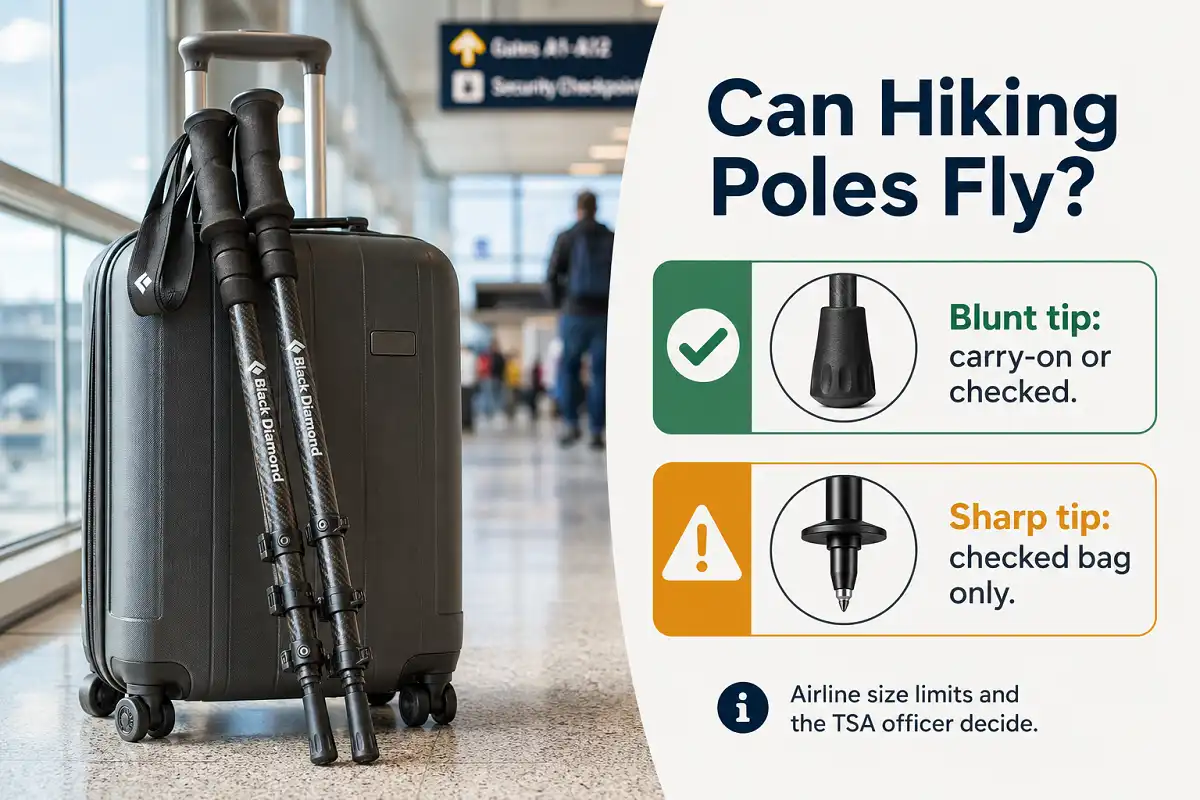
Can Hiking Poles Be Carried on a Plane? TSA Rules for 2026
Last spring I packed for a trip to the Sierra and got everything right except one thing. I had strapped my trekking poles to the outside of my pack, and I had no clue whether security would wave them through. That small worry follows a lot of hikers to the airport. If you have ever stood in the check-in line wondering can hiking poles be carried on a plane, here is the plain answer, plus the rules that decide it.
So, Can Hiking Poles Be Carried on a Plane?
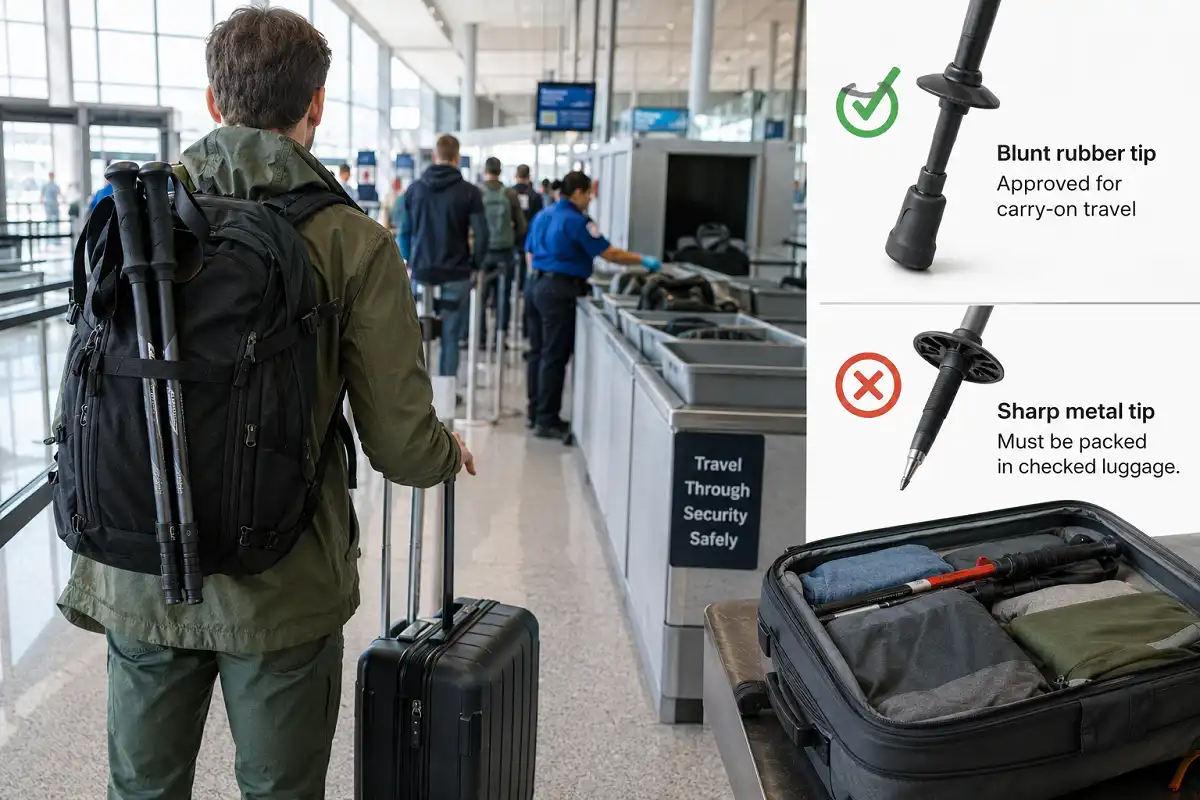
Yes, in most cases.
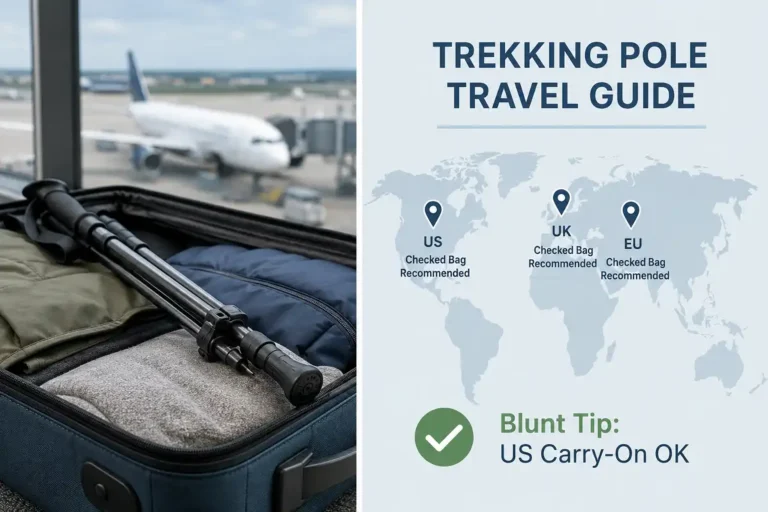
Under the current TSA guidance (last updated in April 2025), TSA allows blunt-tipped hiking poles in both carry-on and checked bags. Sharp-tipped poles, however, cannot fly in the cabin and must ride in your checked bag. Two other groups still have the final say: the TSA officer at the checkpoint, and your airline, which sets its own size limits.
That single change matters, because for years the honest answer to can hiking poles be carried on a plane was a flat no. Plenty of older blog posts still claim the cabin bans poles outright. So if a friend told you to always check them, they were right until fairly recently. Now the tip of the pole decides most of it.
Why the Tip Matters More Than the Pole
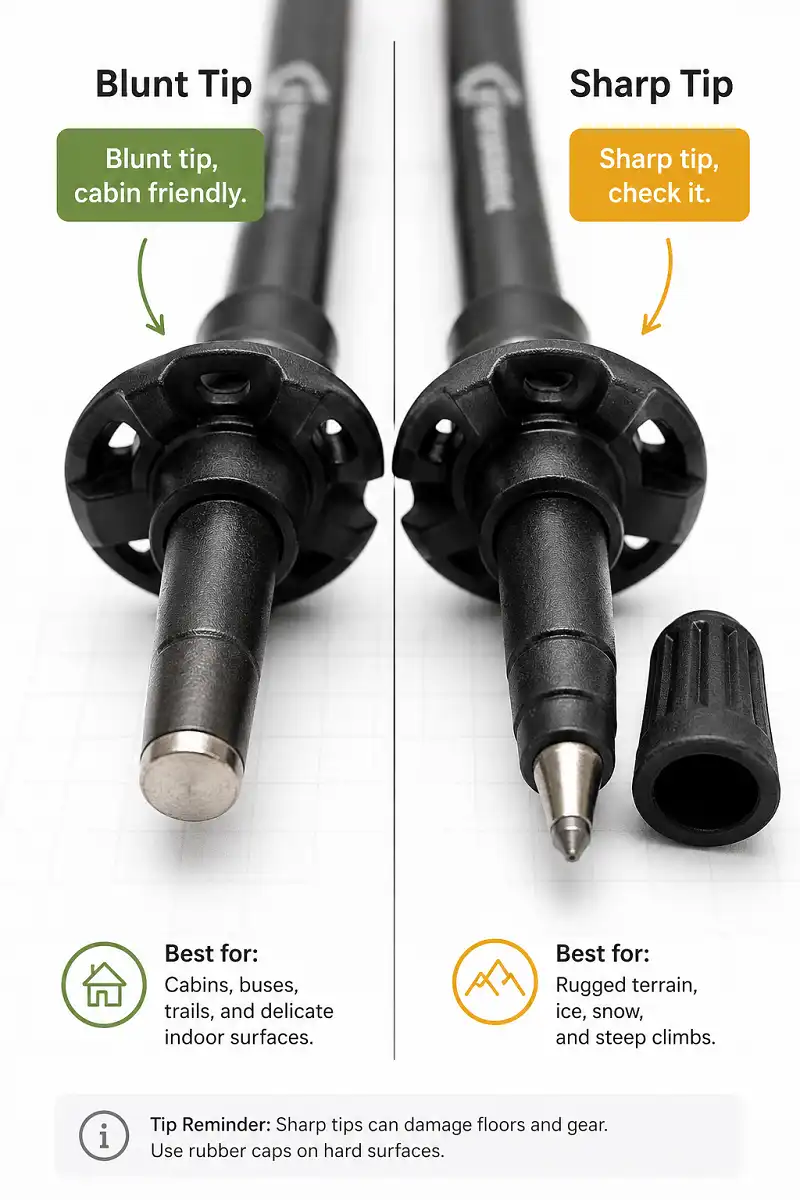
The tip is the whole story here. TSA does not care much about the shaft, the grip, or whether your poles are carbon or aluminum. It cares about the point at the bottom, because that is the part an officer could read as a weapon on an X-ray.
Blunt tips get the green light. A rounded or flat metal tip counts as blunt-tipped, so those poles can go in your carry-on. Many walking-style poles from brands like Leki and Black Diamond ship with a flat foot under the rubber cap, and that flat foot is what keeps them cabin-friendly.
Sharp tips get sent to the hold. A pointed tungsten carbide tip is the kind most trail poles use for grip on rock and packed dirt. TSA counts that point as sharp, so a pole wearing one must go in checked baggage. Pulling the pole apart does not help, since the sharp piece is still sharp on its own. If you want to read up on why trekking poles use carbide tips, the shape makes sense once you see the terrain they grip.
What about rubber tip caps?
Rubber caps help, but they do not rewrite the rule. A rubber protector covers the carbide point and usually makes screening smoother, and several travelers report officers simply checking that the caps were on before waving them through. Still, the official rule looks at the tip underneath the cap, not the cap itself. So a rubber tip is a smart move, yet an officer can still ask you to check a pole with a sharp point hiding under it.
Because of that gray area, I treat rubber caps as insurance, not a guarantee. If your poles have pointed carbide tips, plan for the possibility that you will check them, even with caps on.
Carry-On vs Checked Bag: Which Should You Pick?
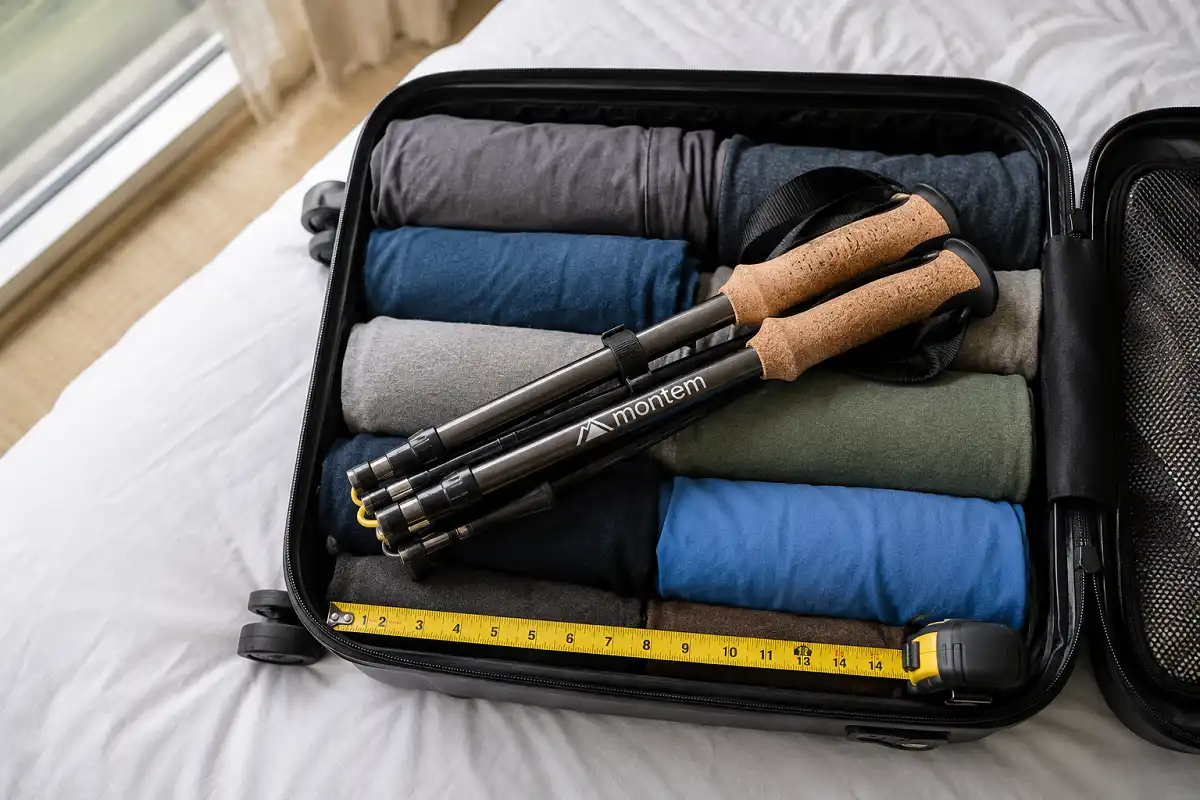
The safe pick is simple: carry them on only if they have blunt tips and fold short enough for the cabin, and check them otherwise. Passing security is only half the job, because your airline controls what fits overhead. The gate agent can still turn away even a blunt-tipped, TSA-approved pole if it will not fit the overhead bin or under the seat. So whether you are flying out for a big alpine trip or a quick desert weekend, the poles still have to clear your carrier’s size rules.
Most US carriers use a standard carry-on limit of about 22 by 14 by 9 inches. That 22-inch length is the number that trips people up. A typical two-section telescoping pole collapses to roughly 24 to 26 inches, so it sticks out past a standard carry-on and usually has to go in your checked bag anyway.
Folding poles solve that problem. A Z-fold or tri-fold model breaks into four or five short sections and packs down to around 13 to 16 inches. At that length, it drops sideways into a carry-on roller and leaves plenty of room for clothes. So if flying with hiking poles in the cabin is your goal, folding poles with blunt tips are the combination that works.
Will your poles fit a carry-on bag?
Measure them collapsed before you leave home. Anything under about 16 inches usually slides into a standard carry-on without a fight. Between 16 and 20 inches, they often fit but draw more scrutiny at tighter checkpoints. Past that, plan to check them. When I fly carry-on only, I bring folding poles for exactly this reason, and I still keep the rubber tips on to keep screening quick.
If you have already decided your poles are worth the investment for steep, rocky trails, it is worth choosing a travel-friendly folding pair so they make the trip with you.
What Major US Airlines Say
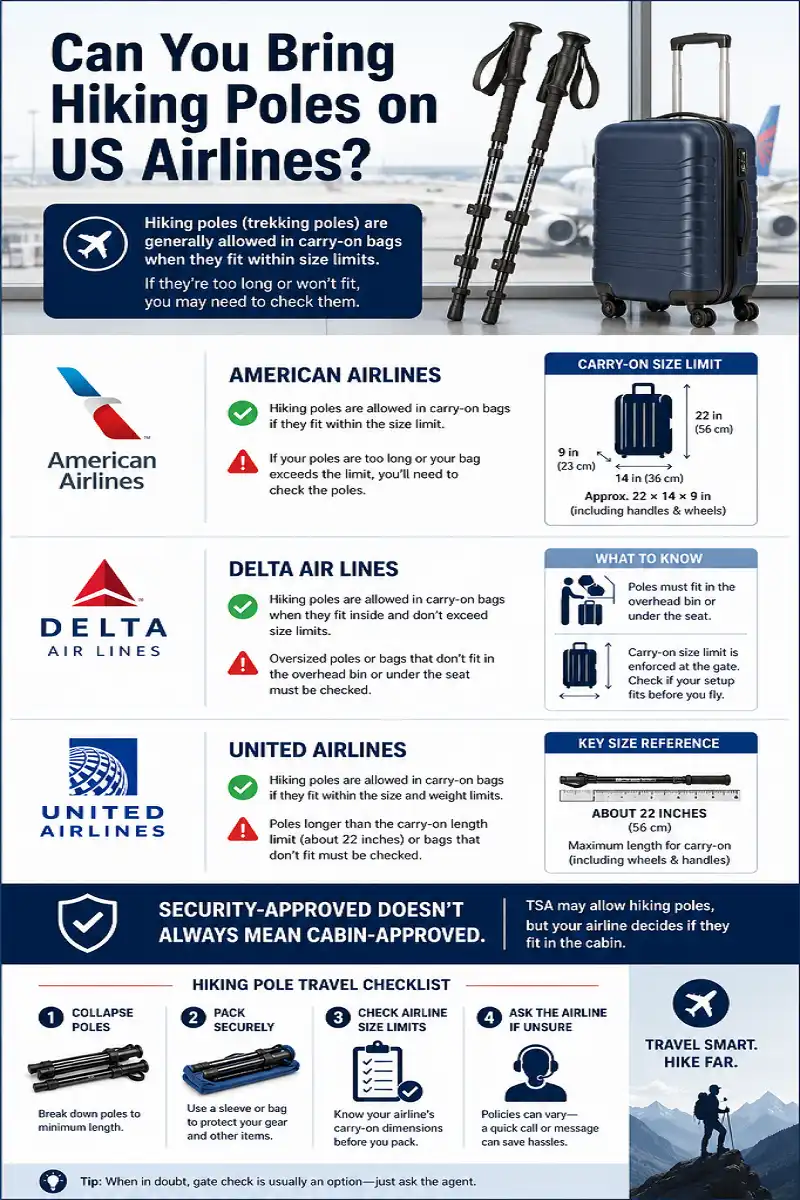
US airlines mostly defer to TSA and then add their own size rules. None of the big three ban hiking poles outright, but each expects your bag to fit its cabin limits.
Follows TSA and requires carry-on items to fit the overhead bin or under the seat, within roughly 22 by 14 by 9 inches.
Lists hiking and trekking poles among items allowed when packed properly, in line with TSA rules and its normal carry-on and checked allowances.
Also caps carry-on length at about 22 inches, so a long telescoping pole gets checked.
A pole can be security-approved and still need checking simply because it is too long.
Budget carriers sometimes charge for checked bags, so factor that cost in before deciding.
Two things follow from this. First, a pole can be security-approved and still need checking simply because it is too long. Second, budget carriers sometimes charge for checked bags, so factor that cost in before you decide. When in doubt, call the airline and ask whether your collapsed length clears its cabin rules.
Hiking Poles, Ski Poles, and Walking Canes Are Not the Same
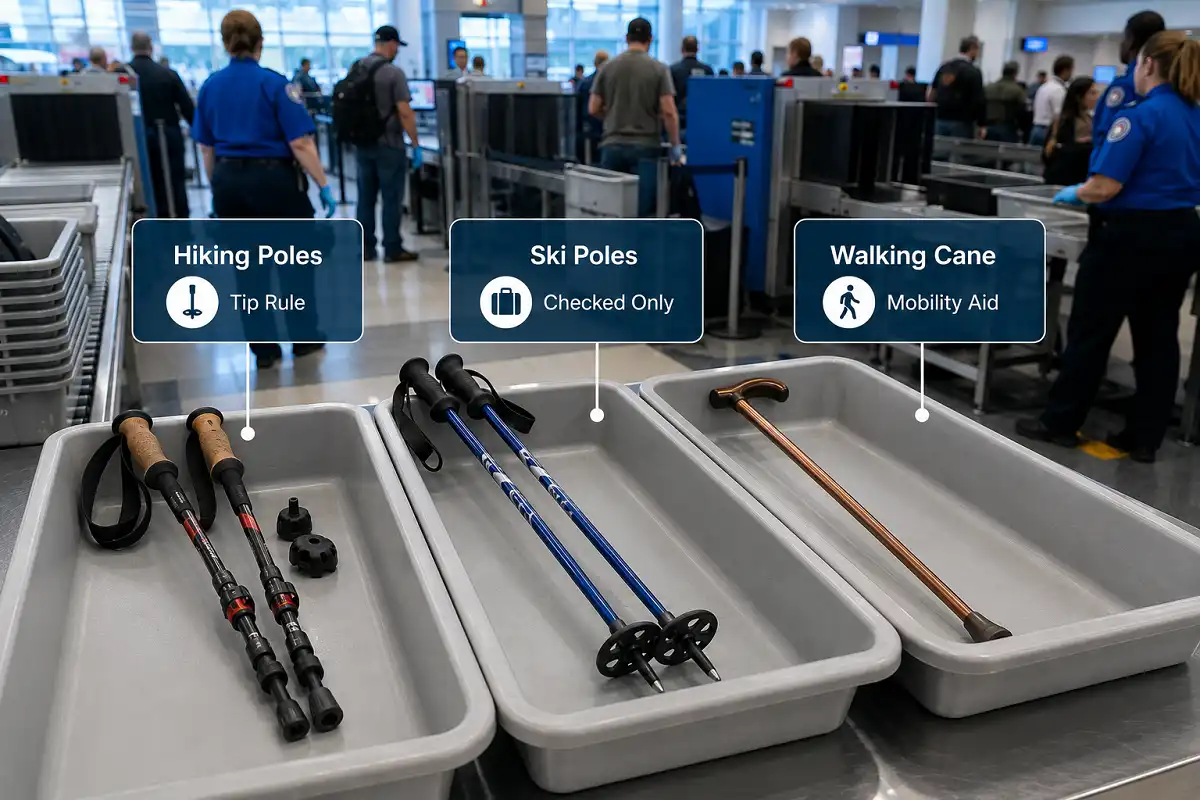
TSA treats these three items very differently, and mixing them up causes trouble at the checkpoint.
Hiking Poles
- Blunt-tipped poles may be allowed in carry-on.
- Sharp carbide-tipped poles must be checked.
- Airline size limits still apply.
Ski Poles & Walking Canes
- Ski poles are carry-on prohibited and checked only.
- Genuine mobility canes are treated as assistive devices.
- Purpose matters when determining the applicable rule.
Ski poles are still a no in the cabin. TSA lists ski poles as carry-on prohibited, checked only, so do not assume the newer hiking-pole rule covers them. Walking canes used as a genuine mobility aid are a separate story, because TSA lets a real assistive device through security after screening, even if it looks pole-like.
That said, please do not dress up a recreational trekking pole as a medical cane to skip the rules. Officers have seen it, the difference between the two comes down to purpose, and misrepresenting your gear is up to officer discretion and can backfire. If you truly rely on a pole to walk, that is a mobility aid and you are fine. If you use it for balance on the trail, it is sporting gear and the tip rule applies.
Can Hiking Poles Be Carried on a Plane Internationally?
Sometimes, but it depends entirely on the country you fly from. Rules change the moment you leave US airspace, so never assume TSA guidance travels with you. Each country runs its own aviation security agency, and some are stricter than TSA about poles in the cabin.
Canada permits many hiking poles in carry-on bags.
The UK generally sends hiking poles to hold luggage instead.
Much of Europe leans stricter, with several airports restricting trekking poles.
Several airports may ban trekking poles from the cabin entirely.
From what I have gathered, Canada (through CATSA) permits many hiking poles in carry-on bags. The UK generally sends them to hold luggage instead. Much of Europe and Asia leans stricter still, and several airports ban trekking poles from the cabin entirely, regardless of tip shape. Because policies vary this much, check the security agency for your departure airport, any connection, and your return.
Here is the trap on a round trip: your poles clear security on the way out, then get refused on the way home from a stricter airport. So the safest habit for international travel is simple. Pack the poles in a checked bag both directions, and you sidestep the whole guessing game.
How to Pack Hiking Poles for a Flight
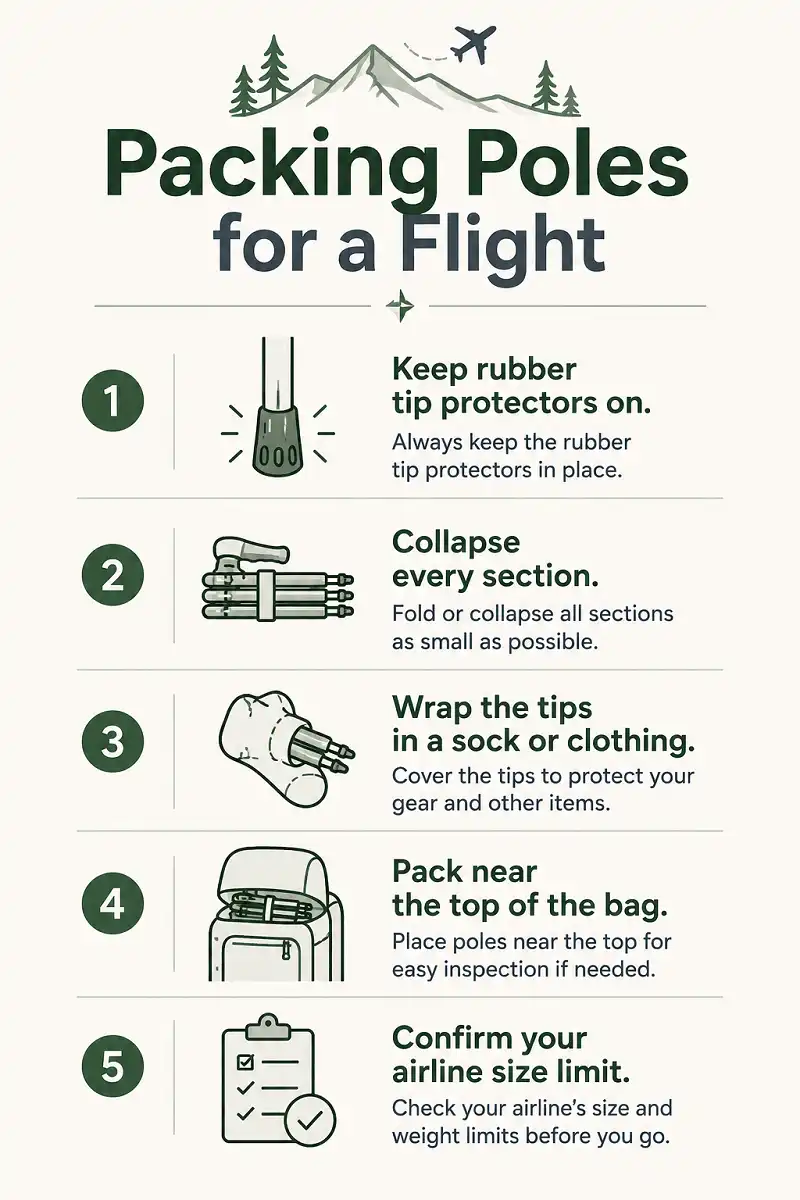
Packing poles well takes about two minutes and saves you a lot of grief. Whether they ride in the cabin or the hold, the same habits protect your gear and speed up screening.
They cover the point, protect your bag, and make the X-ray image cleaner.
Shorter poles fit more bags and are less likely to snag.
Roll them inside a fleece or tuck them in a thick sock for padding, even with caps on.
If an officer wants a look, you can reach them without unpacking everything.
Match your collapsed length against your airline’s cabin rule before you zip up.
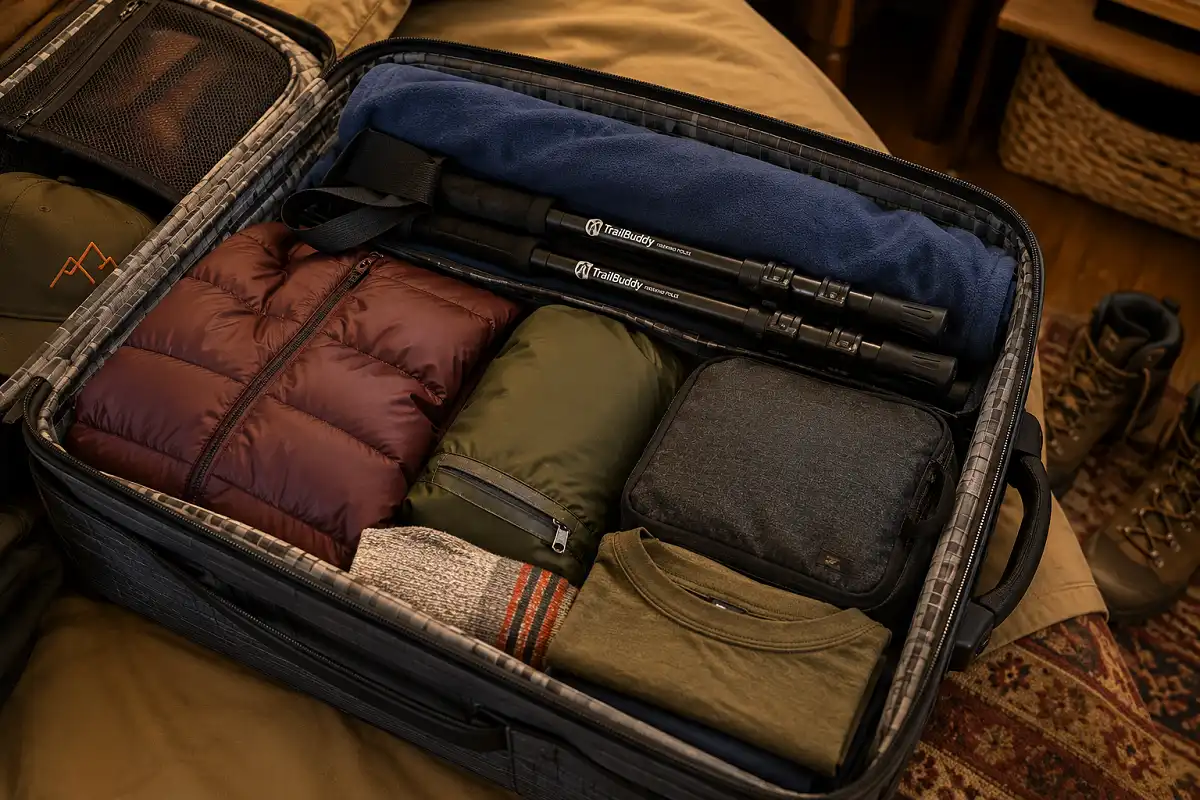
For checked bags, lay the collapsed poles along the inside edge of the suitcase and cushion them with clothing so the tips cannot puncture the fabric. A padded pole case works too, though I usually just bury mine in a rolled jacket. Once you wrap and pack them with the rest of your hiking gear, they travel fine.
What to Do If TSA Won’t Let Your Poles Through
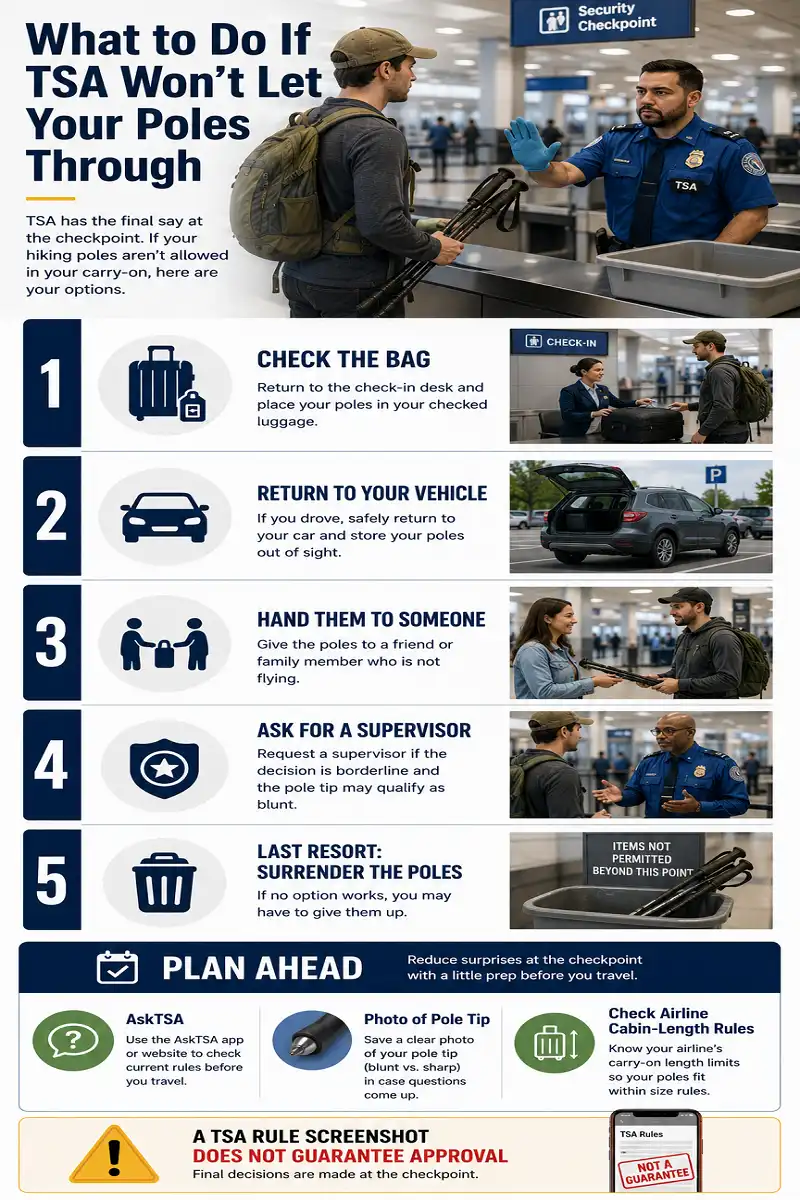
Sometimes an officer says no, and you need a plan for that moment. A screenshot of the TSA rule will not override a live security decision, so arguing rarely helps. Instead, work through your options calmly.
✓ Your Options
- Check the bag if you have not passed the check-in desk.
- Return the poles to your vehicle if time allows.
- Hand them to someone who is not flying.
- Ask for a supervisor if the tip is a borderline call.
! Last Resort
- You may have to surrender the poles to continue through security.
- Do not rely on a screenshot to override a security decision.
- Plan ahead to avoid losing your gear at the airport.
Check the bag. If you have not passed the check-in desk, this is the cleanest fix.
Return them to your vehicle, if you drove and time allows.
Hand them to someone not flying, like whoever dropped you off.
Ask for a supervisor if the tip is a borderline call and you think it qualifies as blunt.
As a last resort, you may have to surrender the poles to continue through security. To avoid that whole scene, contact AskTSA before you fly. Send a clear photo of your pole with the tip uncovered, and ask the operating airline whether your collapsed length fits the cabin. A little planning beats losing gear at the worst possible moment.
Smart Alternatives Worth Considering
If the airport rules feel like more hassle than they are worth, you have a couple of easy outs.
Mail Your Poles Ahead
Mailing your poles ahead is an old thru-hiker habit for a reason. Ship them to your hotel or trailhead lodging, and skip the checkpoint entirely. It costs a little, but so do checked-bag fees, and your poles arrive without any airport drama.
Rent or Buy at Your Destination
Renting or buying at your destination also works well, especially for one-off trips. Many outdoor shops near popular trails rent poles by the day.
Consider a Local Pair
So if you are flying out for something like a winter day hike near Anchorage, grabbing a local pair can be simpler than dragging your own across the country. In a pinch, a solid found stick has gotten me down plenty of trails too.
The Bottom Line
So, can hiking poles be carried on a plane?
Yes, if they have blunt tips and fit your airline’s cabin size, thanks to the TSA rule change in 2025. Poles with sharp carbide tips still go in checked bags, and international airports often require checking regardless. When you are unsure, keep the rubber caps on, choose folding poles for carry-on, and check the bag if a stricter airport or officer says so. Do that, and your poles reach the trail every time.
Frequently Asked Questions
Can hiking poles be carried on a plane if they are brand new in the box?
Yes, the same rules apply to new poles. An unused pole follows the same rule, because the tip still decides it. So check the tip shape on your new pair, keep the packaging or the tip caps on, and confirm they fit your airline’s carry-on size if you want them in the cabin.
Are collapsible hiking poles allowed in carry-on bags?
TSA allows collapsible poles in carry-on bags only when they have blunt tips and fit your airline’s size limit. Folding down does not override the tip rule, so a collapsible pole with a sharp carbide point still belongs in checked baggage. The upside is that folding models pack short enough to fit most cabin bags easily.
Do I have to remove the rubber tips before security?
No, you should keep the rubber tips on. They protect the point and usually make screening faster, and officers may just confirm the caps are on. Removing them offers no benefit and leaves a sharp point exposed in your bag.
Can I bring trekking poles on an international flight?
Sometimes, but it depends entirely on the country. Some agencies like CATSA in Canada allow poles in carry-on, while the UK and many European and Asian airports send them to checked luggage. Because rules differ at every stop, checking poles in the hold is the safest choice for international trips.
Can hiking poles be carried on a plane strapped to the outside of a backpack?
Not in the cabin. Loose poles strapped to a pack exterior will not clear the checkpoint, so tuck them inside a bag that meets your airline’s size limit, or check them instead. On the trail, strap them wherever you like, but security wants them packed inside a bag.