Best Hiking Jackets for Cold Weather: A Beginner’s Guide to Staying Warm on the Trail
Nothing ends a winter hike faster than a jacket that can’t keep up with the conditions. One minute you’re sweating up a switchback, the next you’re standing at a windy overlook wondering why your “warm” jacket suddenly feels like tissue paper. Finding the best hiking jackets for cold weather isn’t about buying the thickest coat on the rack most people don’t struggle with cold weather itself, they struggle with picking the wrong jacket for how they actually hike.
This guide breaks down exactly what to look for in the best hiking jackets for cold weather, how insulation types differ, and which style fits your specific trail habits, whether you’re constantly moving or stopping often to catch the view.
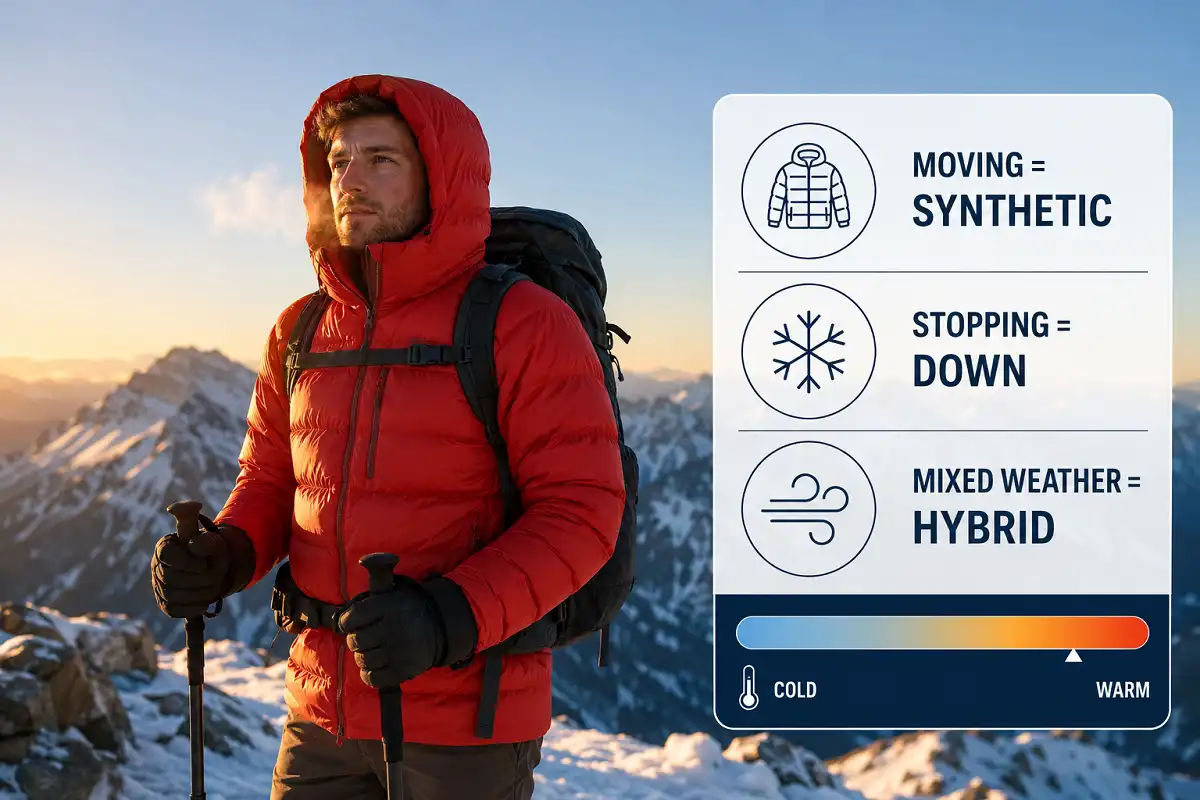
The best hiking jackets for cold weather come down to matching insulation to your activity level. If you hike at a steady pace and rarely stop, a lighter synthetic jacket with breathable side panels keeps you from overheating. If you take long breaks, hike to summits, or stand around in cold wind, a high-fill-power down jacket traps heat far more efficiently once you’re stationary. For unpredictable weather with a mix of movement and moisture, a hybrid jacket that blends down and synthetic insulation offers the best of both. Most beginners do well starting with a mid-weight synthetic hooded jacket it performs in damp conditions, layers easily, and doesn’t require the careful handling that down demands.
Down, Synthetic, or Hybrid: What’s Actually Different
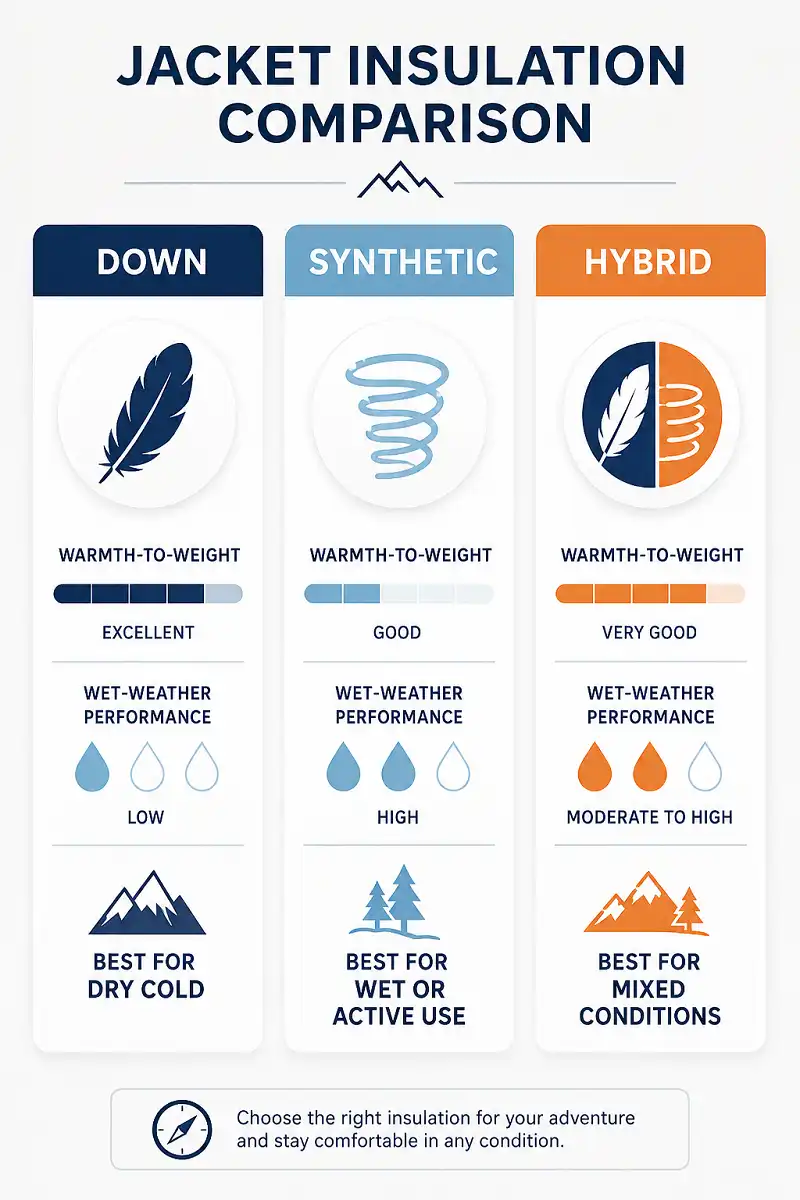
Every conversation about the best hiking jackets for cold weather eventually comes down to one core decision: down insulation or synthetic insulation. Each has real strengths, and understanding them will save you from buying the wrong jacket twice.
Down insulation is made from the fluffy underlayer of duck or goose feathers. As explained on Wikipedia, down grows separately from a bird’s outer feathers and forms a lightweight cluster structure that traps air exceptionally well. That’s exactly why down remains the gold standard for warmth-to-weight ratio in hiking jackets. It compresses down to almost nothing in a stuff sack, making it ideal for backpackers who need to save space. The catch is moisture: down loses its loft and insulating power when wet, so it performs best in cold, dry climates or as a jacket you pull on only during breaks.
Synthetic insulation is built from polyester fibers engineered to mimic the loft of down. It’s bulkier and heavier for the same warmth, but it keeps insulating even when damp, dries much faster, and tends to cost less. This makes synthetic jackets a smarter pick if you hike somewhere that sees rain, snow, or high humidity, or if you plan to wear the jacket while actively moving and sweating.
Hybrid jackets split the difference by placing down in core areas where loft matters most and synthetic insulation in spots prone to moisture, like the shoulders, hood, or underarms. These jackets are increasingly common among the best hiking jackets for cold weather because they reduce the classic down-versus-synthetic tradeoff without fully committing to either extreme.
Down
- Best for dry cold
- Excellent for long stops
- Minimal pack weight
- Loses warmth when wet
Synthetic
- Best for damp weather
- Excellent for active use
- Dries quickly
- Heavier and less packable
Dry cold, long stops, minimal pack weight.
Damp or unpredictable weather and active use.
Mixed conditions and variable moisture.
Loses insulating performance when wet.
Heavier and generally less packable.
Match the Jacket to How You Actually Hike
Picking among the best hiking jackets for cold weather starts with an honest look at your hiking habits, not the spec sheet. This is the piece most buying guides skip, and it’s arguably the most useful insight for choosing among the best hiking jackets for cold weather: your hiking style matters more than the temperature on the forecast.
If you’re moving the entire time steady climbs, minimal stops, a pace that keeps your body generating heat you want a lighter jacket with some breathability built in. Heavier insulation just traps sweat and leaves you clammy. Look for stretch side panels, a trim fit, and moderate insulation (around 60 grams of synthetic fill is common in this category).
If you stop often, whether for photos, snack breaks, or reaching a windy summit, your body cools down fast once you’re not generating heat. This is where a heavier down jacket earns its keep. High fill-power down (800 or higher) with a wind-blocking shell will keep you warm the moment you stop moving, even if it feels like overkill while you’re hiking.
If temperature swings are constant climbing into exposed alpine terrain, then dropping into sheltered valleys a hybrid jacket with body-mapped insulation adjusts better than a single-purpose piece. Warmth is concentrated where you cool down quickest, while more breathable panels sit where you build up heat.
If wind is your biggest enemy, prioritize a fully wind-blocking shell over raw insulation thickness. Wind strips heat away far faster than cold temperatures alone, so a well-sealed shell with a snug hood and cinchable hem often outperforms a warmer jacket that leaks air at the seams. Among the best hiking jackets for cold weather, this wind-first approach is often overlooked in favor of chasing higher warmth ratings.
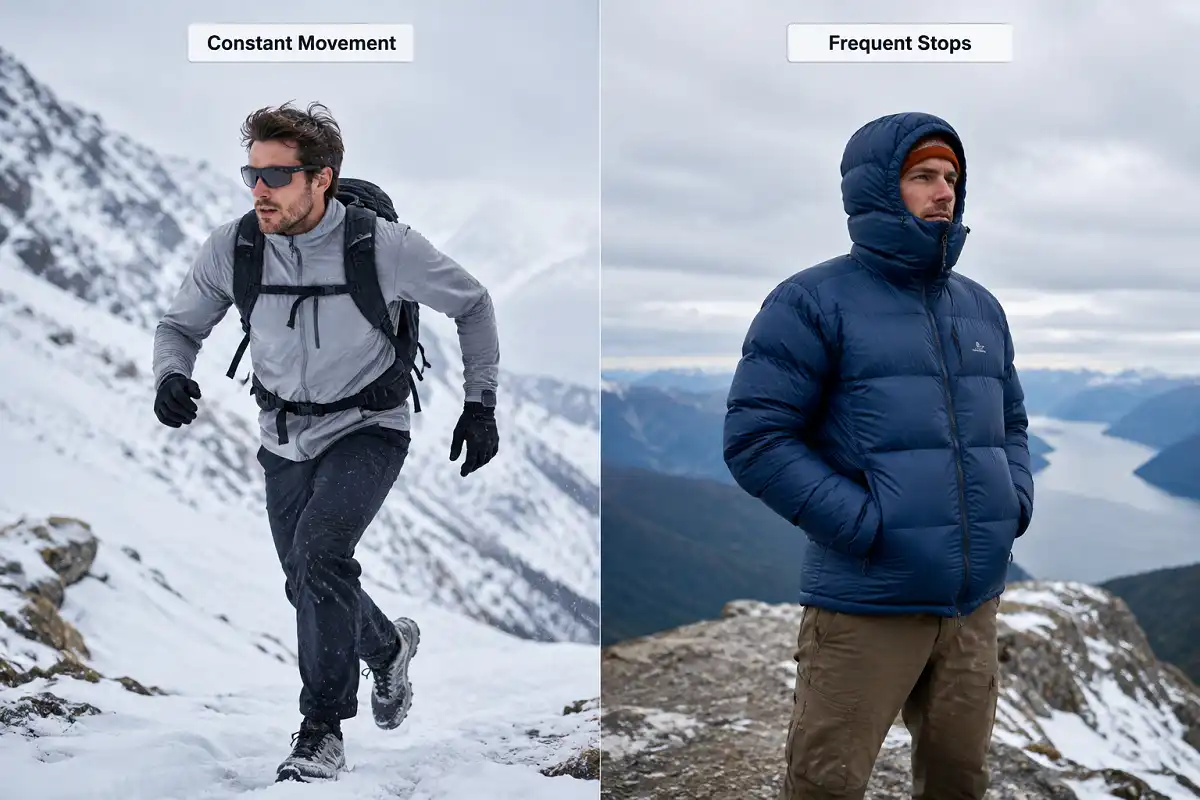
Thinking through your typical hike this way rather than just chasing the highest warmth rating is the fastest way to land on the right pick among the best hiking jackets for cold weather.
Key Features That Actually Matter
Once you’ve settled on an insulation type, these details separate the best hiking jackets for cold weather from a frustrating purchase.
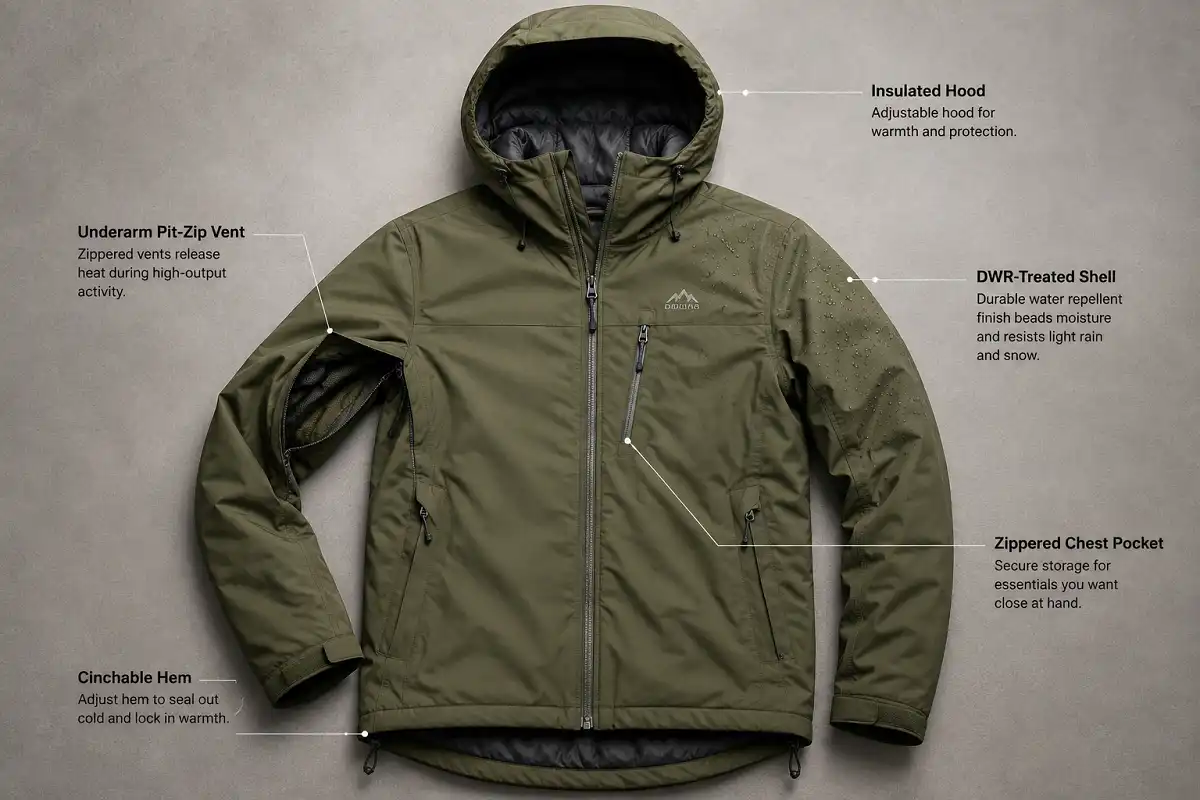
Hood design
An insulated, adjustable hood is one of the most underrated features on cold-weather hiking jackets. It should move with your head without needing constant readjustment. Helmet-compatible hoods only matter if you’re actually wearing a helmet otherwise they just add bulk.
Ventilation
Pit zips or breathable underarm panels let you dump heat quickly without stripping the whole jacket off, which matters most during stop-and-go hiking.
Fill power vs. fill weight
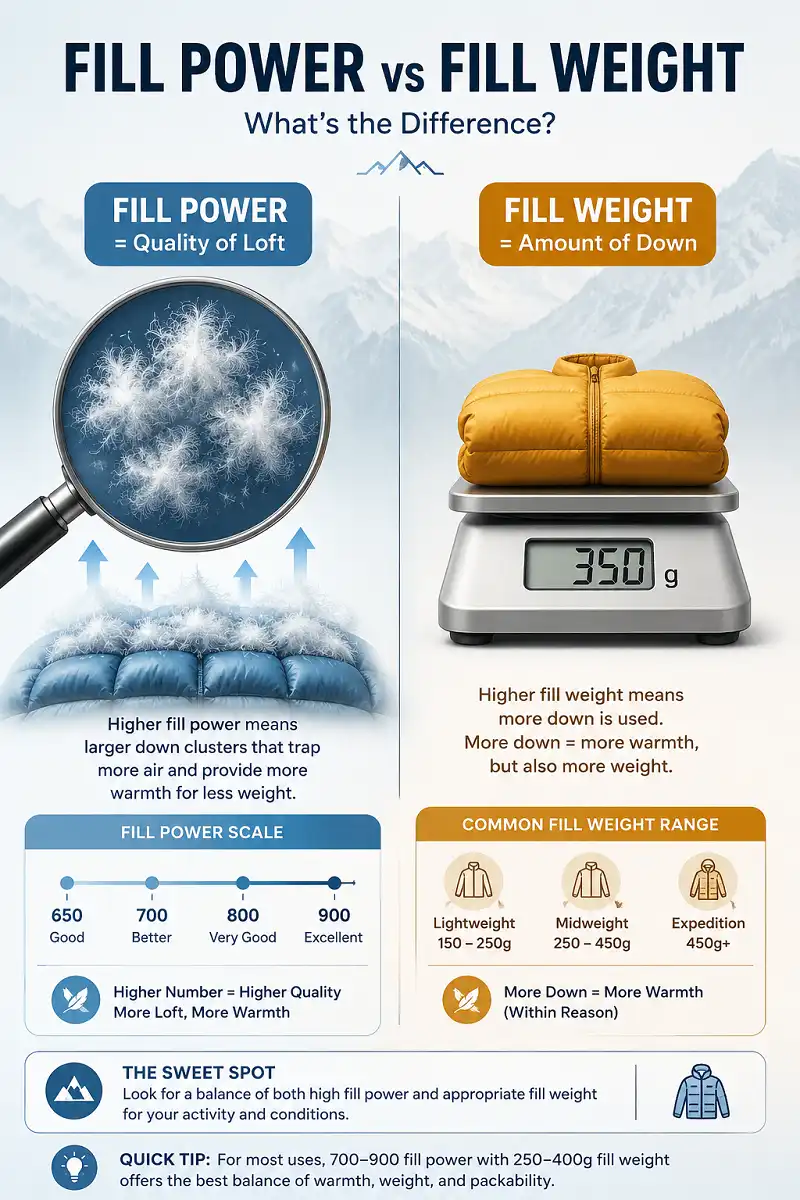
Fill power measures the quality of the down (how much it lofts), typically ranging from 650 to 900+. Fill weight measures the amount of down used. A jacket can have very high fill power but still be less warm than a heavier jacket with lower fill power, simply because it uses less material. Both numbers matter together, not separately.
DWR coatings
Most jackets, whether down or synthetic, use a durable water-repellent (DWR) finish on the outer shell to shed light snow and mist. It’s not waterproofing, and it wears off over time with use and washing, so expect to reapply a DWR spray every season or two if you want your jacket to keep beading water.
Denier and durability
Denier measures the thickness of the shell fabric’s threads. Lower denier (under 15D) means a lighter, more packable jacket that’s also more prone to snags and tears; higher denier (30D and up) trades some weight for durability, which matters if you’re bushwhacking or scrambling over rock. Many of the best hiking jackets for cold weather balance these two extremes rather than maxing out either one.
Fit for layering
A jacket that’s too trim won’t leave room for a fleece or base layer underneath, which flattens insulation and actually makes you colder. Look for a cut that fits comfortably over your typical layering system without restricting your arms this alone separates the best hiking jackets for cold weather from ones that only look warm on a hanger.
How Warm Do You Actually Need to Be?
This is where a lot of beginners overspend or underbuy when shopping for the best hiking jackets for cold weather. There’s a big difference between a lightweight three-season jacket and an expedition-grade parka, and matching that to your climate saves both money and comfort.
For most hikers in the continental U.S. dealing with typical winter trail conditions freezing mornings, cold wind, occasional snow a mid-weight jacket in the 60 to 100 gram synthetic fill range, or a down jacket in the 650 to 800 fill-power range, covers the vast majority of situations. Reserve the heaviest, warmest options for genuinely extreme cold: high-altitude routes, exposed winter summits, or regions that regularly drop well below freezing for extended periods.
If you’re not sure, it’s almost always smarter to buy a slightly lighter jacket and build a proper layering system underneath than to buy the warmest jacket you can find and overheat on every climb. If you’re gearing up for winter trips generally, our guide on clothing for hiking in winter covers how to build that full system from base layer to shell.
Building a Layering System Around Your Jacket
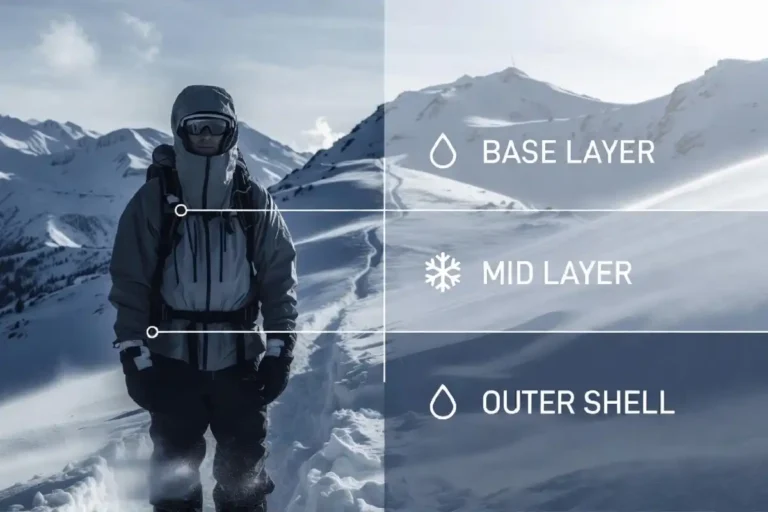
A jacket rarely works alone in serious cold, which is one reason the best hiking jackets for cold weather are designed to be one piece of a bigger system rather than a standalone solution:
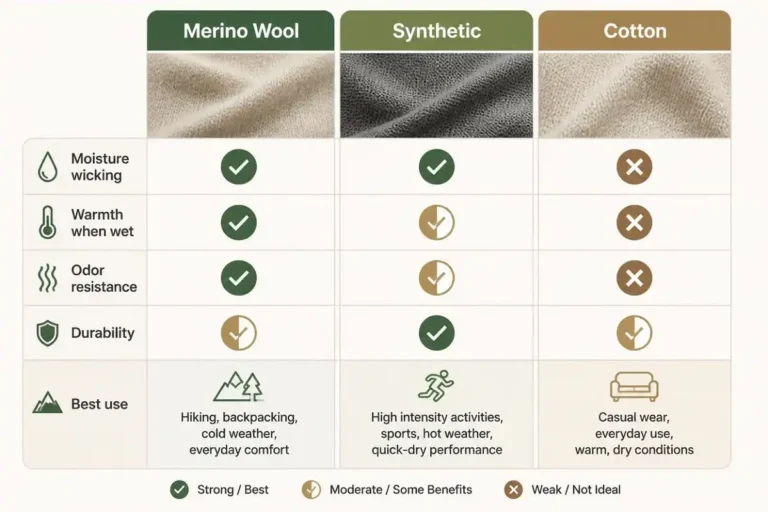
- Base layer worn against the skin, wicks sweat, usually merino wool or synthetic.
- Mid-layer fleece or lightweight wool that traps warm air and layers comfortably under your jacket.
- Insulated jacket your down, synthetic, or hybrid piece, providing the bulk of your warmth.
- Shell layer a waterproof or wind-resistant outer layer for genuinely wet or stormy conditions, worn on top of everything else.
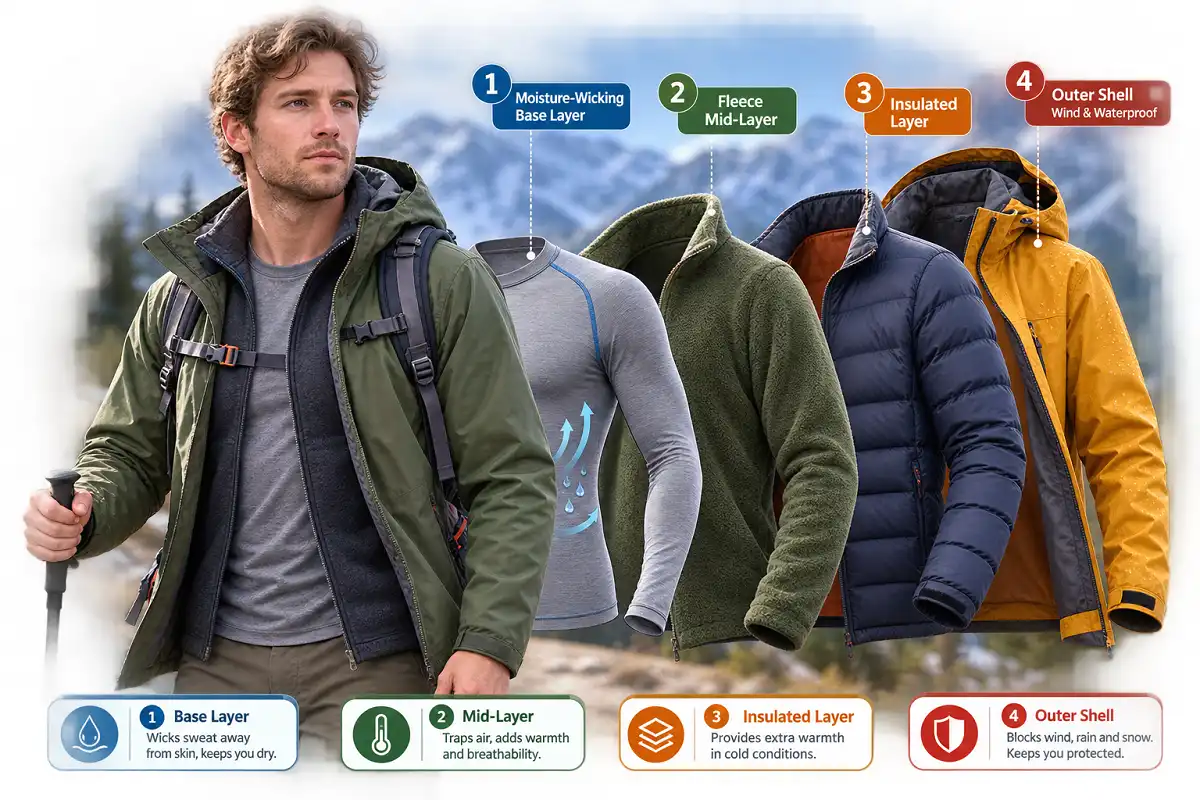
This system lets you add or remove layers as your effort level changes throughout the hike, which matters more than any single “warmest” jacket on the market. If you’re planning a specific route, checking trail-specific conditions ahead of time like on our guide to the best hikes in the winter helps you decide how many layers you’ll actually need.
Care and Longevity
Even the best hiking jackets for cold weather lose performance if they’re washed incorrectly, so a little maintenance goes a long way toward protecting your investment. Down should be washed with a down-specific detergent in a front-loading machine, then dried on low heat with a few clean tennis balls to break up clumps and restore loft this step often takes multiple cycles, so don’t stop early. Synthetic insulation is more forgiving and can typically handle a gentle cycle with regular detergent, though checking the care label first is always worth the extra minute. Either way, reapplying a DWR treatment once or twice a season keeps the shell shedding moisture the way it did when new.
Common Mistakes When Buying Cold-Weather Hiking Jackets
Even shoppers who do their homework on the best hiking jackets for cold weather tend to trip up on a few recurring mistakes.
Two jackets rated for the “same” cold can feel completely different depending on your activity level and personal cold tolerance.
This usually backfires with overheating and unnecessary sweat, which then makes you colder once you stop.
A jacket that fits perfectly with just a t-shirt underneath may feel restrictive the moment you add a fleece.
Insulation alone doesn’t stop wind chill; a jacket with poor wind-blocking can feel far colder than its warmth rating suggests, no matter how much fill it has.
Avoiding these mistakes is often more important than chasing the single “best” jacket on paper the best hiking jackets for cold weather are the ones that match your specific trail habits, not the ones with the highest specs.
FAQs About Cold Weather Hiking Jackets
What type of jacket is best for cold weather hiking?
The best type depends on how you hike. A lighter synthetic jacket works well for active hikers who generate plenty of body heat, while a high-fill-power down jacket is better for long stops, summit breaks, and dry cold. A hybrid jacket is useful when conditions and moisture levels change.
Is down or synthetic insulation better for winter hiking?
Down offers an excellent warmth-to-weight ratio and packs very small, making it ideal for cold, dry conditions. Synthetic insulation is heavier but continues to provide insulation when damp and dries faster, making it a strong choice for wet, snowy, or humid conditions.
Is 800 fill power warm enough for winter hiking?
High fill-power down can provide excellent warmth, but fill power alone does not determine how warm a jacket is. The amount of insulation, shell construction, fit, wind protection, and your activity level all affect real-world warmth.
How much synthetic insulation do I need for winter hiking?
For many typical winter trail conditions, the article recommends a mid-weight jacket in roughly the 60 to 100 gram synthetic fill range. More extreme cold or exposed high-altitude conditions may require substantially more insulation.
Should a winter hiking jacket be waterproof?
Not necessarily. A DWR-treated insulated jacket can shed light snow and mist, but DWR is not waterproofing. In genuinely wet or stormy conditions, a waterproof or wind-resistant shell can be worn over the insulated jacket as part of a layering system.
What should I wear under a cold weather hiking jacket?
A practical system includes a moisture-wicking base layer, a fleece or lightweight wool mid-layer, and the insulated jacket. In genuinely wet or stormy weather, add a waterproof or wind-resistant shell over the top.
How should I choose a hiking jacket if I sweat a lot?
If you hike continuously and generate a lot of heat, choose a lighter jacket with breathable panels or stretch side panels. Pit zips and other ventilation features can also help release excess heat without removing the entire jacket.
How should I care for a down hiking jacket?
Down should generally be washed with a down-specific detergent in a front-loading machine and dried on low heat until the insulation fully lofts again. The article also recommends checking the care label and using proper drying techniques to prevent clumping.
Final Choice
Choosing among the best hiking jackets for cold weather isn’t about finding the warmest jacket on the shelf it’s about matching insulation, fit, and features to how you actually spend time outside. Think honestly about your pace, how often you stop, and the kind of weather you’re likely to face, then build a simple layering system around that jacket rather than expecting one piece to do everything.
Choosing among the best hiking jackets for cold weather isn’t about finding the warmest jacket on the shelf it’s about matching insulation, fit, and features to how you actually spend time outside. Think honestly about your pace, how often you stop, and the kind of weather you’re likely to face, then build a simple layering system around that jacket rather than expecting one piece to do everything. Get that match right, and you’ll stop thinking about your jacket altogether, which is exactly the point. For more on outfitting yourself for the trail, browse our full clothing category for additional cold-weather guides.
The best hiking jacket is the one that matches your movement, moisture, wind, and layering needs.