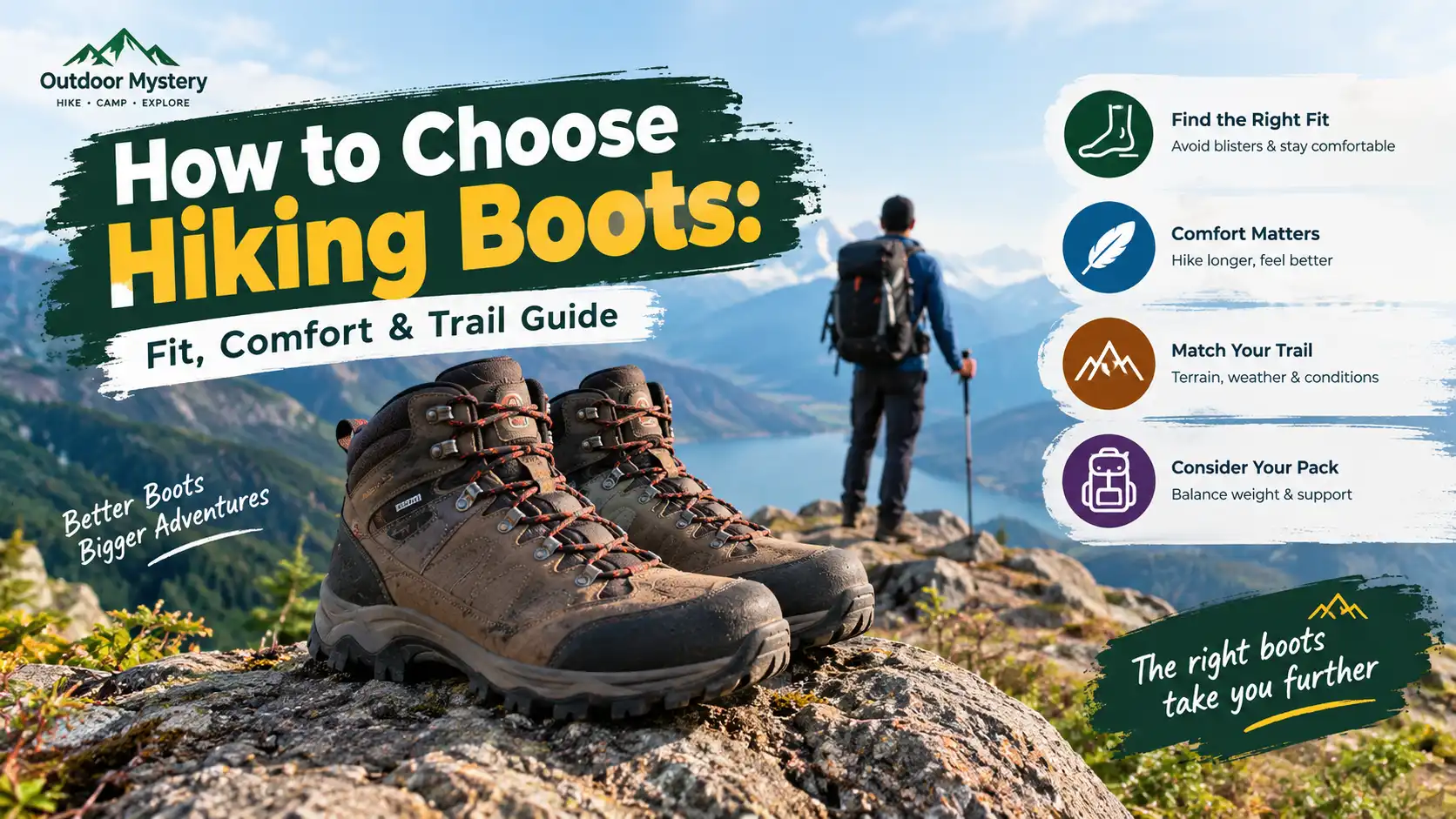
How to Choose Hiking Boots: Fit, Comfort & Trail Guide
I’ve been hiking and camping since 2018, mostly out of Bakersfield, California. What started as a few weekend trips slowly turned into something I plan my year around. These days, I spend a lot more time thinking about the trail before I step onto it and that includes what I’m putting on my feet.
I didn’t figure all of this out the easy way.
I’ve bought the wrong boots. I’ve carried a backpack that was far too heavy. I’ve headed out without properly checking the weather. And I’ve definitely had trips where a small mistake became a much bigger problem several miles down the trail.
The best hiking gear isn’t necessarily the most expensive gear. It’s the gear that fits the trip you’re actually taking.
That’s especially true with hiking boots.
A boot that feels perfect on a short local trail might feel completely different after eight hours of walking. A heavy waterproof boot can be great in cold, wet conditions but unnecessarily hot on a dry summer trail. And a boot that looks incredibly supportive isn’t useful if it gives you blisters before you’ve finished the first few miles.
So, if you’re wondering how to choose hiking boots, that’s what this guide is about.
I’m going to walk through the things I actually pay attention to now: fit, comfort, terrain, hiking distance, backpack weight, waterproofing, traction, materials and break-in time. I’ve also included 10 hiking boots worth considering, with options for day hikes, rough trails, wider feet, lightweight trips and heavier backpacking.
Some of the gear mentioned here is based on products I’ve researched rather than personally used. I don’t want to pretend otherwise. Outdoor Mystery is my personal blog, and when I haven’t tested something myself, I’ll tell you.
Let’s get into it.
Why Choosing the Right Hiking Boots Matters
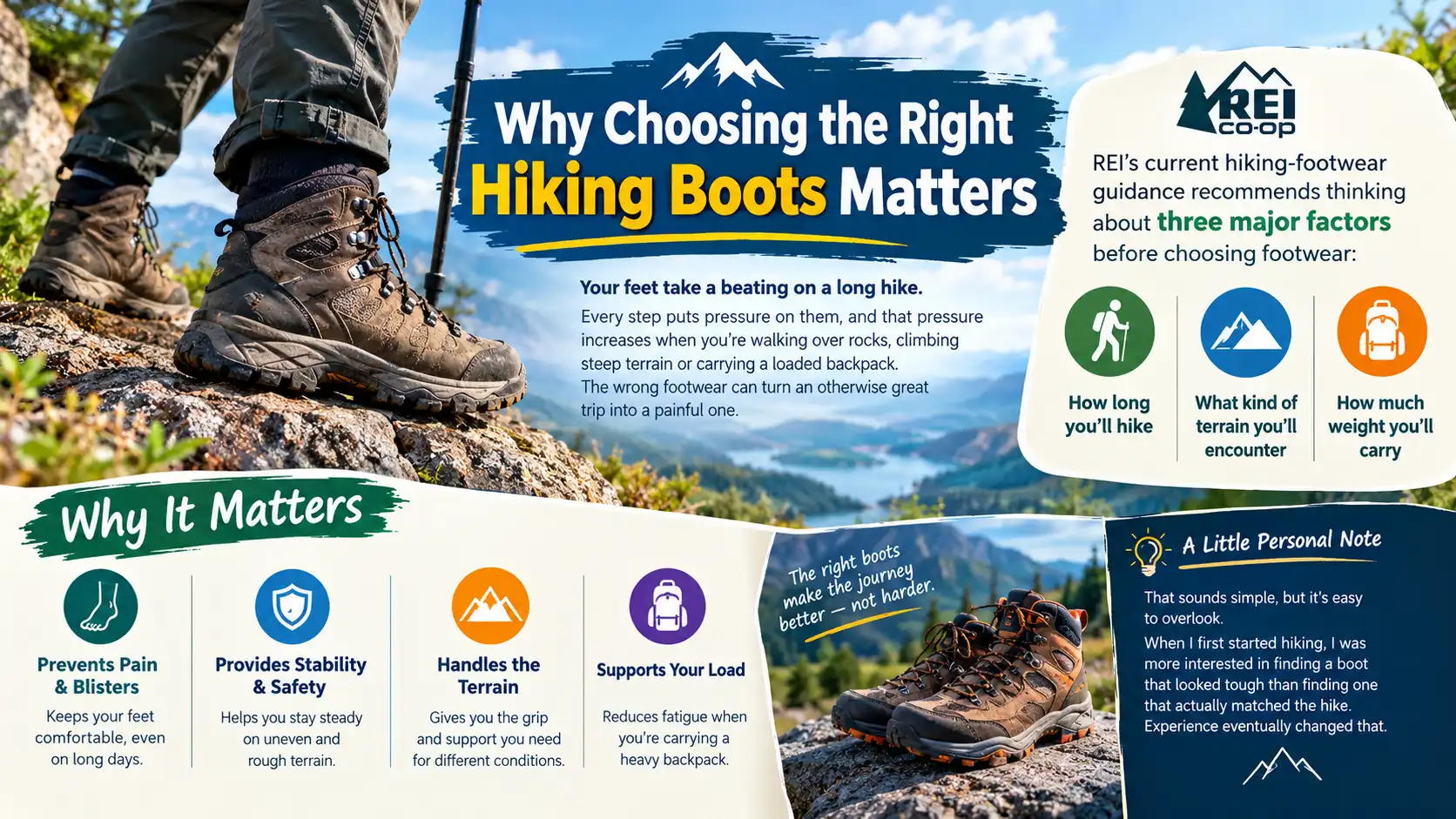
Your feet take a beating on a long hike.
Every step puts pressure on them, and that pressure increases when you’re walking over rocks, climbing steep terrain or carrying a loaded backpack. The wrong footwear can turn an otherwise great trip into a painful one.
REI’s current hiking-footwear guidance recommends thinking about three major factors before choosing footwear: how long you’ll hike, what kind of terrain you’ll encounter, and how much weight you’ll carry.
That sounds simple, but it’s easy to overlook.
When I first started hiking, I was more interested in finding a boot that looked tough than finding one that actually matched the hike. Experience eventually changed that.
Now I start with the trail.
How to Choose Hiking Boots
There isn’t one hiking boot that’s perfect for everyone. Your feet, hiking style and trails are different from mine.
But there are a few things I always look at.
Start With the Trail
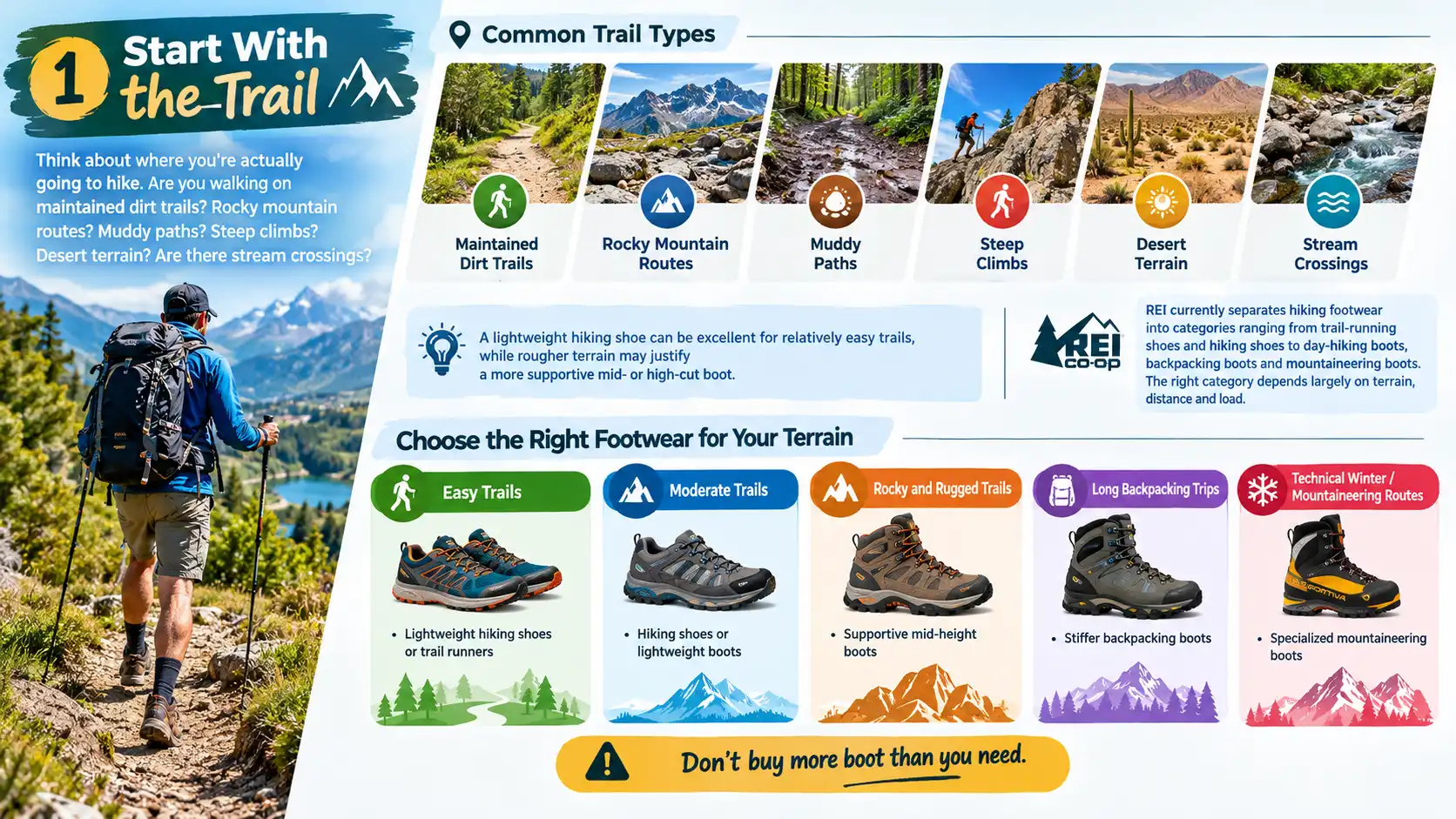
Think about where you’re actually going to hike.
Are you walking on maintained dirt trails? Rocky mountain routes? Muddy paths? Steep climbs? Desert terrain? Are there stream crossings?
A lightweight hiking shoe can be excellent for relatively easy trails, while rougher terrain may justify a more supportive mid- or high-cut boot.
REI currently separates hiking footwear into categories ranging from trail-running shoes and hiking shoes to day-hiking boots, backpacking boots and mountaineering boots. The right category depends largely on terrain, distance and load.
Don’t buy more boot than you need.
Get the Fit Right
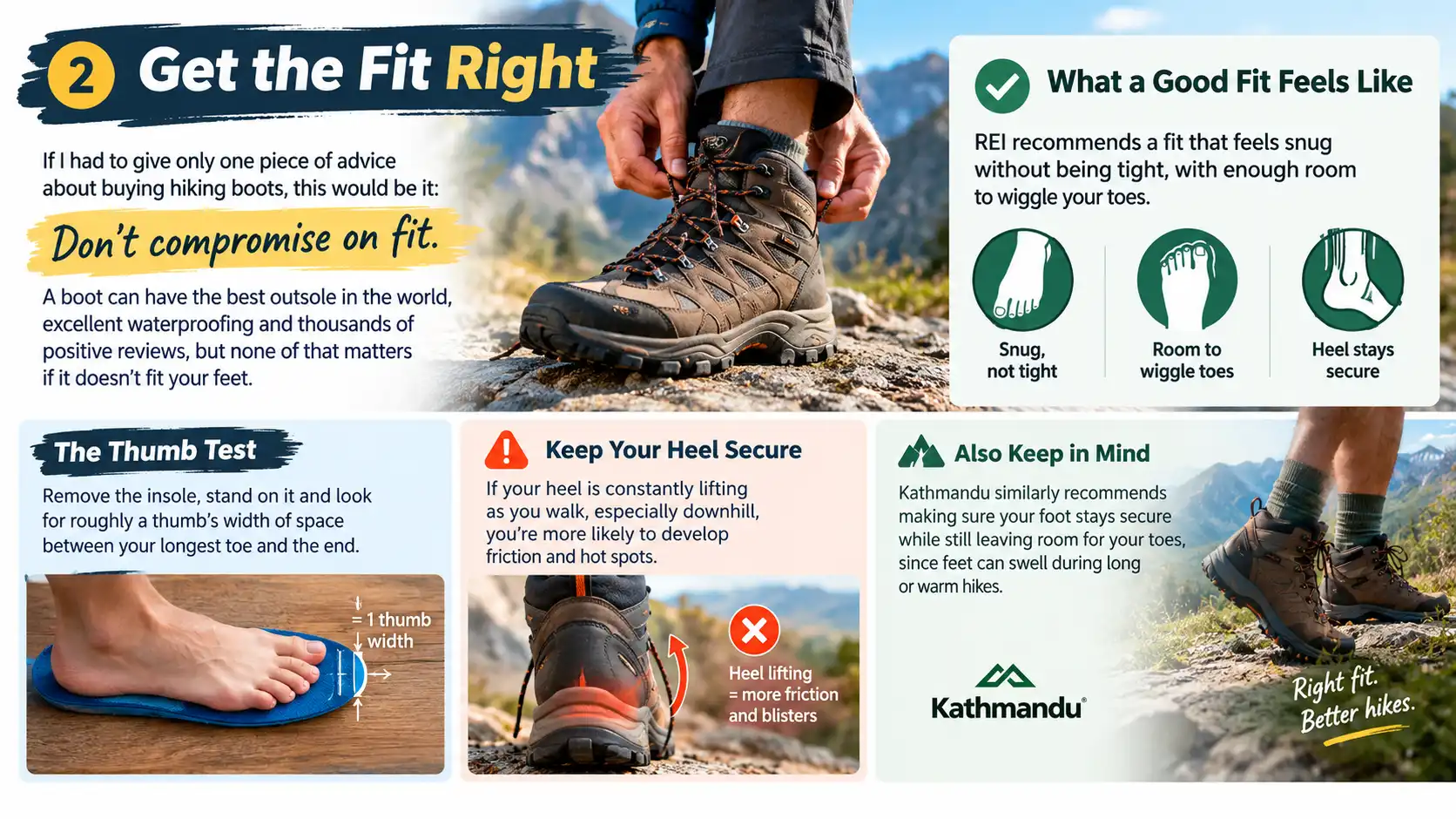
If I had to give only one piece of advice about buying hiking boots, this would be it:
Don’t compromise on fit.
A boot can have the best outsole in the world, excellent waterproofing and thousands of positive reviews, but none of that matters if it doesn’t fit your feet.
REI recommends a fit that feels snug without being tight, with enough room to wiggle your toes. A useful check is to remove the insole, stand on it and look for roughly a thumb’s width of space between your longest toe and the end.
You also want your heel to stay secure.
If your heel is constantly lifting as you walk, especially downhill, you’re more likely to develop friction and hot spots.
Kathmandu similarly recommends making sure your foot stays secure while still leaving room for your toes, since feet can swell during long or warm hikes.
Try Hiking Boots With Your Hiking Socks
This is an easy mistake to make.
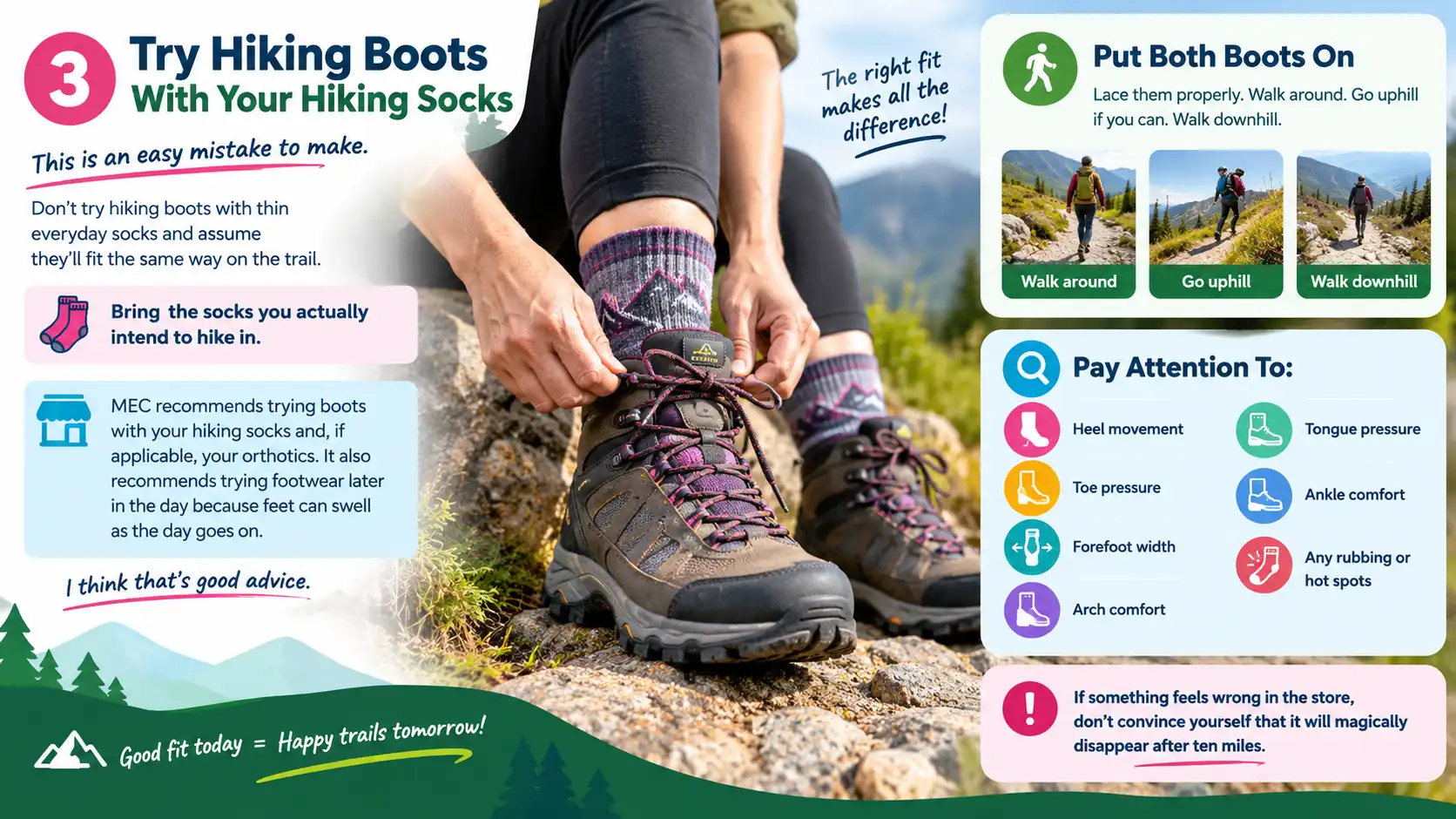
Don’t try hiking boots with thin everyday socks and assume they’ll fit the same way on the trail.
Bring the socks you actually intend to hike in.
MEC recommends trying boots with your hiking socks and, if applicable, your orthotics. It also recommends trying footwear later in the day because feet can swell as the day goes on.
I think that’s good advice.
Put both boots on. Lace them properly. Walk around. Go uphill if you can. Walk downhill.
If something feels wrong in the store, don’t convince yourself that it will magically disappear after ten miles.
Consider Your Foot Shape
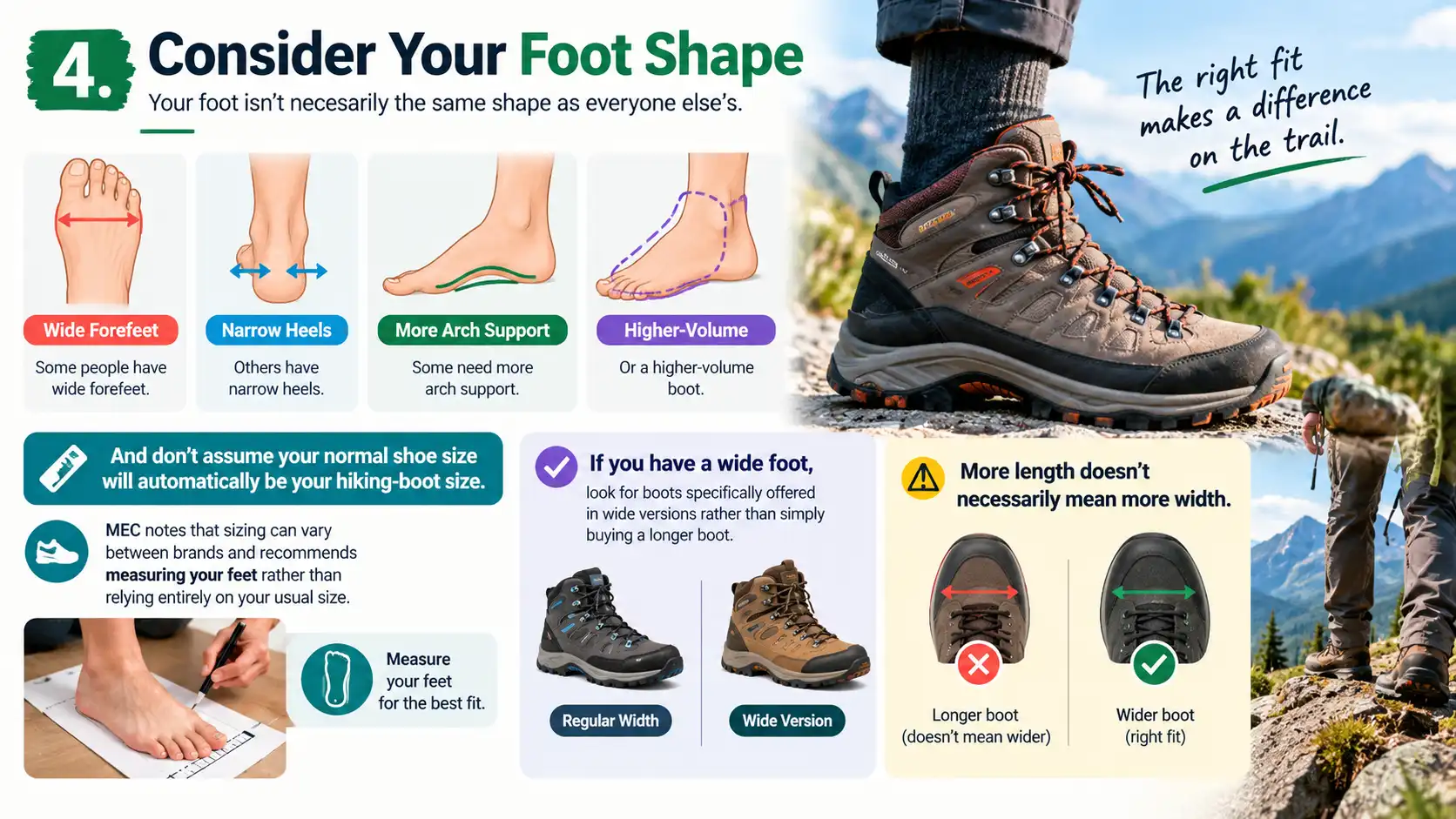
Your foot isn’t necessarily the same shape as everyone else’s.
Some people have wide forefeet. Others have narrow heels. Some need more arch support or a higher-volume boot.
And don’t assume your normal shoe size will automatically be your hiking-boot size.
MEC notes that sizing can vary between brands and recommends measuring your feet rather than relying entirely on your usual size.
If you have a wide foot, look for boots specifically offered in wide versions rather than simply buying a longer boot.
More length doesn’t necessarily mean more width.
Think About Backpack Weight
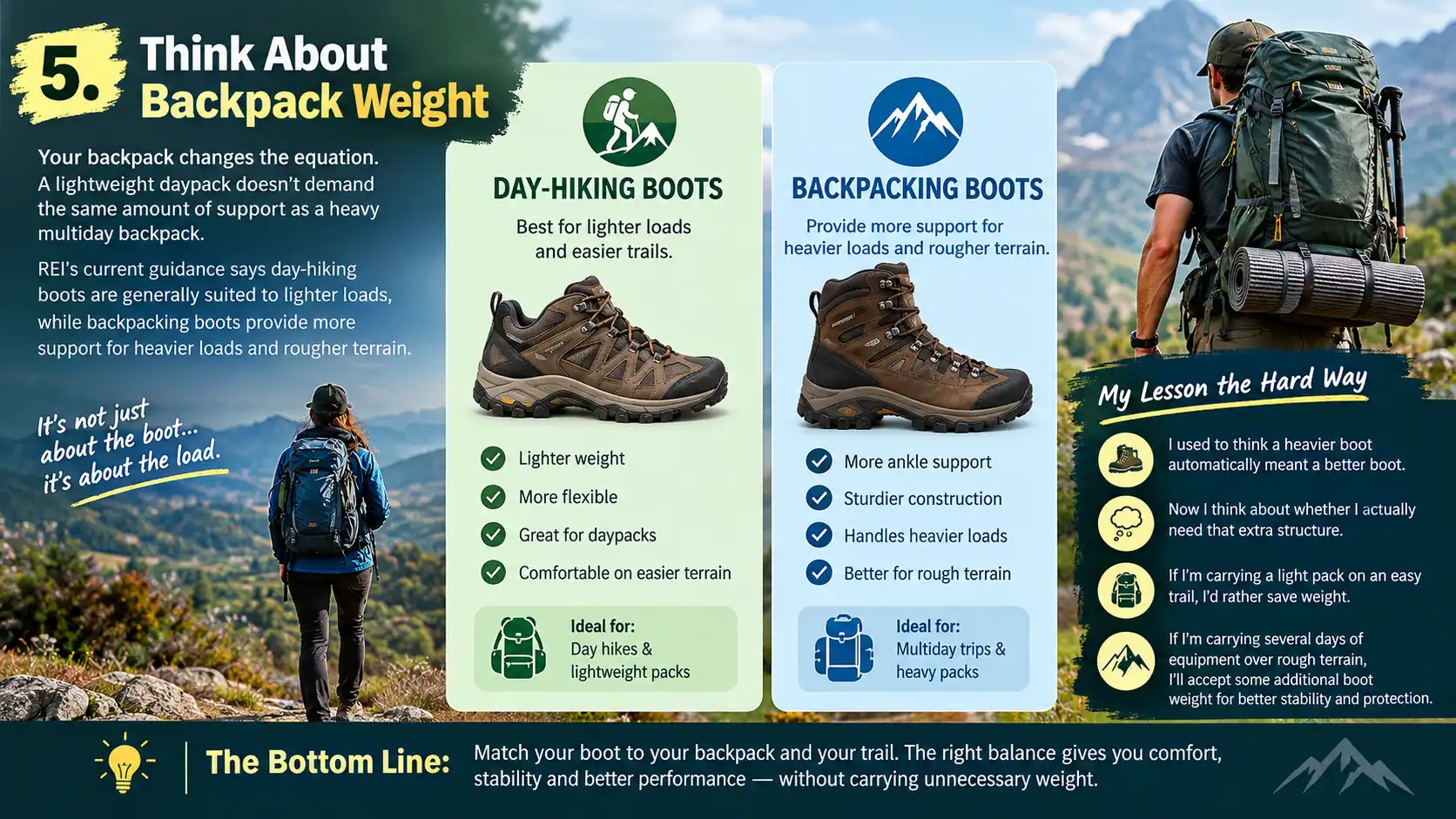
Your backpack changes the equation.
A lightweight daypack doesn’t demand the same amount of support as a heavy multiday backpack.
REI’s current guidance says day-hiking boots are generally suited to lighter loads, while backpacking boots provide more support for heavier loads and rougher terrain.
That’s something I learned the hard way.
I used to think a heavier boot automatically meant a better boot. Now I think about whether I actually need that extra structure.
If I’m carrying a light pack on an easy trail, I’d rather save weight.
If I’m carrying several days of equipment over rough terrain, I’ll accept some additional boot weight for better stability and protection.
Don’t Ignore Boot Weight
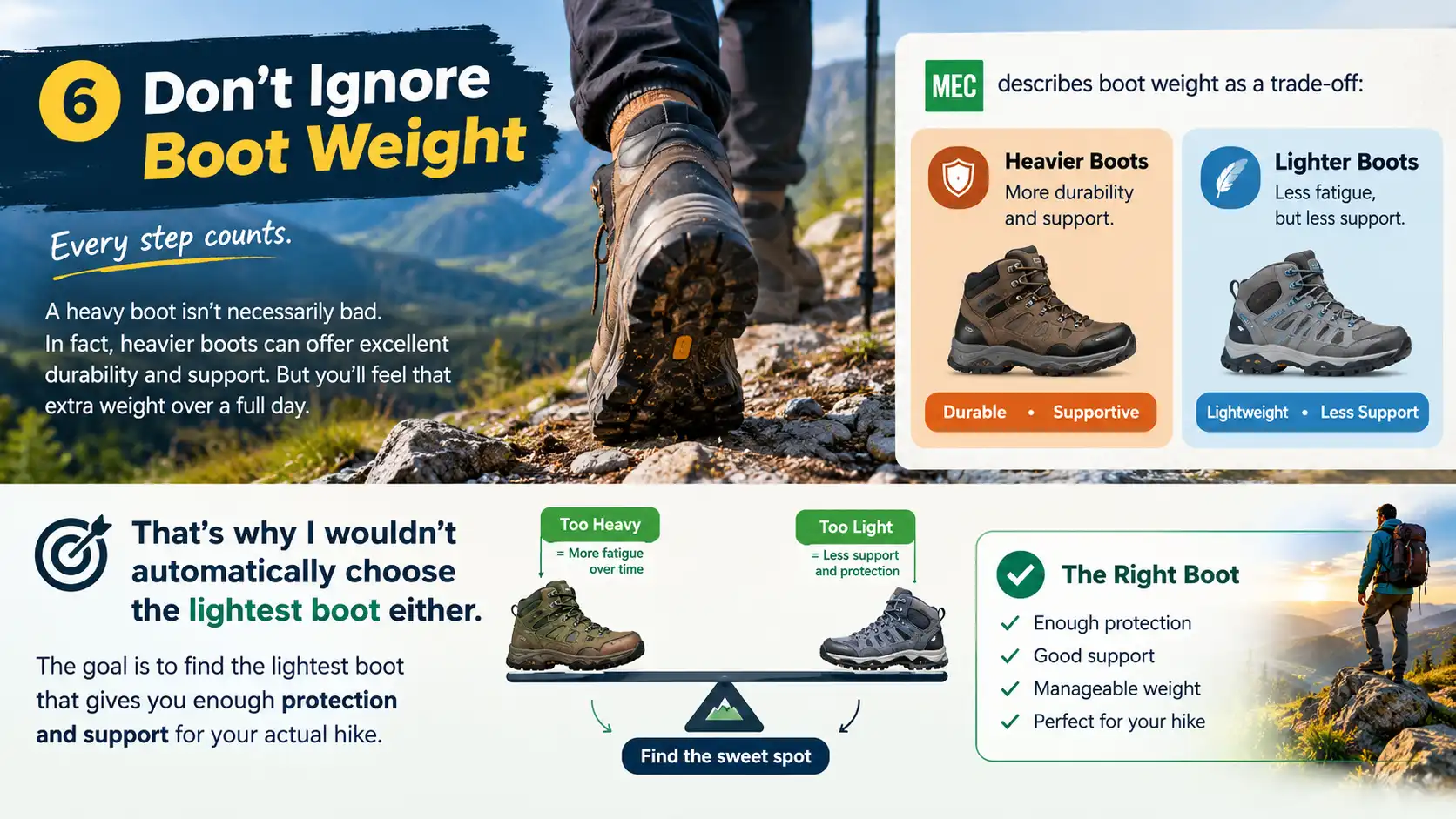
Every step counts.
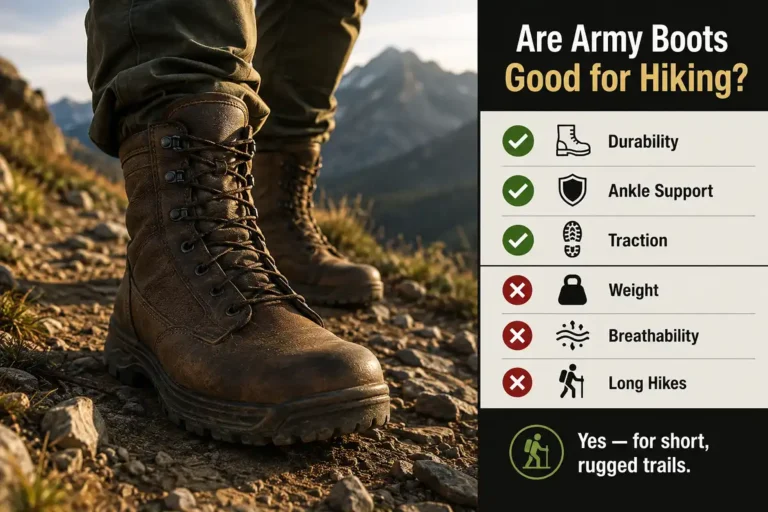
A heavy boot isn’t necessarily bad. In fact, heavier boots can offer excellent durability and support. But you’ll feel that extra weight over a full day.
MEC describes boot weight as a trade-off: heavier footwear generally provides more durability and support, while lighter footwear reduces fatigue but offers less support.
Find the lightest boot that gives you enough protection and support for your actual hike.
Waterproof vs. Breathable
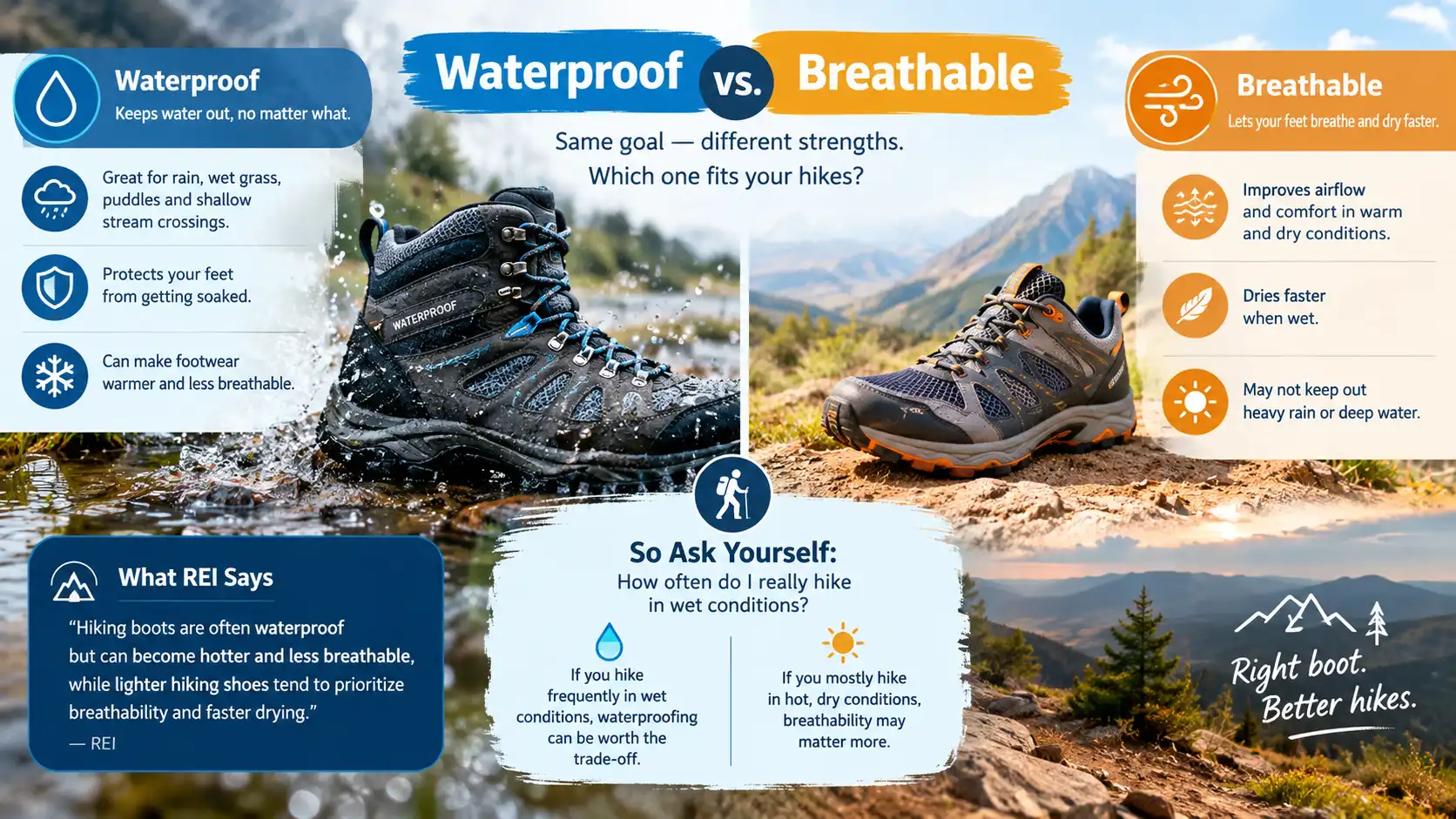
Waterproofing sounds like an automatic win.
It isn’t always.
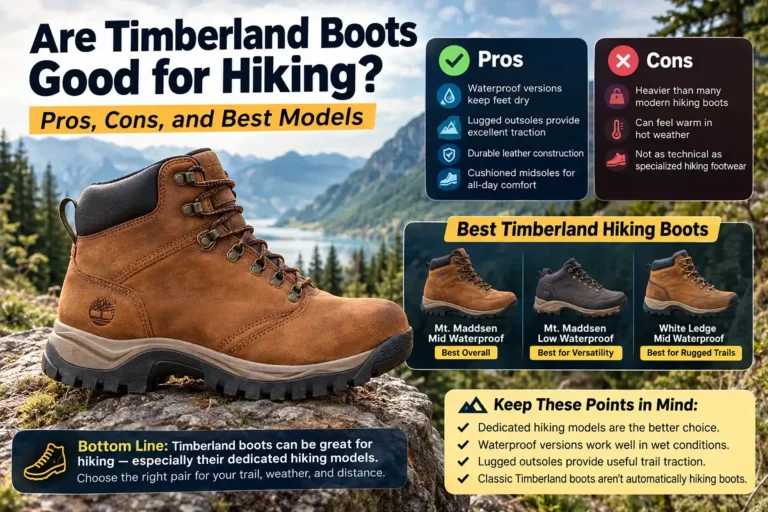
Waterproof boots can be fantastic when you’re dealing with rain, wet grass, puddles or shallow stream crossings. But waterproof membranes can also make footwear warmer and less breathable.
REI notes that hiking boots are often waterproof but can become hotter and less breathable, while lighter hiking shoes tend to prioritize breathability and faster drying.
If the answer is frequently, waterproofing can be worth the trade-off.
If you mostly hike in hot, dry conditions, breathability may matter more.
Look at the Outsole
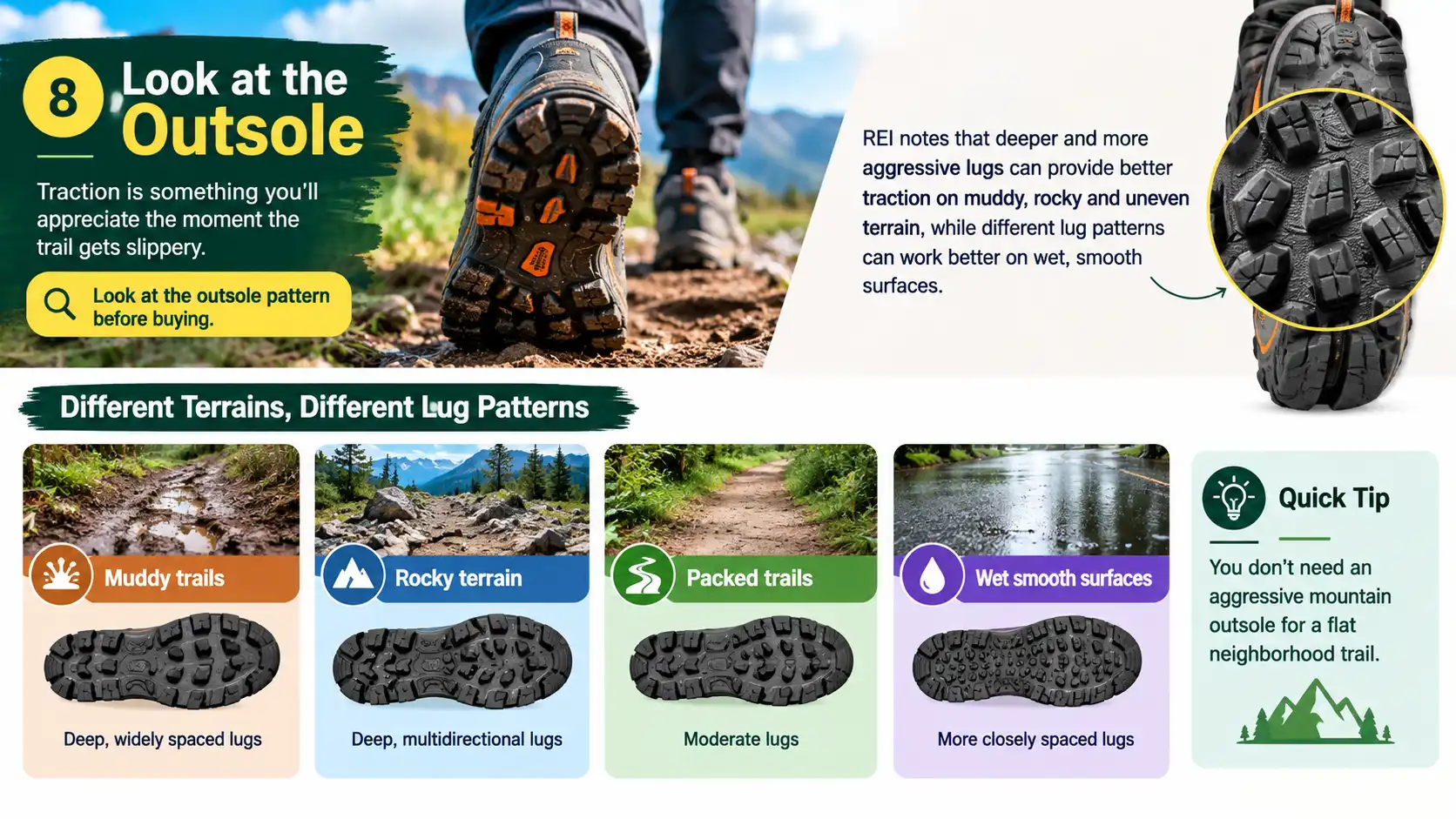
Traction is something you’ll appreciate the moment the trail gets slippery.
Look at the outsole pattern before buying.
REI notes that deeper and more aggressive lugs can provide better traction on muddy, rocky and uneven terrain, while different lug patterns can work better on wet, smooth surfaces.
You don’t need an aggressive mountain outsole for a flat neighborhood trail.
Choose the Right Upper Material
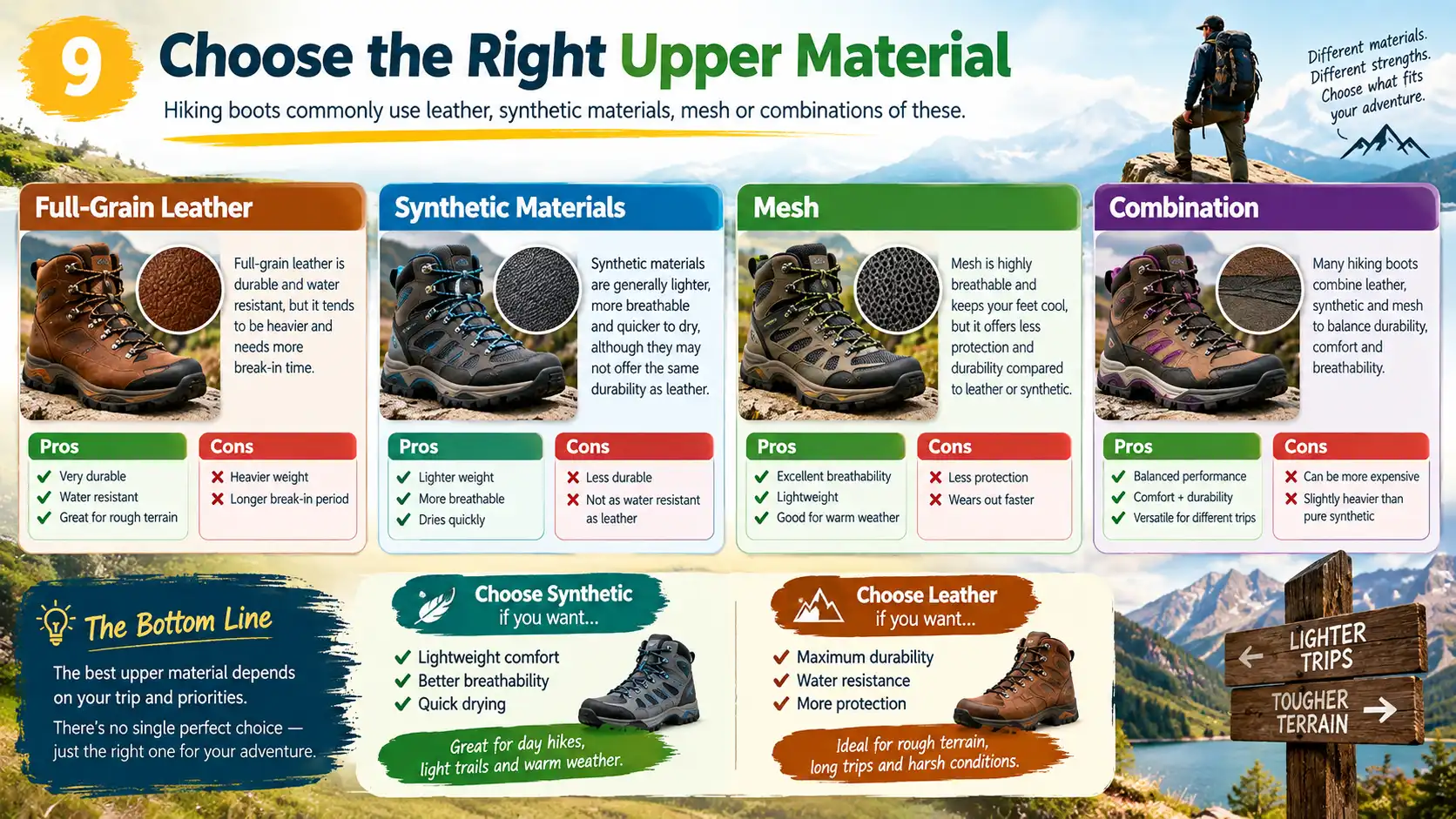
Hiking boots commonly use leather, synthetic materials, mesh or combinations of these.
Leather
Full-grain leather is durable and water resistant, but it tends to be heavier and needs more break-in time.
Synthetic
Synthetic materials are generally lighter, more breathable and quicker to dry, although they may not offer the same durability as traditional leather.
MEC and REI both highlight these trade-offs when comparing hiking-footwear materials.
For me, the choice comes down to the trip.
If I’m prioritizing lightweight comfort, synthetic materials make sense.
If I’m heading into rough terrain and care more about durability, leather becomes more appealing.
Consider Break-In Time
Not every hiking boot feels trail-ready straight out of the box. Lightweight modern footwear may need little break-in, while stiff leather or backpacking boots can require considerably more.
Start with short periods of use and gradually increase the time before taking a new pair on a major adventure.
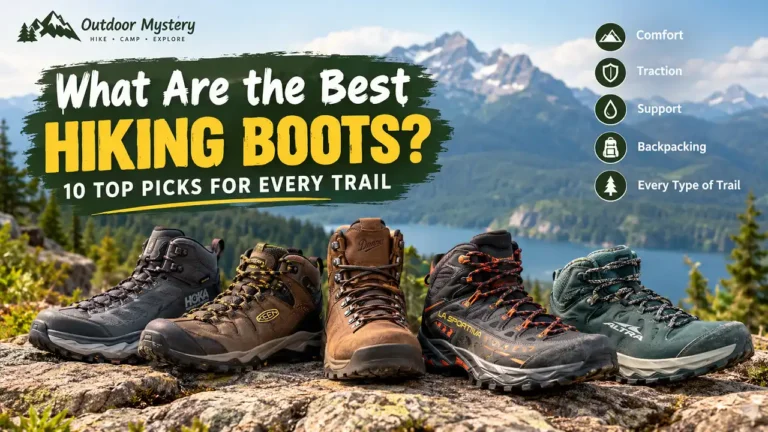
10 Best Hiking Boots to Consider
Here are 10 hiking boots worth putting on your shortlist.
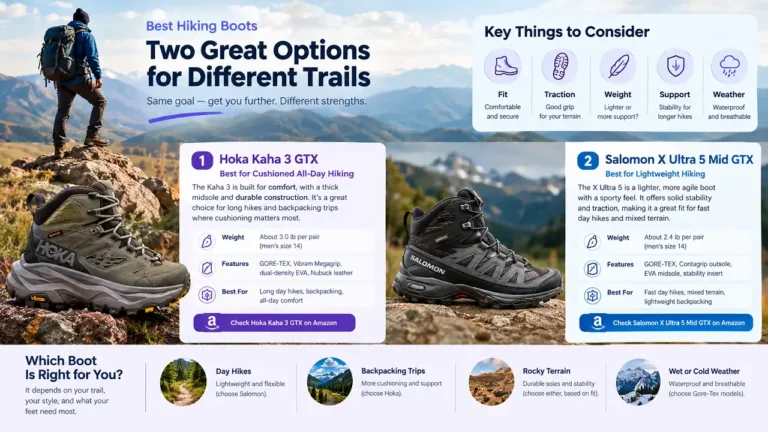
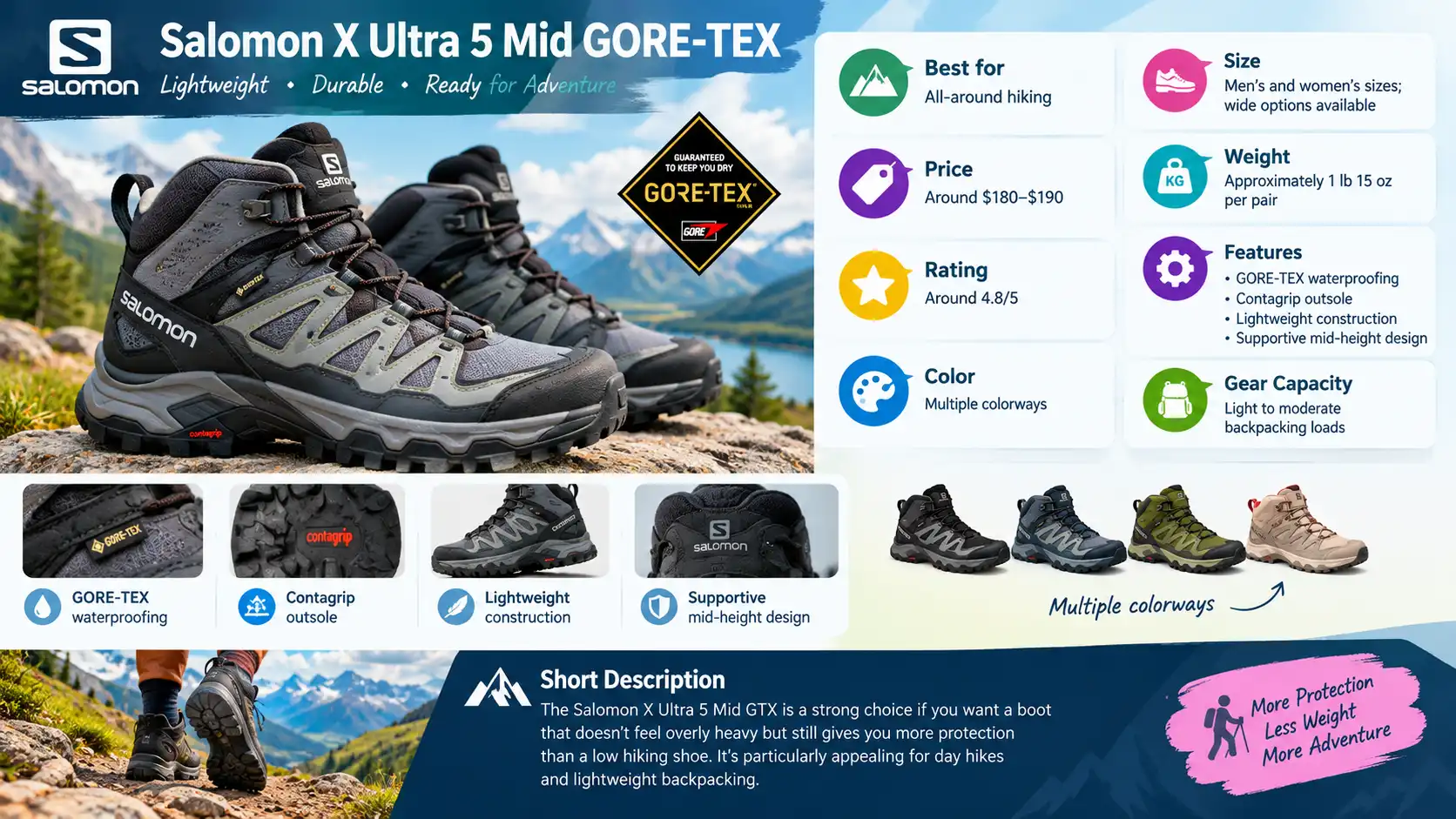
Salomon X Ultra 5 Mid GORE-TEX
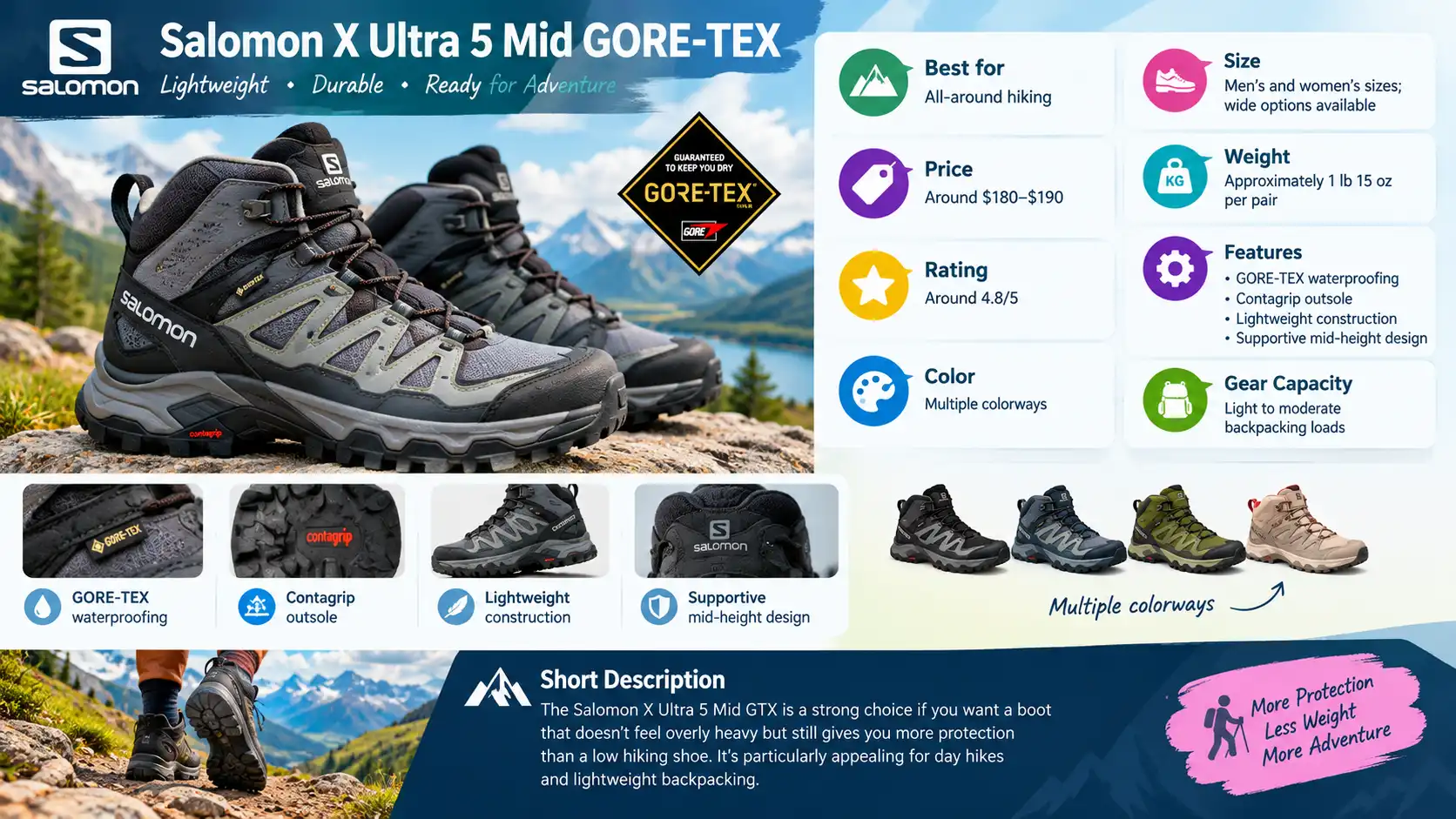
Features: GORE-TEX waterproofing, Contagrip outsole, lightweight construction, supportive mid-height design.
The Salomon X Ultra 5 Mid GTX is a strong choice if you want a boot that doesn’t feel overly heavy but still gives you more protection than a low hiking shoe. It’s particularly appealing for day hikes and lightweight backpacking.
Merrell Moab 3 Mid Waterproof
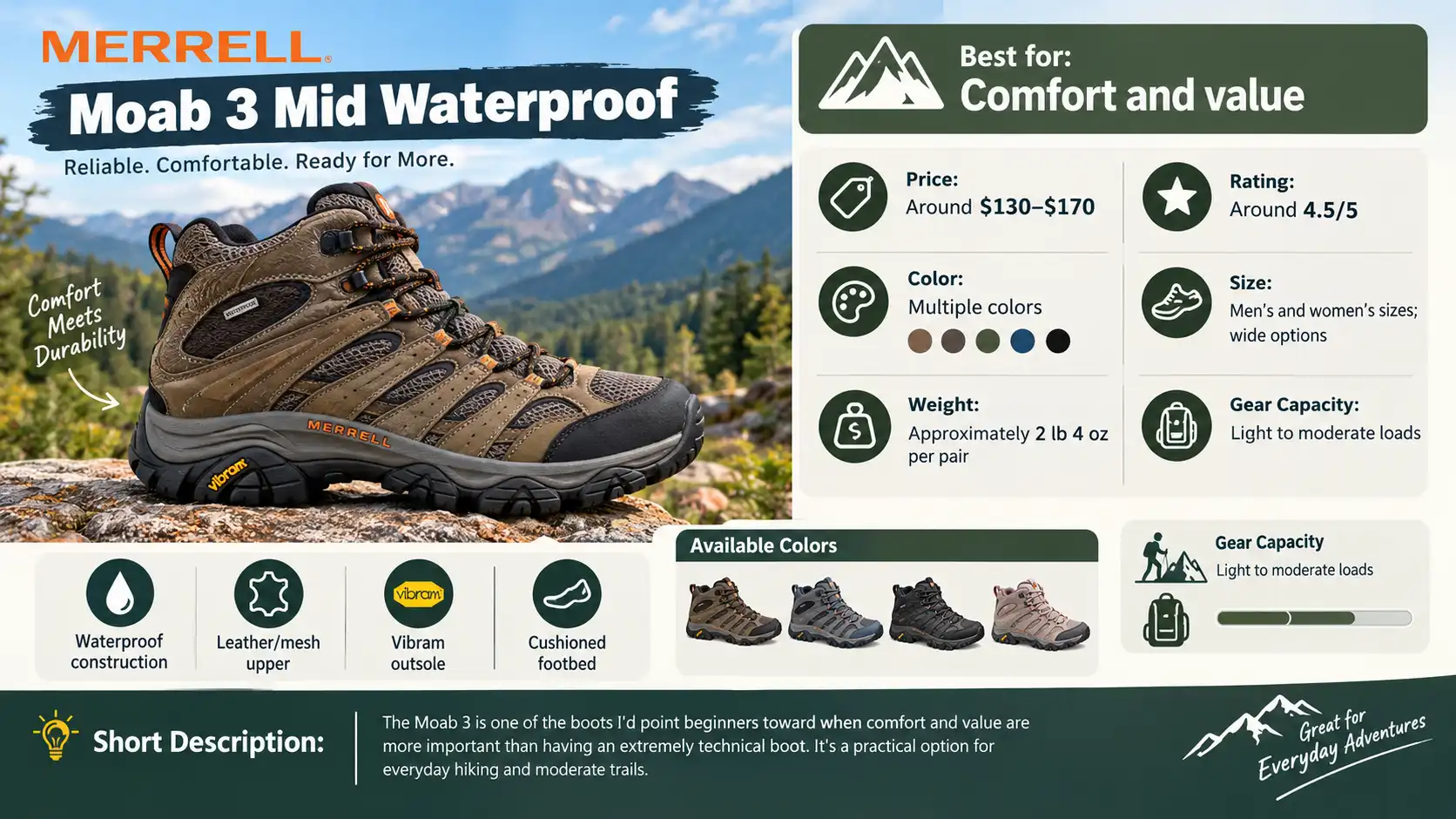
Features: Waterproof construction, leather/mesh upper, Vibram outsole, cushioned footbed.
The Moab 3 is one of the boots I’d point beginners toward when comfort and value are more important than having an extremely technical boot. It’s a practical option for everyday hiking and moderate trails.
LOWA Renegade EVO GTX Mid
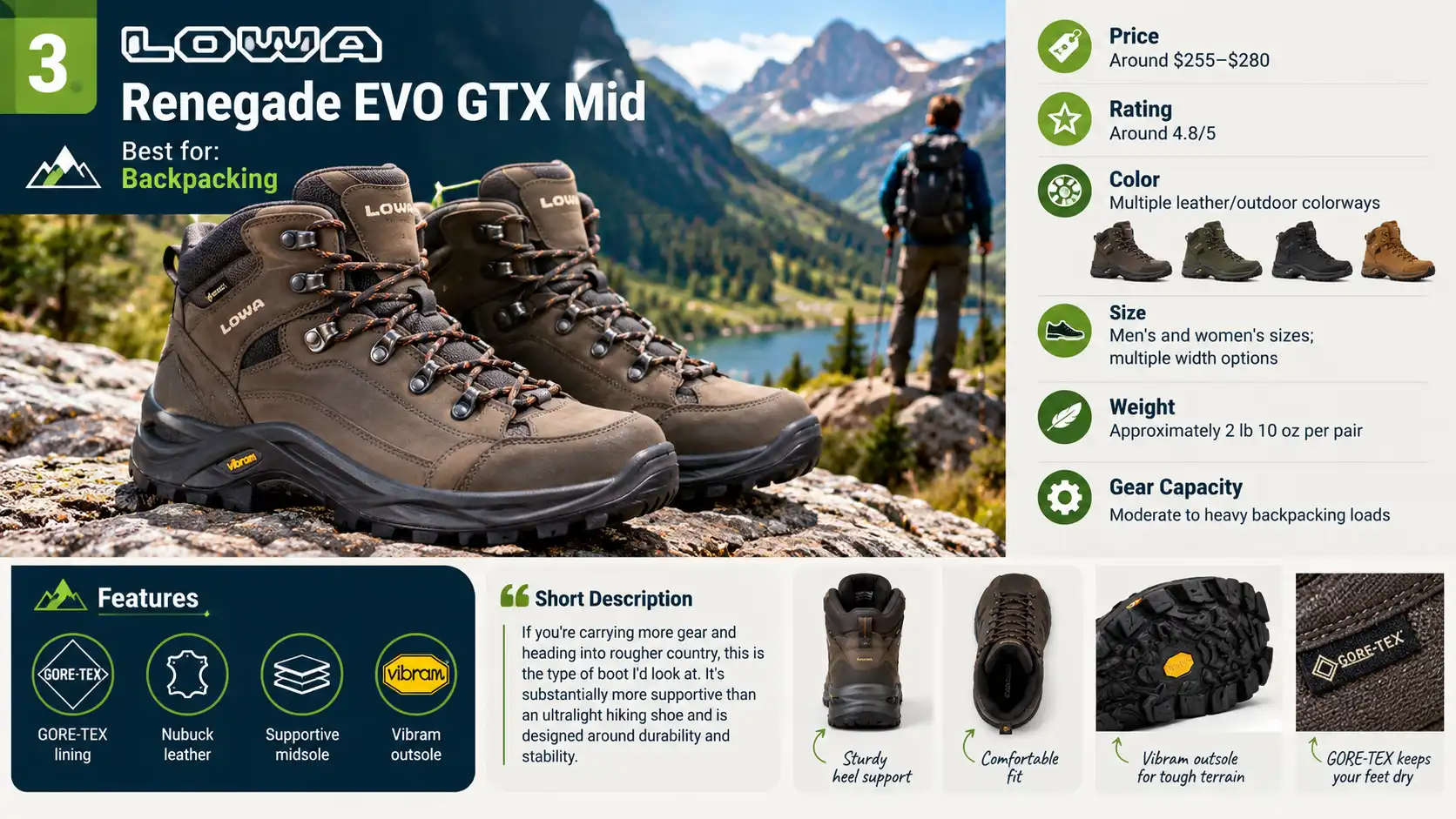
Features: GORE-TEX lining, nubuck leather, supportive midsole, Vibram outsole.
If you’re carrying more gear and heading into rougher country, this is the type of boot I’d look at. It’s substantially more supportive than an ultralight hiking shoe and is designed around durability and stability.
KEEN Targhee IV Mid Waterproof
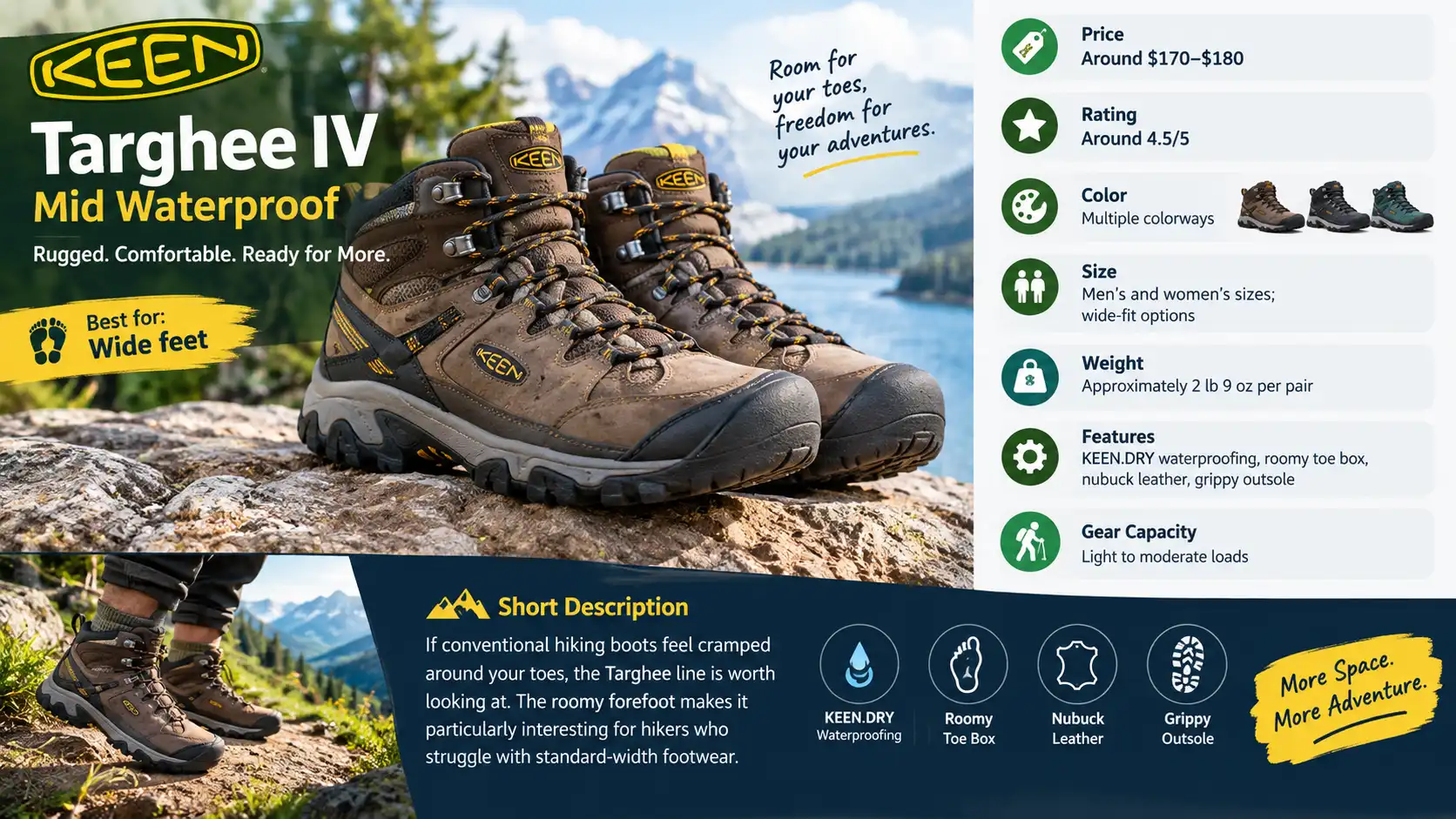
Features: KEEN.DRY waterproofing, roomy toe box, nubuck leather, grippy outsole.
If conventional hiking boots feel cramped around your toes, the Targhee line is worth looking at. The roomy forefoot makes it particularly interesting for hikers who struggle with standard-width footwear.
HOKA Anacapa 2 Mid GTX
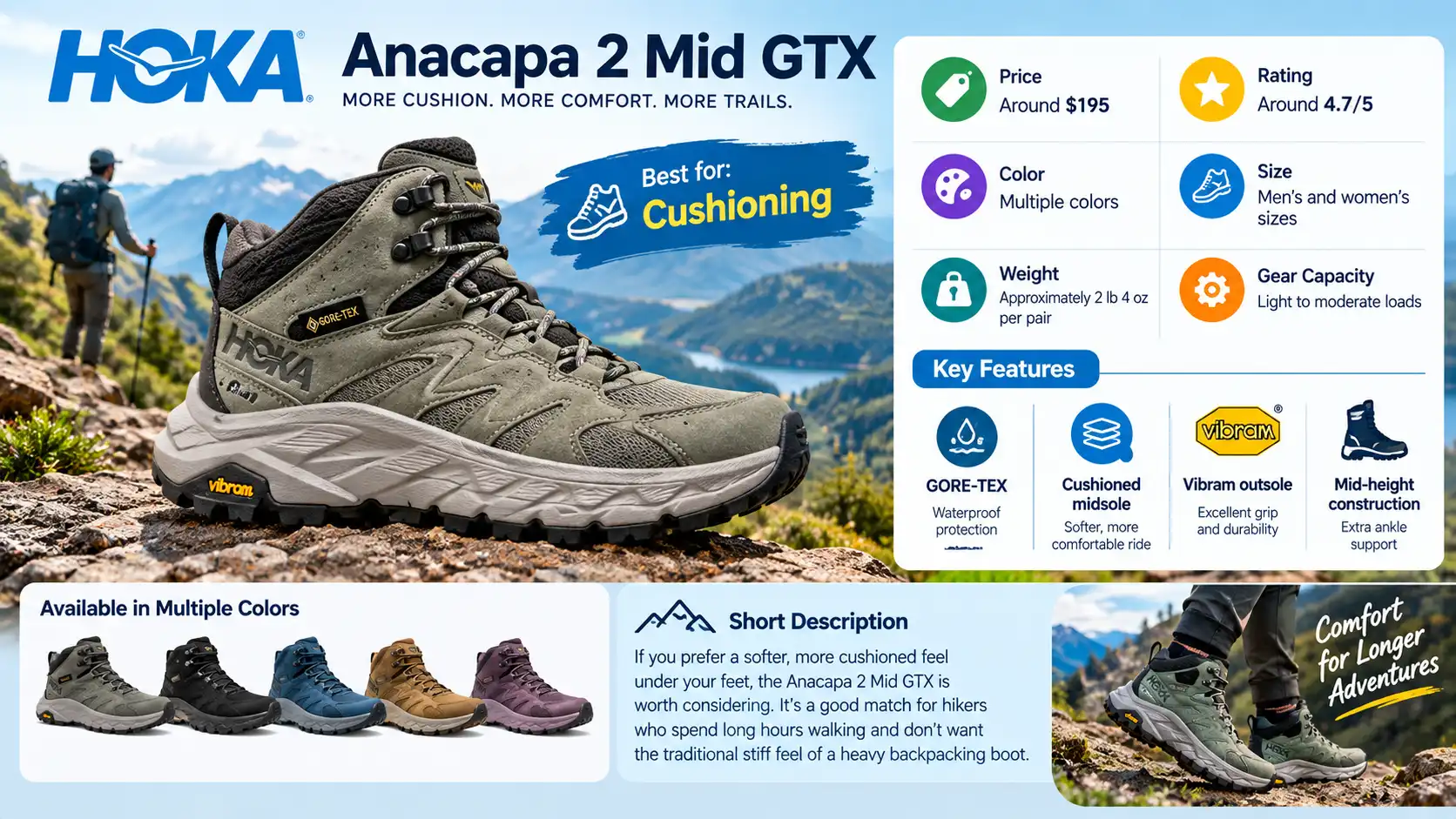
Features: GORE-TEX, cushioned midsole, Vibram outsole, mid-height construction.
If you prefer a softer, more cushioned feel under your feet, the Anacapa 2 Mid GTX is worth considering. It’s a good match for hikers who spend long hours walking and don’t want the traditional stiff feel of a heavy backpacking boot.
Salomon Quest 4 GTX
Features: GORE-TEX, strong ankle support, durable construction, aggressive outsole.
This is a boot for hikers who value stability over minimal weight. If you’re carrying a larger backpack through rough terrain, the additional structure can be worthwhile.
Oboz Katabatic LT Mid GTX
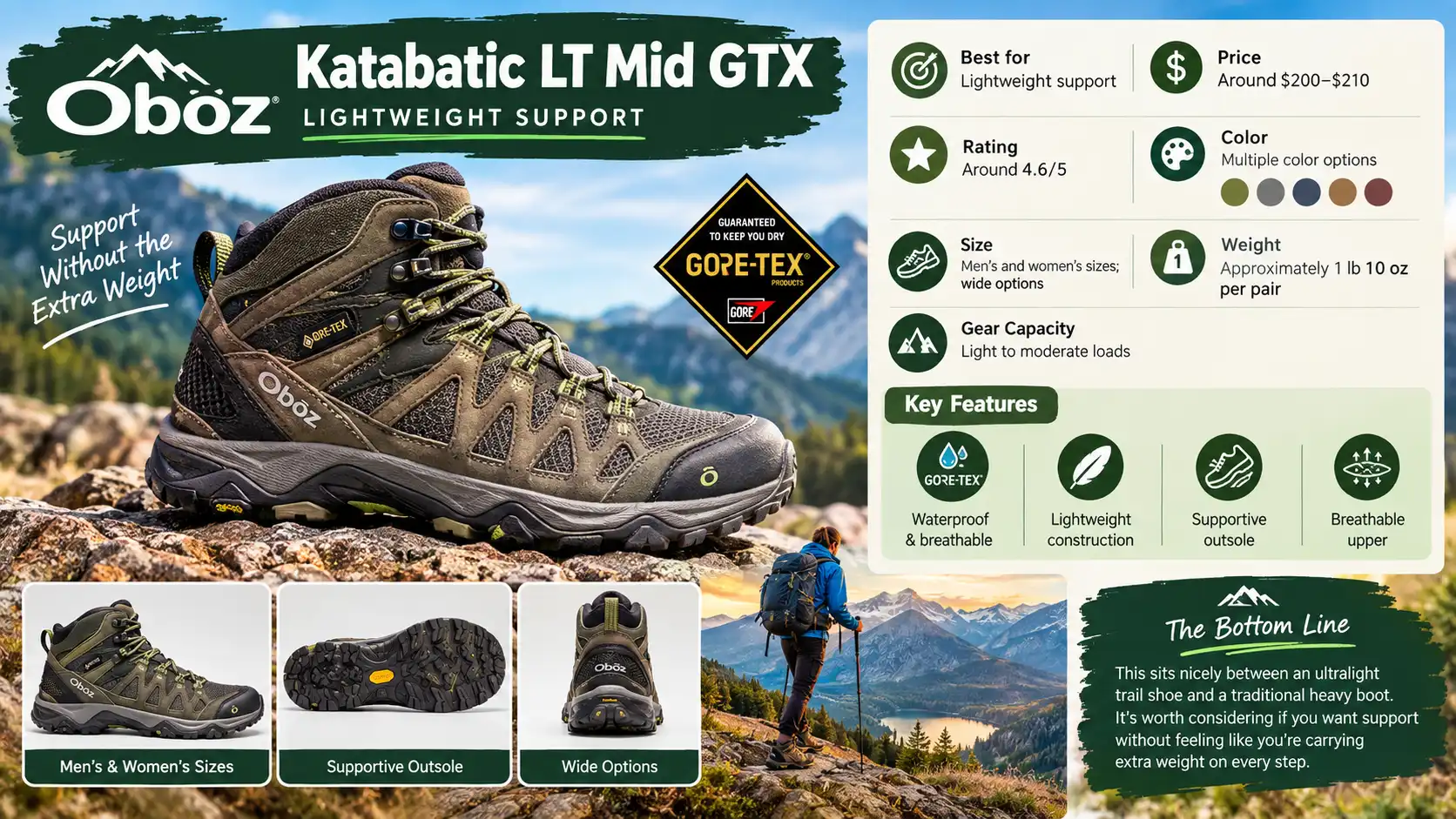
Features: GORE-TEX, lightweight construction, supportive outsole, breathable upper.
This sits nicely between an ultralight trail shoe and a traditional heavy boot. It’s worth considering if you want support without feeling like you’re carrying extra weight on every step.
La Sportiva Nucleo High II GTX
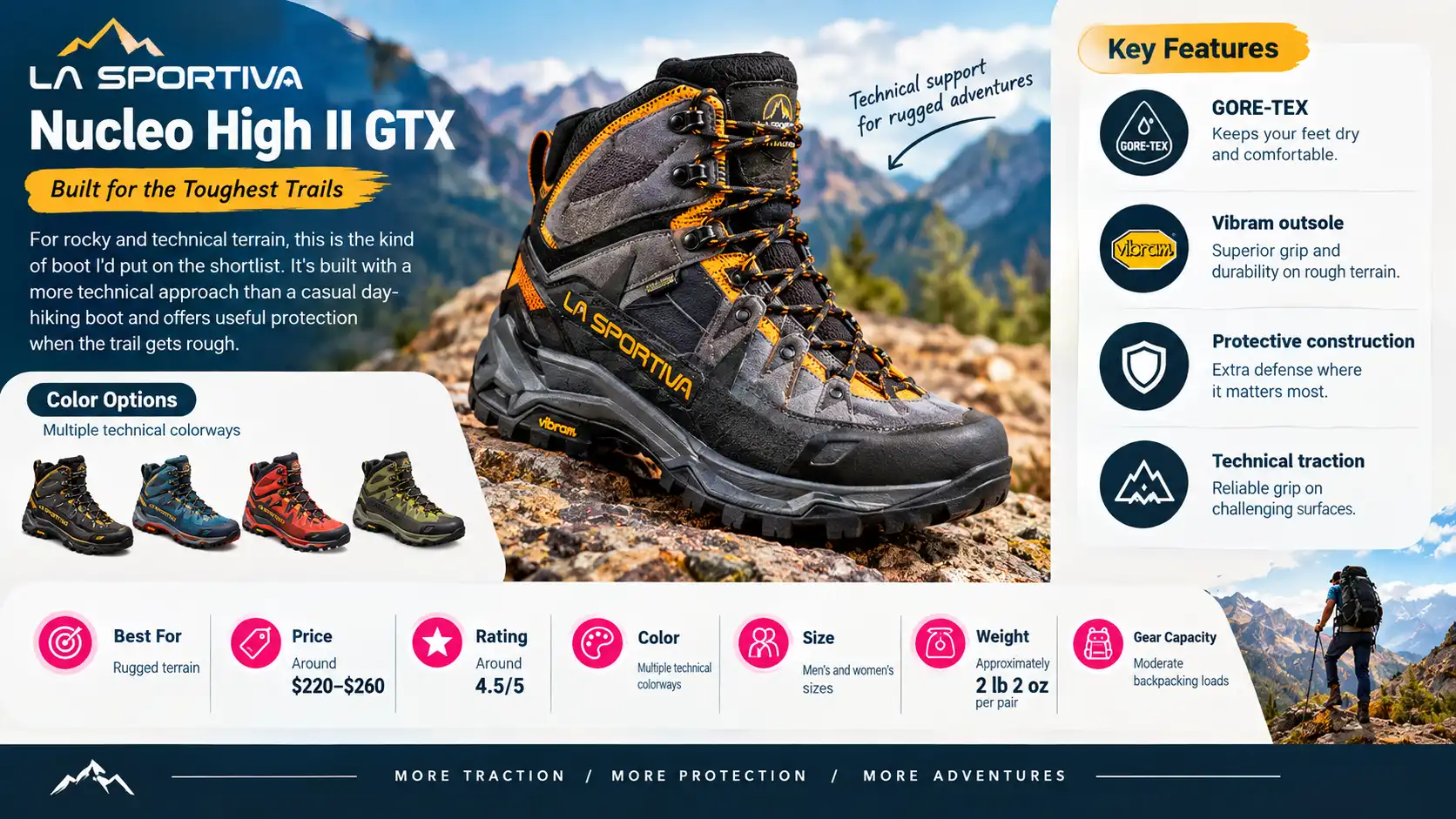
Features: GORE-TEX, Vibram outsole, protective construction, technical traction.
For rocky and technical terrain, this is the kind of boot I’d put on the shortlist. It’s built with a more technical approach than a casual day-hiking boot and offers useful protection when the trail gets rough.
Danner Mountain 600 EVO GTX
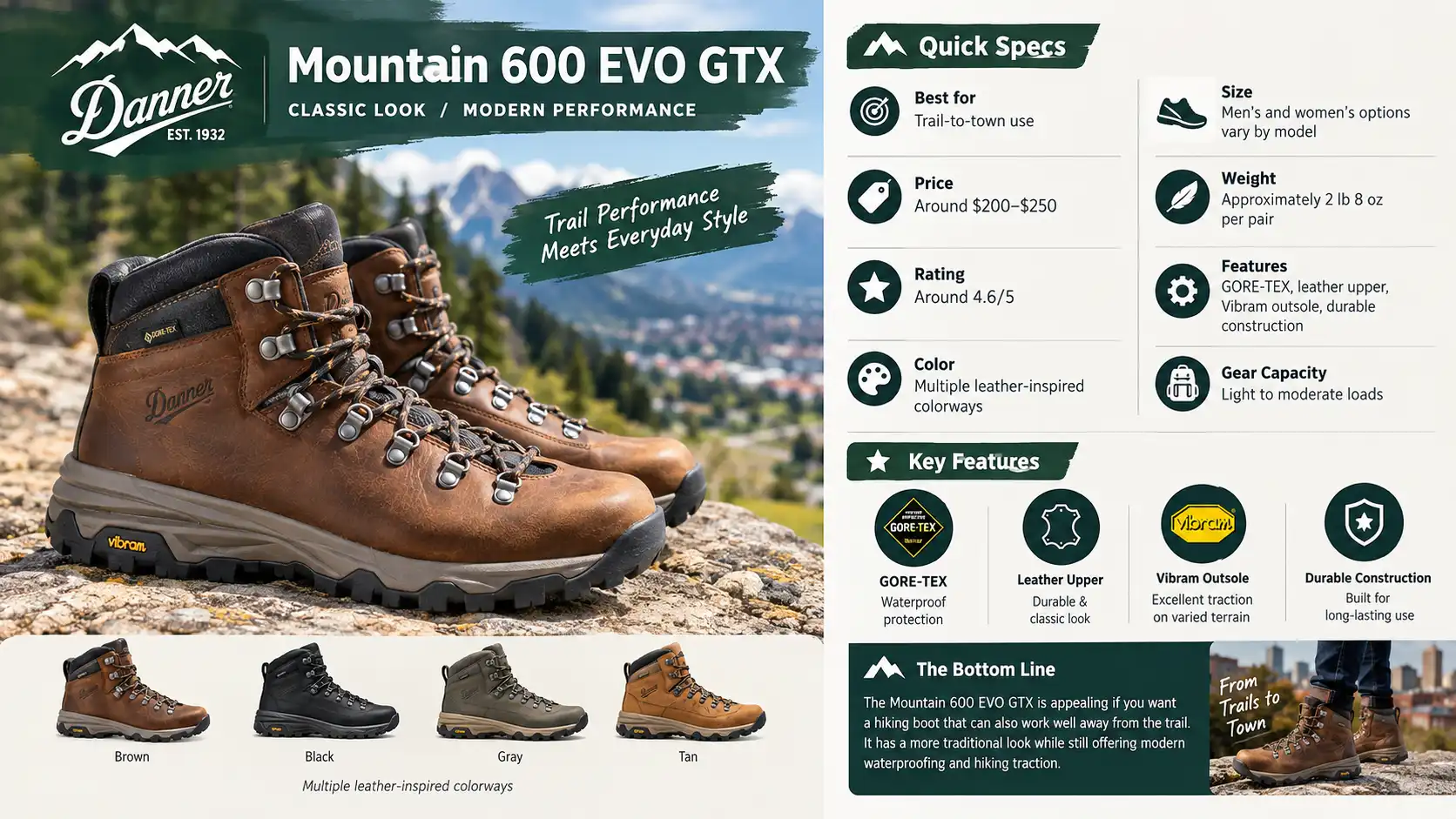
Features: GORE-TEX, leather upper, Vibram outsole, durable construction.
The Mountain 600 EVO GTX is appealing if you want a hiking boot that can also work well away from the trail. It has a more traditional look while still offering modern waterproofing and hiking traction.
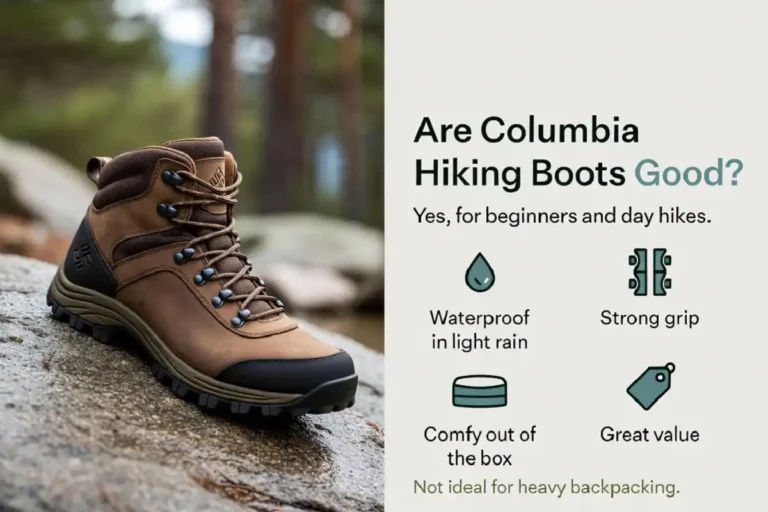
Columbia Newton Ridge Plus II Waterproof
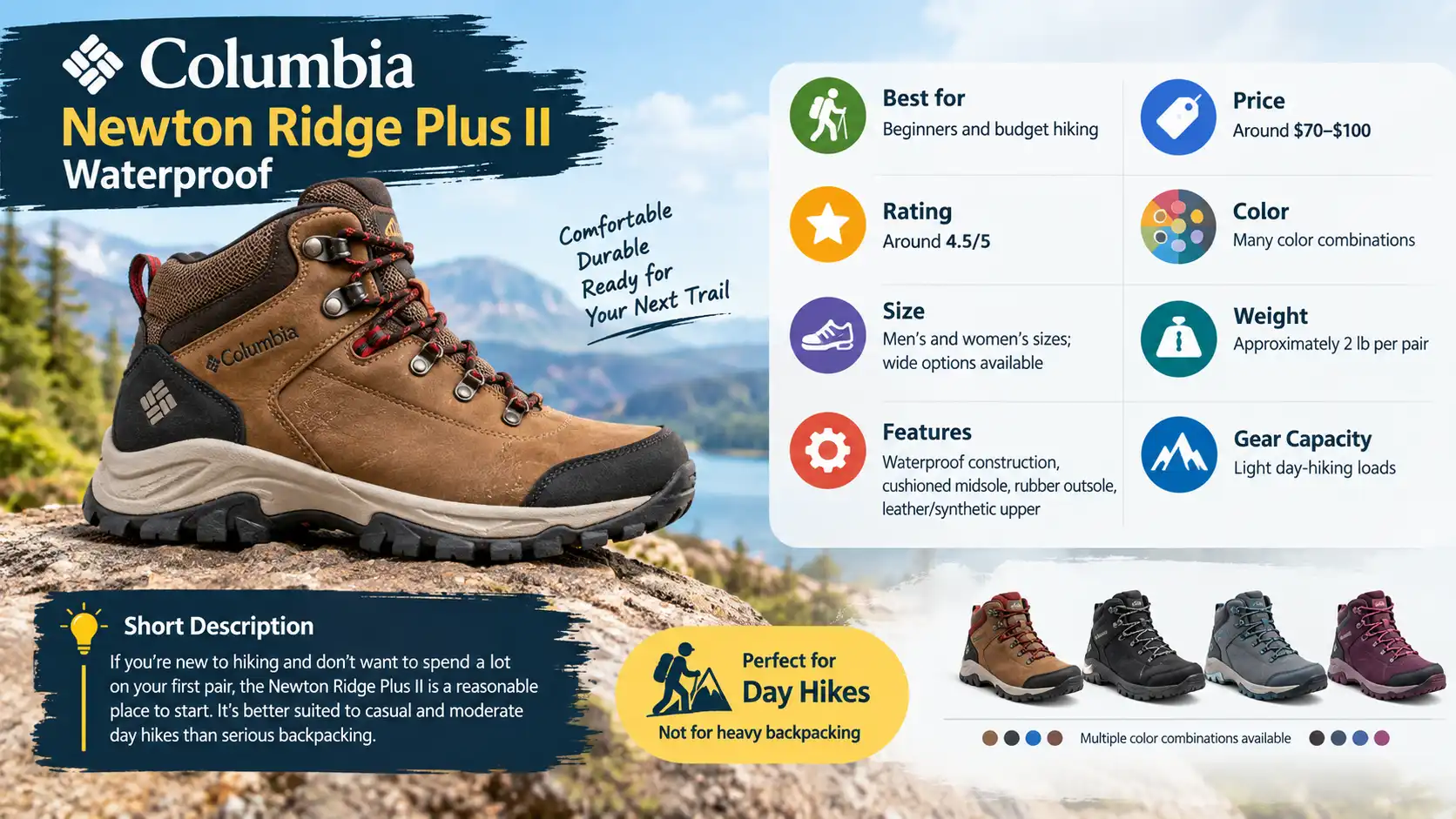
Features: Waterproof construction, cushioned midsole, rubber outsole, leather/synthetic upper.
If you’re new to hiking and don’t want to spend a lot on your first pair, the Newton Ridge Plus II is a reasonable place to start. It’s better suited to casual and moderate day hikes than serious backpacking.
Hiking Boots vs. Hiking Shoes vs. Trail Runners
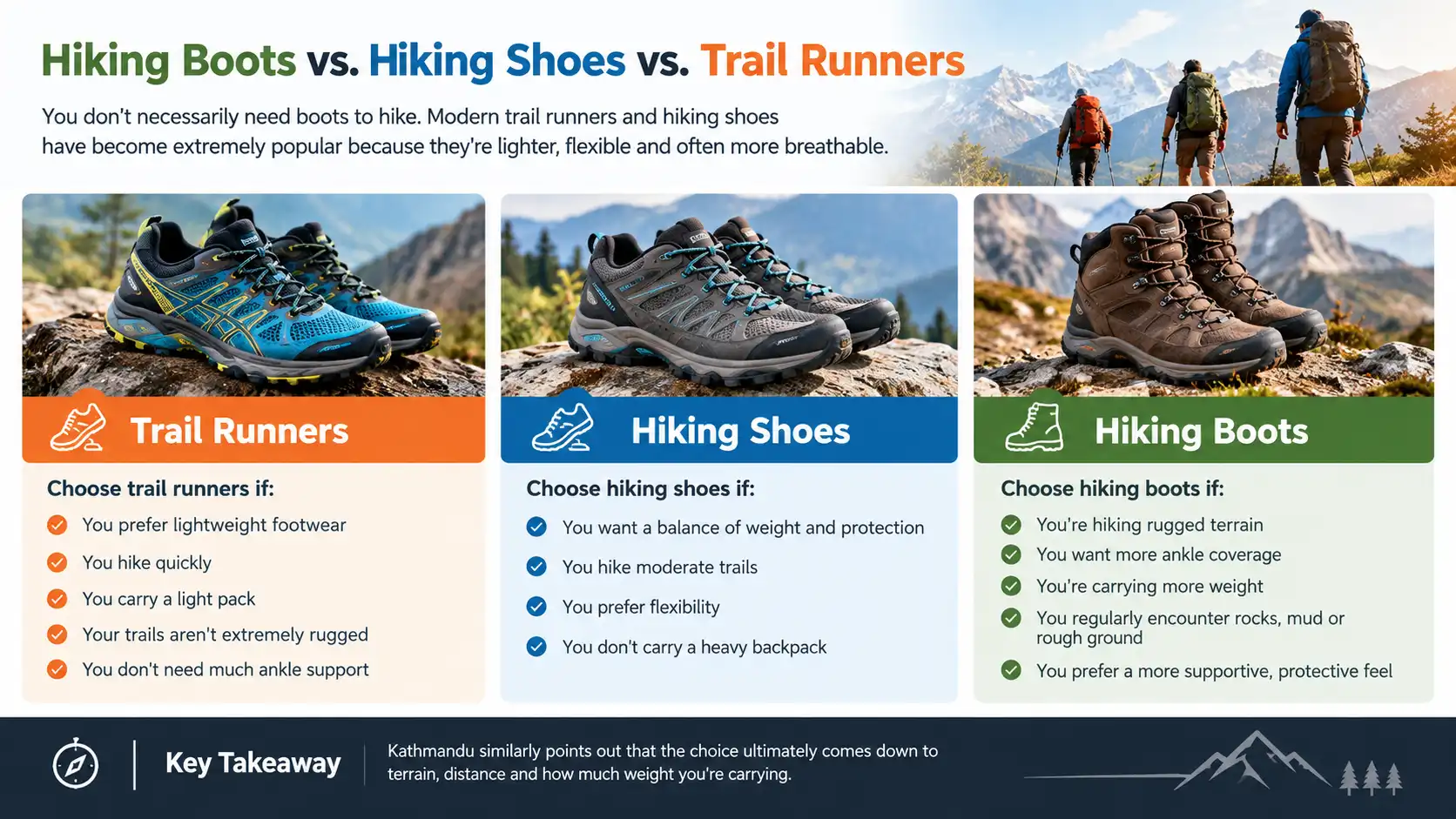
You don’t necessarily need boots to hike.
Modern trail runners and hiking shoes have become extremely popular because they’re lighter, flexible and often more breathable.
MEC notes that trail runners can be a good choice for short hikes, lightweight packs and hikers who don’t need much ankle support. Hiking shoes sit between trail runners and boots, offering more stability and protection without the full weight of a traditional boot.
Trail Runners
- You prefer lightweight footwear
- You hike quickly
- You carry a light pack
- Your trails aren’t extremely rugged
- You don’t need much ankle support
Hiking Shoes
- You want a balance of weight and protection
- You hike moderate trails
- You prefer flexibility
- You don’t carry a heavy backpack
Hiking Boots
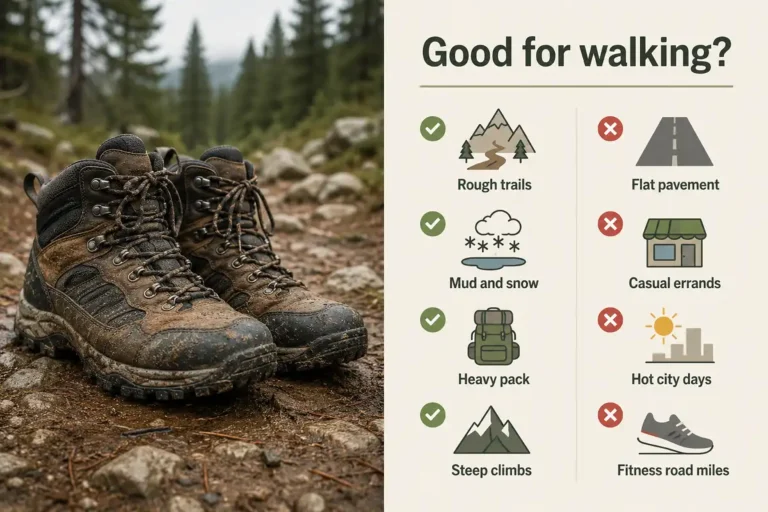
- You’re hiking rugged terrain
- You want more ankle coverage
- You’re carrying more weight
- You regularly encounter rocks, mud or rough ground
- You prefer a more supportive, protective feel
Kathmandu similarly points out that the choice ultimately comes down to terrain, distance and how much weight you’re carrying.
What I’ve Learned About Choosing Hiking Boots
After hiking and camping since 2018, I’ve stopped looking for the mythical “best hiking boot.” I don’t think it really exists.
There’s only the best boot for the hike you’re actually planning.
I’ve learned that lesson through plenty of mistakes—boots that weren’t right, packs that were too heavy, and trips where I didn’t pay enough attention to the weather. Those experiences changed how I choose gear today. I think about the whole trip now, from what I’m carrying to how the trail is likely to feel several hours in.
If you’re still figuring out your hiking setup, my guide to the 10 essentials every hiker should carry is a good place to start. Your boots are important, but they’re only one part of the kit that gets you through a long day outside.
Now, before I buy a pair of hiking boots, I ask myself a few simple questions: Where am I going? How long will I be out? What will the terrain look like? How much weight am I carrying? And, most importantly, do these boots actually fit my feet?
That’s the approach I’d recommend to you too.
If you’re mostly doing easy day hikes, you probably don’t need a massive backpacking boot. If you’re carrying a heavy pack through rocky terrain, don’t be afraid to choose something more supportive. And if you’re still deciding between boots and lighter footwear, take a look at my guide to hiking boots vs. trail runners before you buy.
I’ve also learned that the rest of your gear can change how your footwear feels. A badly packed or unnecessarily heavy bag can make a perfectly good pair of boots feel much worse after a few miles. If you’re working on keeping your load under control, my guide to choosing the best backpack for hiking and travel may help.
For me, that’s what good outdoor gear is all about—not buying the most expensive equipment, but choosing something that makes the time outside easier, safer, and more comfortable.
I’ve made enough rookie mistakes over the years that I don’t want to repeat them, and hopefully you don’t have to either.
For a little more background on what hiking boots are designed to do and how the footwear category has evolved, the Wikipedia guide to hiking boots is a useful general reference.
FAQs
What should I look for when buying hiking boots?
Start with fit, terrain, hiking distance, backpack weight, traction and weather conditions. Comfort and fit should come before brand or appearance.
Should hiking boots be tight or loose?
They should feel secure but not tight. Your toes need enough room to move, while your heel should remain relatively secure.
Should hiking boots be waterproof?
Not necessarily. Waterproof boots are useful in wet conditions, but non-waterproof footwear can be more breathable and may dry faster.
Are heavier hiking boots better?
Not automatically. Heavy boots can provide additional support and durability, but lightweight footwear can reduce fatigue.
How much room should be in hiking boots?
A commonly recommended check is roughly a thumb’s width between your longest toe and the end of the insole when you’re standing on it.
Should I wear thick socks with hiking boots?
Wear the socks you actually plan to hike in. The important thing is that the boot still fits comfortably with those socks.
How long does it take to break in hiking boots?
It depends on the boot. Lightweight modern footwear may need little break-in, while stiff leather or backpacking boots can require considerably more. Start with short periods and gradually increase use.
Can I use hiking boots for backpacking?
Yes, provided they’re designed for the terrain and load you’re carrying. Heavier backpacking loads generally benefit from more supportive footwear.