Approach Shoes vs Hiking Boots for Climbing: Which One Actually Belongs on Your Feet?
You’re standing in the gear shop, staring at two very different pairs of footwear, and your upcoming trip doesn’t care which one you pick—it just wants you to get it right. That’s the real challenge behind the approach shoes vs hiking boots for climbing debate. One is low, light, and grippy enough to stick to a granite slab. The other is tall, sturdy, and built to carry you (and a heavy pack) over miles of rough ground without your ankle giving out.
Neither shoe is “better” in a vacuum. Picking between approach shoes vs hiking boots for climbing really comes down to terrain, load, and how much technical rock stands between you and your objective. This guide breaks down exactly how the two categories differ, where hiking shoes fit into the picture, and how to match your footwear to the adventure you’re actually planning.
Approach Shoes or Hiking Boots?
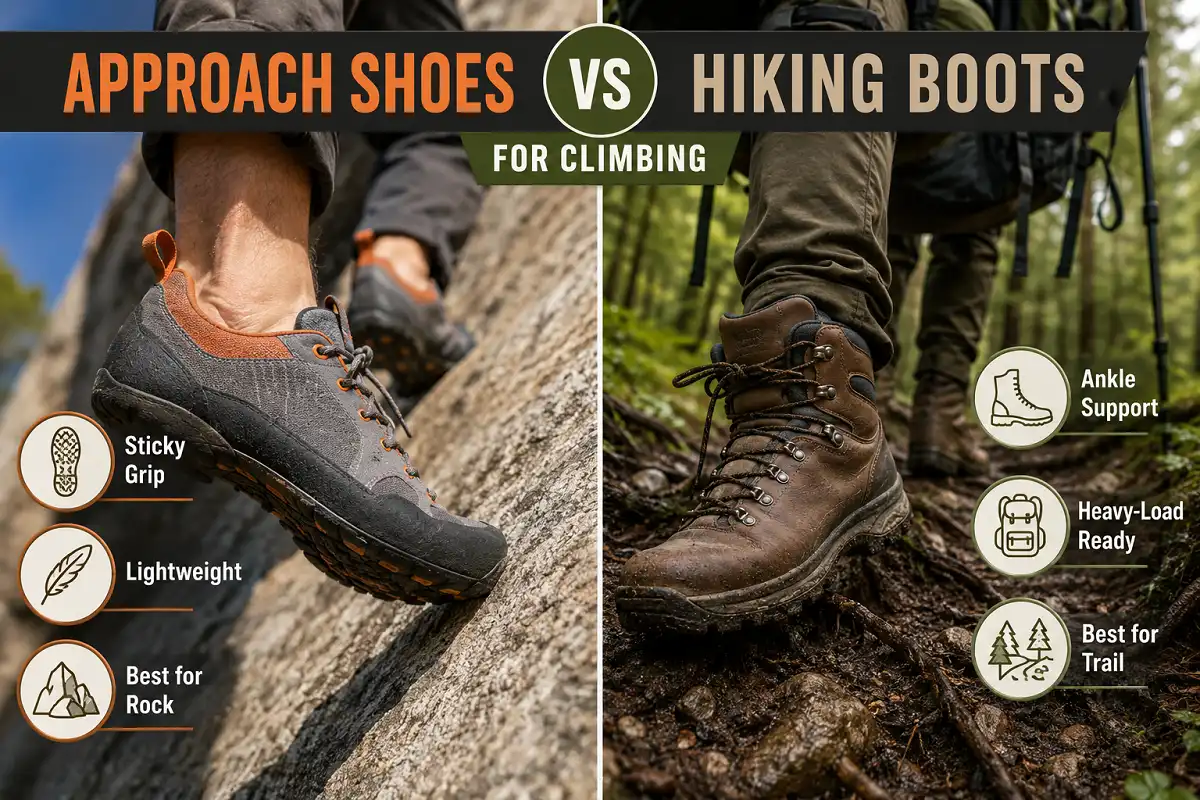
Choose approach shoes when technical rock, scrambling, and precise grip matter most. Choose hiking boots when you’re carrying a heavy pack or covering long stretches of rough, wet, or uneven terrain.
Low, agile footwear designed for climbing approaches and technical rock.
Tall, supportive footwear built for rough trails, long distances, and heavy loads.
Approach shoes use softer sticky rubber for confident movement on rock.
Hiking boots provide better support and cushioning when carrying serious weight.
The right choice depends on terrain, weather, pack weight, and technical difficulty.
What Are Approach Shoes?
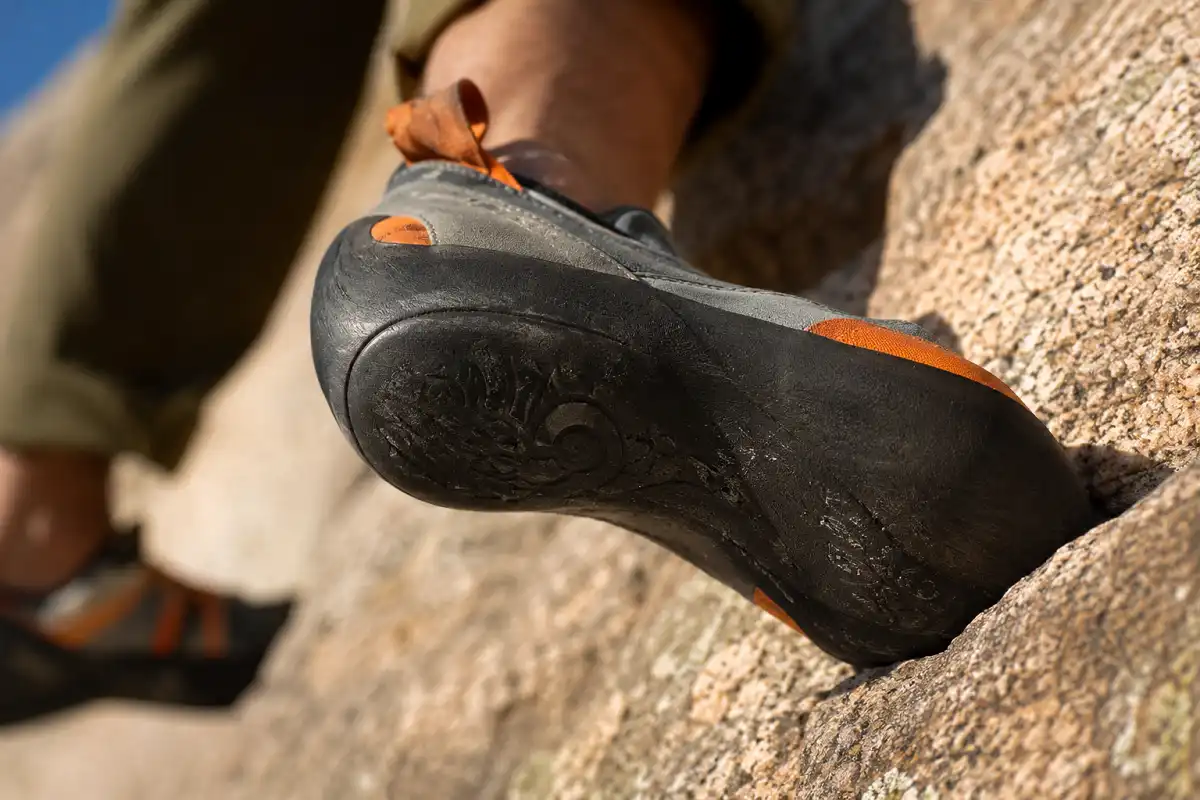
Approach shoes were born in the rock-climbing world, designed to get climbers from the trailhead to the base of a route—the “approach” over scrambly, technical ground. In the approach shoes vs hiking boots for climbing conversation, approach shoes represent the climbing-first end of the spectrum, built specifically for confidence on rock rather than comfort under a heavy pack.
The defining feature is a soft, sticky rubber outsole, similar in spirit to what’s used on dedicated climbing shoes. Many models also build in a “climbing zone”: a smooth patch of rubber under the toe designed for smearing and standing on tiny footholds. Because that sticky rubber compound is softer than what you’ll find on a typical hiking shoe, it grips rock far more confidently—but it also wears down faster.
Low-Profile, Flat Sole
Unlike the curved, rockered sole of a hiking shoe, most approach shoes have a flatter platform that channels power straight into your toes for precise footwork.
Light and Flexible
They’re generally lighter than hiking boots and much more responsive underfoot, closer in feel to a beefed-up trail runner.
Reinforced Toe Rand
A wraparound rubber rand protects the front of the shoe when you’re jamming your foot into cracks or scrambling over talus.
Minimal Ankle Support
The trade-off for that low, agile profile is little to no support above the ankle.
Climbing-Oriented Construction
Some approach shoes lean stiffer for edging, while softer models are designed for smearing on low-angle rock.
Some approach shoes lean stiffer, favoring “edging” (standing precisely on small ledges), while softer models are built for “smearing,” where you trust your weight to friction alone on low-angle rock. If you climb multi-pitch routes, you’ll also notice many approach shoes include a fabric loop for clipping them to your harness—handy when you need to swap into climbing shoes partway up.
What Are Hiking Boots?

On the other side of the approach shoes vs hiking boots for climbing question sits the hiking boot—the workhorse built to carry weight, absorb miles, and protect your feet from whatever the terrain throws at them, whether that’s roots, scree, mud, or water.
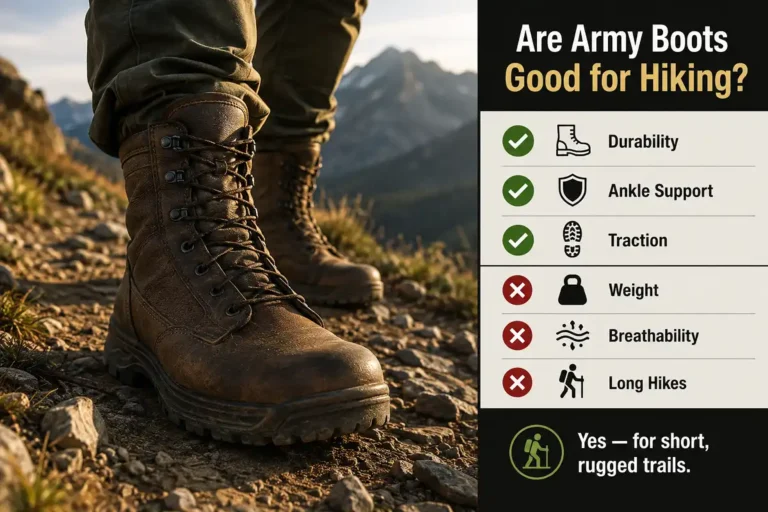
The most obvious difference is height: hiking boots rise above the ankle, and that extra material is doing real work. It restricts unwanted ankle movement, which matters most when you’re tired, carrying a loaded pack, or crossing uneven ground where a rolled ankle is one bad step away.
Full-grain leather or rugged synthetics stand up to abrasion, scuffs, and impact, often paired with reinforced toe caps and heel counters.
Extra cushioning soaks up shock over long distances, helping your feet feel fresher after a long day.
The tread is designed to bite into mud, dirt, and loose gravel rather than stick to rock.
Hiking boots more commonly include waterproof membranes that help keep feet dry on wet trails.
Between a lightweight approach shoe and a full-height mountaineering boot sits a third category worth knowing about: the hiking shoe. Think of it as a hiking boot that’s been cut down below the ankle—still durable and well-cushioned, but lighter and cooler than a full boot, without quite the same support.
Approach Shoes vs Hiking Boots for Climbing: The Key Differences
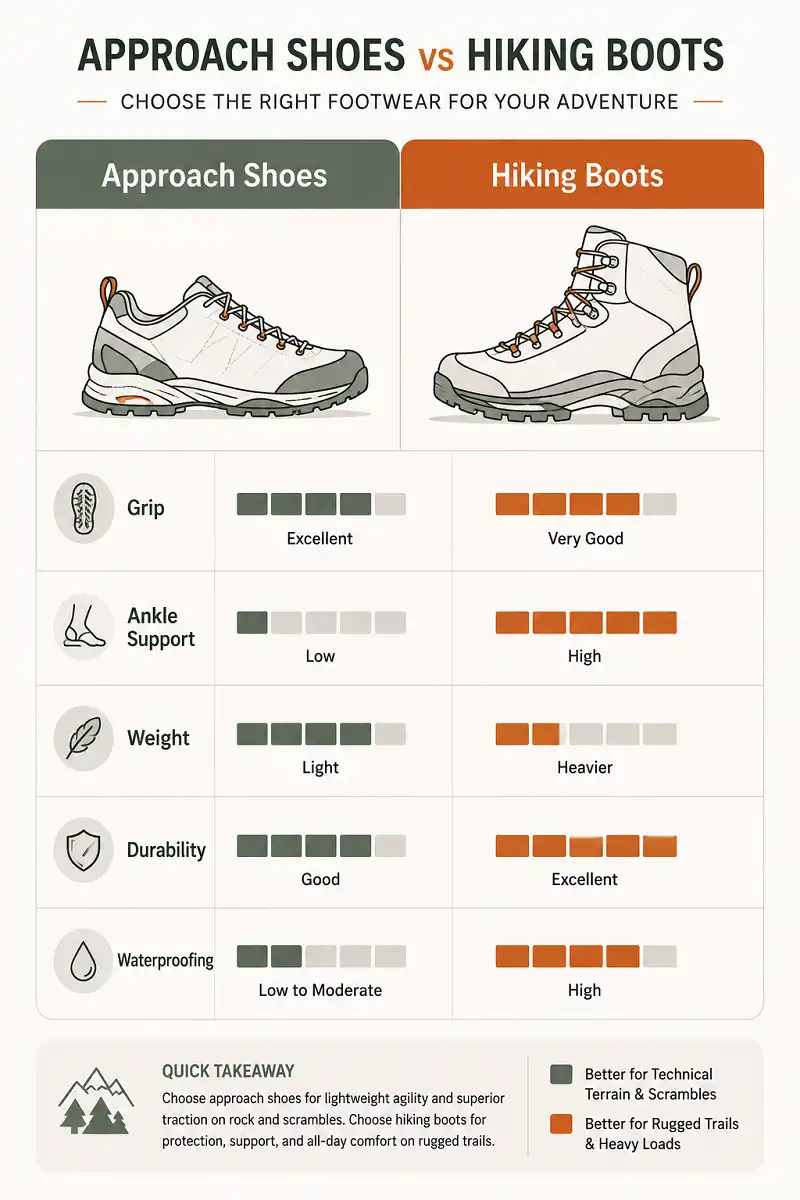
Here’s how the two options in the approach shoes vs hiking boots for climbing comparison actually stack up side by side.
Approach Shoes
- Best for: Scrambling, climbing approaches, light technical trails
- Ankle support: Minimal
- Outsole: Sticky rubber
- Flexibility: High
- Weight: Generally lighter
- Durability: Rubber wears faster
- Waterproofing: Less common
- Typical price: $160–$230
Hiking Boots
- Best for: Backpacking, rough terrain, heavy loads
- Ankle support: High
- Outsole: Deep lugs
- Flexibility: Moderate to stiff
- Weight: Generally heavier
- Durability: Long-lasting
- Waterproofing: More common
- Typical price: $130–$250+
Grip and Traction
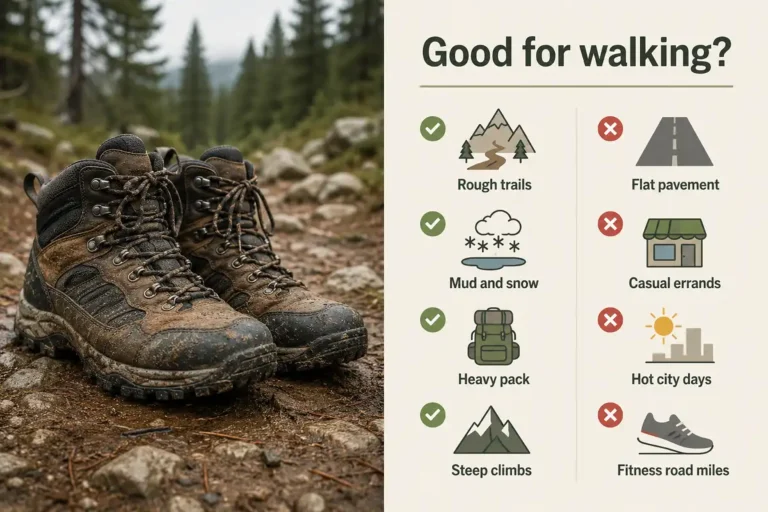
Grip is usually the deciding factor in the approach shoes vs hiking boots for climbing decision. Approach shoes use a softer rubber compound—the same idea behind soft tires that grip a race track better than hard ones—so they cling to granite slabs, scree, and rocky scrambles in a way hiking boots simply can’t match. Flip the terrain to mud, loose dirt, or a rain-soaked trail, though, and hiking boots take the lead thanks to their deeper, more aggressive lug pattern.
Rock or Mud?
Rock = approach shoes. Sticky rubber gives them the advantage on slabs, talus, and technical scrambling.
Mud and loose dirt = hiking boots. Deep lugs provide better bite and traction.
Ankle Support and Stability
Hiking boots win decisively here. The higher collar limits side-to-side ankle movement, which becomes increasingly important as your pack gets heavier or the trail gets rockier. Approach shoes offer next to nothing in this department—they’re built assuming you have good balance and a light load, not a 40-pound pack on an uneven descent.
Weight and Flexibility
Approach shoes tend to be lighter and more flexible, letting your foot move more naturally and giving you better sensitivity for precise footwork. That flexibility is a liability on long, flat miles with a heavy pack, though, which is exactly where a stiffer hiking boot shines.
Durability and Materials
Hiking boots are built to last, often for years of hard trail use, thanks to tougher rubber and reinforced construction. Approach shoes trade some of that longevity for grip—the softer rubber that sticks so well to rock also wears out faster. The upside is that many approach shoes, like climbing shoes, can be resoled once the tread wears thin.
Waterproofing
Neither category is automatically waterproof; it comes down to whether the shoe includes a membrane like Gore-Tex. Hiking boots are far more likely to have one built in, since they’re designed for extended exposure to wet trail conditions. Approach shoes often skip it entirely, since climbers typically head out only in fair weather.
Approach Shoes vs Hiking Shoes vs Hiking Boots
Since “hiking footwear” isn’t really one category, here’s a quick side-by-side of all three so you can see where each one sits on the spectrum—and where the approach shoes vs hiking boots for climbing comparison actually leaves room for a middle option.
Approach Shoes
Hiking Shoes
Hiking Boots
Choosing Between Approach Shoes and Hiking Boots for Climbing on Different Terrain
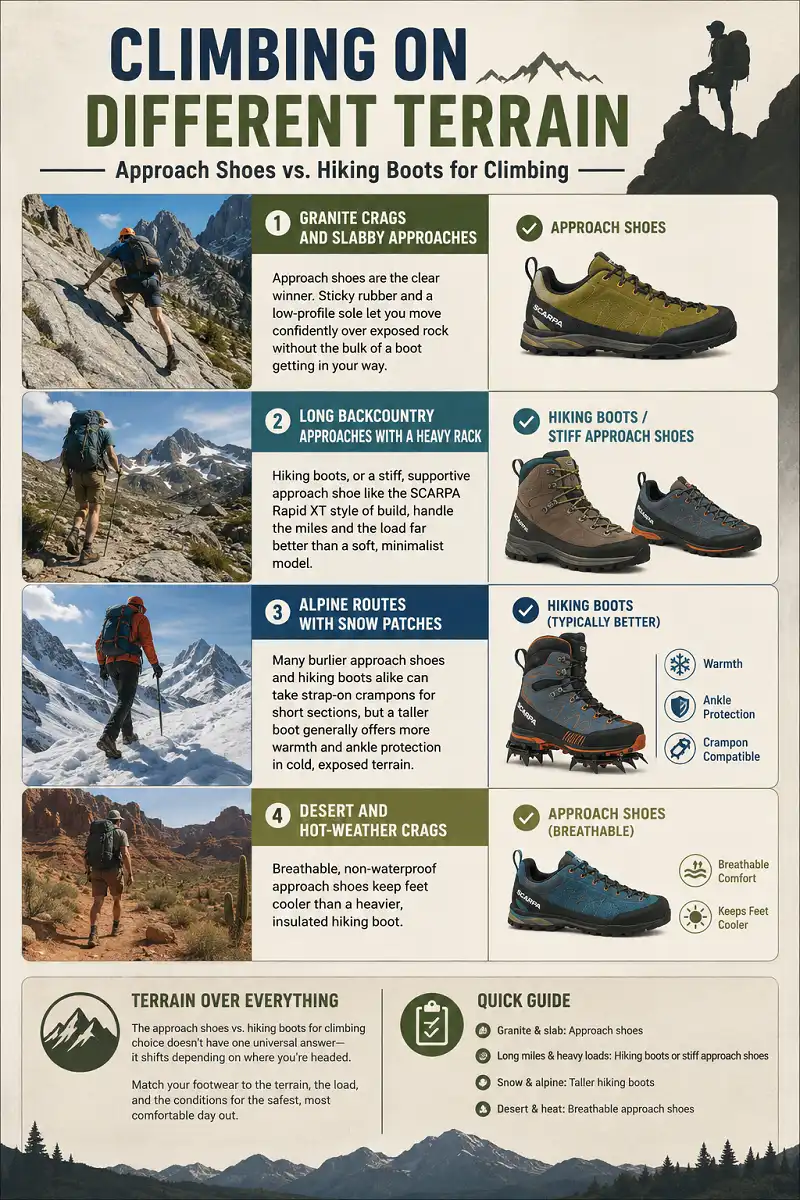
The approach shoes vs hiking boots for climbing choice doesn’t have one universal answer—it shifts depending on where you’re headed.
Granite Crags & Slabs
Approach shoes are the clear winner. Sticky rubber and a low-profile sole let you move confidently over exposed rock without the bulk of a boot getting in your way.
Backcountry & Heavy Racks
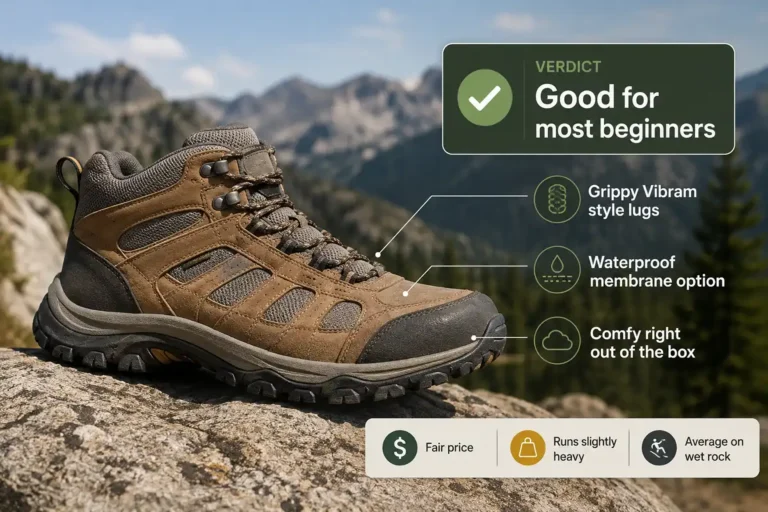
Hiking boots, or a stiff, supportive approach shoe like the SCARPA Rapid XT style of build, handle the miles and the load far better than a soft, minimalist model.
Snow Patches
Many burlier approach shoes and hiking boots alike can take strap-on crampons for short sections, but a taller boot generally offers more warmth and ankle protection.
Desert Crags
Breathable, non-waterproof approach shoes keep feet cooler than a heavier, insulated hiking boot.
Working through the approach shoes vs hiking boots for climbing decision terrain by terrain, rather than trying to find one shoe that does everything, is usually the fastest way to land on the right pair.
When Approach Shoes Are the Better Choice
Reach for approach shoes when the route to the climb involves scrambling or exposed rock.
Sticky rubber provides the confidence and precision needed on technical rock.
Approach shoes make sense when you’re carrying a lighter pack and value ground feel.
When Hiking Boots Are the Better Choice
Hiking boots provide more support and cushioning for heavy loads and long days.
Their deep lugs and protective construction are better suited to traditional hiking terrain.
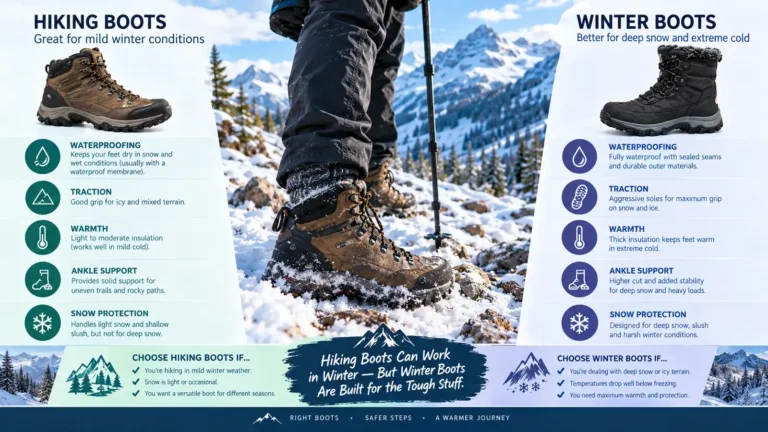
Boots are generally the stronger choice for cold, wet, or extended backcountry conditions.
Can You Use One for the Other?
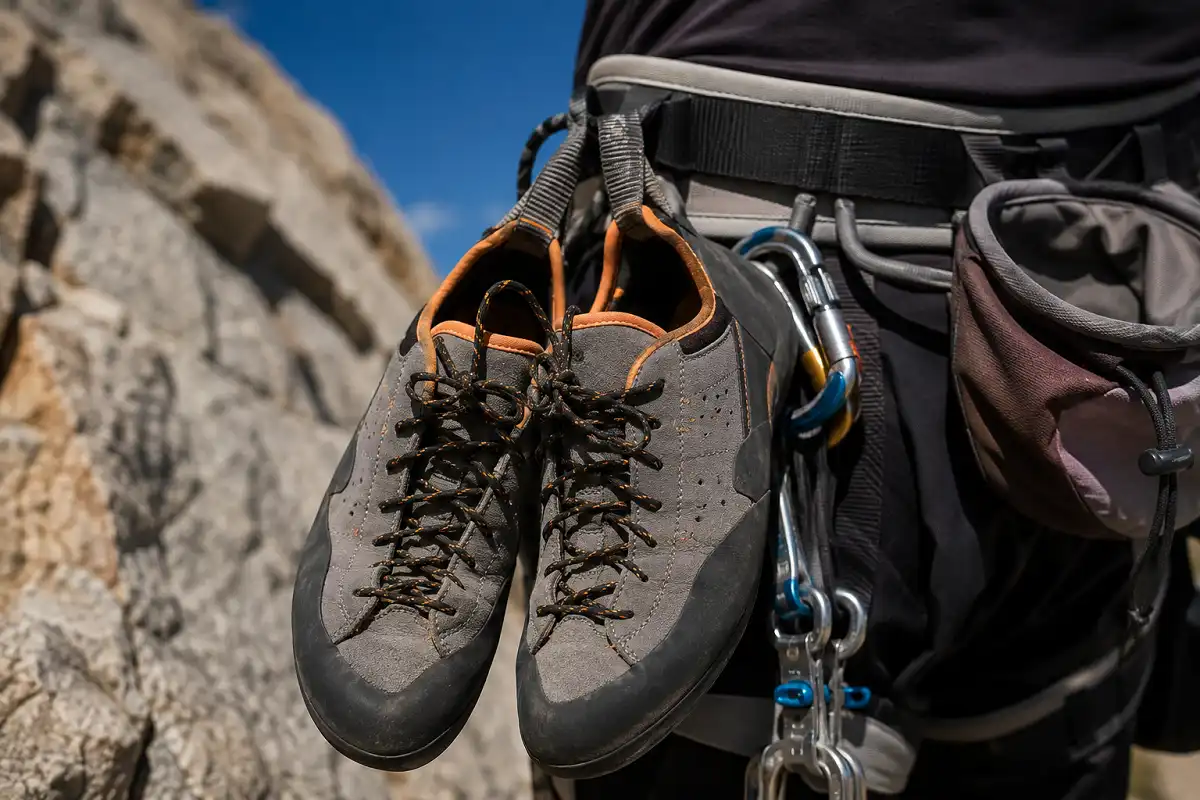
There’s real overlap, and part of what makes the approach shoes vs hiking boots for climbing question so situational is that plenty of hikers use approach shoes as their everyday hiking footwear on moderate trails, especially if they also do some scrambling along the way. They’re comfortable enough for casual wear and light hiking, though they won’t match the cushioning or ankle support of a dedicated boot on long, heavy-pack days.
The reverse is trickier. You can technically scramble in hiking boots, but their stiffness and bulk make it harder to feel the rock and place your feet precisely—exactly what approach shoes are designed to solve. If your trip mixes serious scrambling with long approach hikes, some climbers carry both: boots for the haul in, approach shoes clipped to a pack or harness for the technical section.
Mixed Trip?
If your adventure includes both long approaches and technical scrambling, carrying both pairs can be the most practical solution.
Fit, Break-In, and Foot Care Tips
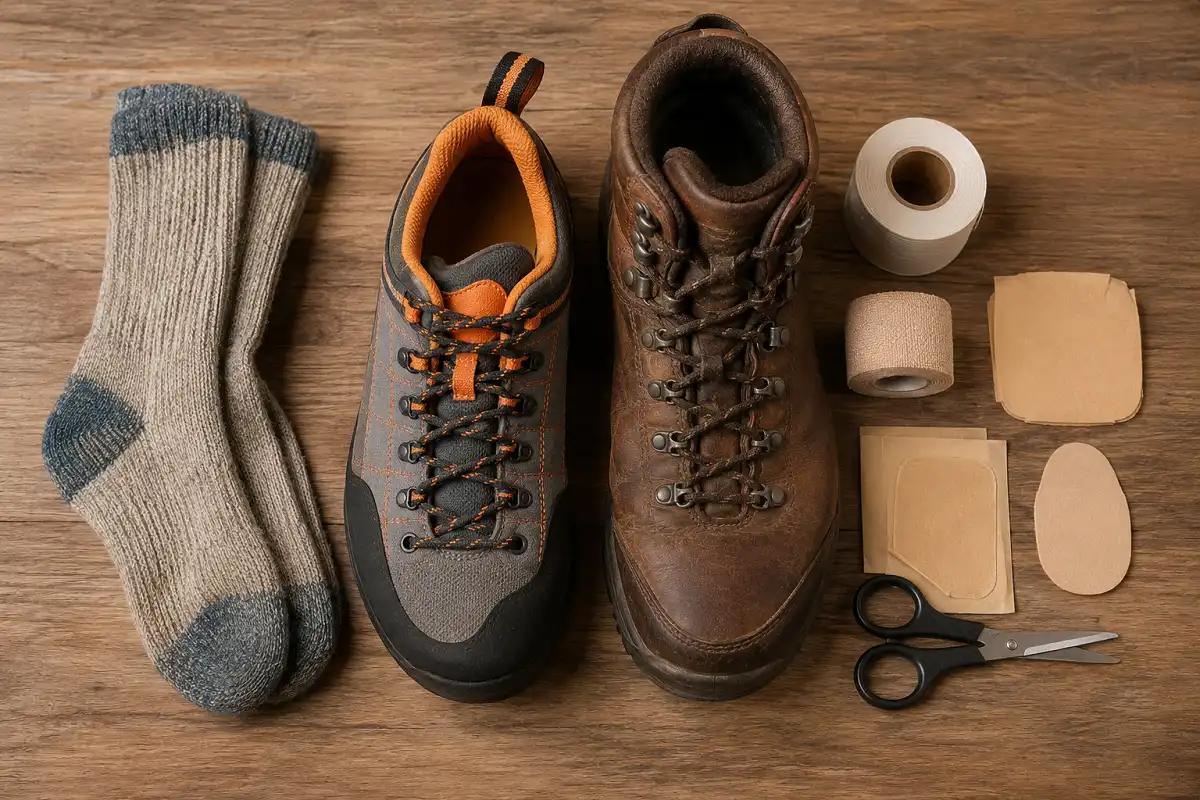
Getting the fit right matters just as much as the approach shoes vs hiking boots for climbing choice itself. A few practical details that often get overlooked:
Sizing Runs Differently
Some approach shoe brands run narrow and require sizing up, while hiking boots often fit closer to your street shoe size—always try before a big trip.
Leather vs Synthetic
Leather uppers stretch, while synthetic ones don’t. If you’re between sizes in a leather shoe, expect it to loosen slightly with wear.
Break-In Matters
Give hiking boots and firmer approach shoes several short walks before committing to a long day.
Choose the Right Socks
Pairing either shoe with the right pair of hiking socks helps manage moisture and reduce friction.
Do hiking socks make a difference →Prevent Hot Spots
If hot spots have ruined trips before, prepare your feet before the trail rather than waiting for a blister to develop.
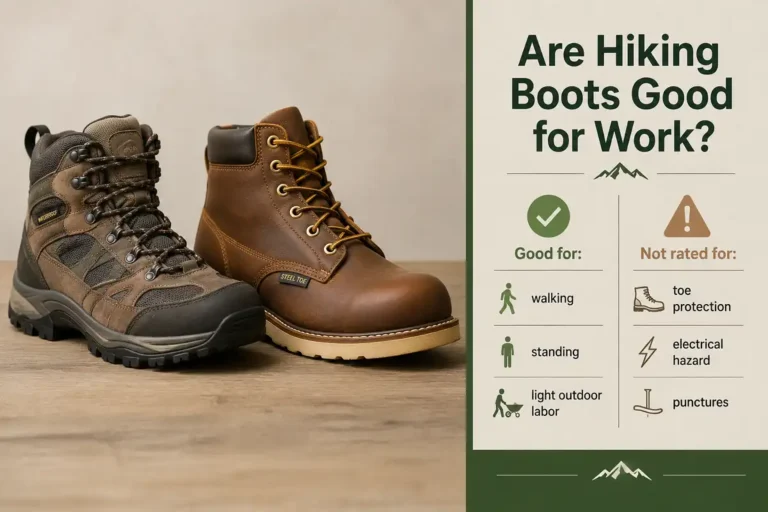
How to avoid blisters while hiking →For hikers who split time between casual walks and rougher trails, it’s also worth checking whether hiking boots are a good option for everyday walking and if you’re carrying extra weight or dealing with uneven ground, trekking poles can take real pressure off your knees and ankles, partly compensating for the lower support of an approach shoe.
According to Wikipedia, approach shoes generally offer neither the walking comfort of hiking footwear nor the pure climbing performance of a dedicated climbing shoe on the most extreme terrain—which is exactly why matching the shoe to the specific trip matters so much.
Quick Decision Checklist
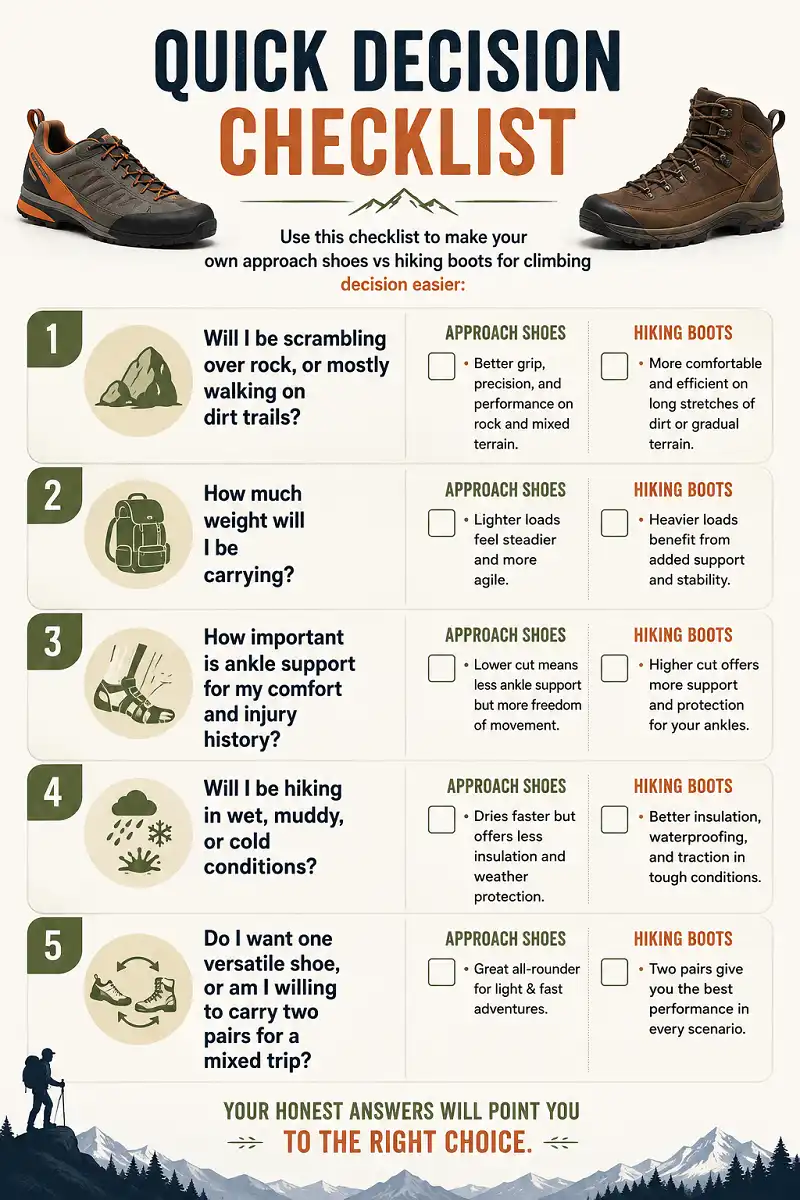
Use this checklist to make your own approach shoes vs hiking boots for climbing decision easier:
Will I be scrambling over rock, or mostly walking on dirt trails?
How much weight will I be carrying?
How important is ankle support for my comfort or injury history?
Will I be hiking in wet, muddy, or cold conditions?
Do I want one versatile shoe, or am I willing to carry two pairs for a mixed trip?
Your answers point to the right footwear.
Honest answers will usually point you toward approach shoes, hiking boots, or possibly a hiking shoe that splits the difference.
Final Thoughts
At its core, the approach shoes vs hiking boots for climbing decision comes down to terrain and load.
Approach shoes are the better call when grip on rock and agility matter most—think scrambling, climbing approaches, and technical day trips with a light pack.
Hiking boots earn their keep when you need ankle support, cushioning, and protection over long, rugged, or wet miles with real weight on your back.
Once you’re honest about what your next adventure actually demands, the choice tends to make itself.
For more on gearing up the rest of your kit, browse our full footwear guides before you head out.
Match the footwear to the terrain, the load, and the objective—not simply to the label on the shoe.
FAQs
Are approach shoes better than hiking boots for climbing approaches?
Approach shoes are generally better when the route to the climb involves technical rock, scrambling, exposed slabs, or talus. Their sticky rubber and low-profile construction provide better rock grip and foot sensitivity. Hiking boots are usually the better choice when the approach involves long distances, heavy loads, mud, or rough trail conditions.
Can you hike in approach shoes instead of hiking boots?
Yes. Approach shoes can work very well for moderate hikes, especially when scrambling or rocky terrain is part of the route. However, they provide less ankle support and usually less cushioning than hiking boots, so boots may be more comfortable for long days with a heavy backpack.
Do approach shoes have better grip than hiking boots?
On rock, generally yes. Approach shoes use softer, stickier rubber designed to provide confidence on slabs, granite, talus, and technical scrambling. Hiking boots usually have deeper lugs that perform better on mud, dirt, loose gravel, and wet trails.
Do approach shoes provide ankle support?
Most approach shoes provide minimal ankle support because they use a low-cut design. This improves agility and ground feel but offers less restriction of ankle movement than a high-cut hiking boot. If ankle stability and support are priorities, hiking boots are generally the stronger option.
Should I take hiking boots or approach shoes on a mixed climbing trip?
It depends on how much technical terrain and hiking your trip includes. For a long approach followed by serious scrambling or climbing, carrying both can be the most versatile solution. Use hiking boots for the long, heavy-load approach and switch to approach shoes for the technical rock section.