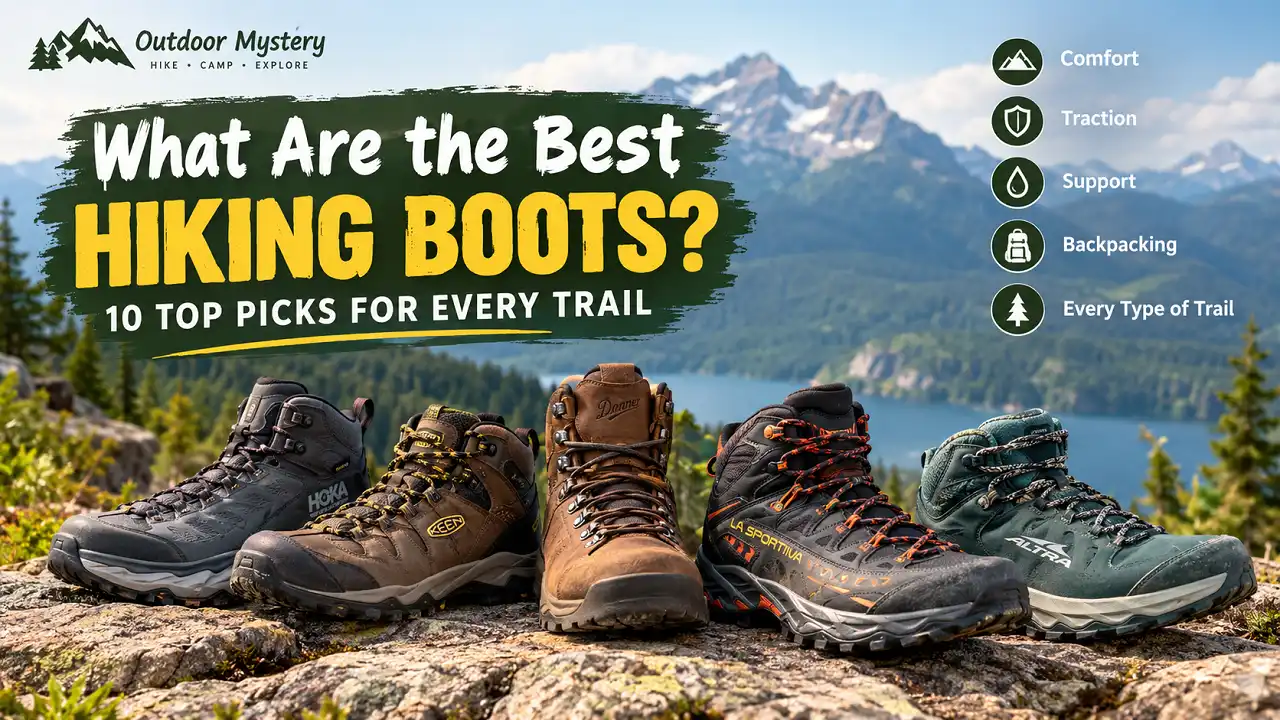
What Are the Best Hiking Boots? 10 Top Picks for Every Trail
I’ve been hiking and camping since 2018, and one question I’ve come back to more times than I can count is what are the best hiking boots for different trails and conditions? After trying different footwear and making a few rookie mistakes along the way, I’ve learned that the best hiking boots aren’t simply the most expensive or popular pair. The right choice depends on comfort, fit, terrain, weather, support, and how much weight you’re carrying.
Over the years, I’ve learned a lot on the trail, and not always the easy way. I’ve worn boots that were completely wrong for the hike, carried a pack that felt heavier with every mile, and gone out without paying enough attention to changing weather. Those mistakes were frustrating at the time, but they taught me things I wouldn’t have learned from simply reading a gear list.
Boots were one of the biggest lessons for me. A pair can feel great when you first try it on, but that doesn’t necessarily mean it will still feel great after several hours on rocky or uneven ground. I’ve learned to pay attention to things like comfort, traction, support, weight, and how a boot actually performs once you’re several miles into a hike.
That experience is also why I created Outdoor Mystery. It’s my personal blog, and I write the guides myself. When I recommend gear, I try to keep things simple and honest: I recommend equipment I’ve used on the trail when I can, and when I haven’t personally tested something, I tell you that too.
So when someone asks me what are the best hiking boots, my answer is usually, “It depends.” The best boots for a short day hike around a maintained trail may be completely different from the pair I’d choose for a rocky route, a backpacking trip, or wet and cold conditions.
In this guide, I’ll share some of the best hiking boots worth considering and, more importantly, what makes each one a good fit for a particular type of hiker.
1. HOKA Kaha 3 GTX — Best Overall
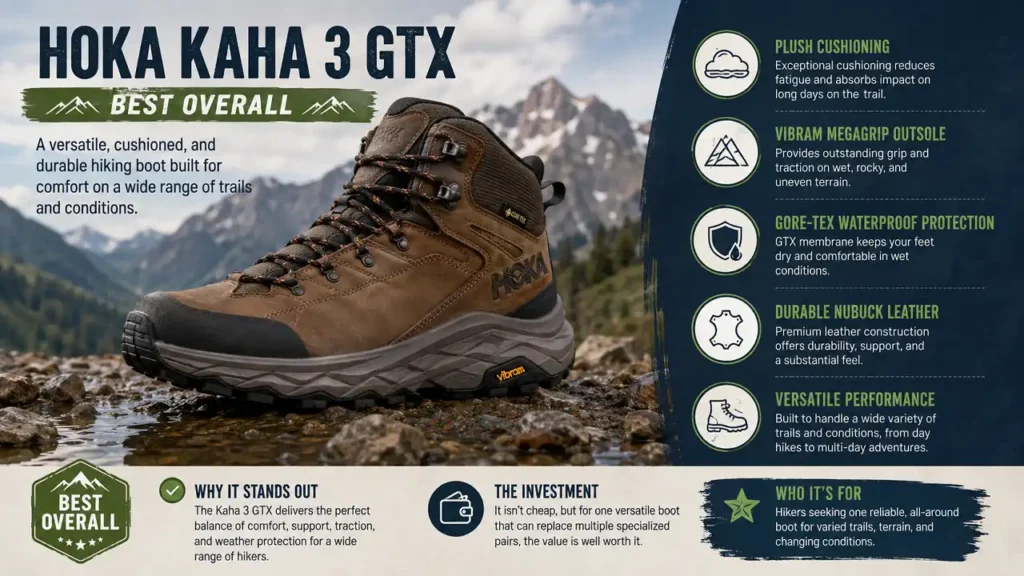
HOKA Kaha 3 GTX stands out as a versatile hiking boot for varied trails and wet conditions.
If I wanted one hiking boot that could handle a wide variety of trails, the HOKA Kaha 3 GTX would be one of the first pairs I’d look at.
What immediately stands out is the cushioning. After spending enough time on rocky trails, I’ve come to appreciate a boot that takes some of the punishment out of each step. The Kaha 3 has that comfortable, cushioned feeling while still offering the structure I expect from a hiking boot.
It also uses a Vibram Megagrip outsole, which is useful when the trail gets wet, rocky, or uneven. The nubuck leather construction gives the boot a substantial feel, while the GTX waterproof membrane adds protection when conditions turn wet.
It isn’t cheap, but for someone looking for one versatile boot rather than several specialized pairs, I think the price is easier to understand.
2. KEEN Targhee IV Mid — Best Value
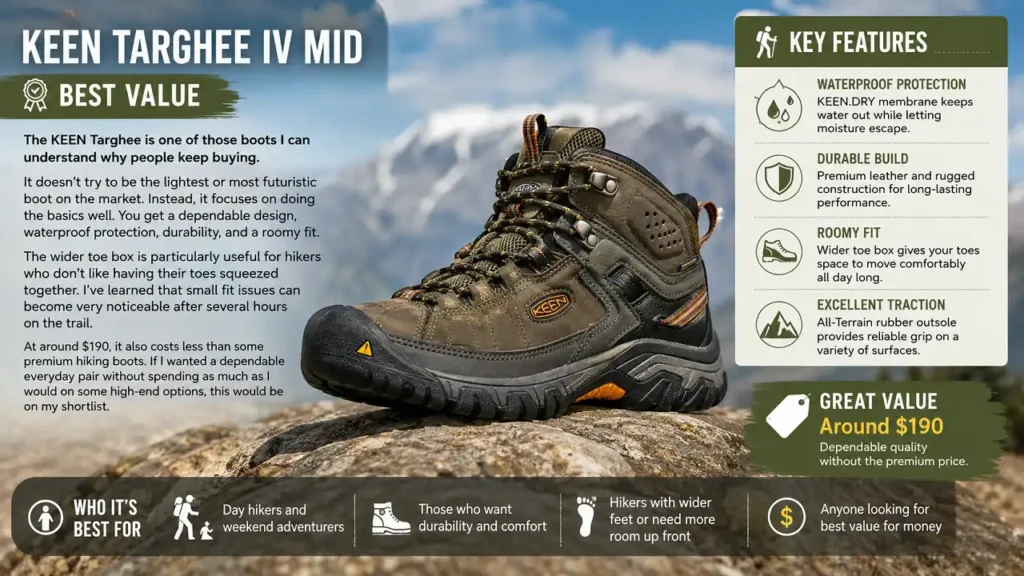
KEEN Targhee IV Mid offers dependable waterproof protection, durability, comfort, and value.
The KEEN Targhee is one of those boots I can understand why people keep buying.
It doesn’t try to be the lightest or most futuristic boot on the market. Instead, it focuses on doing the basics well. You get a dependable design, waterproof protection, durability, and a roomy fit.
The wider toe box is particularly useful for hikers who don’t like having their toes squeezed together. I’ve learned that small fit issues can become very noticeable after several hours on the trail.
At around $190, it also costs less than some premium hiking boots. If I wanted a dependable everyday pair without spending as much as I would on some high-end options, this would be on my shortlist.
3. Danner N45 Mid GTX — Best for Backpacking
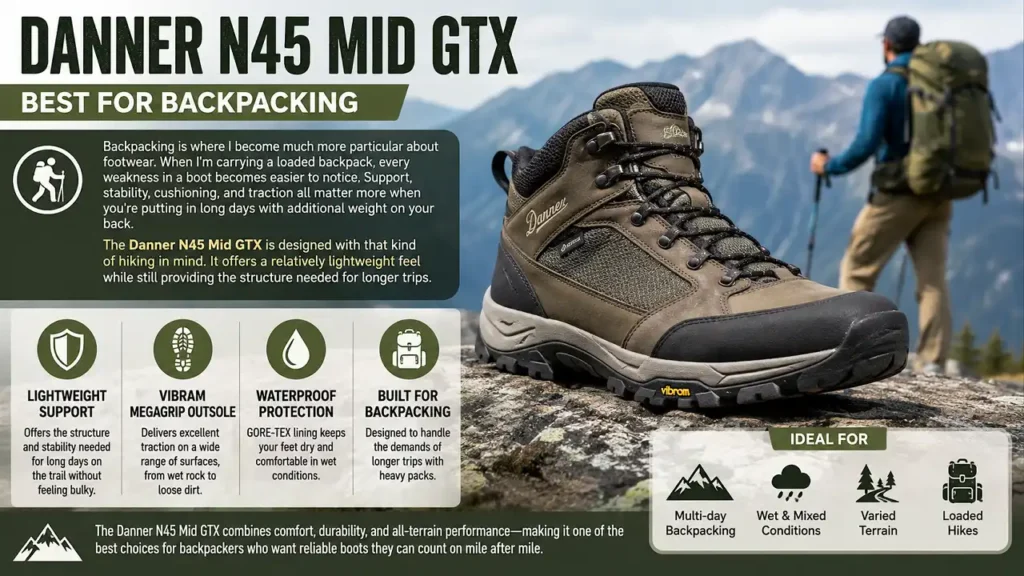
Danner N45 Mid GTX offers lightweight support, waterproof protection, and reliable traction for backpacking.
Backpacking is where I become much more particular about footwear.
When I’m carrying a loaded backpack, every weakness in a boot becomes easier to notice. Support, stability, cushioning, and traction all matter more when you’re putting in long days with additional weight on your back.
The Danner N45 Mid GTX is designed with that kind of hiking in mind. It offers a relatively lightweight feel while still providing the structure needed for longer trips.
The Vibram Megagrip outsole is another advantage for mixed terrain, while the waterproof construction makes it a practical option when you’re dealing with wet trails.
4. KEEN Zionic NXT — Best Lightweight Option
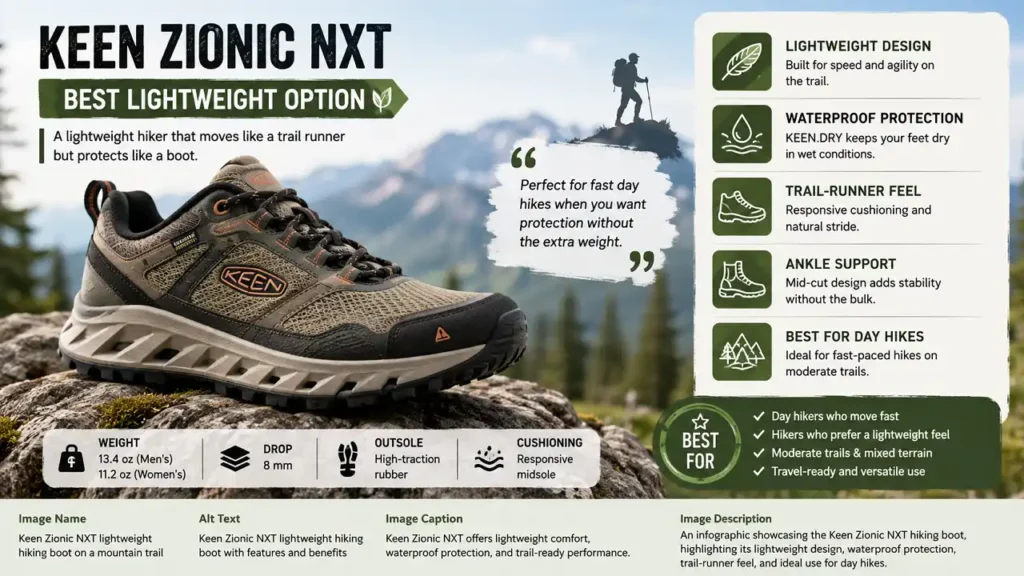
KEEN Zionic NXT combines lightweight comfort, waterproof protection, and trail-ready performance.
There are days when I simply don’t want a heavy hiking boot on my feet.
For faster day hikes on decent trails, I prefer something that lets me move naturally without feeling like I’m carrying extra weight with every step. That’s where the KEEN Zionic NXT becomes interesting.
It provides ankle coverage and waterproof protection, but the overall feeling is closer to a trail-running shoe than a traditional hiking boot.
That makes it a particularly good option for hikers who want to move quickly or simply don’t enjoy the bulk of conventional boots.
I wouldn’t make it my first choice for a very heavy backpacking load, but for day hikes, it makes a lot of sense.
5. Altra Timp 6 Mid GTX — Best Zero-Drop Option
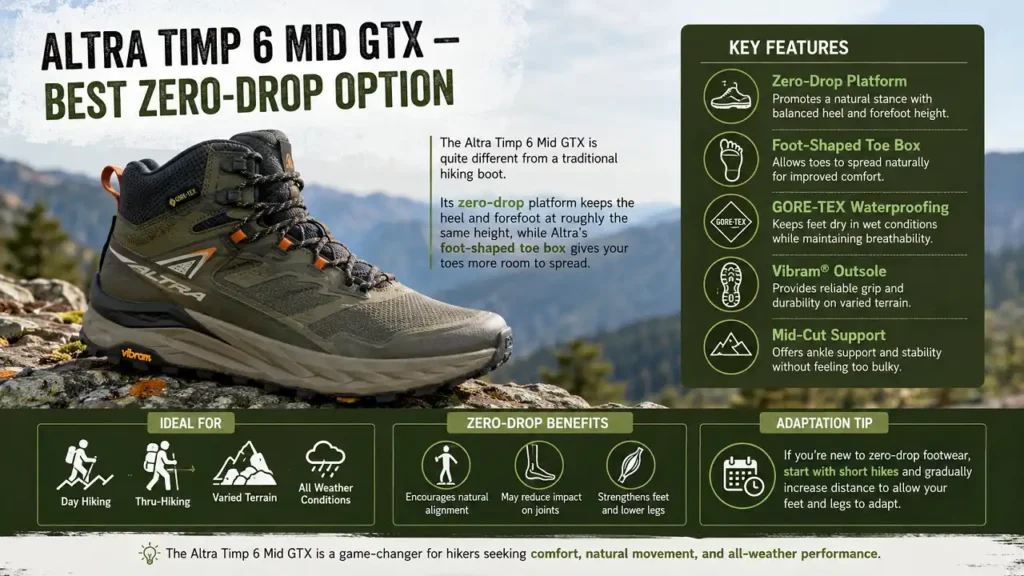
Altra Timp 6 Mid GTX is a zero-drop hiking boot with a foot-shaped toe box and roomy fit.
The Altra Timp 6 Mid GTX is quite different from a traditional hiking boot.
Its zero-drop platform keeps the heel and forefoot at roughly the same height, while Altra’s foot-shaped toe box gives your toes more room to spread.
For hikers who regularly experience cramped toes or discomfort in conventional footwear, that extra space can be a major advantage.
However, I’d be careful about jumping straight into a zero-drop boot for a long hike. If your feet and legs are used to shoes with a raised heel, give yourself some time to adapt.
6. La Sportiva Ultra Raptor 3 Mid GTX — Best for Technical Terrain
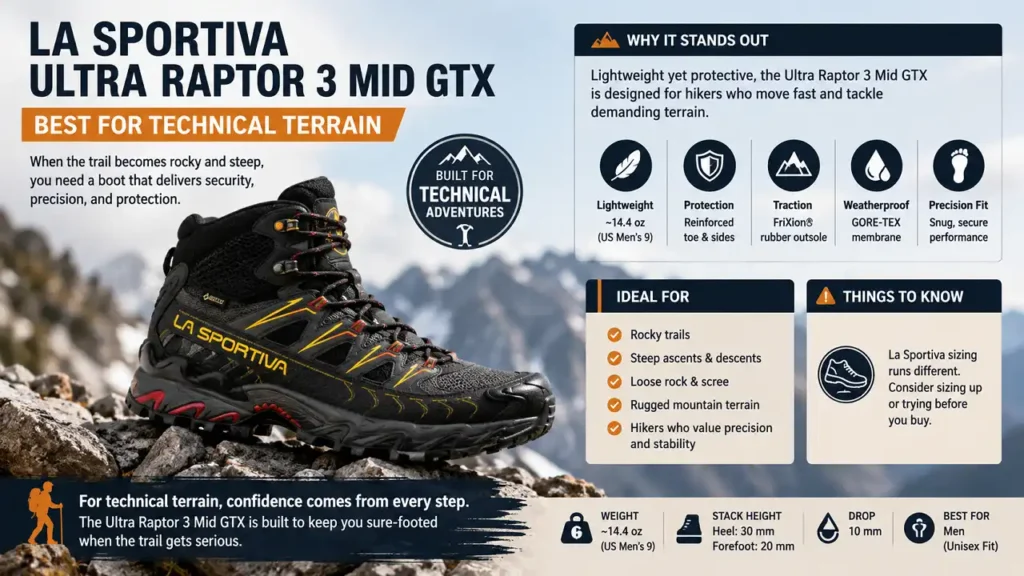
La Sportiva Ultra Raptor 3 Mid GTX delivers lightweight protection and precise grip for technical terrain.
When the trail becomes rocky and steep, I care less about having the softest boot and more about feeling secure with every foot placement.
The La Sportiva Ultra Raptor 3 Mid GTX is built around that idea.
It’s relatively light at about 14.4 ounces per boot in a US men’s size 9, yet it offers protection and a precise feel that works well on technical terrain.
If your hikes regularly include loose rock, steep sections, scree, or rugged mountain trails, this is the kind of footwear worth considering.
Just pay close attention to sizing. La Sportiva footwear can have a different fit compared with some traditional hiking brands.
7. Danner Mountain 600 Evo — Best Classic Style
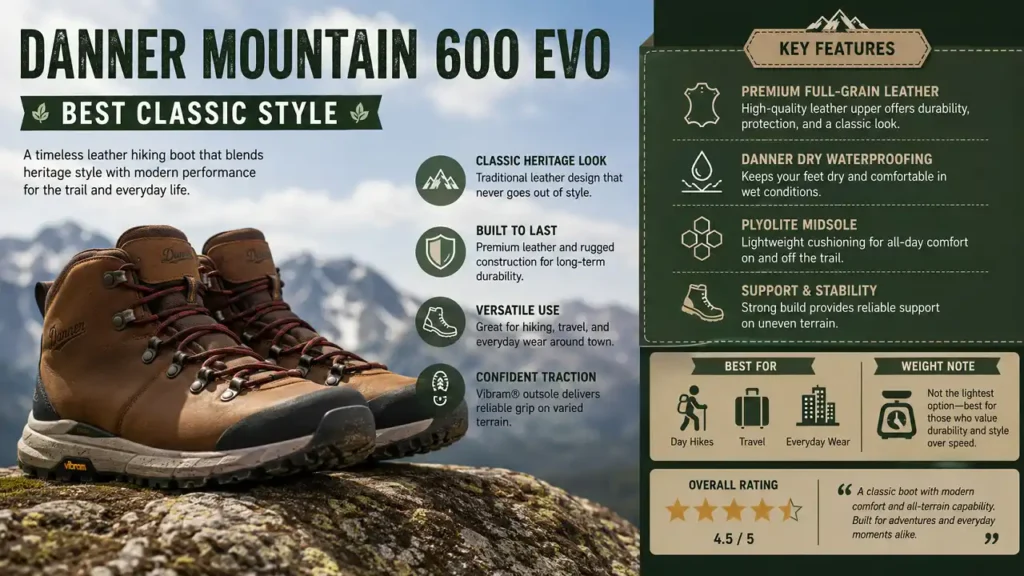
Danner Mountain 600 Evo combines classic leather style with modern trail versatility.
I understand why some hikers still prefer the look and feel of a traditional leather hiking boot.
The Danner Mountain 600 Evo has that classic appearance while still being designed for modern outdoor use. It also makes sense for someone who doesn’t want their hiking footwear to be useful only on the trail.
You can wear a boot like this while traveling, walking around town, or heading out for a casual hike.
It’s not the lightest option here, so I wouldn’t choose it purely for long-distance speed. But if you value classic styling, durability, and versatility, it has a lot going for it.
8. HOKA Transport Hike GTX — Best Sneaker-Like Feel
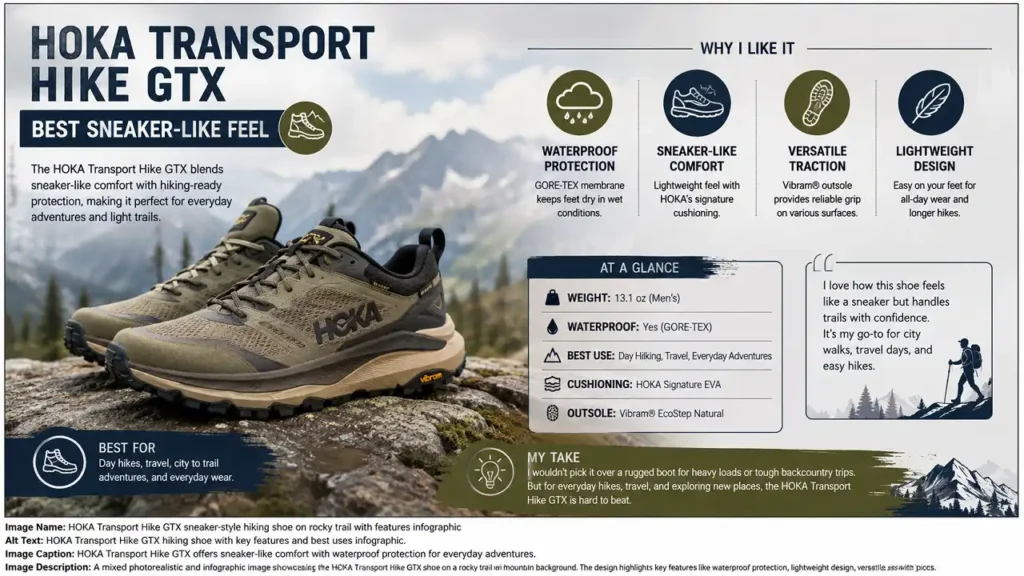
HOKA Transport Hike GTX combines sneaker like comfort with hiking ready performance.
One of the things I appreciate about modern hiking footwear is that you don’t always have to choose between a bulky boot and a low-cut trail shoe.
The HOKA Transport Hike GTX sits somewhere in between.
It provides the cushioning HOKA is known for while keeping the overall experience closer to wearing a comfortable sneaker. For casual hikers or people who spend time moving between city streets and trails, that’s a useful combination.
I wouldn’t choose it over a more supportive boot for carrying a heavy backpack over rough terrain. But for ordinary day hikes, it’s an appealing option.
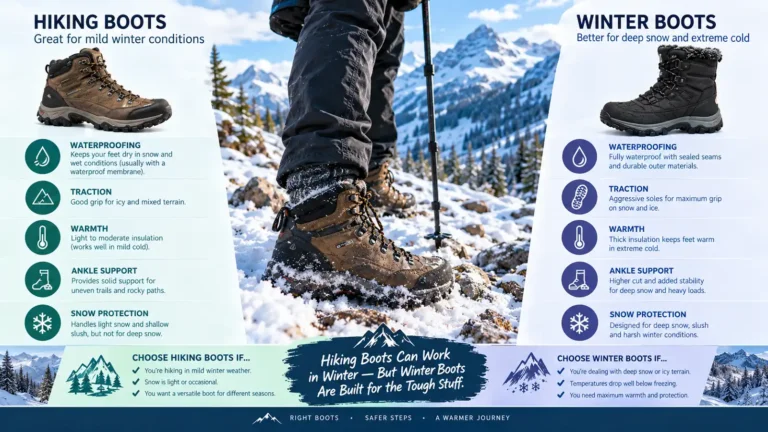
9. Merrell Thermo Snow Grip Mid — Best Winter Hiking Boot
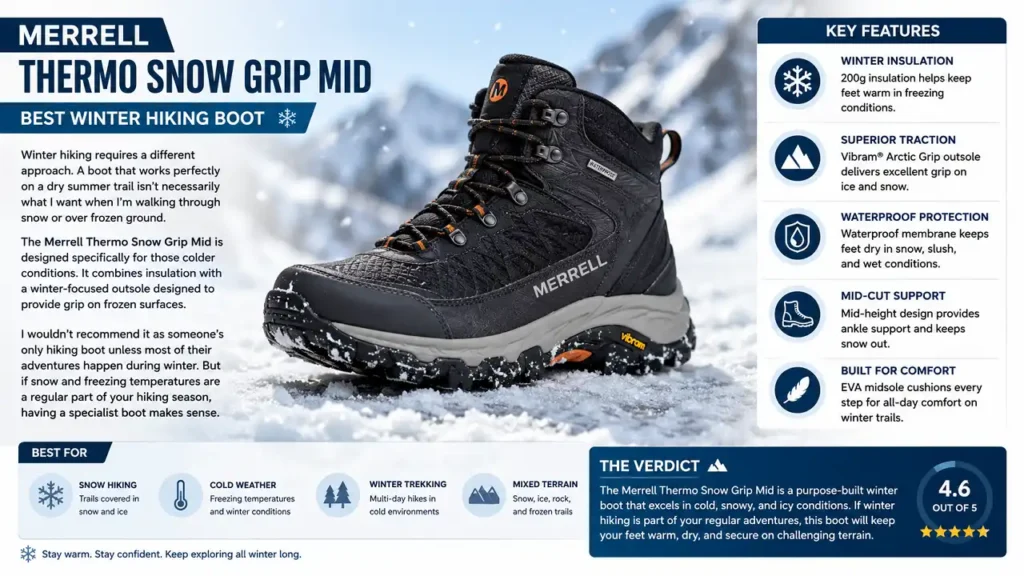
Merrell Thermo Snow Grip Mid is designed for snow, ice, and freezing winter trails.
Winter hiking requires a different approach.
A boot that works perfectly on a dry summer trail isn’t necessarily what I want when I’m walking through snow or over frozen ground.
The Merrell Thermo Snow Grip Mid is designed specifically for those colder conditions. It combines insulation with a winter-focused outsole designed to provide grip on frozen surfaces.
I wouldn’t recommend it as someone’s only hiking boot unless most of their adventures happen during winter. But if snow and freezing temperatures are a regular part of your hiking season, having a specialist boot makes sense.
10. Altra Lone Peak 9 Waterproof Mid — Best for Long-Distance Hiking
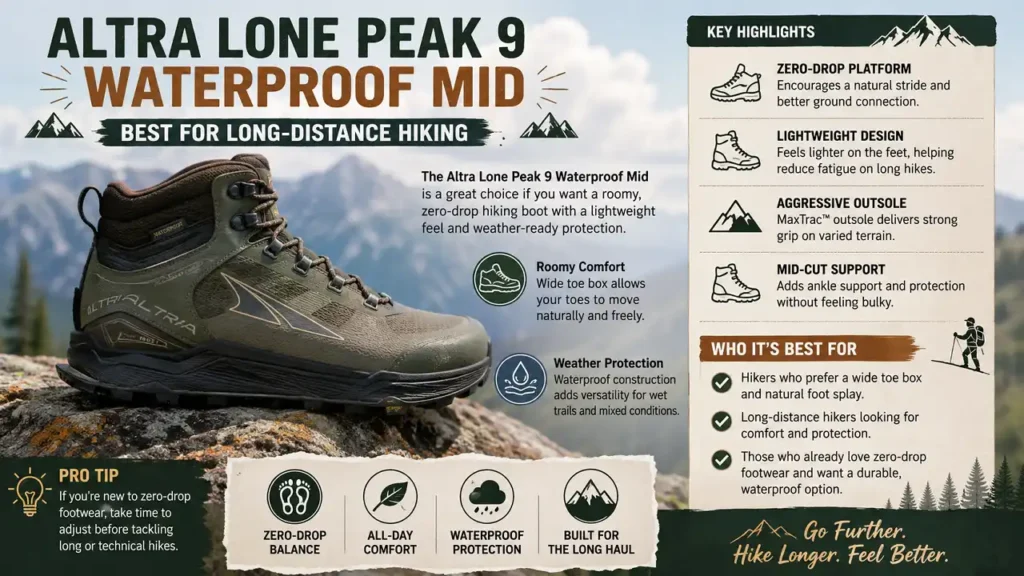
Altra Lone Peak 9 Waterproof Mid features a roomy zero-drop design for long-distance hiking.
The Altra Lone Peak 9 Waterproof Mid is another option I’d look at if I wanted a roomy, zero-drop hiking boot with a lighter feel.
The wide toe box gives your toes plenty of room, while the waterproof construction adds versatility when conditions aren’t completely dry.
It’s particularly interesting for hikers who already know they like Altra’s zero-drop design. If you’re new to zero-drop footwear, I’d still recommend giving yourself time to adjust before taking them on a long mountain route.
How to Choose the Best Hiking Boots
After enough time on the trail, I’ve stopped looking for the boot with the longest list of features. Instead, I start by thinking about where I’m actually going to use it.
Your boots should feel good after several hours, not just during the first few minutes of trying them on.
Consider whether you’ll be walking on dirt, mud, wet rock, loose gravel, or snow.
Waterproof boots are useful in rain, mud, and wet grass, but breathable footwear may be preferable in hot, dry conditions.
Heavy boots can provide more structure, but lightweight boots can make long hiking days feel easier.
If you’re carrying a heavy pack or hiking rough terrain, extra support can be worthwhile.
This is the one area where I wouldn’t compromise. Your heel should stay secure, while your toes need enough room to move naturally.
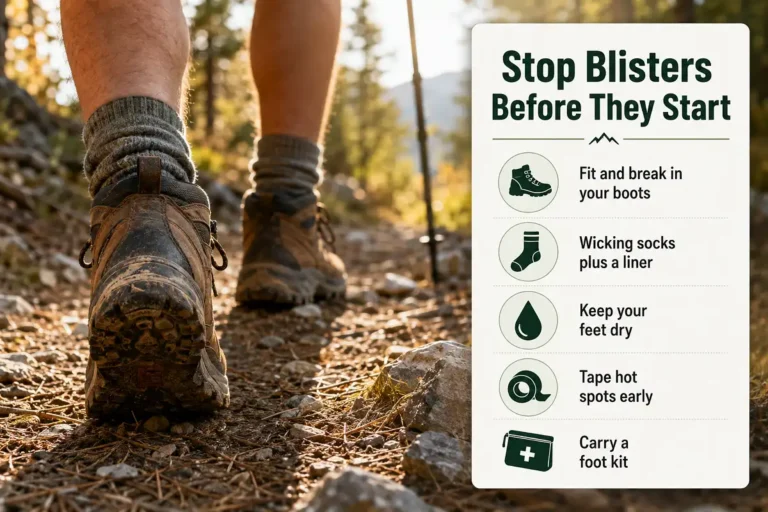
Fit is especially important because a boot that rubs in the wrong place can turn a good hike into a miserable one. If you want more practical advice on preventing foot problems before they ruin a trip, check out my guide on how to prevent blisters when hiking .
Hiking Boots vs. Hiking Shoes
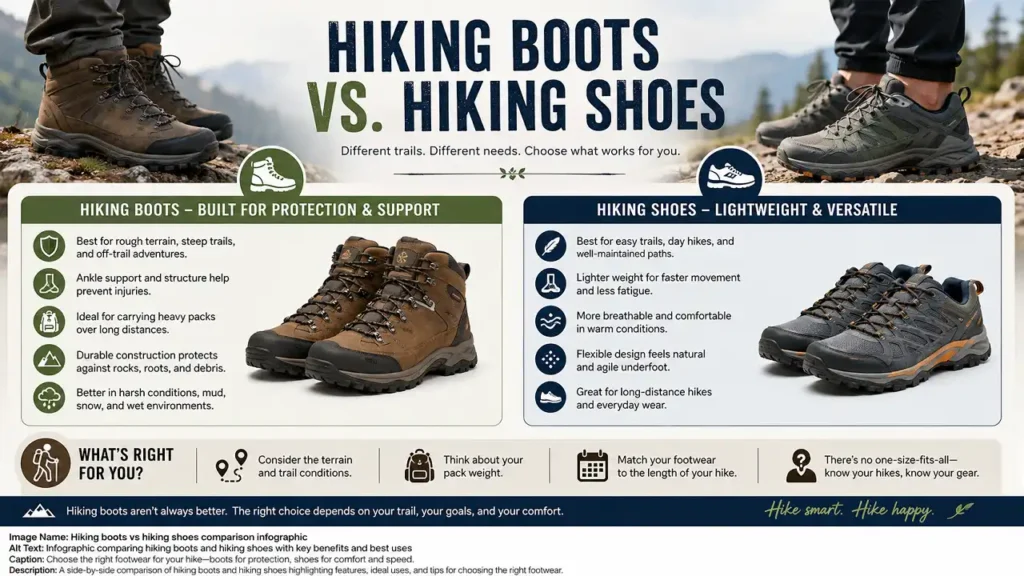
Something I’ve changed my mind about over the years is the idea that every hike requires a traditional hiking boot.
It doesn’t.
For easy trails and long-distance hikes, lightweight hiking shoes or trail-running shoes can sometimes be a better option. They reduce weight and can feel much more natural underfoot.
On the other hand, if I’m carrying a heavy pack or dealing with rough terrain, I appreciate the additional protection and structure of a mid-height hiking boot.
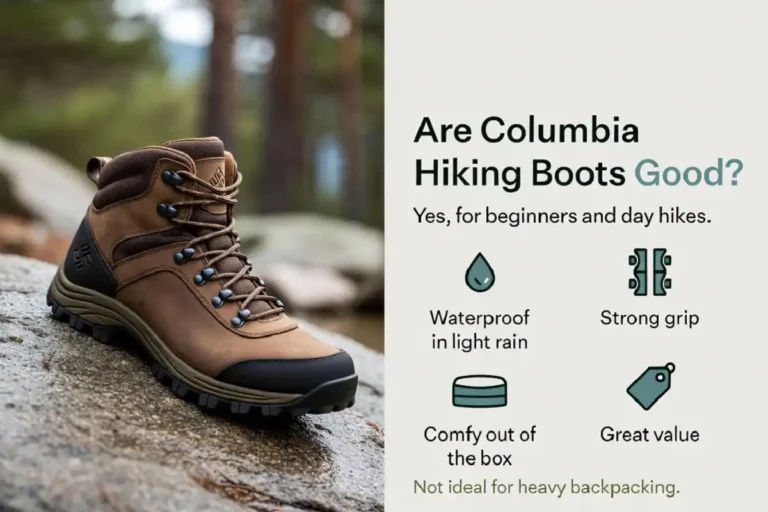
I’ve also written about whether hiking boots are good for walking , because this is something I get asked about quite often. The short answer is that hiking boots are excellent on rough, uneven ground, but they can be more boot than you need for everyday pavement walking.
That’s why I wouldn’t automatically choose the highest or heaviest boot available. Think about what your hikes actually look like.
What Are the Best Hiking Boots?
After hiking and camping since 2018, I’ve learned that there really isn’t one hiking boot that I can honestly call the best for everyone.
If I wanted a versatile all-around boot, I’d start with the HOKA Kaha 3 GTX.
For value, the KEEN Targhee IV Mid is a strong choice. For backpacking, I’d look closely at the Danner N45 Mid GTX, while the KEEN Zionic NXT makes more sense if keeping weight down is important.
For technical mountain terrain, the La Sportiva Ultra Raptor 3 Mid GTX stands out. If you’re dealing with snow and freezing temperatures, the Merrell Thermo Snow Grip Mid is the more specialized choice.
But the biggest lesson I’ve learned from my own hiking mistakes is that the best hiking boot isn’t necessarily the one with the most features or the highest price.
It’s the one that fits your feet, matches your terrain, handles your typical weather, and feels comfortable several miles into the hike.
Before you buy, think about the trails you’ll actually be walking over the next year. That simple question will usually get you much closer to the right pair than simply searching for the boot with the highest rating.
FAQs
What are the best hiking boots for beginners?
For beginners, I’d look for a comfortable, supportive boot that works well on the type of trails you actually plan to hike. The HOKA Kaha 3 GTX and KEEN Targhee IV Mid are good options to consider because they offer a useful balance of comfort, traction, and support without being specialized for just one type of terrain.
Are waterproof hiking boots worth it?
They can be, especially if you regularly hike in rain, wet grass, mud, or areas where trails stay damp. Waterproof boots can help keep your feet dry, but they may also feel warmer than more breathable footwear. If most of your hiking happens in hot and dry conditions, I’d think about breathability before automatically choosing waterproofing.
How should hiking boots fit?
Your hiking boots should feel secure around your heel and midfoot without squeezing your foot. You should also have enough room around your toes to move naturally. I pay particular attention to downhill walking because your toes can slide forward in a boot that doesn’t fit properly. Try boots with the socks you normally hike in and, when possible, walk around in them before committing to a long trip.
How long should hiking boots last?
There isn’t a fixed lifespan because it depends heavily on how often you hike, the terrain, your mileage, and how well you care for them. A pair used occasionally on easy trails can last much longer than boots used every week on rocky mountain routes. Instead of relying only on age, check the outsole, midsole, stitching, upper, and waterproofing to see how much life remains.
Do I really need hiking boots instead of hiking shoes?
Not necessarily. For maintained trails, lightweight day hikes, and long-distance hiking, hiking shoes or trail-running shoes can be excellent choices. I usually think more seriously about boots when I’m dealing with rough terrain, a heavier backpack, poor weather, or when I want additional protection around my ankles.
Should I break in new hiking boots before a long hike?
Yes. I strongly recommend wearing new hiking boots on shorter walks before taking them on a major hiking trip. This gives you a chance to discover rubbing, heel movement, pressure points, or sizing problems while you’re still close to home. A little time spent breaking them in can save you from a very uncomfortable day on the trail.