How to Dress for Hiking: 10 Essential Clothes & Gear for Every Weather
If you are wondering how to dress for hiking, the answer is not simply “wear hiking clothes.” Your outfit needs to deal with sweat, sun, wind, rain, changing temperatures, rough trails, and sometimes all of them on the same hike.
The easiest way to get it right is to think in layers. A moisture-wicking base layer manages sweat, a midlayer provides warmth when you need it, and an outer shell protects you from wind and rain. Your pants, socks, footwear, and accessories then fill in the rest of the system.
I have been hiking and camping since 2018, out of Bakersfield, California. What started as weekend trips turned into a habit I plan my year around. Along the way, I made every rookie mistake: wrong boots, a pack that was too heavy, no plan for the weather, and I learned from all of them.
That is why I don’t think dressing for a hike should be complicated. You don’t need a closet full of expensive technical clothing. You need a few pieces that work together and make sense for the trail and weather you’re actually facing.
Outdoor Mystery is my personal blog, not a company. I write the guides myself. When I recommend gear, it is either kit I have used out on the trail or something I have researched carefully. If I have not tried it, I tell you.
This guide breaks down the 10 essential clothes and gear pieces I would consider when figuring out how to dress for hiking, from your first layer to your feet and the rain gear you hope you never need but should still carry.
How Should You Dress for Hiking?
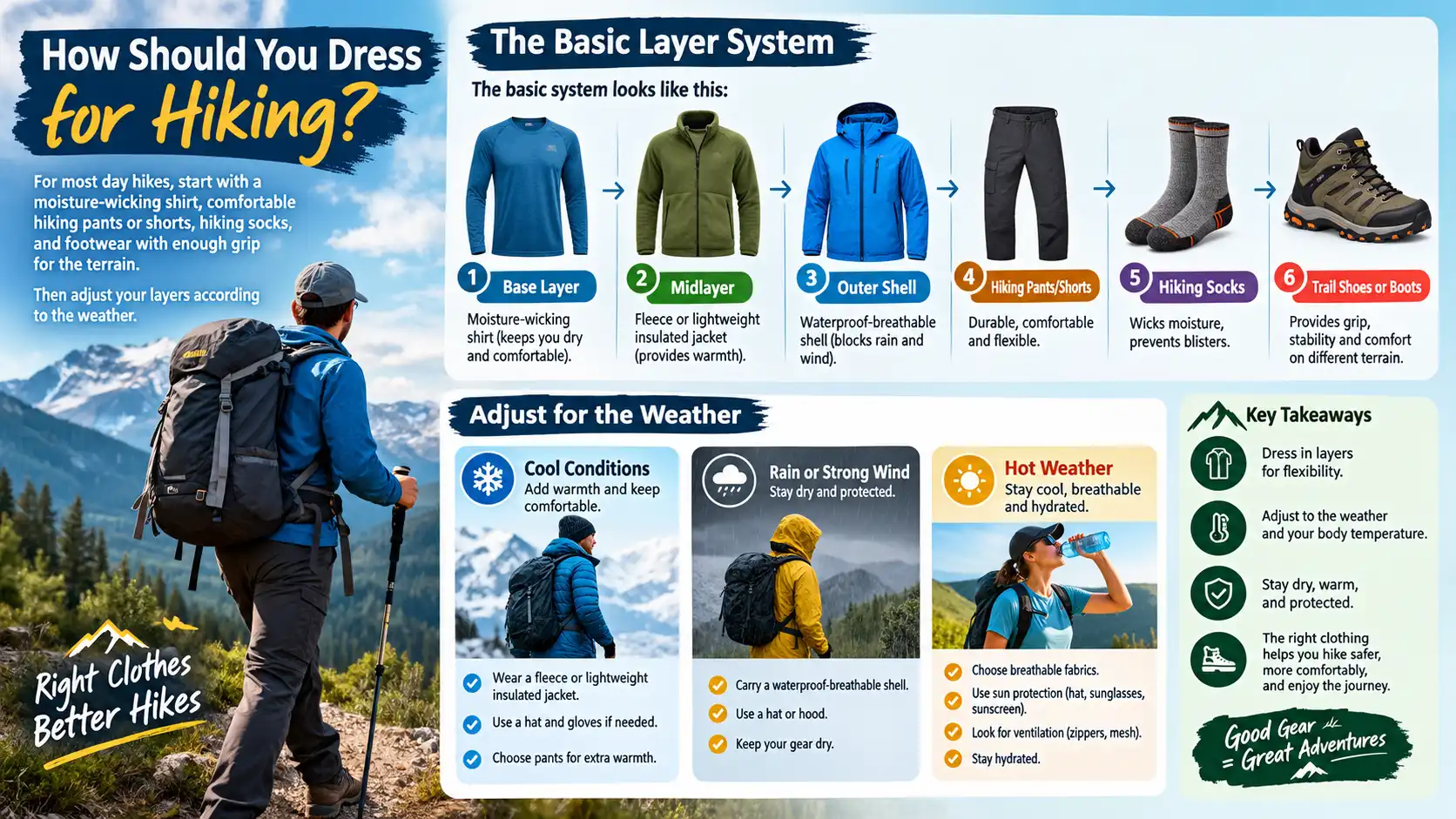
For most day hikes, start with a moisture-wicking shirt, comfortable hiking pants or shorts, hiking socks, and footwear with enough grip for the terrain.
Then adjust your layers according to the weather.
For cool conditions, add a fleece or lightweight insulated jacket. For rain or strong wind, carry a waterproof-breathable shell. In hot weather, prioritize breathable fabrics, sun protection, ventilation, and hydration.
The basic system looks like this:
Base layer → Midlayer → Outer shell → Hiking pants/shorts → Hiking socks → Trail shoes or boots
The important part is that you can remove or add layers as your body temperature changes. A three-layer system is widely used because it lets hikers manage moisture, insulation, and weather protection independently.
The 3-Layer System for Hiking
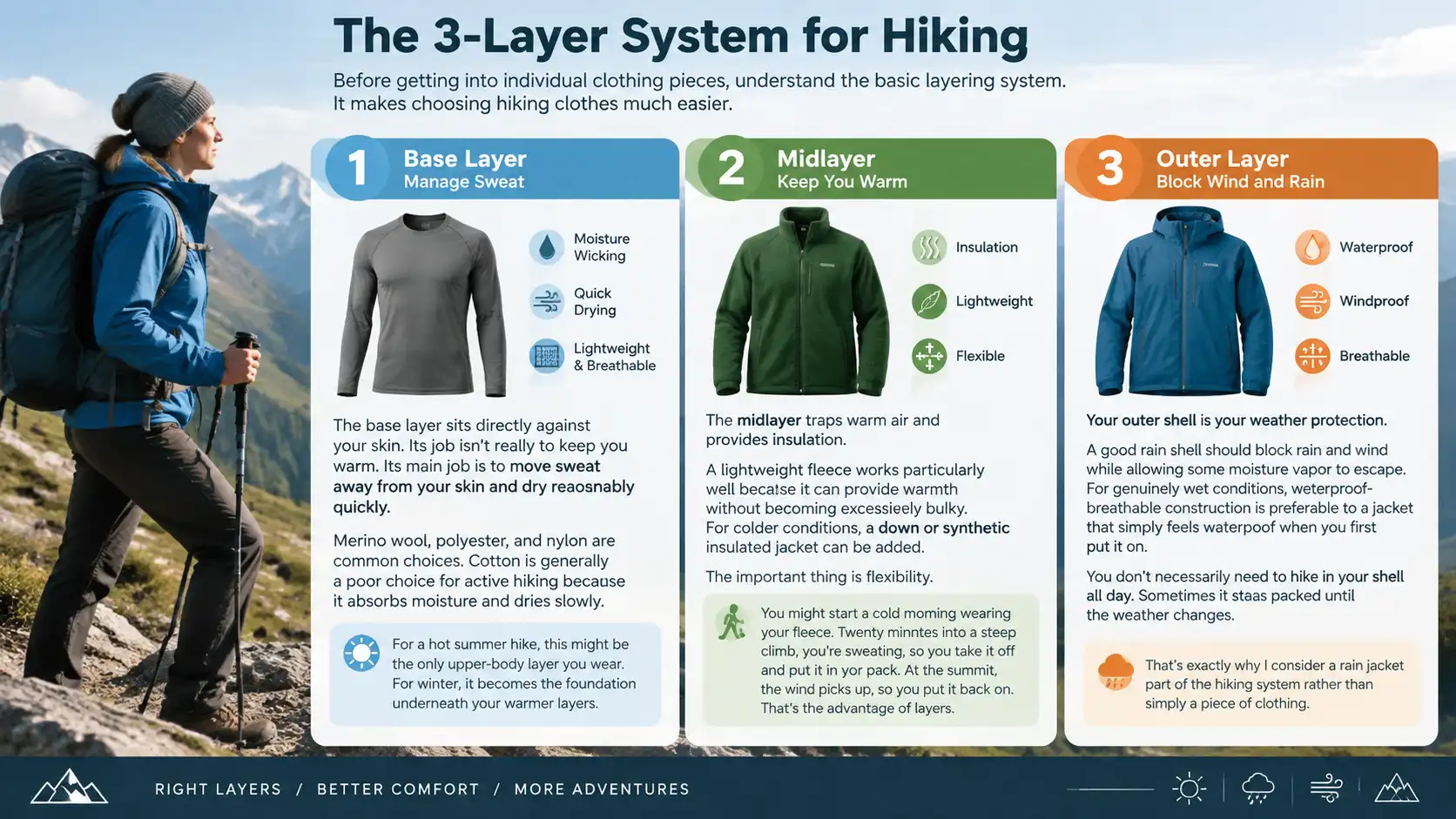
Before getting into individual clothing pieces, understand the basic layering system.
It makes choosing hiking clothes much easier.
1. Base Layer: Manage Sweat
The base layer sits directly against your skin.
Its job isn’t really to keep you warm. Its main job is to move sweat away from your skin and dry reasonably quickly.
Merino wool, polyester, and nylon are common choices. Cotton is generally a poor choice for active hiking because it absorbs moisture and dries slowly.
For a hot summer hike, this might be the only upper-body layer you wear.
For winter, it becomes the foundation underneath your warmer layers.
2. Midlayer: Keep You Warm
The midlayer traps warm air and provides insulation.
A lightweight fleece works particularly well because it can provide warmth without becoming excessively bulky. For colder conditions, a down or synthetic insulated jacket can be added.
The important thing is flexibility.
You might start a cold morning wearing your fleece. Twenty minutes into a steep climb, you’re sweating, so you take it off and put it in your pack. At the summit, the wind picks up, so you put it back on.
That’s the advantage of layers.
3. Outer Layer: Block Wind and Rain
Your outer shell is your weather protection.
A good rain shell should block rain and wind while allowing some moisture vapor to escape. For genuinely wet conditions, waterproof-breathable construction is preferable to a jacket that simply feels waterproof when you first put it on.
You don’t necessarily need to hike in your shell all day.
Sometimes it stays packed until the weather changes.
That’s exactly why I consider a rain jacket part of the hiking system rather than simply a piece of clothing.
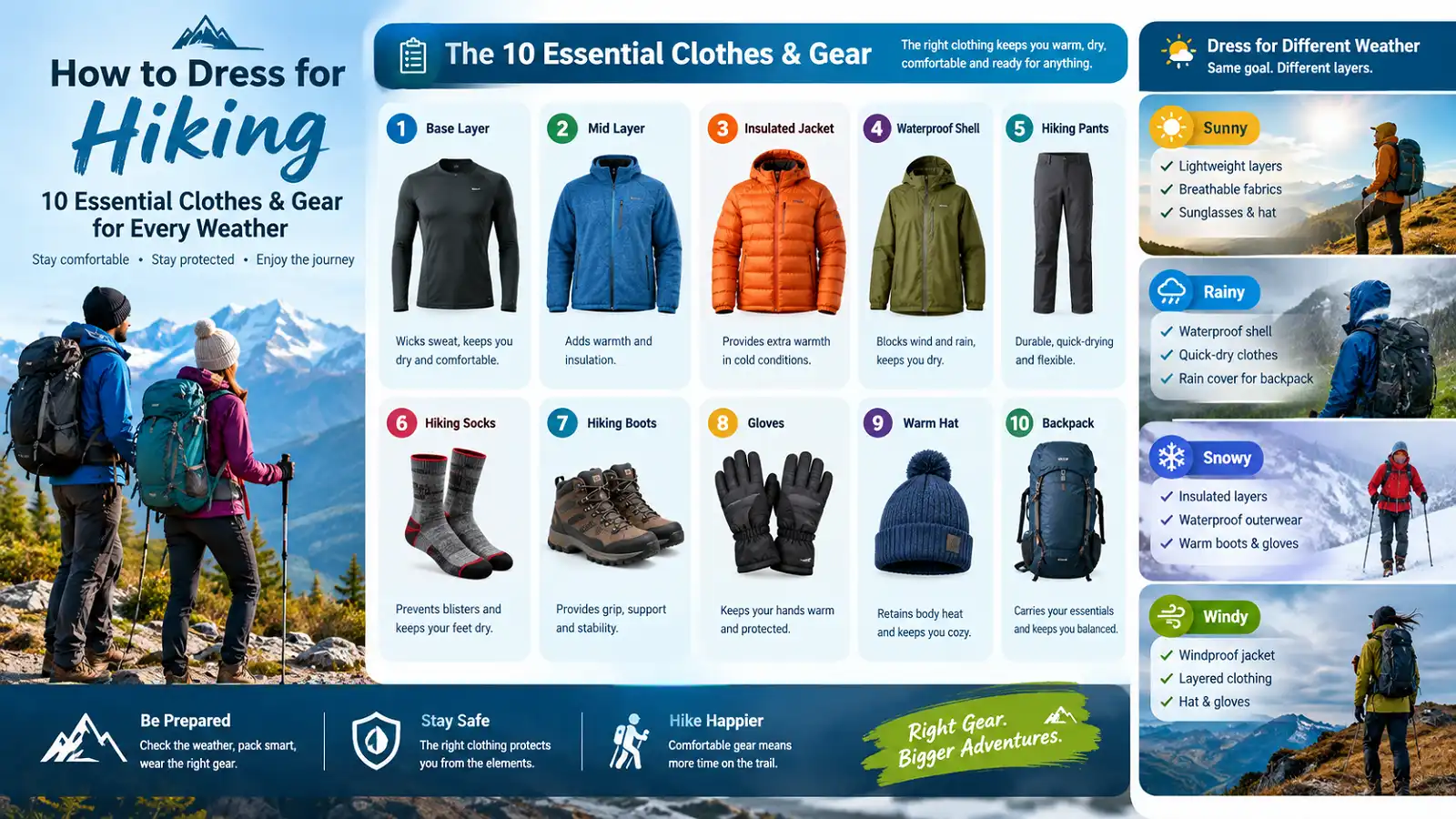
10 Essential Clothes & Gear for Hiking
Here is the gear breakdown I would use when building a hiking wardrobe.
Important: prices change frequently, especially on Amazon. The prices below are approximate U.S. prices based on the product information available when this guide was researched. Sizes, colors, and availability can also vary.
The rankings below are the order used in this guide, not laboratory scores or a claim that one product is universally better than another.
| RankNameApprox. PriceColorSizeWeightFeaturesGear CapacityShort Description | ||||||||
|---|---|---|---|---|---|---|---|---|
| 1 | Smartwool Classic All-Season Merino Base Layer | \~$90 | Multiple | XS–XXL\* | \~7–9 oz\* | Merino, moisture management, odor resistance | N/A | Comfortable next-to-skin layer for cool to moderate conditions |
| 2 | Outdoor Research Ferrosi Pants | $99–$110 | Black, Pewter, Pro Khaki, others | 28–42\* | 12.7 oz / 360 g | Stretch, breathable, quick-drying, water/wind resistant, UPF 50+ | N/A | Versatile hiking pants for changing trail conditions |
| 3 | REI Co-op Screeline Alpha Hoodie | \~$100 | Multiple | Multiple | 5.3 oz / \~150 g | Polartec Alpha Direct, lightweight, breathable, fast drying | N/A | Lightweight insulating midlayer |
| 4 | Zpacks Vertice Rain Jacket | $299 | Multiple | Multiple | 5.4 oz / 152 g men’s | Waterproof, breathable, ultralight | N/A | Lightweight shell for rain and wind |
| 5 | Zpacks Vertice Rain Pants | $159 | Black/other options | Multiple | 2.5 oz / 72 g | Waterproof, breathable, packs small | N/A | Rain protection for legs without much added weight |
| 6 | Salomon X Ultra 4 Mid GTX | \~$160–$180 | Multiple | Multiple | Varies by size | GORE-TEX, trail traction, supportive construction | N/A | Waterproof hiking boot for wet and uneven trails |
| 7 | Darn Tough Hiker Micro Crew Cushion | \~$25–$30 | Multiple | Multiple | Varies by size | Merino blend, cushioning, moisture management | N/A | Durable hiking sock for long trail days |
| 8 | Outdoor Research Sun Runner Cap | \~$40–$50 | Multiple | S–XL\* | Lightweight | Sun coverage, removable neck protection | N/A | Useful for exposed summer trails |
| 9 | Salomon Trailblazer 20 | \~$60–$70 | Multiple | 20L | 14.6 oz / 414 g | Adjustable harness, breathable back panel, hydration compatibility | 20 L | Compact daypack for clothing, water, food and essentials |
| 10 | Hiking Dress / Trail Dress | \~$70–$150+ | Multiple | Multiple | Varies | Lightweight, breathable, unrestricted movement | N/A | A practical warm-weather alternative to pants or shorts |
\*Sizing and weight vary by model, gender, and size. Always confirm the current manufacturer’s specifications before purchasing.
Outdoor Research lists the Ferrosi Pants at 12.7 oz/360 g and describes them as breathable, quick-drying, water- and wind-resistant, stretchy, abrasion-resistant, and UPF 50+.
Zpacks currently lists the Vertice Rain Jacket at 5.4 oz/152 g for the men’s version and the Vertice Rain Pants at 2.5 oz/72 g.
The Salomon Trailblazer 20 is listed at 14.6 oz with a 20-liter capacity and includes features such as an adjustable chest strap, hydration-tube routing, pole attachments, and a breathable back panel.
Moisture-Wicking Base Layer
Smartwool Classic All-Season Merino Base Layer on Amazon
Your shirt is probably the simplest hiking clothing decision, but it is also one of the easiest places to make a mistake.
A regular cotton T-shirt might feel perfectly comfortable when you leave the house. Then the trail climbs, your heart rate goes up, and that shirt becomes soaked with sweat.
The problem isn’t that cotton is uncomfortable.
The problem is what happens afterward.
A wet shirt can leave you cold when the wind hits or when you stop moving.
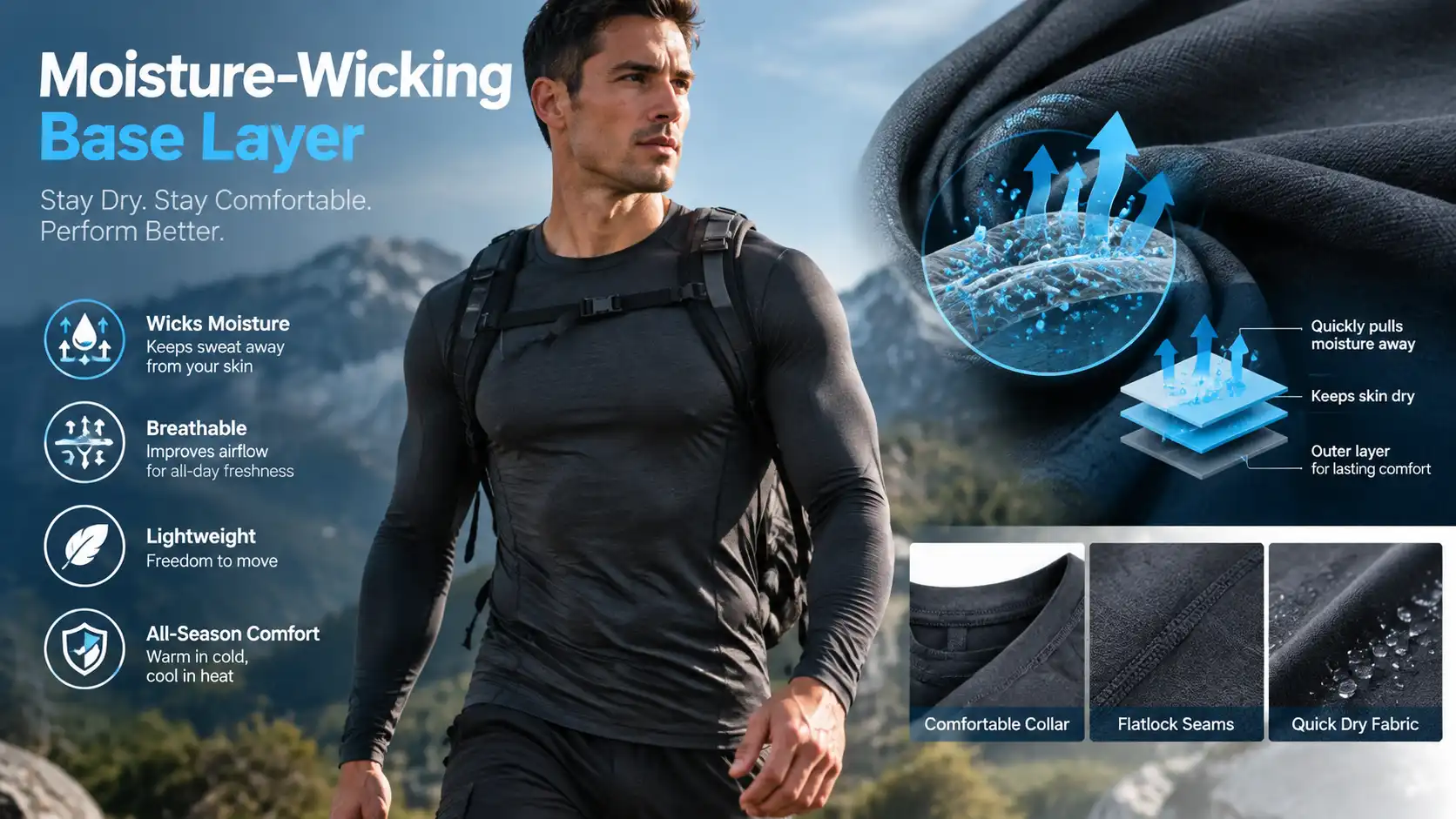
For hiking, I generally look for:
- Merino wool
- Polyester
- Nylon blends
- Moisture-wicking construction
- Quick-drying fabric
- Comfortable fit
- Flat seams when possible
Merino is particularly useful when you want odor resistance and temperature regulation, while synthetic fabrics are often lighter, faster-drying, and less expensive.
REI similarly recommends polyester, nylon, or merino for hiking base layers because they manage moisture better than cotton.
When to wear a long-sleeve hiking shirt
Use a lightweight long-sleeve shirt when:
- The sun is strong
- You are hiking through brush
- Temperatures are mild
- Bugs are a concern
- You want additional sun protection
In hot weather, a thin long-sleeve shirt can actually feel better than exposing your arms all day.
Hiking Pants or Shorts
Outdoor Research Ferrosi Pants on Amazon
Your bottom layer needs to move with you.
That sounds obvious until you’re halfway up a steep trail and realize your pants don’t bend comfortably at the knees.
Good hiking pants should allow a long stride, climbing movement, and sitting on rocks without fighting your body.
The Outdoor Research Ferrosi Pants are a good example of this approach. The current model uses a recycled nylon blend with stretch and is designed to be breathable, quick-drying, wind-resistant, water-resistant, and abrasion-resistant.
I look for:
- Stretch
- Breathability
- Quick drying
- Secure pockets
- Comfortable waistband
- Articulated knees
- Reasonable abrasion resistance
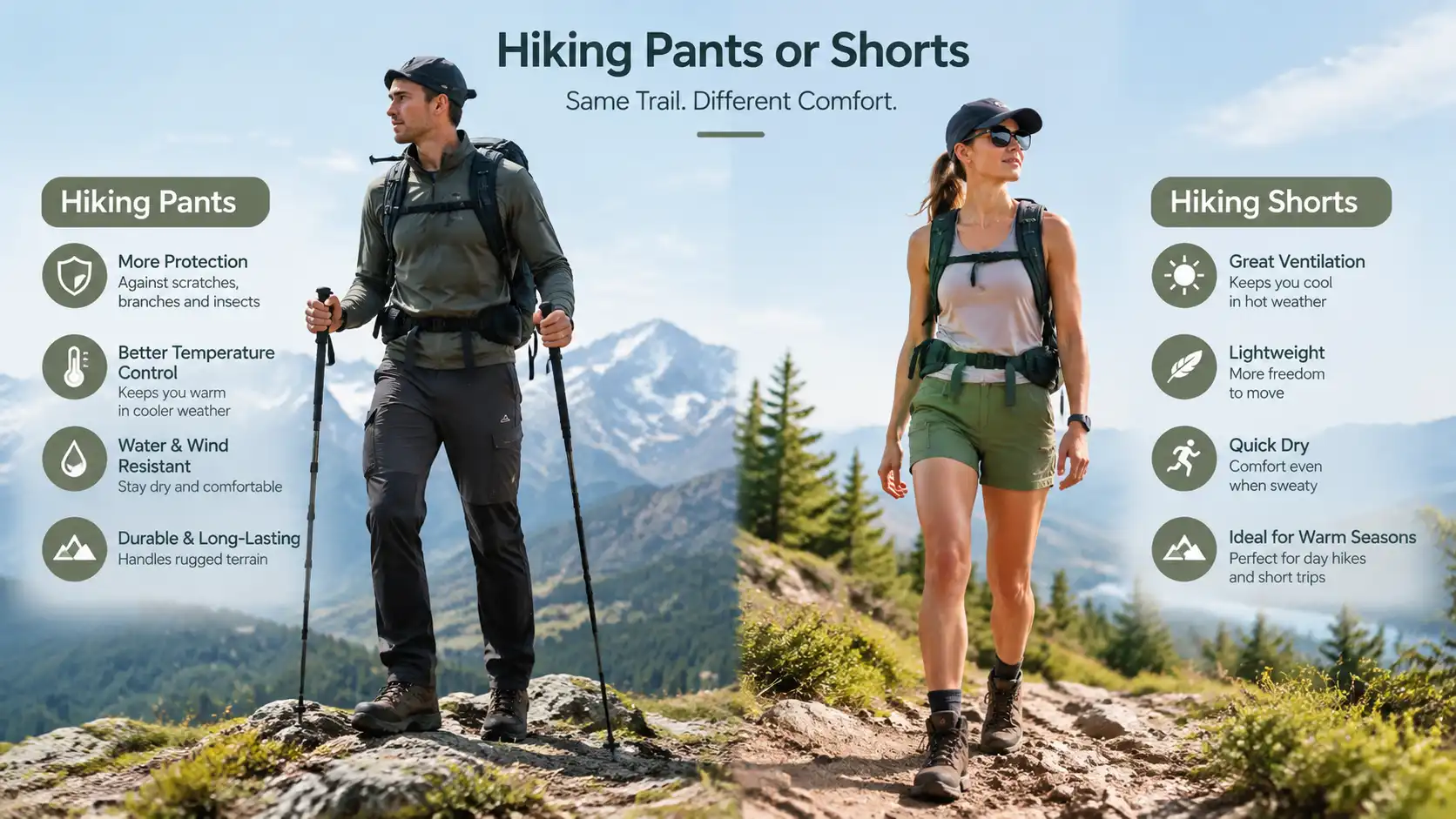
For hot, dry trails, shorts can make more sense.
For brushy trails, cooler weather, or routes with lots of exposed rock, lightweight pants offer more protection.
What about hiking leggings?
Leggings can work perfectly well for hiking if they are comfortable, durable enough for the terrain, and allow unrestricted movement.
You don’t need a product labeled “hiking pants” simply because you’re hiking.
The trail doesn’t care what the tag says.
Fleece or Lightweight Insulating Layer
Fleece or Lightweight Insulating Layer on Amazon
This is the layer you appreciate when the temperature drops.
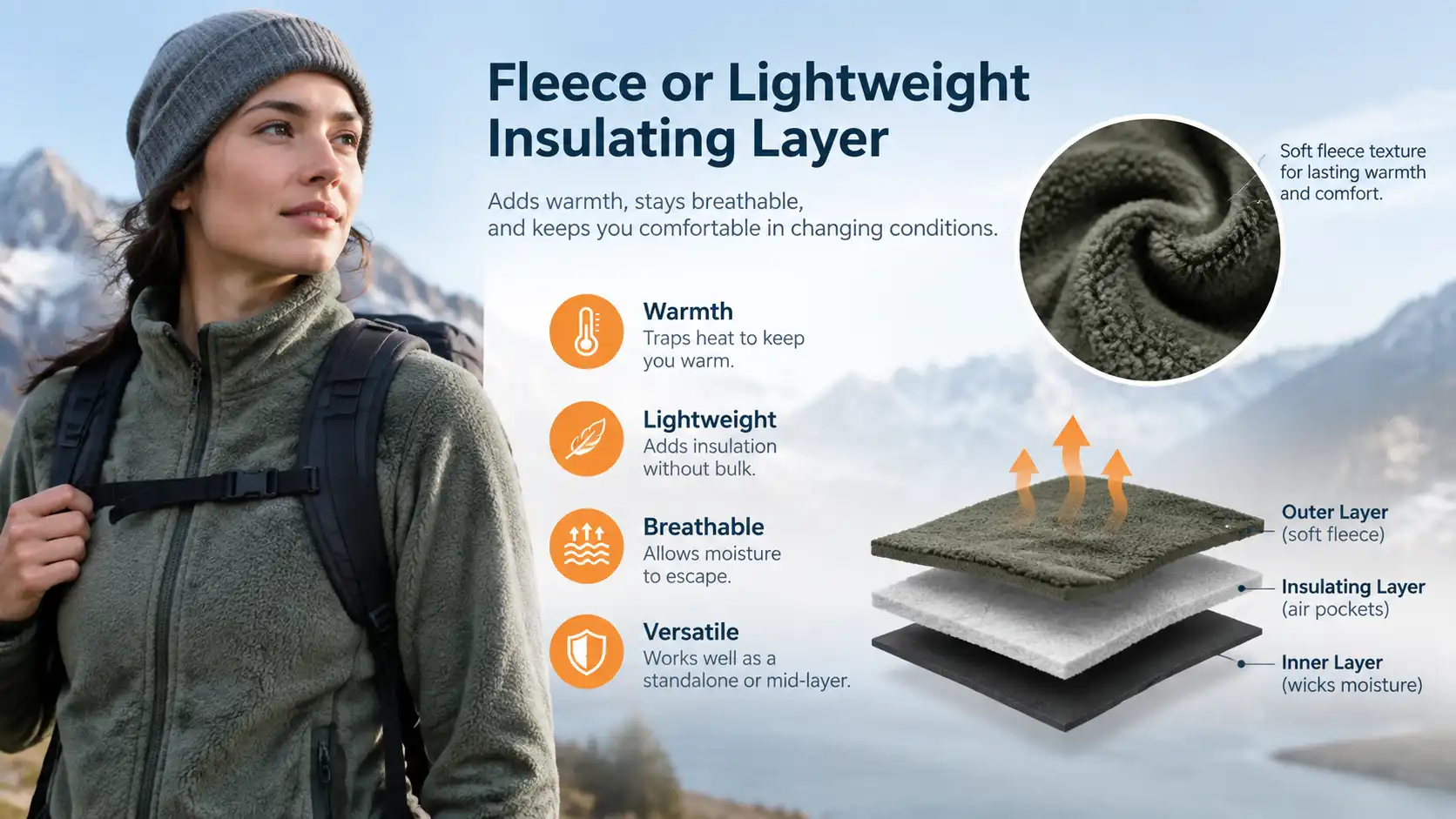
A lightweight fleece works particularly well because it can provide warmth while still allowing moisture to escape.
For backpacking, weight becomes more important.
Adventure Alan’s current ultralight gear list, for example, highlights the REI Co-op Screeline Alpha as a 5.3-ounce Polartec Alpha Direct midlayer.
That’s the kind of thinking I like for longer trips: don’t carry a giant jacket when a much lighter layer can solve the problem.
For normal day hiking, though, you don’t need to obsess over every ounce.
A comfortable fleece that you already own may be a perfectly good hiking layer.
Waterproof Rain Jacket
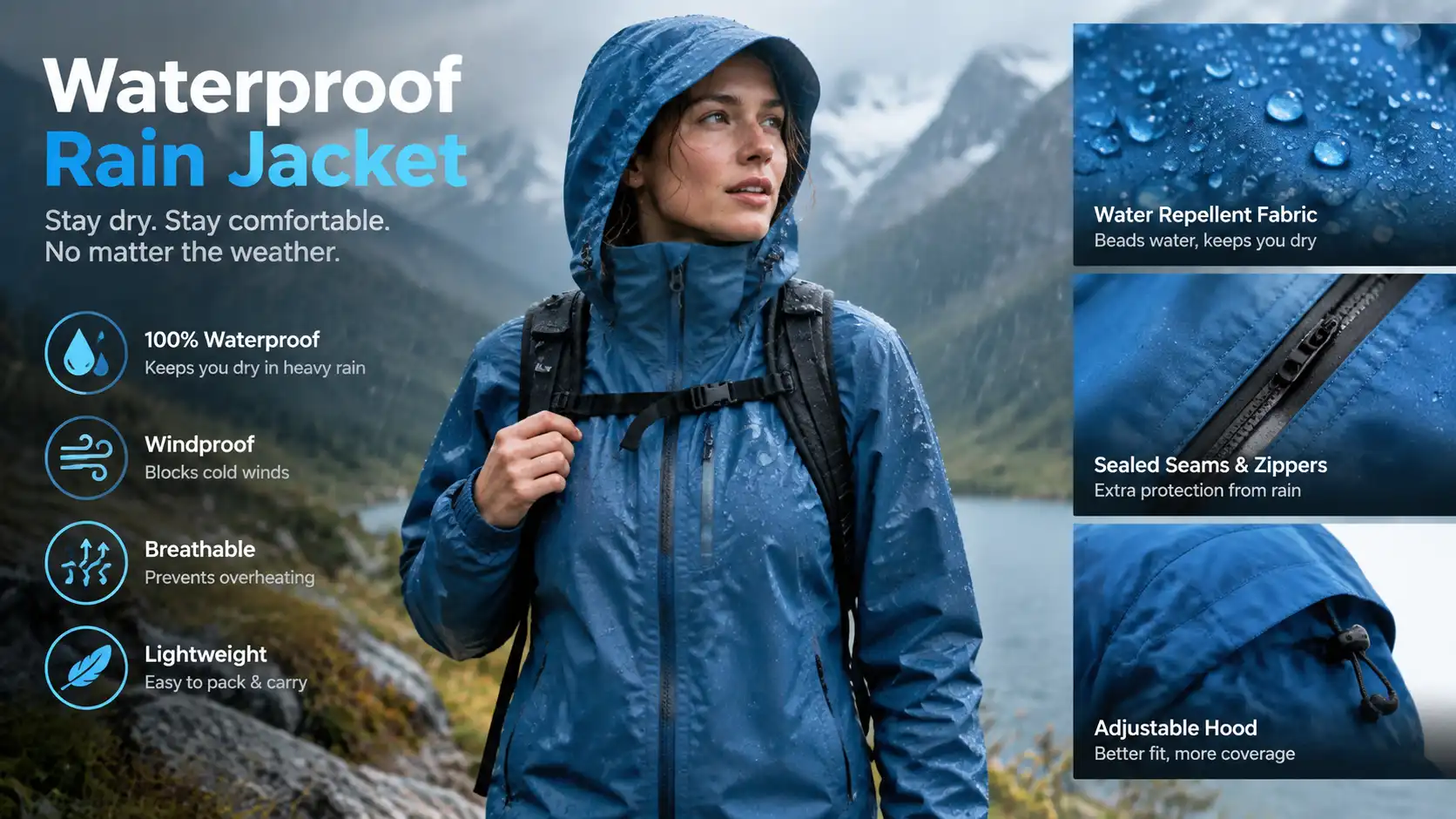
Zpacks Vertice Rain Jacket on Amazon
If there is one piece of clothing I would rather carry and not use than desperately need and not have, it’s a rain jacket.
Weather changes.
A forecast that looks harmless at the trailhead can look very different two hours later.
The best hiking rain jackets balance three things:
- Waterproofing
- Breathability
- Weight
You don’t want rain coming through the jacket, but you also don’t want to feel like you’re hiking inside a plastic bag.
For ultralight hikers, the Zpacks Vertice Rain Jacket is an interesting example. Zpacks currently lists the men’s version at 5.4 ounces/152 grams and $299.
That’s an expensive shell, so it isn’t automatically the right choice for everyone.
For a beginner doing occasional day hikes, a less expensive waterproof-breathable jacket can make much more financial sense.
The important part is carrying appropriate rain protection when the forecast and trail conditions call for it.
Rain Pants or Lower-Body Protection
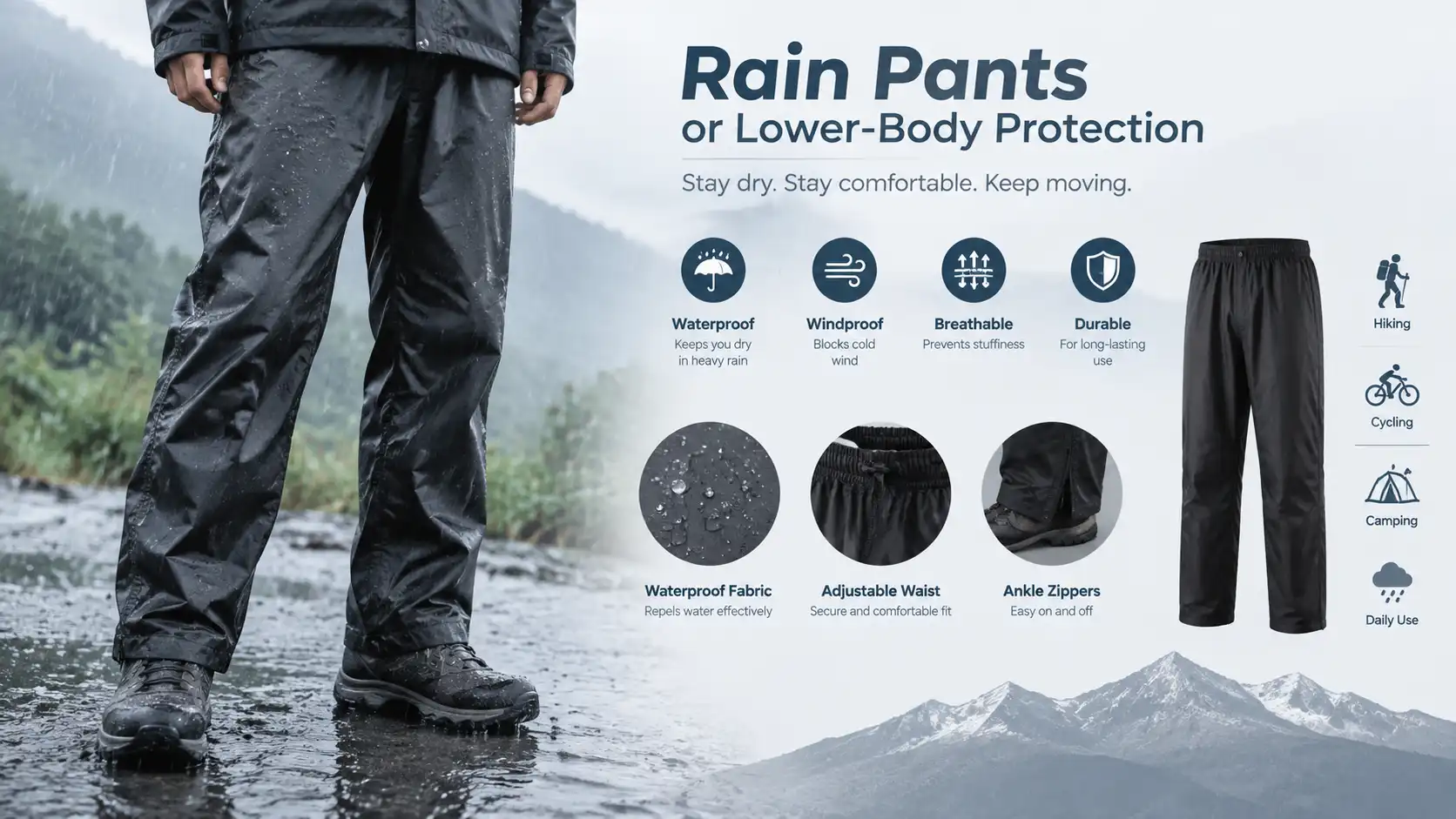
Zpacks Vertice Rain Pants on Amazon
People often remember the rain jacket and forget their legs.
I did this myself.
A wet jacket keeps your upper body reasonably protected, but if you’re walking through steady rain for hours, soaked pants can become just as miserable.
Rain pants are particularly useful for:
- Heavy rain
- Cold rain
- Snow
- Long exposed hikes
- Backpacking trips
- Wet brush
The Zpacks Vertice Rain Pants weigh only 2.5 ounces/72 grams according to the current manufacturer listing. They’re designed to fit over hiking pants and provide waterproof protection without much weight.
For a short summer hike where a quick shower is the only concern, you might decide that rain pants aren’t worth carrying.
For an all-day wet-weather trip, I’d think differently.
Hiking Boots or Trail Shoes
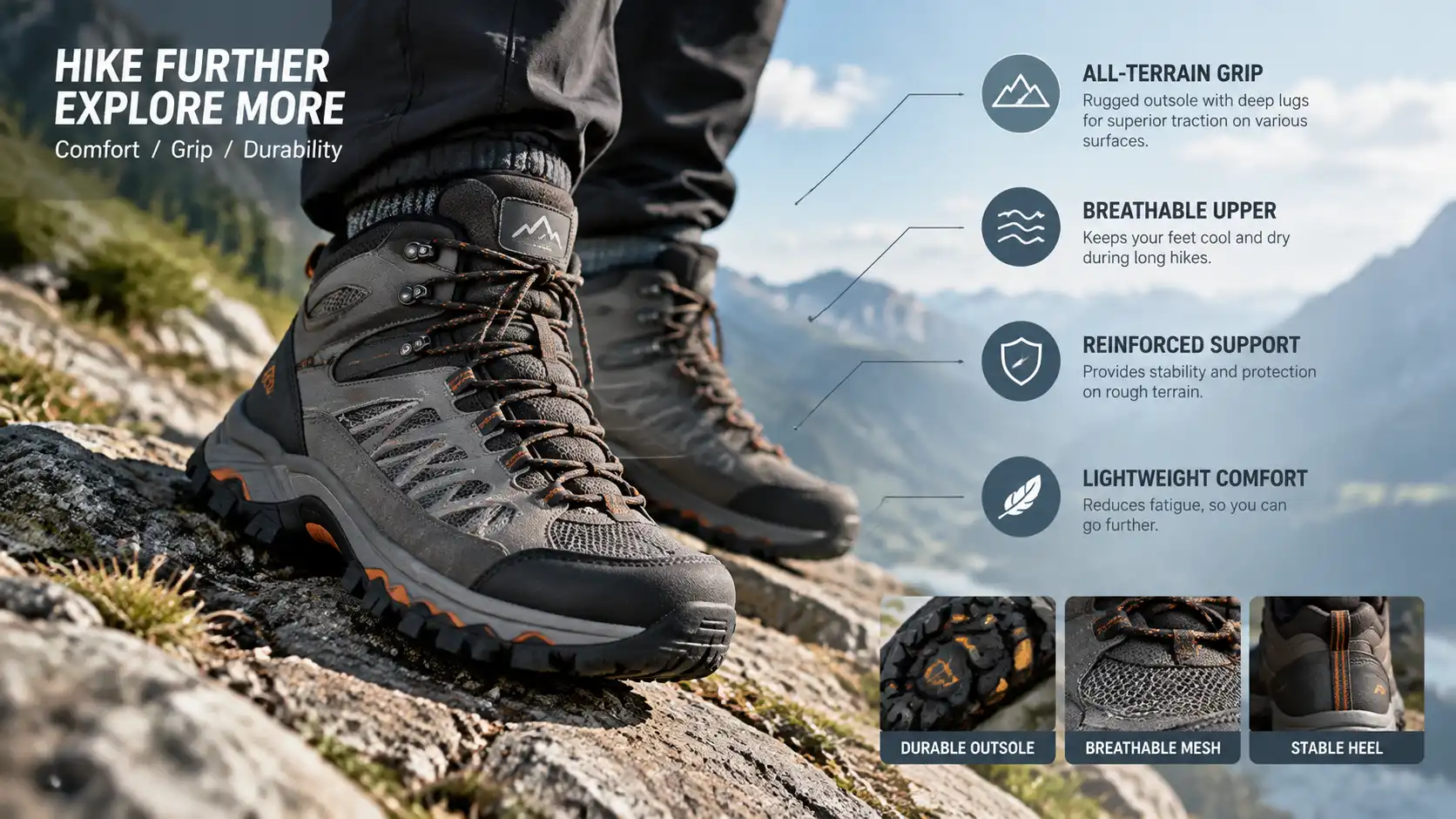
Salomon X Ultra 4 Mid GTX on Amazon
This is where personal preference matters more than people sometimes admit.
You do not automatically need heavy hiking boots.
On many maintained trails, lightweight trail shoes are completely reasonable. On rocky, wet, rough, or heavily loaded hikes, a more supportive hiking boot may make more sense.
The key questions are:
- Does it fit your foot?
- Does the sole grip the terrain?
- Is it comfortable after several hours?
- Does it protect your feet appropriately?
- Is it appropriate for the conditions?
A waterproof boot can be useful in wet conditions, but waterproof footwear isn’t always better.
If you are hiking in hot, dry weather and frequently crossing streams, a breathable shoe may be more comfortable.
If you are hiking in cold rain or snow, waterproofing becomes much more valuable.
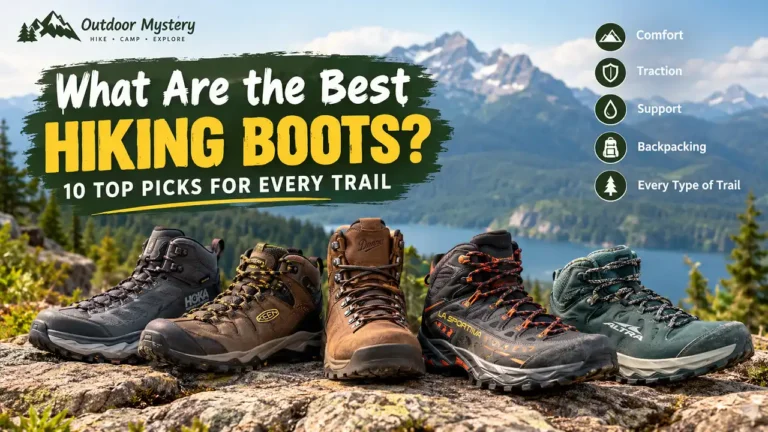
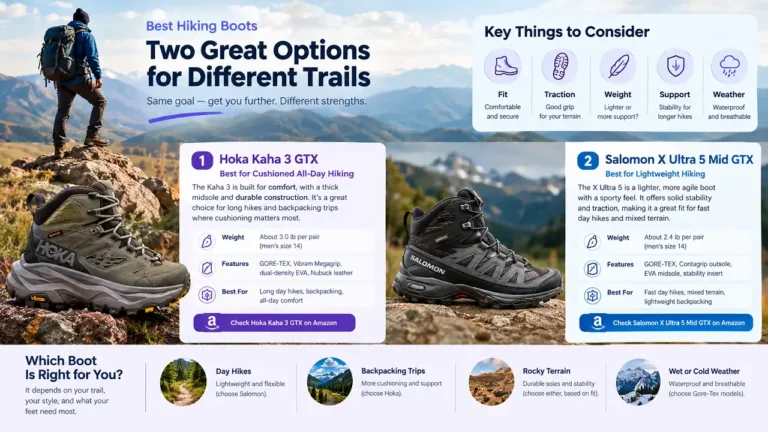
I’ve written more about this in the Outdoor Mystery guides on hiking boots and walking and choosing footwear for the trail.
The larger lesson is simple:
Buy footwear for your trail, not because it looks like hiking footwear.
Hiking Socks
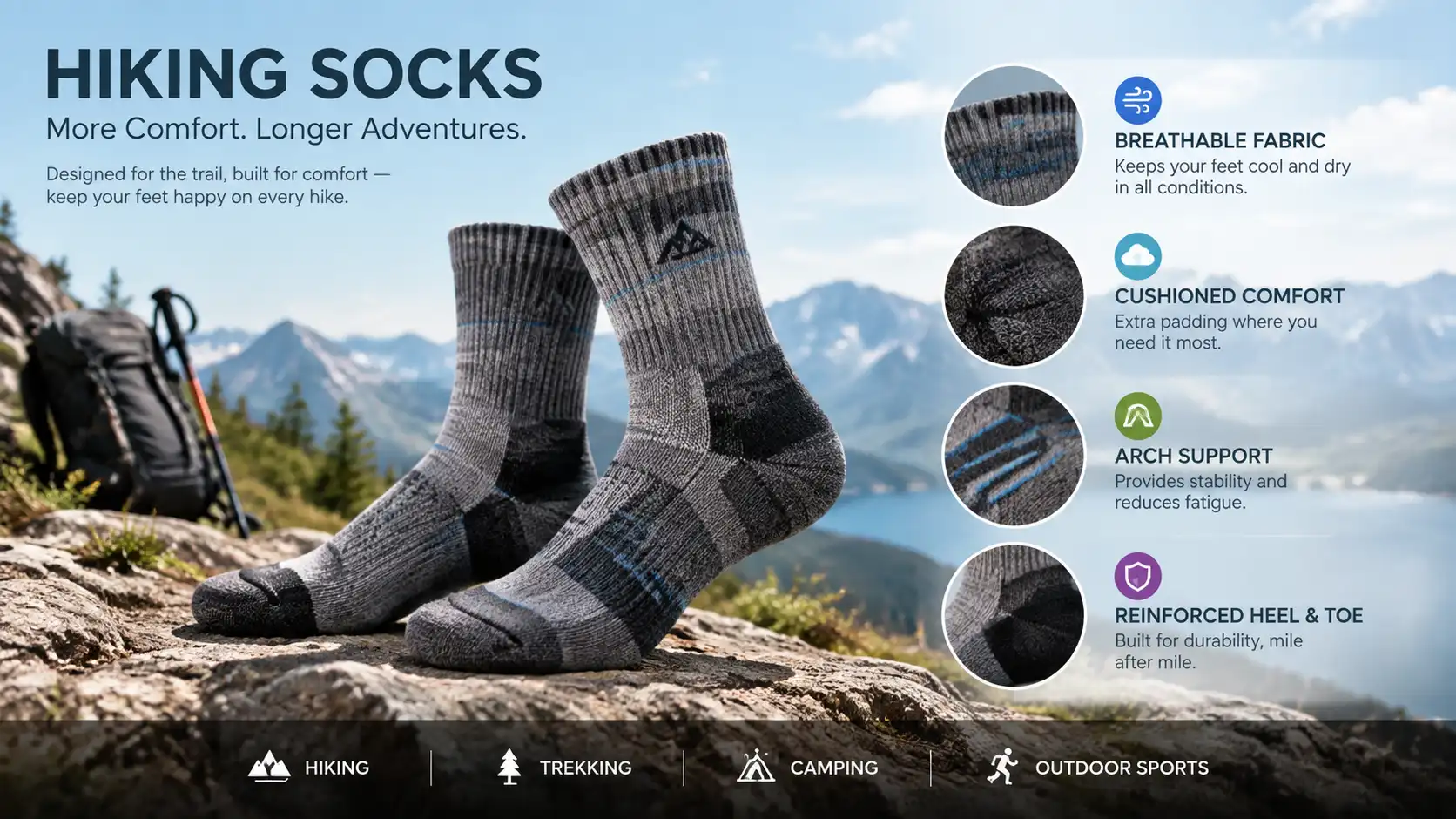
Darn Tough Hiker Micro Crew Cushion on Amazon
Never underestimate socks.
A great pair of boots with terrible socks can still give you a terrible hike.
Your socks should manage moisture, fit without bunching, and provide enough cushioning for your footwear.
Merino wool is popular because it can manage moisture and resist odor, while synthetic hiking socks can dry quickly and often cost less.
I generally avoid cotton socks for serious hikes.
If your feet sweat heavily, experiment with different thicknesses rather than simply buying the thickest sock you can find.
Fit matters.
A thick sock inside an already-tight boot can create pressure points.
A sock that’s too loose can bunch up.
And both can contribute to hot spots and blisters.
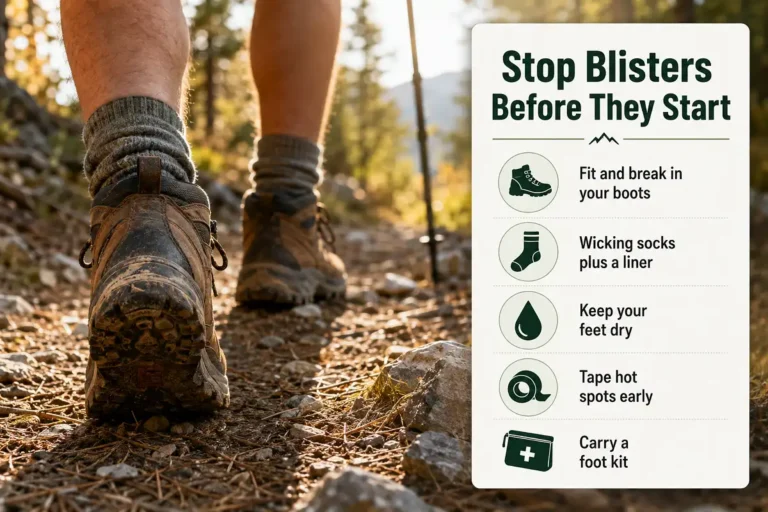
If you regularly struggle with foot pain, my guide on how to avoid blisters while hiking goes deeper into the friction, moisture, and fit problem.
Hat and Sun Protection
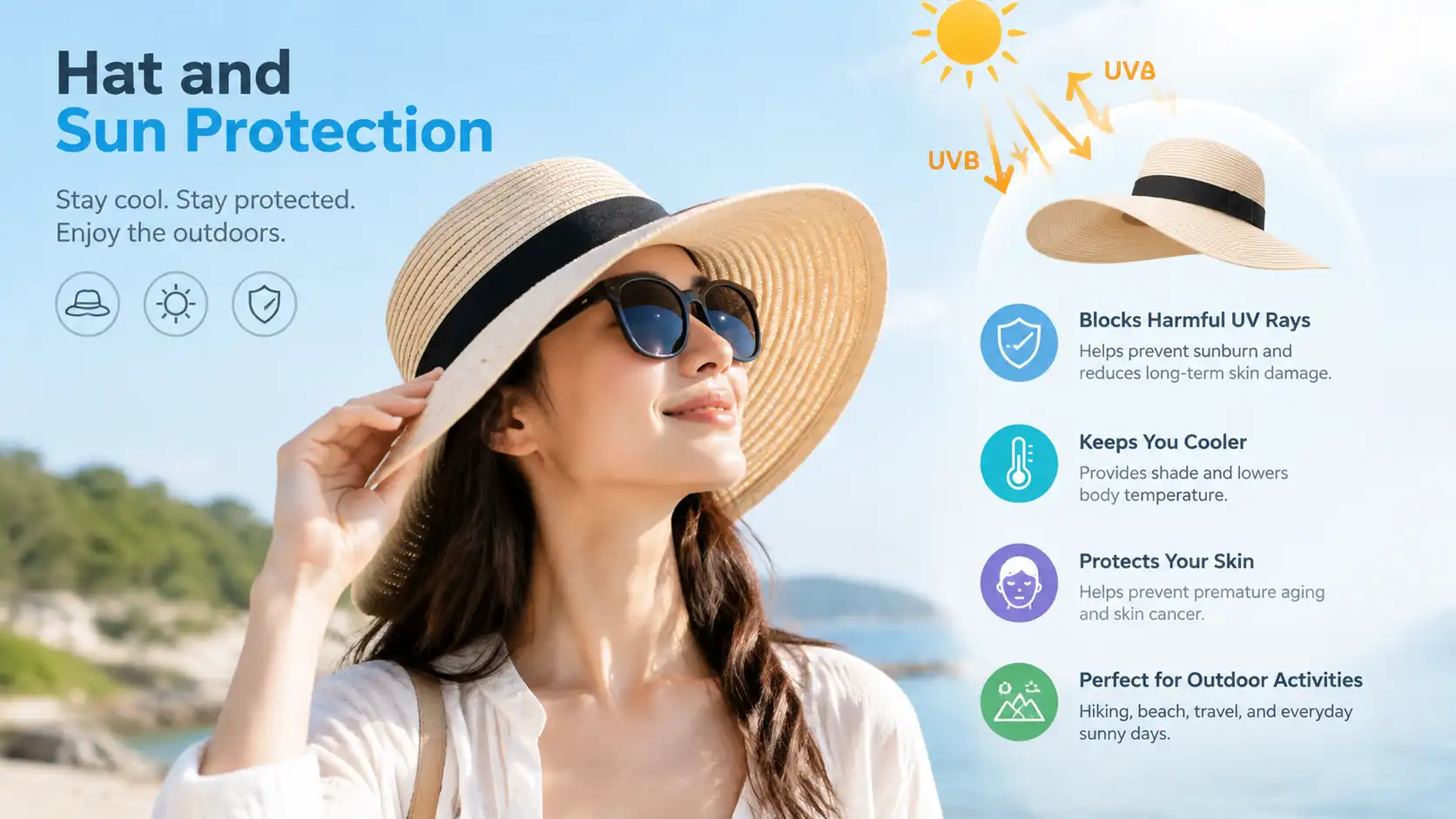
Outdoor Research Sun Runner Cap on Amazon
A hiking hat does more work than it gets credit for.
On exposed trails, your head and face can take hours of direct sun.
A simple cap can help, but a broader-brim or neck-covering design can provide more protection.
For hot and exposed trails, look for:
- Breathable fabric
- Ventilation
- Adjustable fit
- Sun protection
- Quick drying
- Lightweight construction
A sun hat is particularly useful when there isn’t much shade.
And don’t forget sunglasses.
Your hiking outfit isn’t complete just because your shirt and pants are right.
Sunglasses
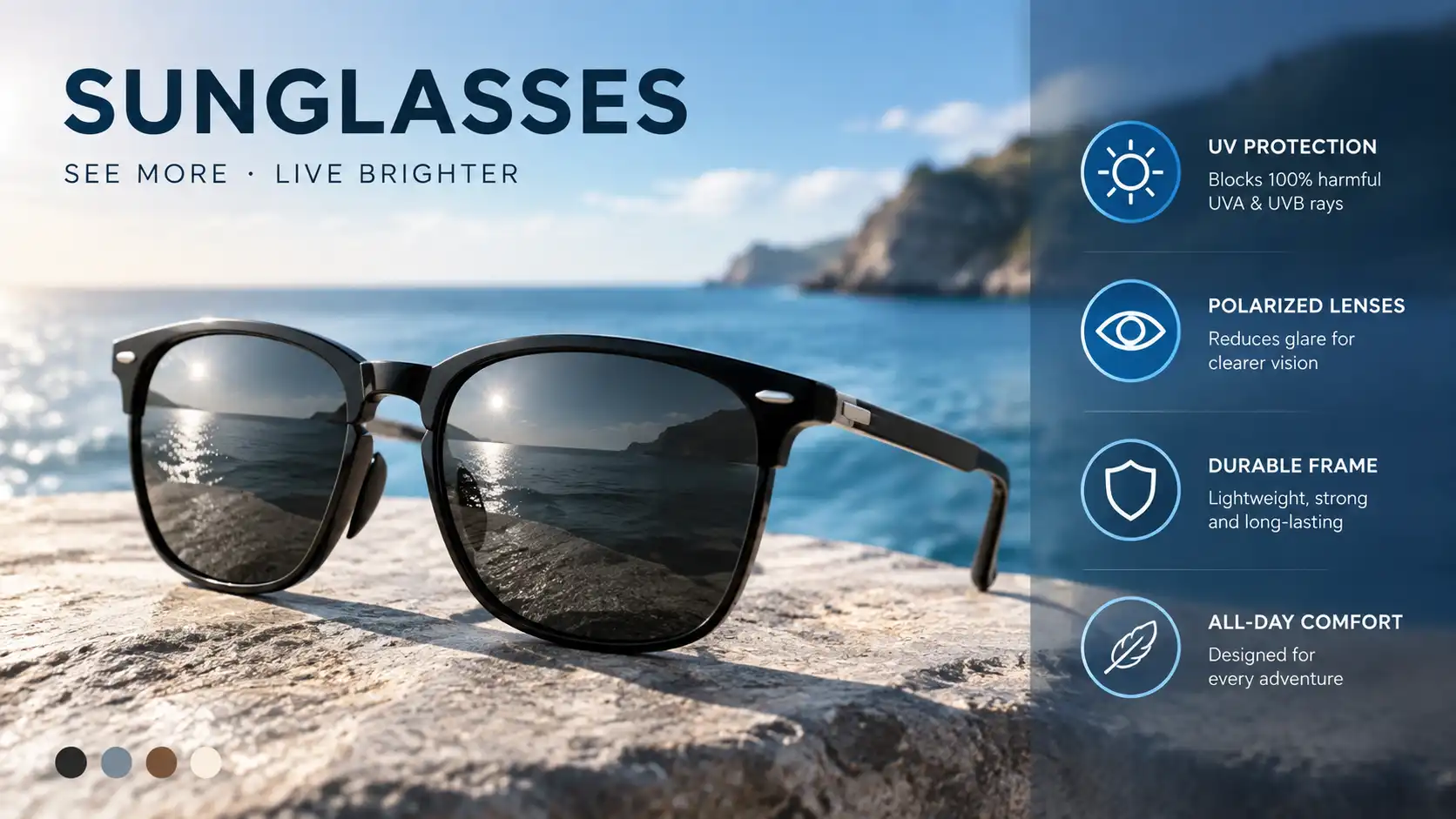
Sunglasses are both a comfort item and eye protection.
They’re especially useful around:
- Snow
- Water
- Exposed rock
- High-altitude terrain
- Open desert
- Bright summer trails
You don’t need an expensive pair just because you’re hiking.
Look for comfortable coverage, good UV protection, secure fit, and lenses suitable for the light conditions.
If you’re hiking in dense forest most of the day, extremely dark lenses may be unnecessary.
If you’re walking across exposed terrain, better coverage can make a noticeable difference.
A Small Hiking Daypack
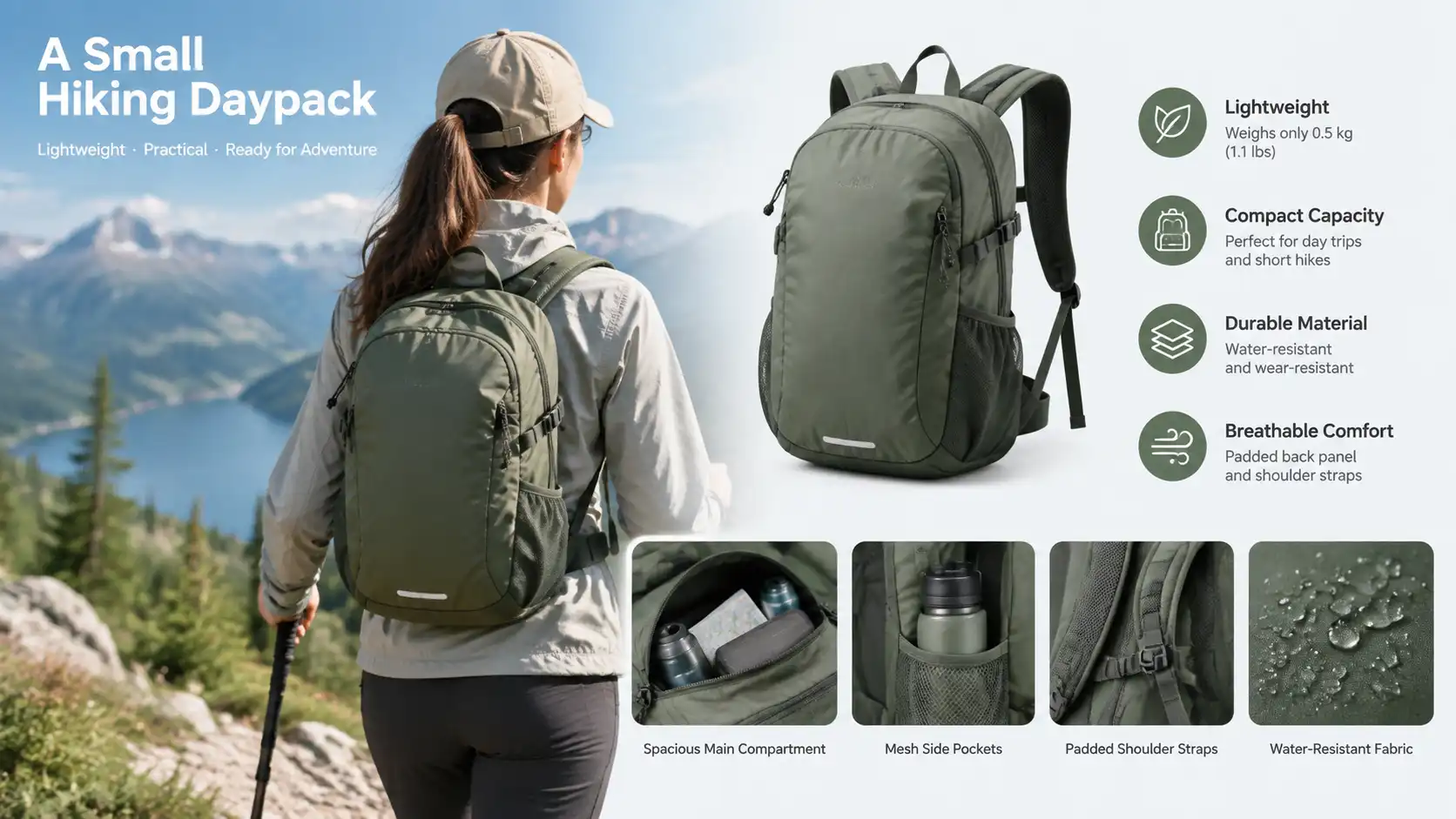
Small Hiking Daypack on Amazon
Technically, a backpack isn’t clothing.
But when you’re figuring out how to dress for hiking, your clothing system only works if you have somewhere to put the layers you aren’t wearing.
That’s why I include the daypack here.
You need room for things such as:
- Rain jacket
- Fleece
- Extra socks
- Water
- Food
- First-aid supplies
- Navigation equipment
- Phone
- Sunscreen
- Emergency items
A 20-liter pack is often plenty for a typical day hike if you pack efficiently.
The Salomon Trailblazer 20 is one example. Amazon currently lists a 20-liter version at about 14.6 ounces, with an adjustable harness, breathable back panel, hydration routing, and pole attachments.
You don’t need a huge backpack for every day hike.
One of my biggest rookie mistakes was carrying more than I needed.
A lighter pack is often a more comfortable pack.
What to Wear Hiking in Hot Weather
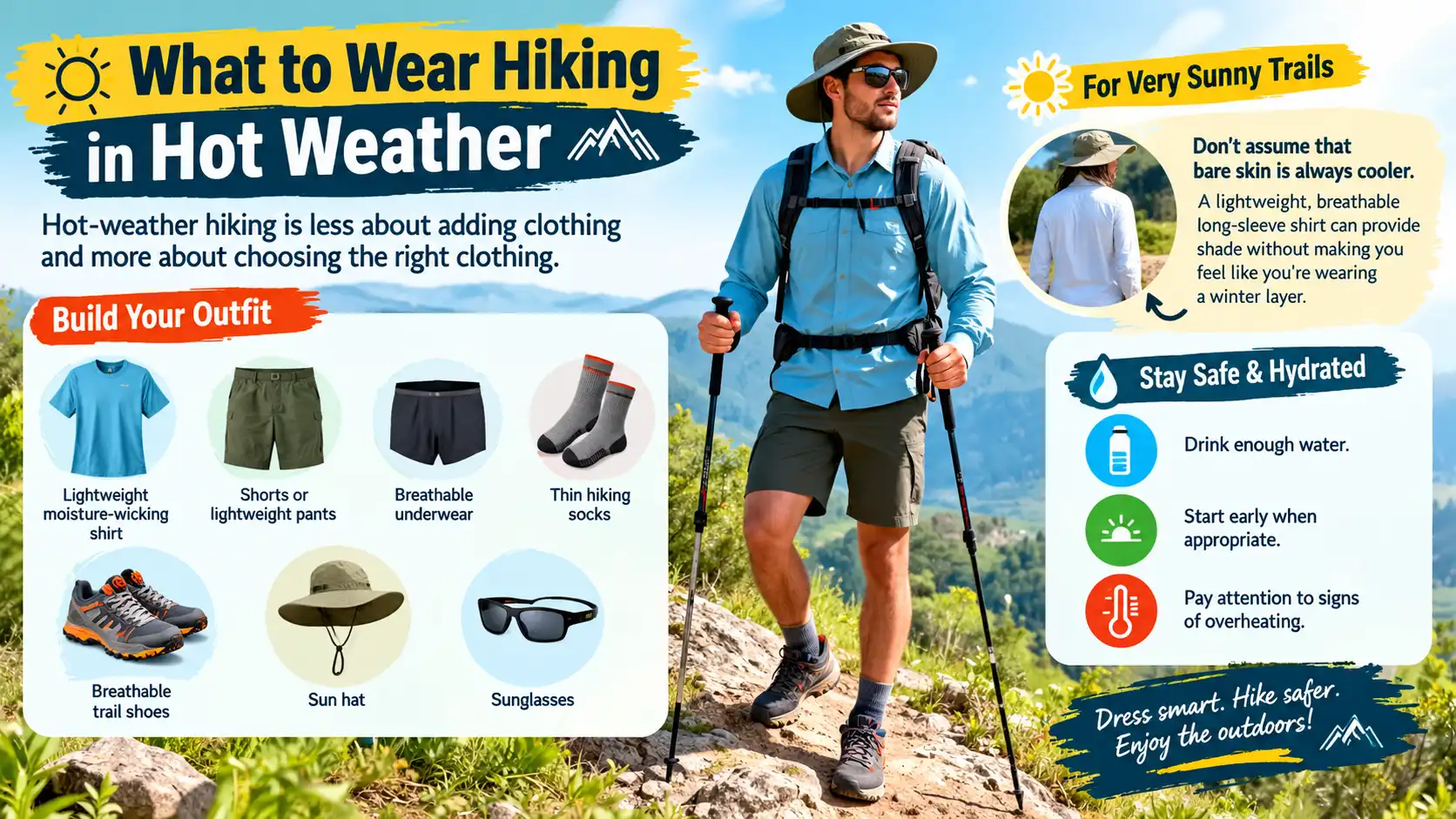
Hot-weather hiking is less about adding clothing and more about choosing the right clothing.
I’d build the outfit around:
- Lightweight moisture-wicking shirt
- Shorts or lightweight pants
- Breathable underwear
- Thin hiking socks
- Breathable trail shoes
- Sun hat
- Sunglasses
For very sunny trails, don’t assume that bare skin is always cooler.
A lightweight, breathable long-sleeve shirt can provide shade without making you feel like you’re wearing a winter layer.
Drink enough water, start early when appropriate, and pay attention to signs of overheating.
What to Wear Hiking in Cold Weather
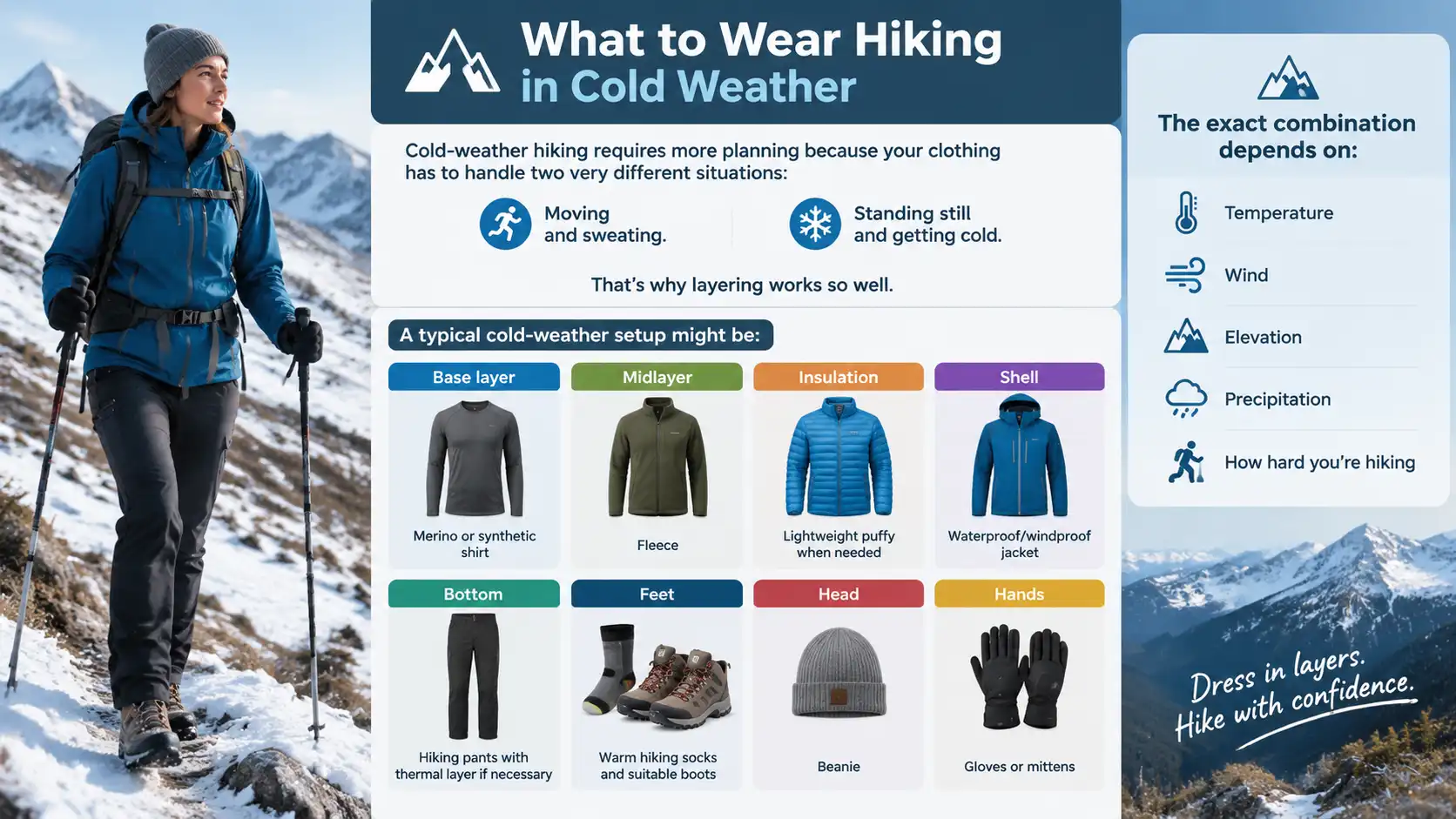
Cold-weather hiking requires more planning because your clothing has to handle two very different situations:
Moving and sweating.
Standing still and getting cold.
That’s why layering works so well.
A typical cold-weather setup might be:
Base layer: Merino or synthetic shirt
Midlayer: Fleece
Insulation: Lightweight puffy when needed
Shell: Waterproof/windproof jacket
Bottom: Hiking pants with thermal layer if necessary
Feet: Warm hiking socks and suitable boots
Head: Beanie
Hands: Gloves or mittens
The exact combination depends on temperature, wind, elevation, precipitation, and how hard you’re hiking.
For a more detailed winter breakdown, see the Outdoor Mystery guide on clothes for hiking in winter.
What to Wear Hiking in the Rain
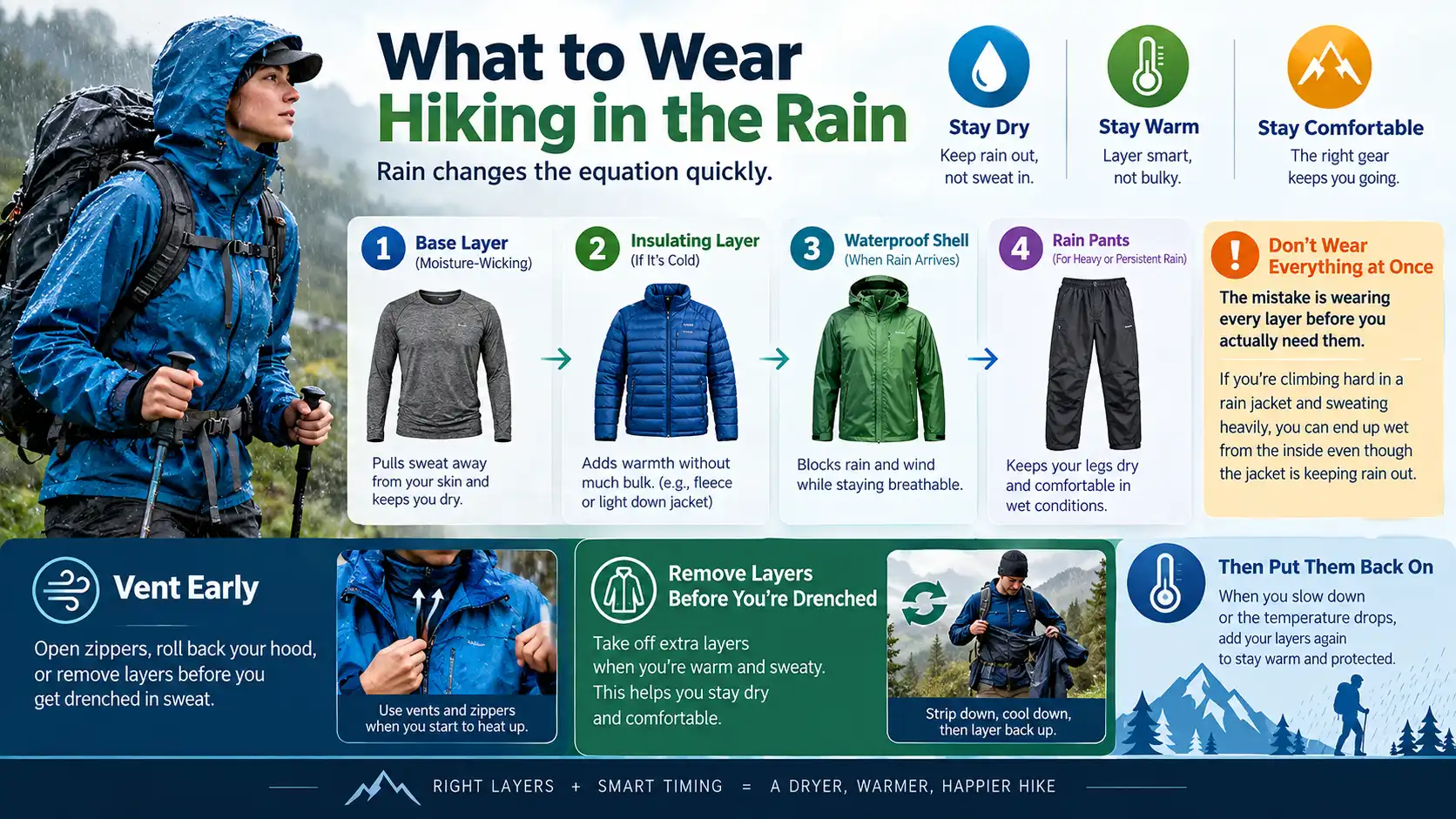
Rain changes the equation quickly.
Start with a moisture-wicking base layer.
Add a light insulating layer if it’s cold.
Then use a waterproof shell when the rain arrives.
If the rain is heavy or persistent, add rain pants.
The mistake is wearing every layer before you actually need them.
If you’re climbing hard in a rain jacket and sweating heavily, you can end up wet from the inside even though the jacket is keeping rain out.
Vent early.
Remove layers before you’re drenched in sweat.
Then put them back on when you slow down or the temperature drops.
What to Wear Hiking in Snow
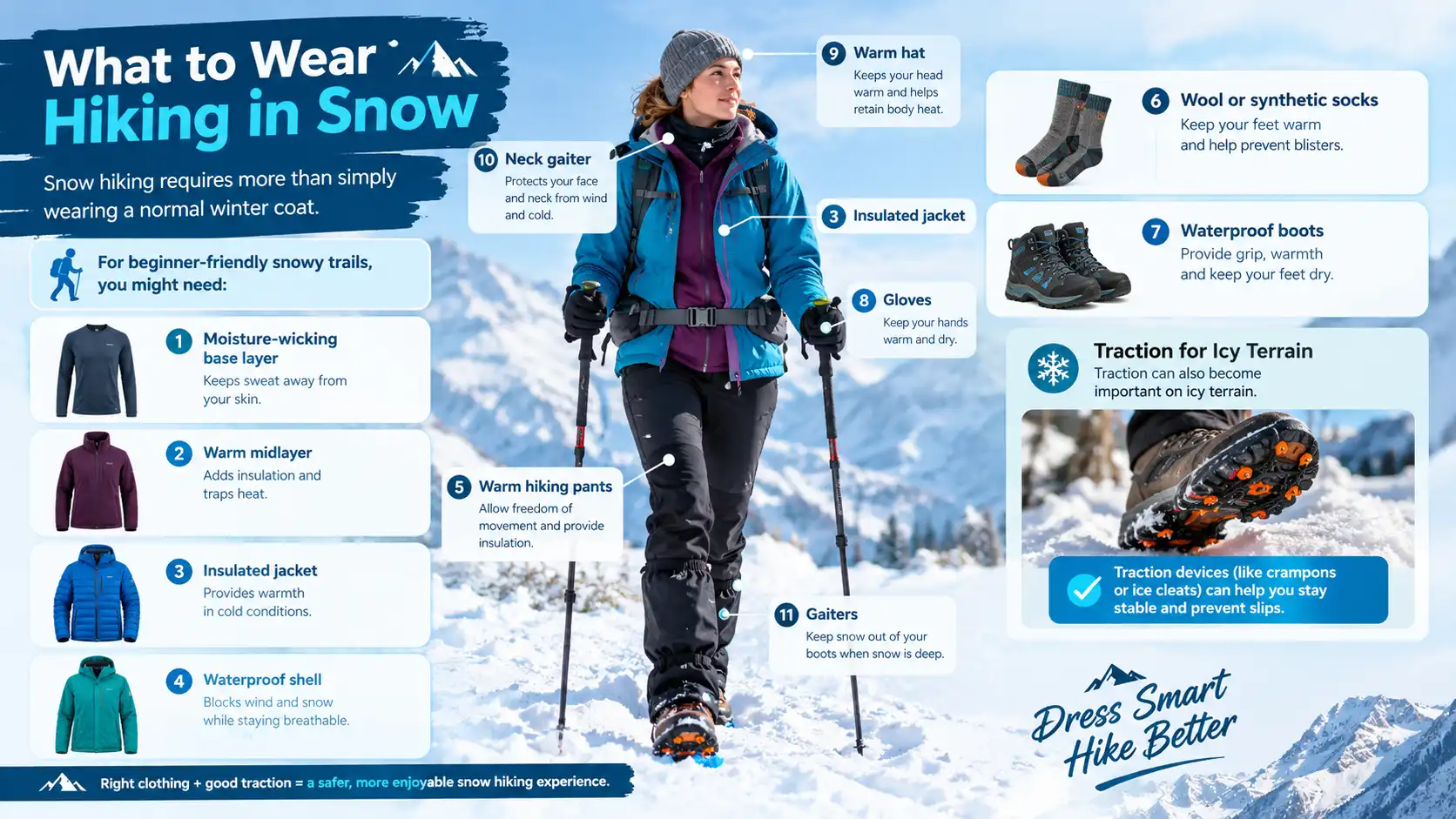
Snow hiking requires more than simply wearing a normal winter coat.
For beginner-friendly snowy trails, you might need:
- Moisture-wicking base layer
- Warm midlayer
- Insulated jacket
- Waterproof shell
- Warm hiking pants
- Wool or synthetic socks
- Waterproof boots
- Gloves
- Warm hat
- Neck gaiter
- Gaiters when snow is deep
Traction can also become important on icy terrain.
This is where hiking poles can help with stability, although they’re not mandatory for every trail. I wrote a separate beginner guide on whether you actually need hiking poles.
Can You Wear a Dress Hiking?
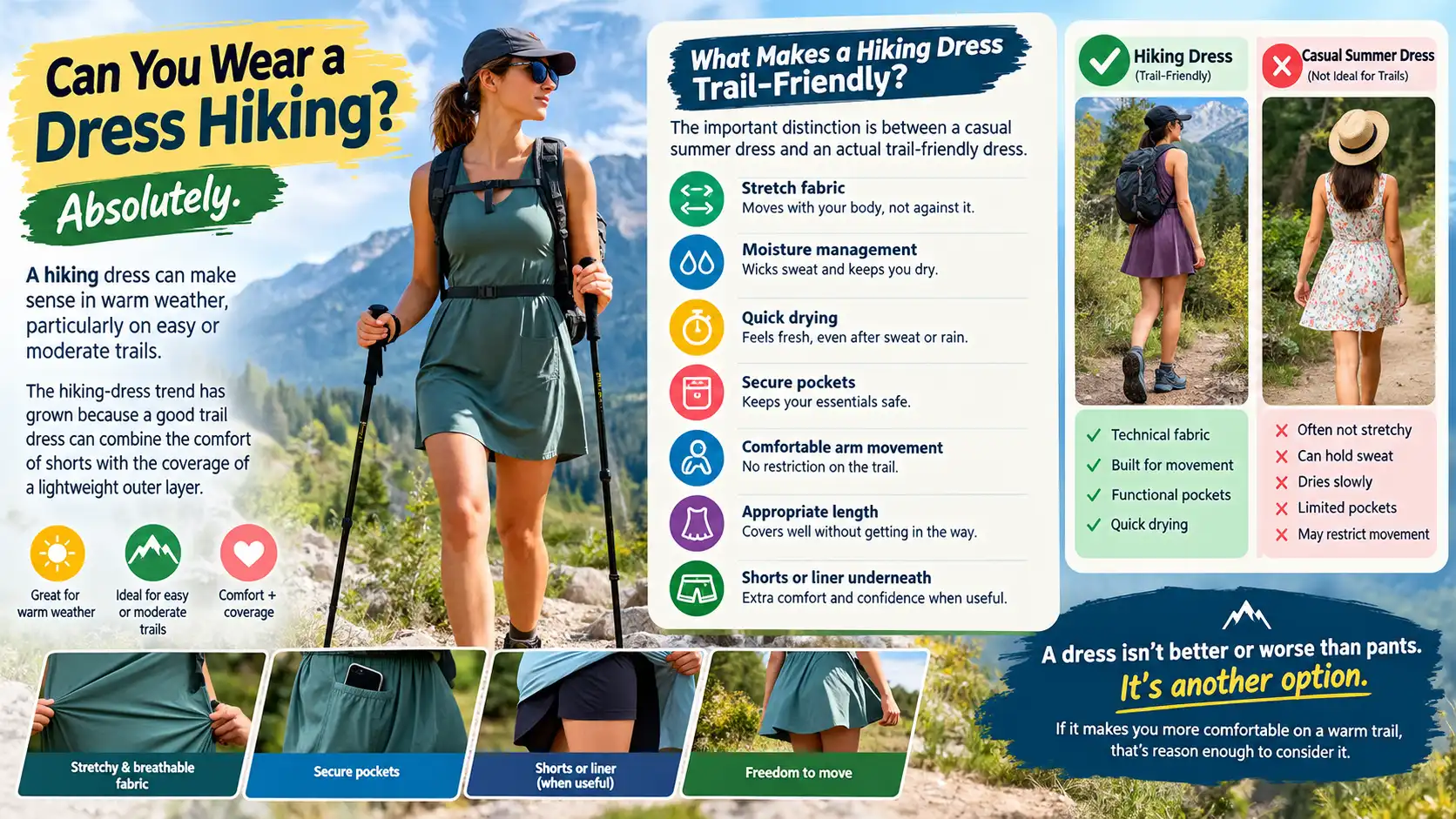
Absolutely.
A hiking dress can make sense in warm weather, particularly on easy or moderate trails.
The hiking-dress trend has grown because a good trail dress can combine the comfort of shorts with the coverage of a lightweight outer layer. Hiking-specific dresses are typically designed with stretch, quick-drying fabrics, pockets, and movement in mind.
The important distinction is between a casual summer dress and an actual trail-friendly dress.
For hiking, I would look for:
- Stretch fabric
- Moisture management
- Quick drying
- Secure pockets
- Comfortable arm movement
- Appropriate length
- Shorts or liner underneath when useful
A dress isn’t better or worse than pants.
It’s another option.
If it makes you more comfortable on a warm trail, that’s reason enough to consider it.
Hiking Clothes Mistakes I See Beginners Make
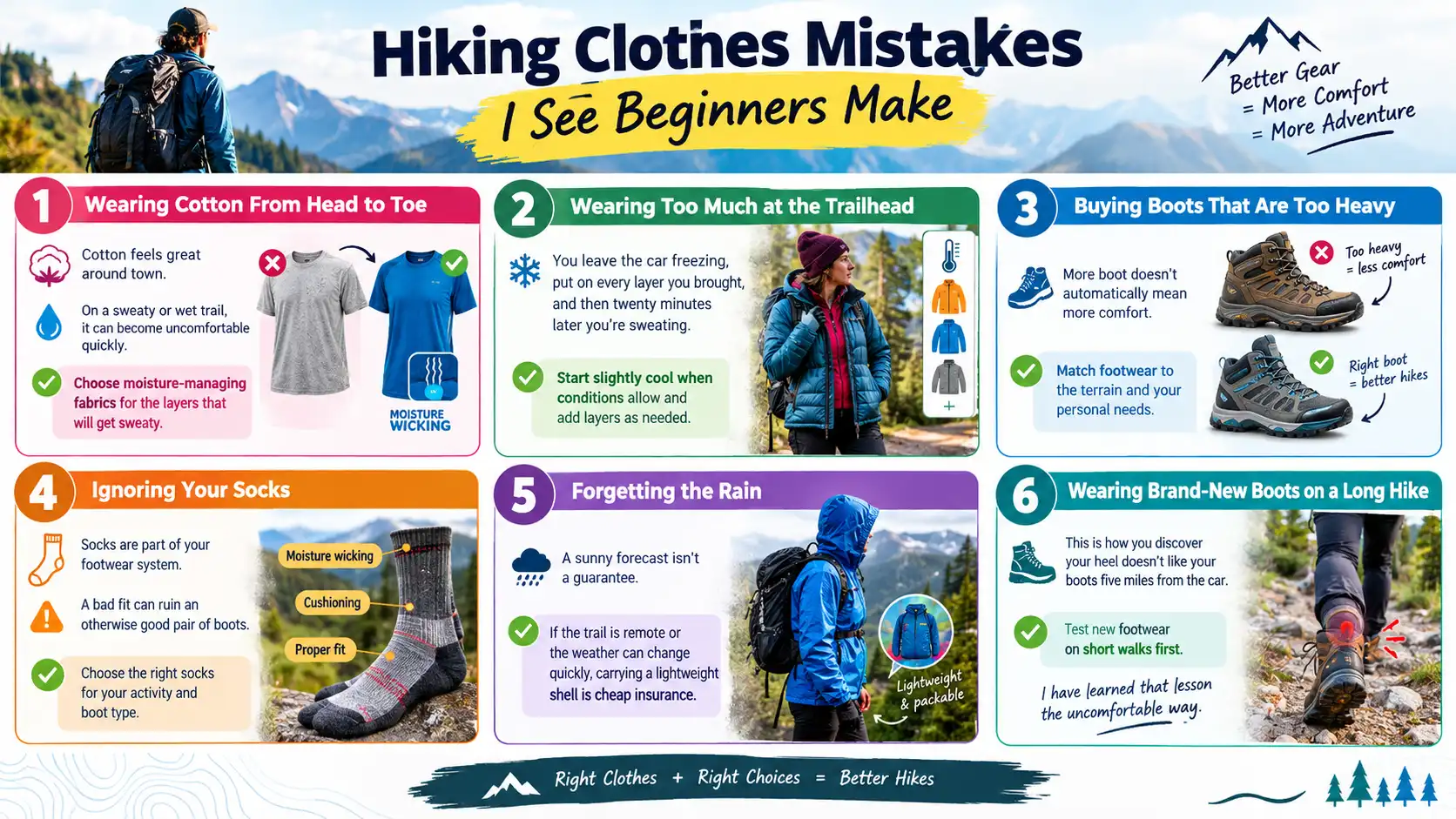
Wearing Cotton From Head to Toe
Cotton feels great around town.
On a sweaty or wet trail, it can become uncomfortable quickly.
Choose moisture-managing fabrics for the layers that will get sweaty.
Wearing Too Much at the Trailhead
You leave the car freezing, put on every layer you brought, and then twenty minutes later you’re sweating.
Start slightly cool when conditions allow and add layers as needed.
Buying Boots That Are Too Heavy
More boot doesn’t automatically mean more comfort.
Match footwear to the terrain and your personal needs.
Ignoring Your Socks
Socks are part of your footwear system.
A bad fit can ruin an otherwise good pair of boots.
Forgetting the Rain
A sunny forecast isn’t a guarantee.
If the trail is remote or the weather can change quickly, carrying a lightweight shell is cheap insurance.
Wearing Brand-New Boots on a Long Hike
This is how you discover your heel doesn’t like your boots five miles from the car.
Test new footwear on short walks first.
I have learned that lesson the uncomfortable way.
How to Dress for Hiking Without Overpacking
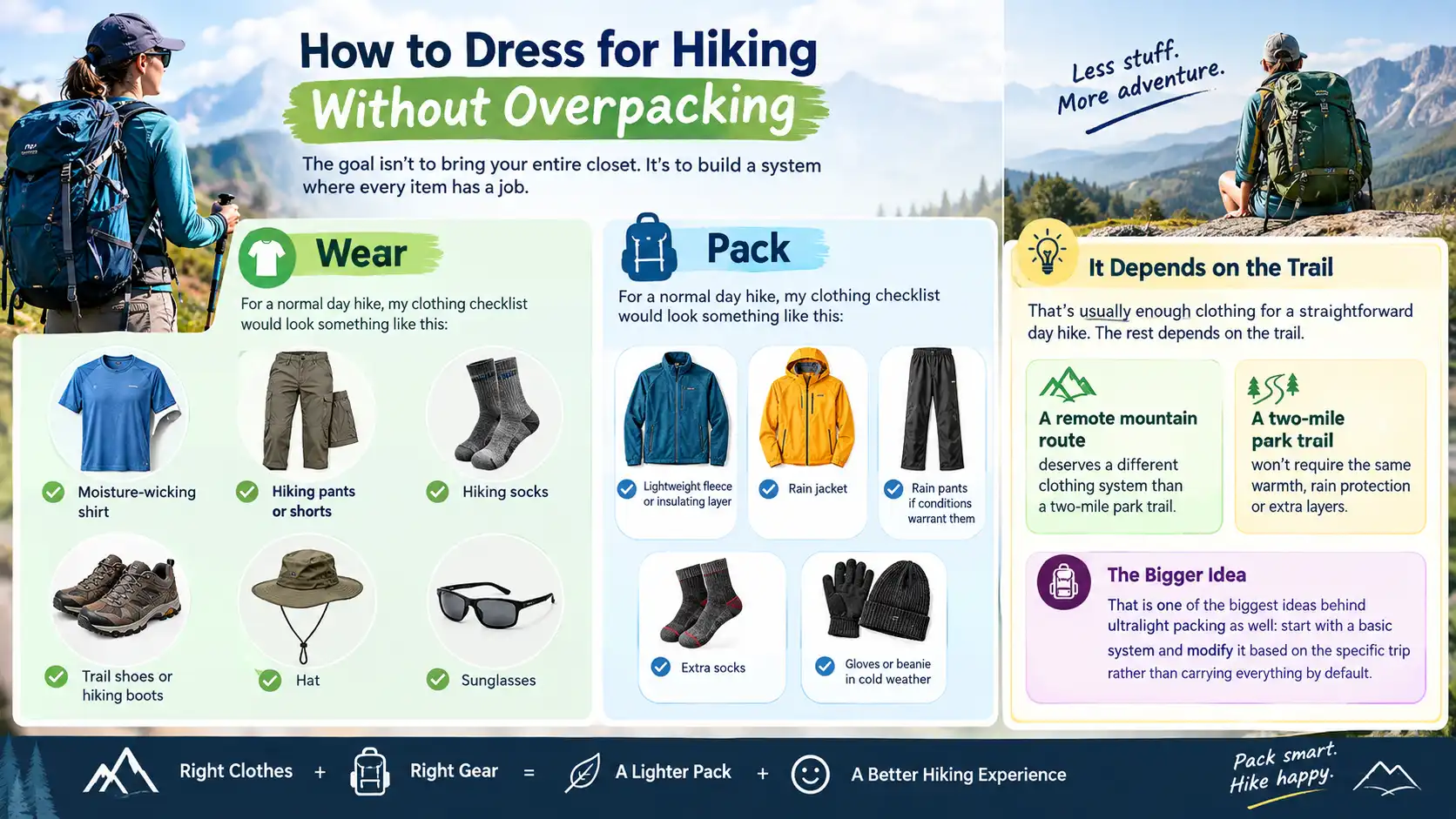
The goal isn’t to bring your entire closet.
It’s to build a system where every item has a job.
For a normal day hike, my clothing checklist would look something like this:
Wear
- Moisture-wicking shirt
- Hiking pants or shorts
- Hiking socks
- Trail shoes or hiking boots
- Hat
- Sunglasses
Pack
- Lightweight fleece or insulating layer
- Rain jacket
- Rain pants if conditions warrant them
- Extra socks
- Gloves or beanie in cold weather
That’s usually enough clothing for a straightforward day hike.
The rest depends on the trail.
A remote mountain route deserves a different clothing system than a two-mile park trail.
That is one of the biggest ideas behind ultralight packing as well: start with a basic system and modify it based on the specific trip rather than carrying everything by default.
How to Choose Hiking Clothes by Weather
| WeatherBase LayerMidlayerOuter LayerBottoms | ||||
|---|---|---|---|---|
| Hot & dry | Lightweight synthetic/merino | None | Optional wind layer | Shorts/light pants |
| Warm & rainy | Moisture-wicking shirt | Optional | Rain shell | Quick-dry pants/shorts |
| Cool | Merino/synthetic | Fleece | Wind/rain shell | Hiking pants |
| Cold | Warm base layer | Fleece/puffy | Weatherproof shell | Pants + thermal layer |
| Snowy | Warm base | Fleece + insulation | Waterproof shell | Insulated/weatherproof pants |
| Windy | Wicking base | Fleece if needed | Wind shell | Wind-resistant pants |
These are starting points, not rigid temperature rules.
Your activity level matters.
A person climbing hard in 40°F weather may be warmer than someone standing still in 55°F wind.
That’s why layering beats dressing according to a single temperature number.
What I Would Actually Pack for a Normal Day Hike
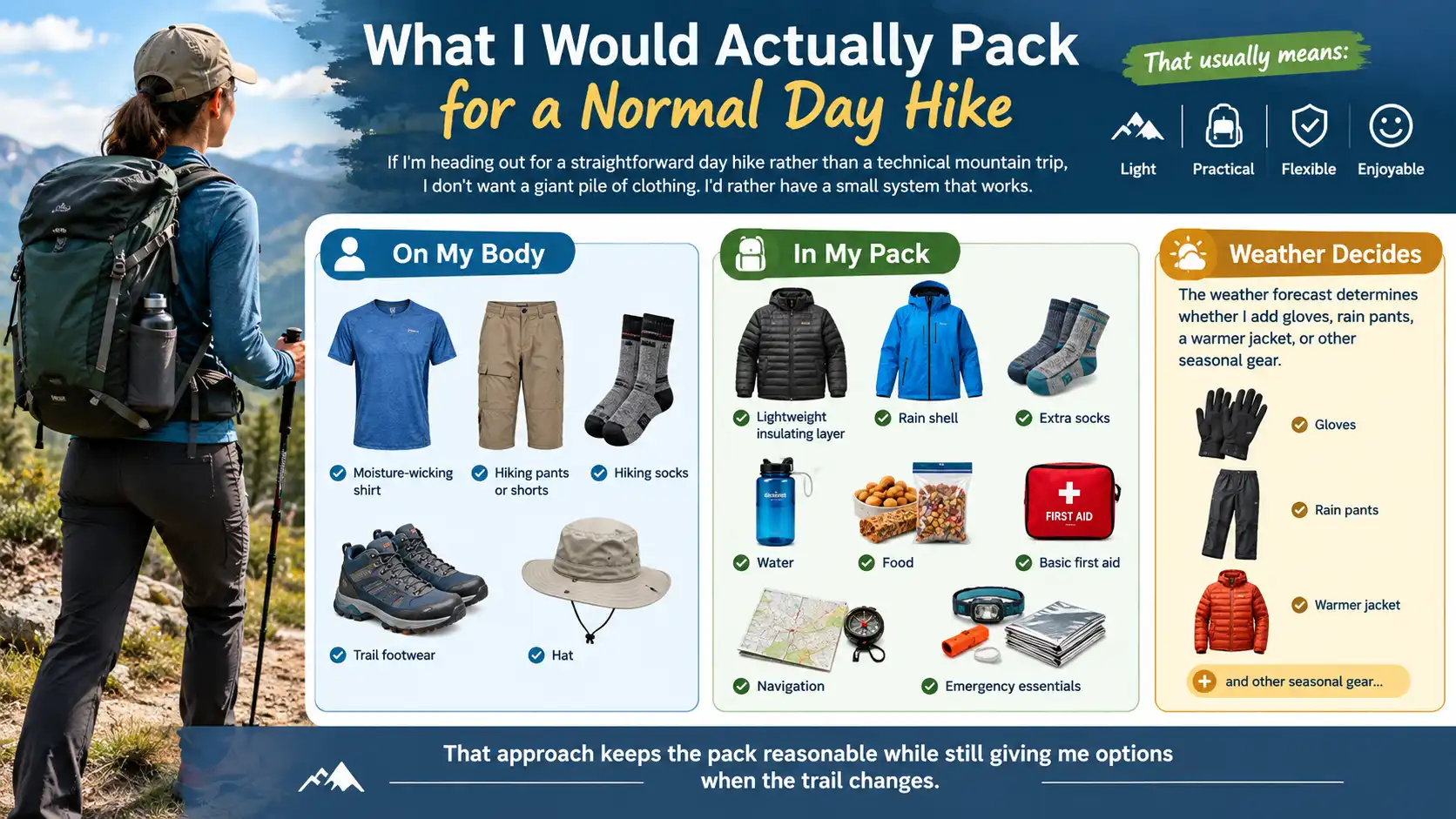
If I’m heading out for a straightforward day hike rather than a technical mountain trip, I don’t want a giant pile of clothing.
I’d rather have a small system that works.
That usually means:
On my body
- Moisture-wicking shirt
- Hiking pants or shorts
- Hiking socks
- Trail footwear
- Hat
In the pack
- Lightweight insulating layer
- Rain shell
- Extra socks
- Water
- Food
- Basic first aid
- Navigation
- Emergency essentials
The weather forecast determines whether I add gloves, rain pants, a warmer jacket, or other seasonal gear.
That approach keeps the pack reasonable while still giving me options when the trail changes.
Lessons I Learned the Hard Way
After years of hiking and camping around Bakersfield and beyond, I’ve learned that dressing for the trail isn’t about looking like a “real hiker.”
It is about solving problems before they happen.
I’ve started hikes wearing too much.
I’ve underestimated weather.
I’ve carried gear I didn’t need and forgotten things I did.
I’ve learned that the best hiking outfit is usually the one that lets you forget about your clothes once you’re on the trail.
A good base layer keeps sweat from becoming a problem. Comfortable pants let you move. Good socks and footwear keep your feet happy. A fleece gives you warmth when the temperature drops. A rain shell sits quietly in your pack until the weather decides to change.
That’s really the whole idea behind how to dress for hiking.
You don’t need ten different outfits for ten different forecasts.
Build a simple system.
Learn how your body responds to heat and cold.
Check the weather before you leave.
Match your clothing to the trail instead of buying gear simply because it says “hiking” on the label.
And most importantly, use what you learn on one hike to make the next one better.
That’s how I went from making rookie mistakes to building a hiking system I actually trust.
The trail teaches you what you need.
You just have to pay attention.
FAQs
What should I wear for hiking for the first time?
For a typical beginner day hike, wear a moisture-wicking shirt, comfortable hiking pants or shorts, hiking socks, and trail shoes or hiking boots that fit well. Carry a lightweight warm layer and rain shell if the weather or route warrants them.
You don’t need expensive gear for your first hike.
Comfort and suitability matter more than brand names.
What should you not wear hiking?
Avoid clothing that becomes uncomfortable when wet, restricts movement, or isn’t appropriate for the conditions.
Cotton-heavy outfits can be problematic on cold or wet hikes because they hold moisture. Jeans are also generally a poor choice for serious hiking because they are heavy, restrictive, and slow to dry.
Are jeans OK for hiking?
For a very short, easy, dry trail, you can technically hike in jeans.
But I wouldn’t choose them for a serious hike.
Hiking pants or lightweight outdoor trousers are usually more comfortable because they offer better mobility, breathability, and drying performance.
Should hiking clothes be tight or loose?
Neither extreme is ideal.
Your base layer should usually sit fairly close to your body without restricting movement. Your outer layers need enough room to fit over the layers underneath.
The goal is freedom of movement without excessive loose fabric catching on branches or equipment.
Do I need waterproof hiking clothes?
Not for every hike.
If the forecast is dry and you’re staying on a short local trail, you may not need a full waterproof outfit.
But carrying a lightweight rain shell becomes much more important when you’re hiking in areas where weather can change quickly, or when you’re far enough from the trailhead that getting wet could become a real problem.