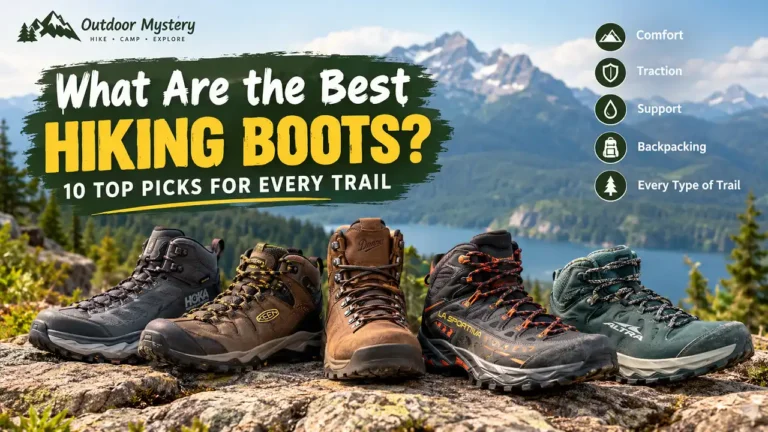
Best Hiking Boots for Every Type of Trail
I’ve been hiking and camping since 2018, mostly out of Bakersfield, California, and somewhere along the way, weekend trips became something I plan my year around. I’ve spent enough time on the trail now to know that the gear mistake you make at home can become the thing you think about for the next ten miles.
I’ve made plenty of those mistakes myself. I’ve worn the wrong boots, carried a pack that was much heavier than it needed to be, and headed out without paying enough attention to what the weather might do.
Boots were one of the biggest lessons.
A pair can feel perfectly comfortable when you first try it on, but that doesn’t tell you how it will feel after several hours on rocky ground, during a long descent, or when you’re carrying a loaded pack.
Choose the boot that matches your hike
The best hiking boot depends on your terrain, pack weight, weather, foot shape, hiking speed, and how much cushioning or support you prefer.
That’s what this best hiking boots guide is about.
Outdoor Mystery is my personal blog, not a company with a testing department or a large editorial team. I write these guides myself. When I recommend gear I’ve personally used on the trail, I’ll tell you. When something comes from research rather than my own experience, I’ll tell you that too.
I’ve also learned that the “best” hiking boot changes with the hike. The boot that makes sense for a comfortable day trail isn’t necessarily the one I’d want for a rocky mountain route or a multi-day backpacking trip.
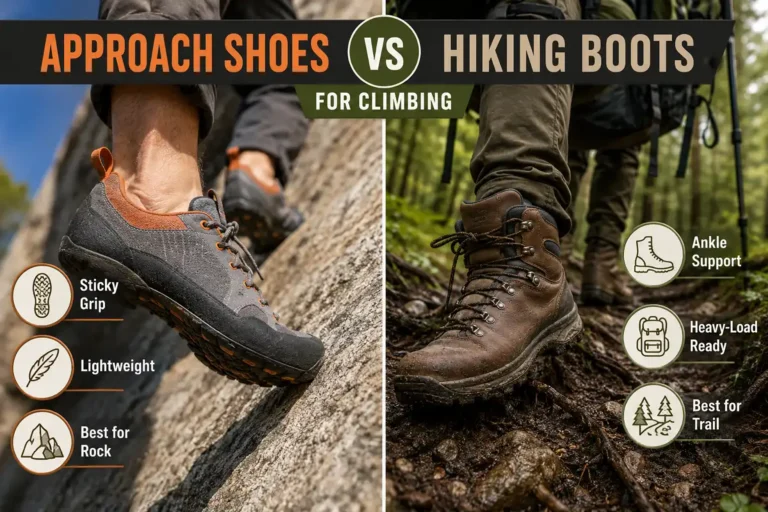
If you’re building your hiking setup, my guide to 10 essentials every hiker should carry is a useful place to start. You can also read my guide to approach shoes vs hiking boots for climbing if you’re still deciding which type of footwear makes sense for you.
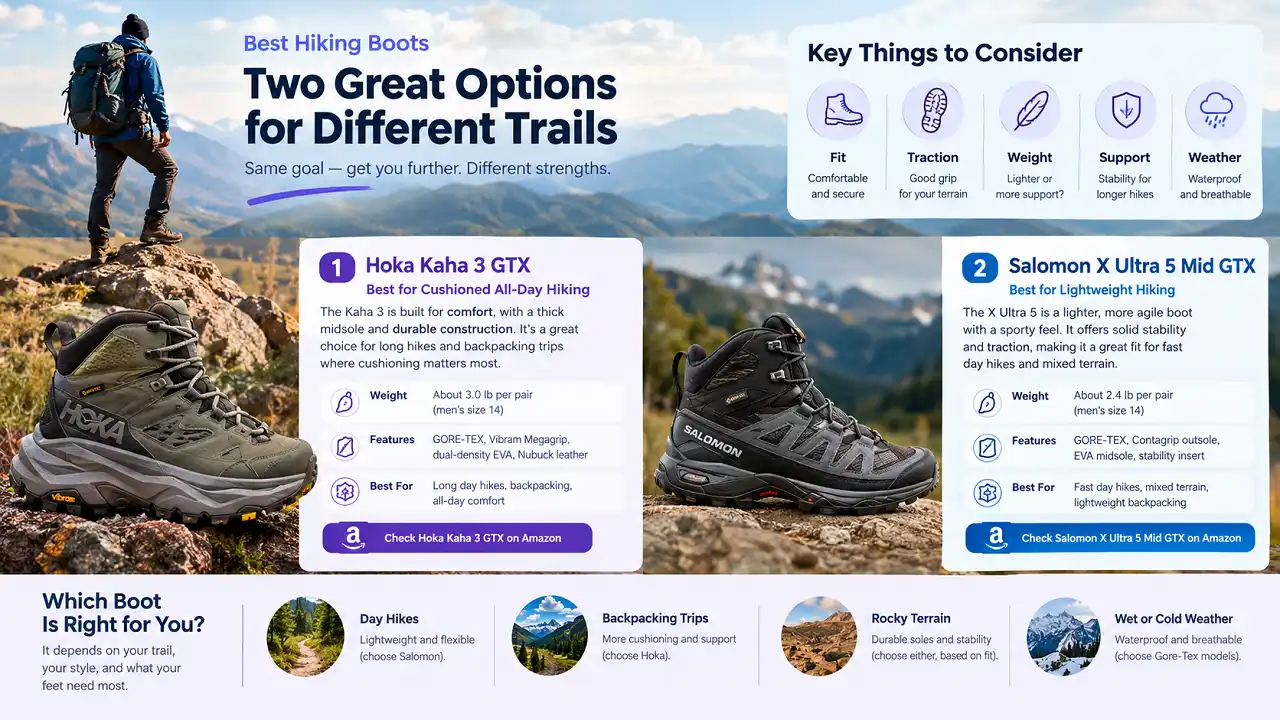
Best Hiking Boots at a Glance
Best for cushioned all-day hiking and hikers who prioritize comfort.
Best for lightweight hiking and a more athletic trail feel.
Best for technical trails, rocky terrain, and precise movement.
Best for backpacking, heavy loads, and multi-day trips.
Best for hikers who prefer a roomier forefoot.
Best for wide feet and hikers who need extra toe room.
Best value for beginners and everyday hiking.
Best for trail-to-town versatility and travel.
Best midweight leather option for moderate-to-difficult hikes.
Best for snow, ice, and cold-weather hiking.
1. Hoka Kaha 3 GTX — Best for Cushioned All-Day Hiking
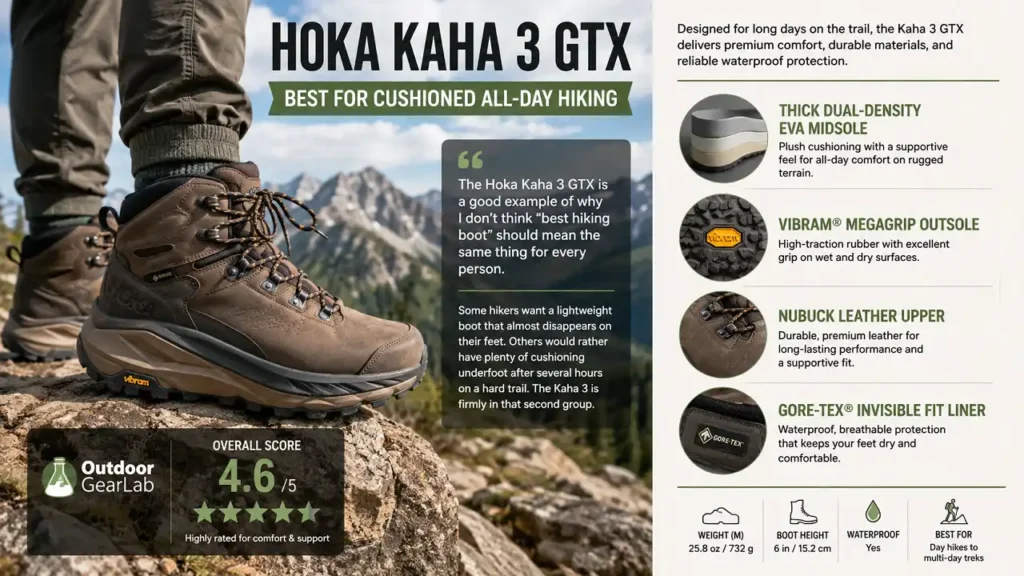
Hoka Kaha 3 GTX combines thick cushioning, supportive construction, waterproof protection, and Vibram Megagrip traction for long days on the trail.
The Hoka Kaha 3 GTX is a good example of why I don’t think “best hiking boot” should mean the same thing for every person.
Some hikers want a lightweight boot that almost disappears on their feet. Others would rather have plenty of cushioning underfoot after several hours on a hard trail. The Kaha 3 is firmly in that second group.
The thick sole takes a little getting used to, and the boot is heavier and bulkier than some lightweight alternatives. But that extra material is part of the appeal if your feet appreciate cushioning.
Check Hoka Kaha 3 GTX on Amazon →2. Salomon X Ultra 5 Mid GTX — Best for Lightweight Hiking
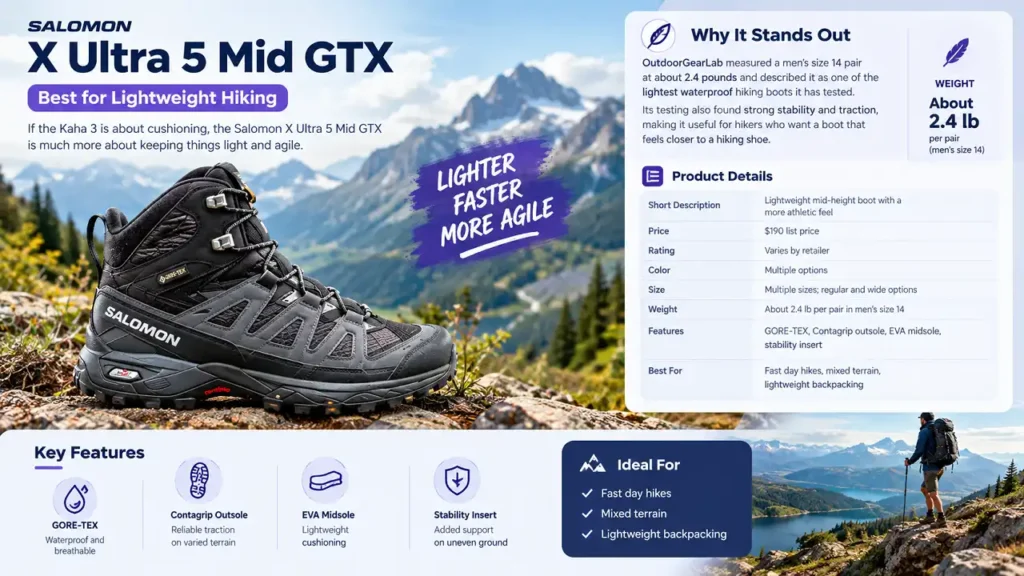
Salomon X Ultra 5 Mid GTX hiking boot featuring lightweight design, waterproof GORE-TEX protection, and reliable trail traction.
If the Kaha 3 is about cushioning, the Salomon X Ultra 5 Mid GTX is much more about keeping things light and agile.
OutdoorGearLab measured a men’s size 14 pair at about 2.4 pounds and described it as one of the lightest waterproof hiking boots it has tested.
The X Ultra 5 Mid GTX makes sense if you don’t want a heavy boot slowing you down. It has enough structure for uneven terrain while retaining a relatively nimble feel.
One thing to keep in mind is fit. OutdoorGearLab’s men’s testing found the boot comfortable out of the box, while its women’s testing reported a narrower fit and a durability issue with an ankle hook during testing.
Check Salomon X Ultra 5 Mid GTX on Amazon →3. La Sportiva Ultra Raptor 3 Mid GTX — Best for Technical Trails
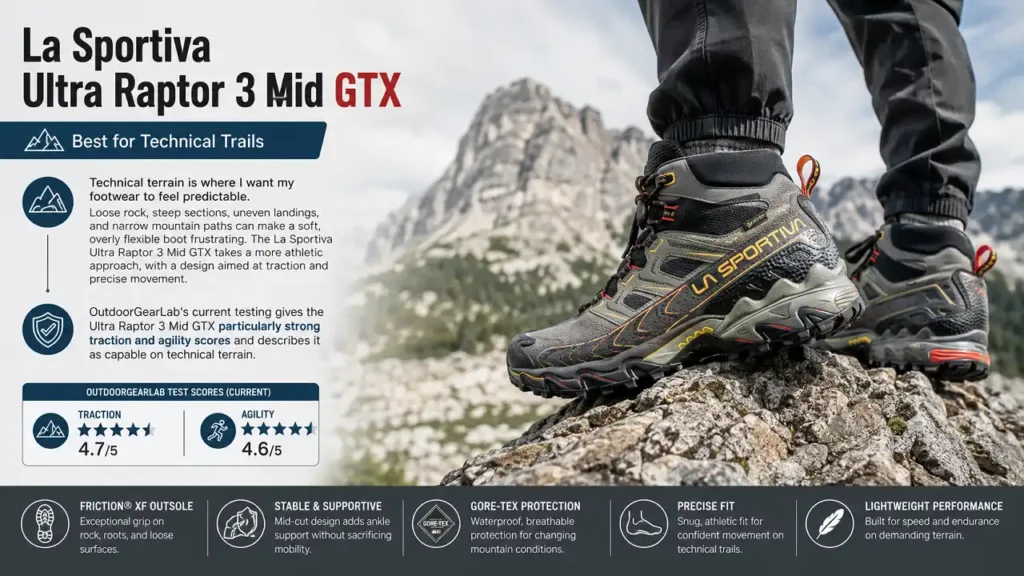
La Sportiva Ultra Raptor 3 Mid GTX combines strong traction and agile movement for technical trails.
Technical terrain is where I want my footwear to feel predictable.
Loose rock, steep sections, uneven landings, and narrow mountain paths can make a soft, overly flexible boot frustrating. The La Sportiva Ultra Raptor 3 Mid GTX takes a more athletic approach, with a design aimed at traction and precise movement.
Aggressive outsole
Designed for grip on demanding and technical terrain.
Precise movement
A more athletic feel for steep and complicated trails.
Technical hiking
Rocky trails, steep terrain, and technical mountain routes.
It isn’t the first boot I’d pick for someone who wants a soft, relaxed walking experience. Its appeal is the more precise feel when the trail becomes complicated.
Check La Sportiva Ultra Raptor 3 Mid GTX on Amazon →4. Salomon Quest 5 GTX — Best for Backpacking
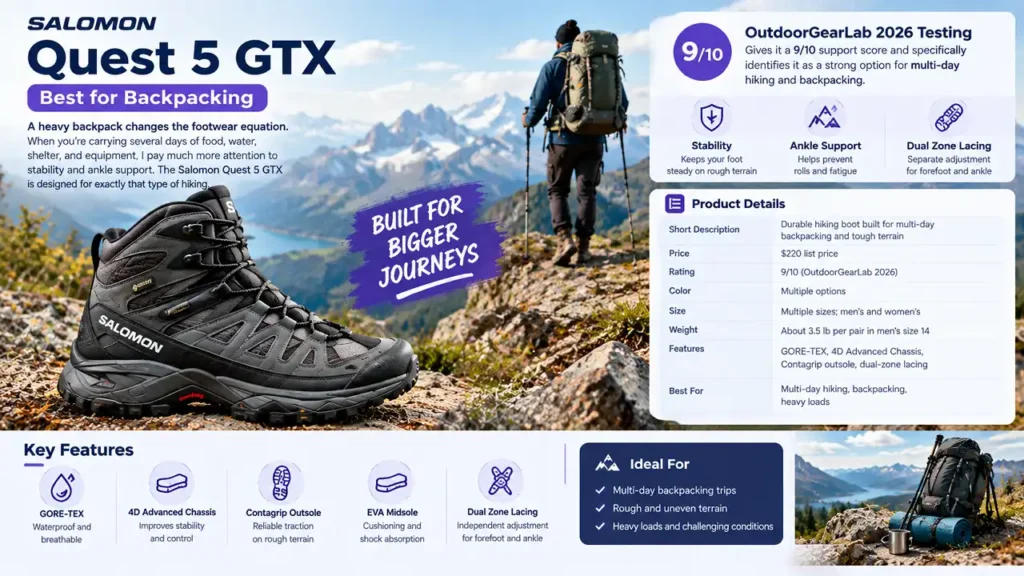
Salomon Quest 5 GTX is a supportive hiking boot designed for multi-day backpacking, heavy loads, and challenging trails.
When a heavier boot makes sense
A heavy backpack changes the footwear equation. When you’re carrying several days of food, water, shelter, and equipment, stability and ankle support become much more important.
The Salomon Quest 5 GTX is designed for exactly that type of hiking. OutdoorGearLab’s 2026 testing gives it a 9/10 support score and specifically identifies it as a strong option for multi-day hiking and backpacking.
This is also a good example of why I wouldn’t automatically recommend the most supportive boot to everyone. OutdoorGearLab describes the Quest 5 as overkill for casual hiking and notes that its taller construction reduces agility.
Check Salomon Quest 5 GTX on Amazon →5. KEEN Targhee IV Mid — Best for a Roomier Fit
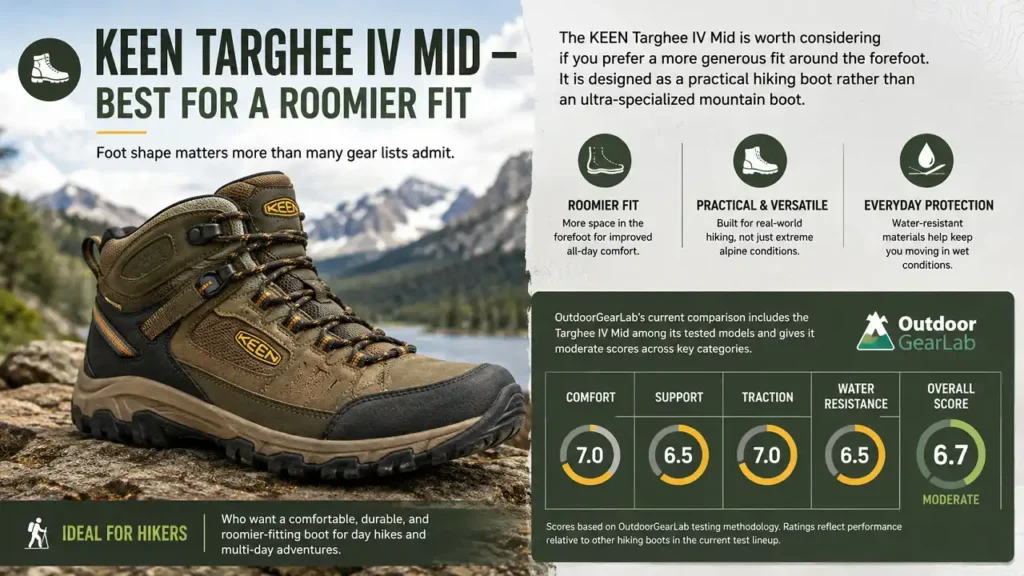
KEEN Targhee IV Mid offers a roomy fit for comfortable day hikes and multi-day adventures.
Foot shape matters more than many gear lists admit.
The KEEN Targhee IV Mid is worth considering if you prefer a more generous fit around the forefoot. It is designed as a practical hiking boot rather than an ultra-specialized mountain boot.
Useful for hikers who dislike cramped toe areas.
Designed for practical trail use rather than specialized alpine routes.
A model worth considering when traditional boots feel narrow.
If you frequently finish hikes with cramped toes, don’t simply buy a different size of the same narrow boot. Look at brands and models designed around a different foot shape.
Check KEEN Targhee IV Mid on Amazon →6. Topo Athletic Trailventure 2 WP — Best for Wide Feet
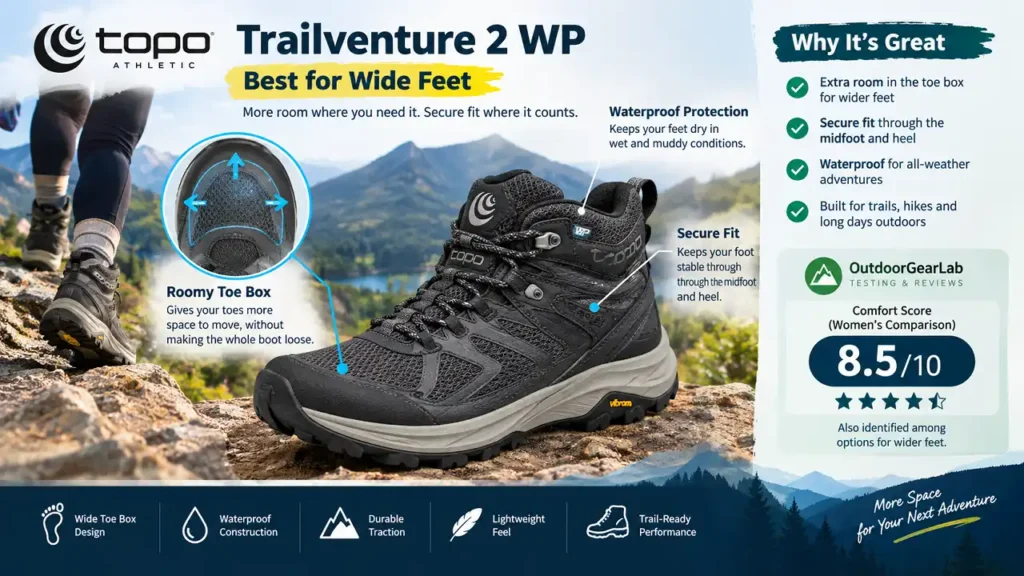
Topo Athletic Trailventure 2 WP offers extra toe room with a secure fit for wider feet.
The Topo Athletic Trailventure 2 WP takes the roomy-toe-box idea even further.
The goal here isn’t simply to make the entire boot loose. Instead, the design gives the toes more room while maintaining a secure fit through the rest of the shoe.
Room where your toes need it
This is particularly worth looking at if your toes feel squeezed in traditional hiking boots.
OutdoorGearLab’s current testing gives the Trailventure 2 WP an 8.5/10 comfort score in its women’s comparison and identifies it among options for wider feet.
Check Topo Athletic Trailventure 2 WP on Amazon →7. Merrell Moab 3 Mid Waterproof — Best Value
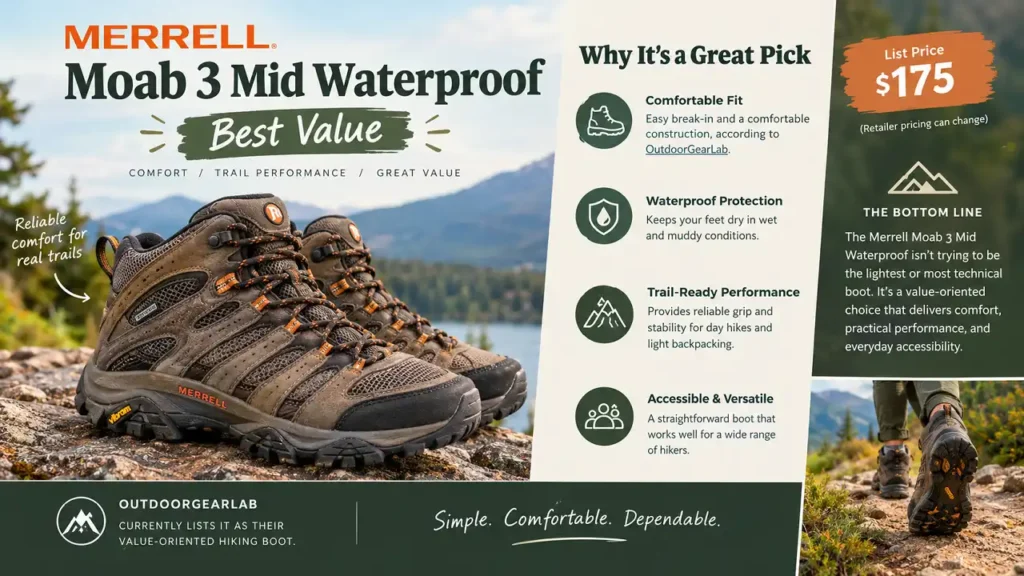
Merrell Moab 3 Mid Waterproof is a comfortable, practical hiking boot and strong value choice.
The Merrell Moab 3 Mid Waterproof is one of the easiest hiking boots to recommend when someone wants something straightforward.
It isn’t trying to be the lightest technical boot or the most supportive backpacking boot. Instead, it focuses on comfort, practical trail performance, and accessibility.
Accessible
Designed as a practical option without excessive specialization.
Easy break-in
OutdoorGearLab highlights its comfortable construction and easy break-in.
Beginners
Weekend hikes, everyday trails, and first-time hiking boot buyers.
OutdoorGearLab currently lists it as its value-oriented hiking boot and notes its easy break-in and comfortable construction.
Check Merrell Moab 3 Mid Waterproof on Amazon →8. Danner Mountain 600 Evo — Best for Trail-to-Town Use
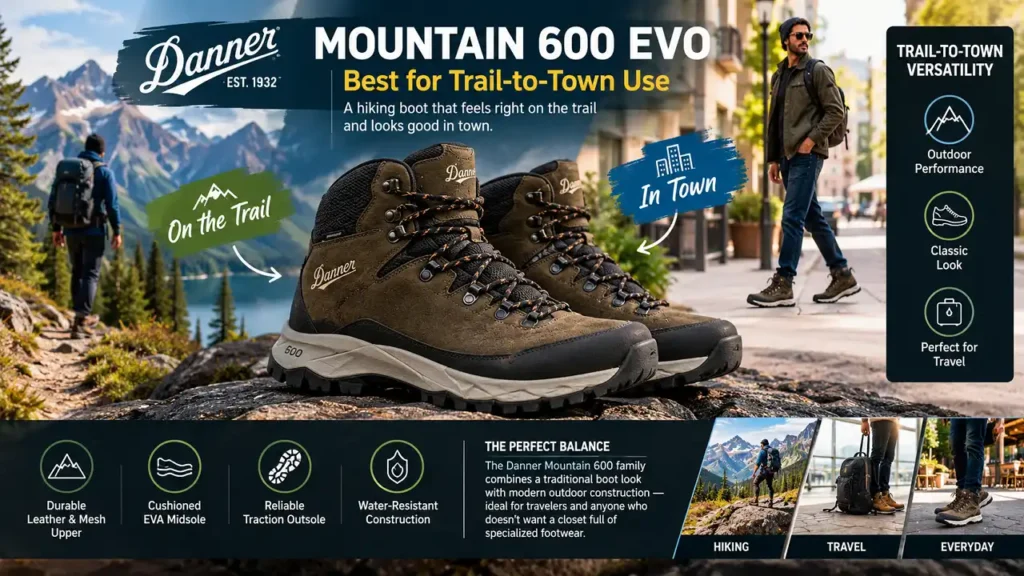
Danner Mountain 600 Evo combines classic hiking boot style with modern trail-to-town versatility.
Some hiking boots are clearly designed for the trail and look like it. Others can transition easily between outdoor adventures and everyday life.
The Danner Mountain 600 family takes the second approach. It combines a more traditional boot appearance with modern outdoor construction.
Why choose a versatile boot?
This category can make sense for people who travel frequently or don’t want a closet full of specialized footwear. Its strength is versatility rather than highly technical mountain performance.
This isn’t necessarily the boot I’d choose for the most technical mountain route. Its strength is versatility.
Check Danner Mountain 600 Evo on Amazon →9. La Sportiva Nucleo High II GTX — Best Midweight Leather Boot
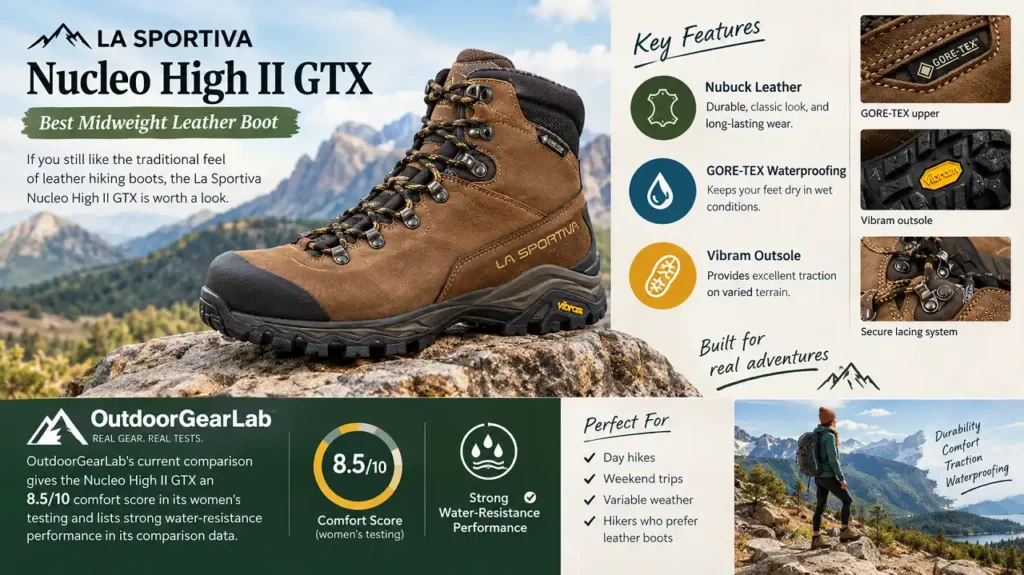
La Sportiva Nucleo High II GTX combines Nubuck leather, GORE-TEX waterproofing, and a Vibram outsole.
If you still like the traditional feel of leather hiking boots, the La Sportiva Nucleo High II GTX is worth a look.
Leather does bring a different feel from lightweight mesh and synthetic footwear. It can also take more time to break in, so give yourself time before taking a new pair on a long trip.
Check La Sportiva Nucleo High II GTX on Amazon →10. Merrell Thermo Snow Grip Mid — Best for Winter Hiking
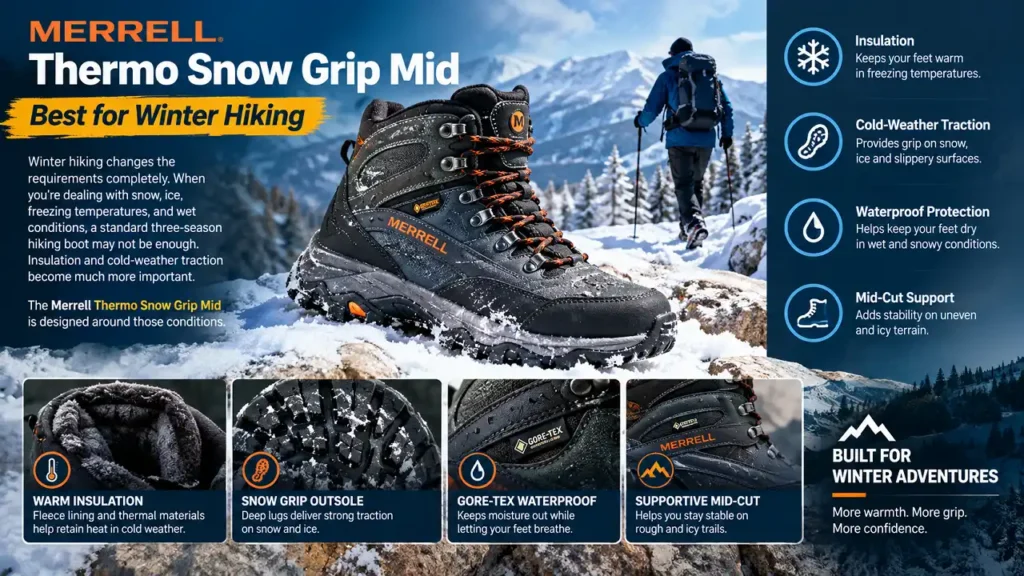
Merrell Thermo Snow Grip Mid is a winter hiking boot built for snow, ice, cold, and wet trails.
Winter hiking changes the requirements
When you’re dealing with snow, ice, freezing temperatures, and wet conditions, a standard three-season hiking boot may not be enough. Insulation and cold-weather traction become much more important.
The Merrell Thermo Snow Grip Mid is designed around those conditions.
Designed for snowy winter trails.
Insulation helps address freezing conditions.
Winter-oriented outsole design for cold-weather surfaces.
For summer hiking, this kind of boot would be unnecessarily warm. But that’s exactly why specialized footwear exists.
Check Merrell Thermo Snow Grip Mid on Amazon →How to Choose the Best Hiking Boots
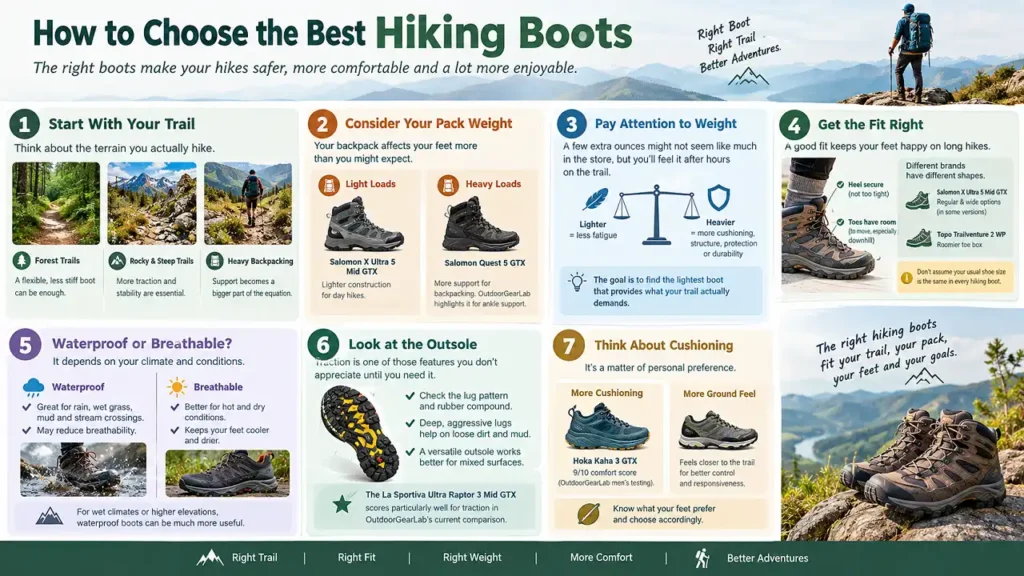
After enough time on the trail, I’ve learned that choosing hiking footwear is less about counting features and more about matching those features to the trip.
Here are the things I’d look at before buying.
Start With Your Trail
Think about the terrain you actually hike.
If your regular route is a maintained forest trail, you probably don’t need an extremely stiff backpacking boot.
If you’re regularly scrambling over rocks or walking steep mountain trails, traction and stability become much more important.
Consider Your Pack Weight
Your backpack affects your feet more than you might expect.
A lightweight daypack and a fully loaded backpacking pack put very different demands on your footwear.
Pay Attention to Weight
I’ve made the mistake of thinking that a little extra weight wouldn’t matter.
The goal is to find the lightest boot that provides what your trail actually demands.
Get the Fit Right
Your heel should feel secure without being painfully squeezed. Your toes need enough space to move, especially when walking downhill.
Don’t assume your usual shoe size automatically means the same size in every hiking boot.
Waterproof or Breathable?
A waterproof boot can be excellent in rain, wet grass, mud, and shallow stream crossings.
If your hiking is mostly in hot and dry conditions, you may value airflow more than waterproof protection.
Look at the Outsole
Look at the lug pattern and rubber compound.
Deep, aggressive lugs can help on loose dirt and muddy trails. A versatile outsole can be better for mixed surfaces.
Think About Cushioning
Some hikers love a thick, soft midsole. Others prefer to feel more connected to the trail.
The important thing is knowing what your feet prefer.
Hiking Boots vs. Hiking Shoes
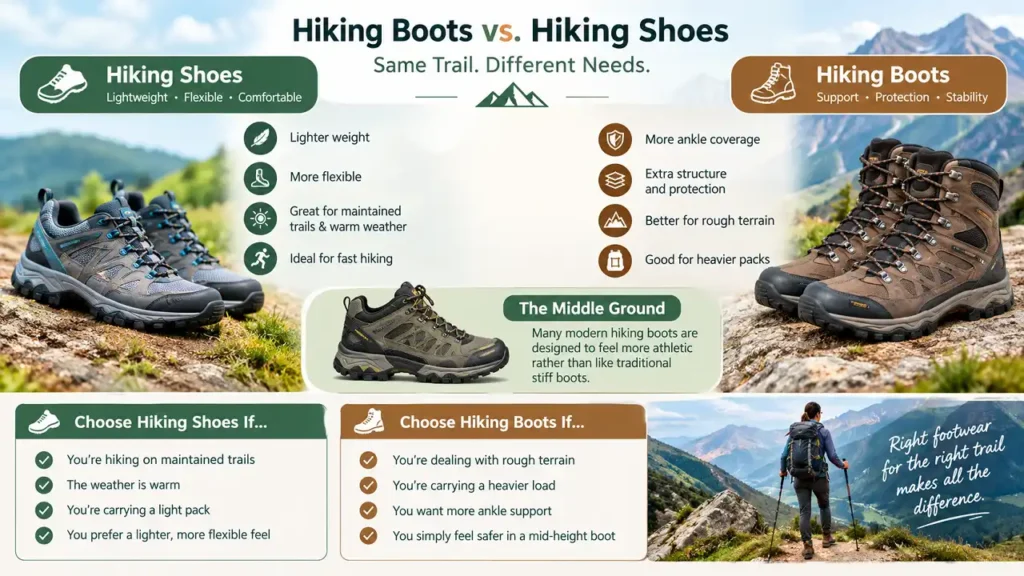
Hiking boots offer more ankle coverage and structure, while hiking shoes are lighter and more flexible for smoother trails.
Hiking Boots
- More ankle coverage
- More structure
- Useful for rough terrain
- Can suit heavier loads
- More protection around the foot
Hiking Shoes
- Lighter construction
- More flexible
- Useful on maintained trails
- Good for warm weather
- Can work well for fast hiking
You don’t necessarily need hiking boots for every hike.
If you’re carrying a light pack and hiking relatively smooth trails, a hiking shoe may be enough.
If you’re dealing with rough terrain, carrying a heavier load, or simply prefer the security of a mid-height boot, hiking boots remain a practical option.
There’s also a growing middle ground between the two. Many modern hiking boots are designed to feel more athletic rather than like traditional stiff boots.
How to Break In New Hiking Boots
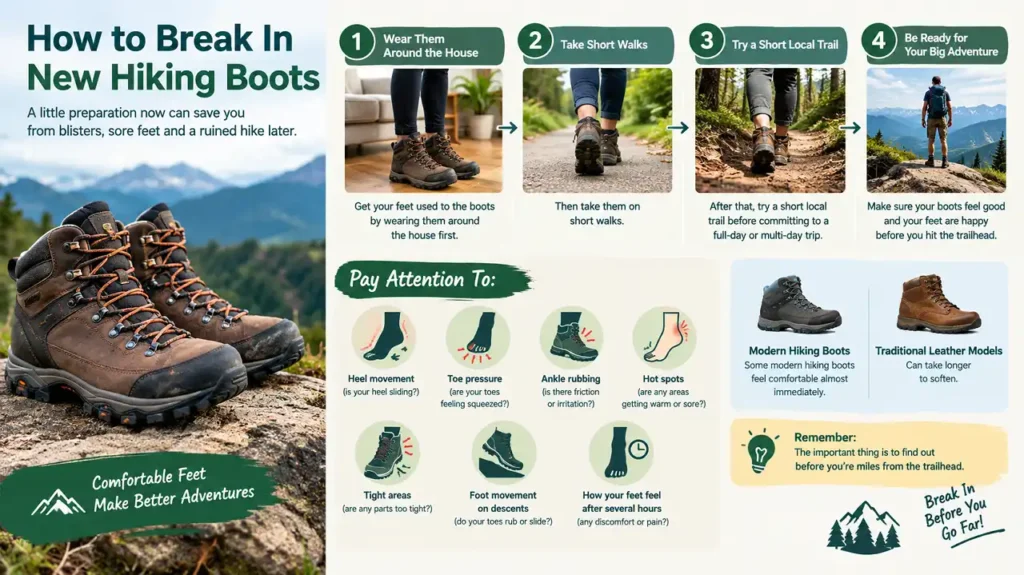
Break in new hiking boots gradually to prevent discomfort, rubbing, and hot spots on the trail.
I learned this lesson the uncomfortable way.
Don’t buy a new pair of hiking boots and immediately take them on the longest hike you’ve planned all year.
Wear Them at Home
Start by wearing your new boots around the house.
Take Short Walks
Gradually increase the amount of time you spend wearing them.
Try a Local Trail
Test them on a short trail before committing to a full-day trip.
Check Your Feet
Pay attention to heel movement, toe pressure, ankle rubbing, hot spots, tight areas, and foot movement on descents.
Your heel should remain secure without excessive movement.
Make sure your toes have enough space, especially downhill.
Look for rubbing before committing to a long hike.
Identify areas that may turn into painful blisters.
Pay attention to pressure points and uncomfortable areas.
Notice how your feet feel after extended wear.
Some modern hiking boots feel comfortable almost immediately. Traditional leather models can take longer to soften.
Choose the Boots That Match Your Hike
What am I actually going to use these boots for?
After hiking and camping since 2018, I’ve stopped looking for one pair of boots that can supposedly do everything perfectly.
If you’re mostly walking maintained trails on weekend day hikes, you probably don’t need the heaviest, most supportive boot you can find.
If you’re heading into rocky or technical terrain, traction and stability become much more important.
If you’re carrying a heavy backpack for several days, the extra support of a more substantial boot can make sense.
And if you’re hiking through snow and freezing temperatures, winter-specific footwear is a completely different consideration.
Fit is just as important. I’ve learned the hard way that a boot can look fantastic on paper and still be the wrong boot for your feet.
Give yourself enough room in the toes, make sure your heel stays secure, and pay attention to how the boot feels when walking downhill.
The goal isn’t to own every piece of hiking gear. It’s to understand what your particular trip requires.
Match the boot to your actual hike
Think about the trails you’ll actually hike over the next year. Consider your pack weight, local weather, terrain, and most importantly, your feet.
The best hiking boots aren’t necessarily the ones I’d choose.
They’re the ones that fit your hike well enough that you can stop thinking about your feet and enjoy the trail.
FAQs
What are the best hiking boots?
There isn’t one hiking boot that works best for every person and every trail. The Hoka Kaha 3 GTX, Salomon X Ultra 5 Mid GTX, La Sportiva Ultra Raptor 3 Mid GTX, and Salomon Quest 5 GTX represent different approaches to cushioning, weight, technical terrain, and support.
What are the best hiking boots for beginners?
For beginners, a comfortable and versatile boot is usually easier to live with than an extremely specialized model. The Merrell Moab 3 Mid Waterproof is one option to consider because OutdoorGearLab currently highlights it as a value-oriented boot with easy break-in characteristics.
What are the best hiking boots for backpacking?
For backpacking, look for stability, support, traction, and a fit that remains comfortable when carrying a loaded pack. The Salomon Quest 5 GTX is specifically designed around this type of use and currently receives strong support scores in OutdoorGearLab’s testing.
Are waterproof hiking boots worth it?
They can be worthwhile if you frequently hike in rain, wet grass, mud, or shallow water. GORE-TEX models such as the Hoka Kaha 3 GTX, Salomon X Ultra 5 Mid GTX, and Salomon Quest 5 GTX provide waterproof protection.
Should hiking boots be tight or loose?
Neither. Your heel should feel secure while your toes need enough room to move naturally. The fit should also remain comfortable when walking downhill, when your feet can slide forward if the boot is too loose.
Are heavier hiking boots better?
Not automatically. Heavier boots can provide additional structure and protection, while lighter boots can make long-distance hiking feel easier. Your terrain, pack weight, hiking speed, and personal preference should determine how much boot you need.
How long should hiking boots last?
There isn’t one mileage number that applies to every boot. Durability depends on construction, terrain, weather, body weight, hiking frequency, and maintenance. Instead of relying only on a mileage estimate, watch for worn tread, compressed cushioning, damaged uppers, loose components, or reduced support.