Anchorage Winter Hike Day Tours: Costs, Options & Tips
Winter hike day tours from Anchorage fall into two clear types: snowshoe tours on trails near the city, and glacier hikes out on the ice. This guide breaks down what each one costs, how long it takes, how hard it is, and who it suits. By the end you’ll know exactly which tour to book and how to prepare for it.
Which Anchorage winter hike should you choose?
Snowshoe tours are best if you want a shorter adventure close to town, while a Matanuska Glacier hike is the better choice for a full-day bucket-list experience on blue ice.
3–4 hours near Anchorage with beginner-friendly terrain.
Full-day adventures on the Matanuska Glacier.
$100–$150 for snowshoeing and $160–$475 for glacier tours.
Snowshoeing is easy to moderate; glacier hiking is moderate.
First-timers, scenic winter walks, and bucket-list ice adventures.
Anchorage Winter Hike Tours at a Glance
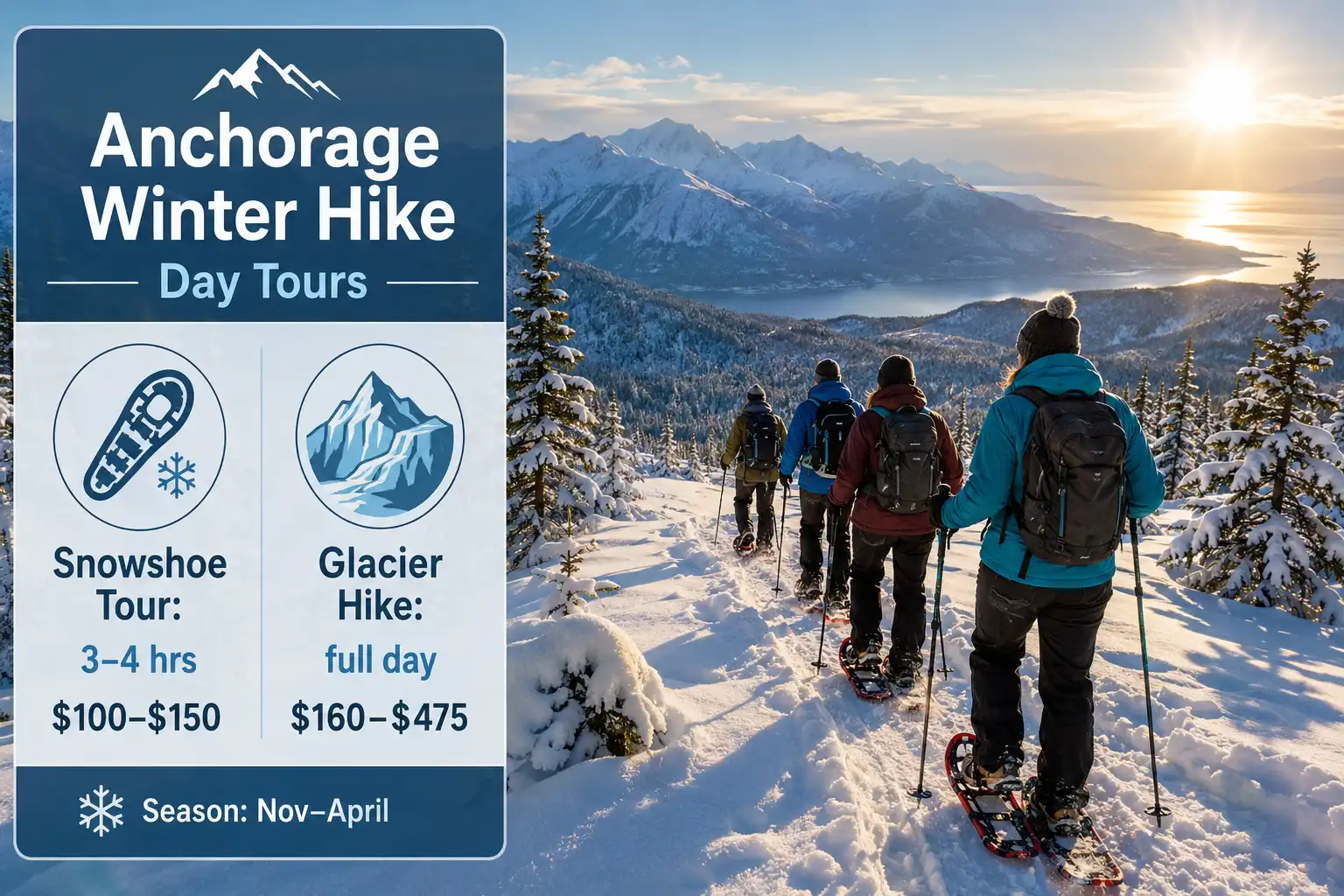
Anchorage winter hike day tours come in two forms. Snowshoe tours run 3 to 4 hours in the Chugach Mountains right next to town, while glacier hikes take a full day and travel about two hours to the Matanuska Glacier. Both provide technical gear and a guide.
Snowshoe Tour
- Duration: 3–4 hours
- Drive: 15–30 minutes
- Cost: $100–$150/person
- Distance: ~2–2.5 miles
- Difficulty: Easy to moderate
- Gear: Snowshoes and poles
- Best for: First-timers and half-day plans
Glacier Hike
- Duration: 8–9 hours
- Drive: ~2 hours each way
- Cost: $160–$475/person
- Distance: ~2–3 miles
- Difficulty: Moderate
- Gear: Ice cleats and helmet
- Best for: A bucket-list ice experience
Snowshoe Tours Near Anchorage
Snowshoe tours are the easiest winter hike to book, and the fastest to reach. Most run about three hours and start right in downtown Anchorage.
The classic route heads to Glen Alps in Chugach State Park. The tour starts in front of the Egan Center in downtown Anchorage, then it’s about a 15-minute drive to the trailhead in the Glen Alps area of the Chugach Mountains. From there you follow a guide through forest and open meadow with wide views over the city and Cook Inlet.
Beginner-Friendly From the Start
The learning curve is almost nothing. Guides get you comfortable in minutes. A typical beginner circuit covers about two miles through hemlock forest and snow-covered alpine meadows.
There are two tiers to pick from with most operators:
Beginner Tours
Gentle pace and easier terrain make these best for first-timers. One popular 3-hour Glen Alps beginner tour is priced from about €97 per person and limited to 12 participants, suitable for ages 6 and up.
Advanced Tours
Longer and steeper. Advanced snowshoe outings follow a 4-mile trail through Chugach State Park and often run as small private groups.
Meeting Point Matters
Many snowshoe tours skip hotel pickup. You may need to meet at the designated spot, often the Egan Center, where parking garages are nearby. This keeps costs lower but means arranging your own transportation.
Prefer to Go on Your Own?
Anchorage has miles of trails for self-guided snowshoeing. Kincaid Park, the Hillside trail system, Far North Bicentennial Park, and Powerline Pass at Glen Alps all offer good snowshoeing within a few minutes of downtown.
Rentals are cheap, too. One Anchorage outfitter rents snowshoes for $25 a day. A guide is worth it your first time, though, for the instruction and wildlife spotting.
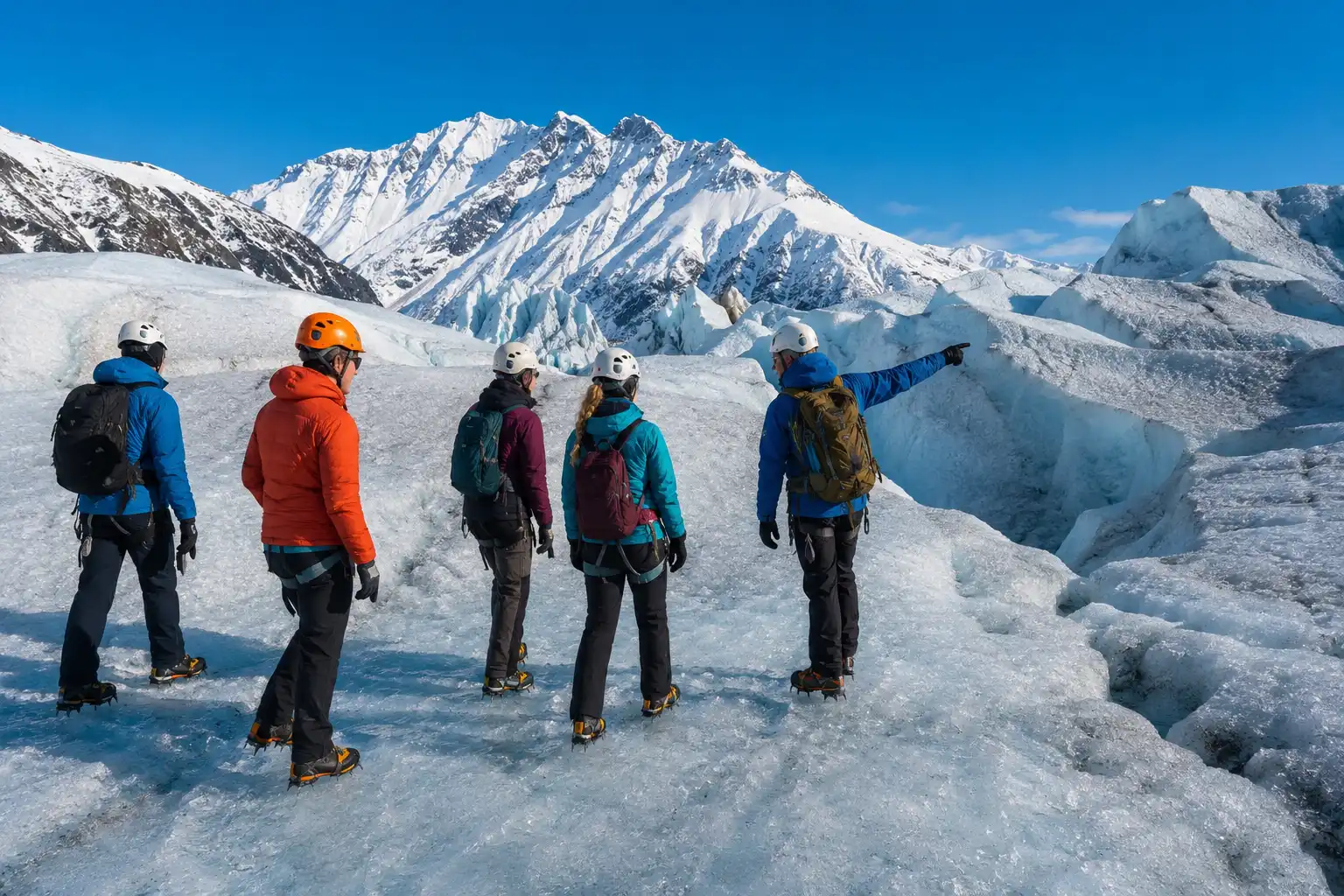
Small group wearing ice cleats and helmets hiking the blue ice of Matanuska Glacier on a clear winter day
Know More
If you’re interested in another cold-weather hiking experience, check out our guide to Hiking 5th Water Hot Springs .
Glacier Hike Day Tours From Anchorage
Glacier hikes are the bigger adventure, and the main reason many people book a winter tour at all. The destination is the Matanuska Glacier, about two hours northeast of Anchorage on the Glenn Highway.
Walk on Blue Ice Year-Round
The Matanuska is one of the few road-accessible glaciers that allows guided access year-round. Your guide fits you with ice cleats and a helmet, gives you a safety briefing, then leads you out onto the blue ice past crevasses and shifting ice formations.
Expect a moderate amount of walking on uneven ground. Tours generally cover up to three miles and involve stepping up and over obstacles and navigating small streams. Time on the ice usually runs 2.5 to 3 hours, with the rest of the day spent driving and stopping for photos.
Winter Can Bring Surprisingly Good Light
Winter often brings better light and, oddly, better weather on the glacier itself. When the weather is bad in and around Anchorage, it is often sunny on the glacier because cold air off the ice pushes warmer valley air up and clears the sky overhead.
Important: You Can’t Hike the Matanuska Alone
You used to be able to take a self-guided tour, but today you have to explore as part of a tour for safety reasons. A guided day tour is required, not just convenient.
How Much Do These Tours Cost?
Winter glacier hike day tours run roughly $160 to $475 per person, while snowshoe tours sit around $100 to $150. The gap comes down to distance, group size, and what’s bundled in.
Current winter pricing from established operators looks like this:
Booking direct with the glacier access company starts near $160 total for a Matanuska tour.
A common full-day guided hike from Anchorage runs $299 per person, from 8 AM to 5 PM, with 2–3 hours on the ice.
Small-group and private tours cost more. One private option starts around $1,395 per group plus $195 per person.
Watch for Extra Costs
Lunch is often not included, though most tours stop at a lodge where you can buy food. Winter gear rental may cost extra. One operator rents a package of parka, snow pants, boots, hat, and gloves for $30 per person.
Tips are customary as well, with private guides suggesting $10 to $20 per person. Prices shift constantly, so confirm the current rate at booking.
When Is the Best Time to Go?
The winter tour season runs late November through April. The main thing that changes month to month is daylight, so an early start matters more than the temperature.
Deep winter is dark. At the December solstice, the sun rises at 10:14 a.m. and sets at 3:42 p.m., giving Anchorage just 5 hours and 28 minutes of daylight. That’s why glacier tours leave around 7:45 a.m. and aim for midday on the ice.
Reliable Winter Conditions
About 6 hours of daylight, temperatures in the low 20s, reliable snow, and strong aurora odds.
More Daylight
Up to 8 hours of daylight with weather commonly in the mid 20s.
The Sweet Spot
Often the sweet spot, with up to 12 hours of daylight and temperatures climbing into the 30s.
The cold stays manageable compared to interior Alaska. Anchorage usually bottoms out around -10°F to -20°F on the coldest nights, with most winter days between 10 and 30°F because Cook Inlet moderates the temperature. On the glacier, though, plan for extremes. Winter temperatures there can range from -30 to 35°F.
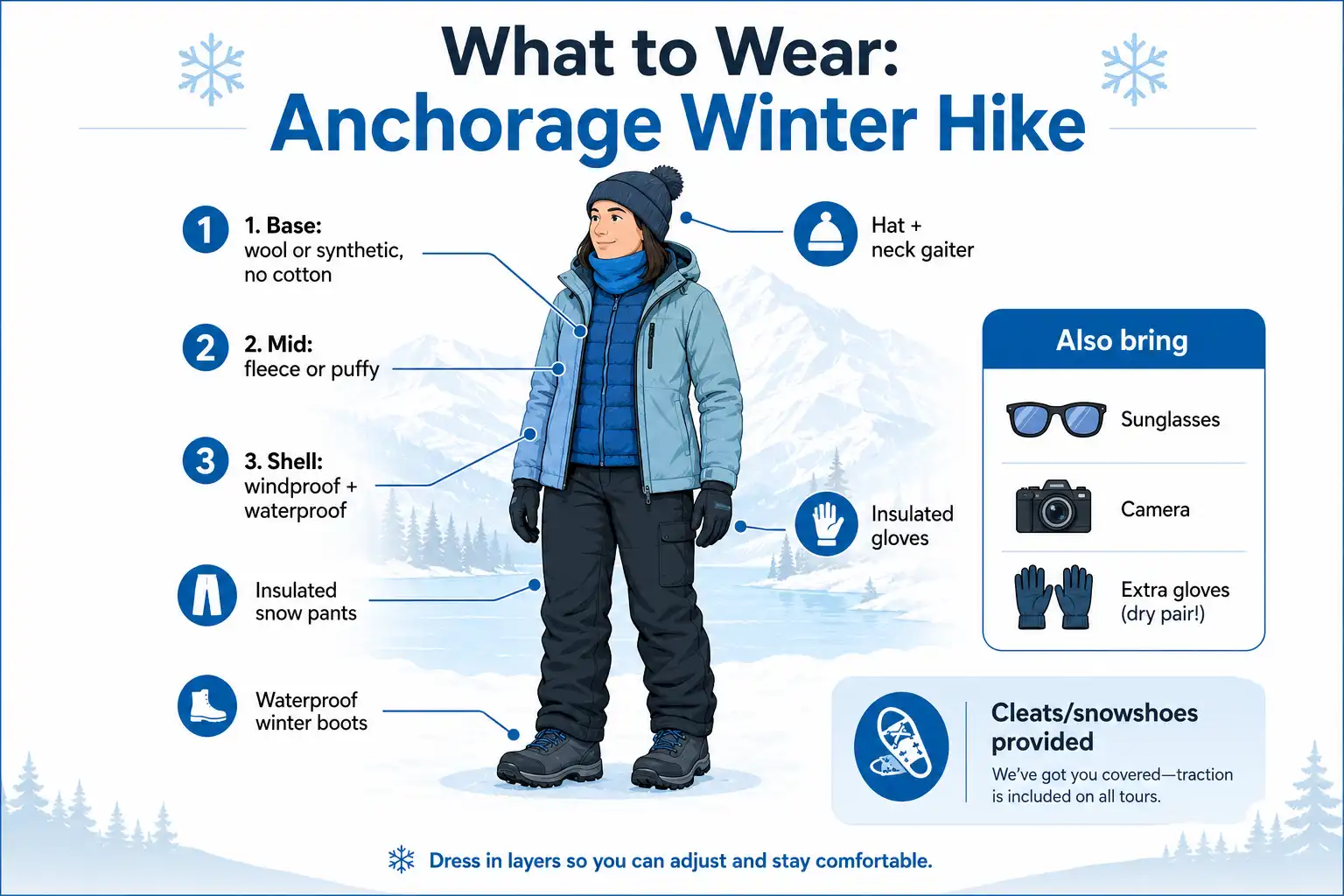
Three-layer clothing system and essential gear for an Anchorage winter hike day tour
What to Wear
Dress in layers and never wear cotton.
That’s the whole rule, and it’s what separates a great day from a cold, wet one.
Base Layer
Wool or synthetic material that wicks sweat. Opt for synthetic fabrics that dry quickly. Do not wear cotton.
Mid Layer
Fleece or a puffy layer provides the insulation you need.
Outer Shell
Windproof and waterproof. For a glacier hike specifically, a parka with a hood, insulated water-resistant snow pants, gloves, and a hat are a must.
Wear warm, waterproof boots and winter socks, preferably not cotton. You can borrow outerwear, but boots are not available to borrow.
Glacier cleats slip over your own boots, so skip sneakers.
Finish the kit with sunglasses, an extra pair of gloves, and a camera. Snow glare is no joke on a clear day.
Are These Tours Good for Beginners?
Yes. Nearly every Anchorage winter hike day tour is built for people with no experience. Guides set the pace to the group and provide the technical gear.
Snowshoeing
- Almost no technical skill required
- Guides teach you in minutes
- Gentle beginner routes available
- Ideal for first-time winter hikers
Glacier Hiking
- Moderate fitness recommended
- 2.5–3 hours on the ice
- Uneven and slippery surfaces
- Technical gear supplied
Snowshoeing needs almost no skill. If you’ve never tried it, you may be surprised the only required skill is walking. Glacier hikes ask a bit more fitness. You’ll be on the ice about 2.5 to 3 hours and walk around 2 miles on a slippery, uneven surface.
Check Age & Mobility Requirements
Many glacier operators set a minimum age of eight, though some private tours take younger kids. If mobility is a concern, ask first, since some winter operators can accommodate all ability levels.
How to Book: 5 Steps
Snowshoe for a half day near town, glacier for a full-day trip on the ice.
Check daylight for your dates and book an early start, especially in December and January.
Look for transportation, gear, and whether lunch is covered.
Many tours pick up only at hotels. They do not pick up at private residences, Airbnb, VRBO, or Alyeska Resort, so plan to meet downtown if you’re at a rental.
Several operators guarantee the best price when you book on their site. Booking early gives you a buffer if weather forces a reschedule.
Many operators allow cancellation up to 24 hours ahead for a full refund.
Snowshoe or Glacier: Which Should You Book?
Choose a snowshoe tour if you want a relaxed half-day adventure close to Anchorage. Choose the Matanuska Glacier if walking across blue ice and seeing crevasses up close is the experience you’re after.
Make Your Anchorage Winter Hike Count
An Anchorage winter hike day tour gives you Alaska’s snowy backcountry without the planning headache. Snowshoe trips near town are perfect for a relaxed half day, while a Matanuska Glacier hike delivers a full-day adventure on blue ice you can’t reach alone.
Dress in warm layers, book an early start to beat the short daylight, and pick a tour that fits your fitness. Do that, and you’ll come home with the kind of winter memories that make people fall for Alaska.
FAQs About Anchorage Winter Hike Day Tours
Are Anchorage winter hike tours suitable for beginners?
Yes. Most tours are designed for people with no previous winter hiking experience. Snowshoeing requires very little skill, while glacier hikes require somewhat more fitness because of uneven and slippery terrain.
How much does an Anchorage winter hike tour cost?
Snowshoe tours generally cost around $100–$150 per person. Winter glacier hikes generally range from about $160 to $475 per person, depending on the operator, group size, and what’s included.
Can you hike the Matanuska Glacier without a guide?
No. The guide states that visitors must explore the Matanuska Glacier as part of a guided tour for safety reasons.
What should I wear for a winter hike in Anchorage?
Use a three-layer system: a moisture-wicking base layer, an insulating mid layer, and a windproof, waterproof outer shell. Warm waterproof boots, winter socks, gloves, a hat, and sunglasses are also important. Avoid cotton.
When is the best month for an Anchorage winter hike?
March can be an especially appealing option because daylight increases to as much as 12 hours while temperatures begin climbing into the 30s. December and January offer much shorter daylight windows.