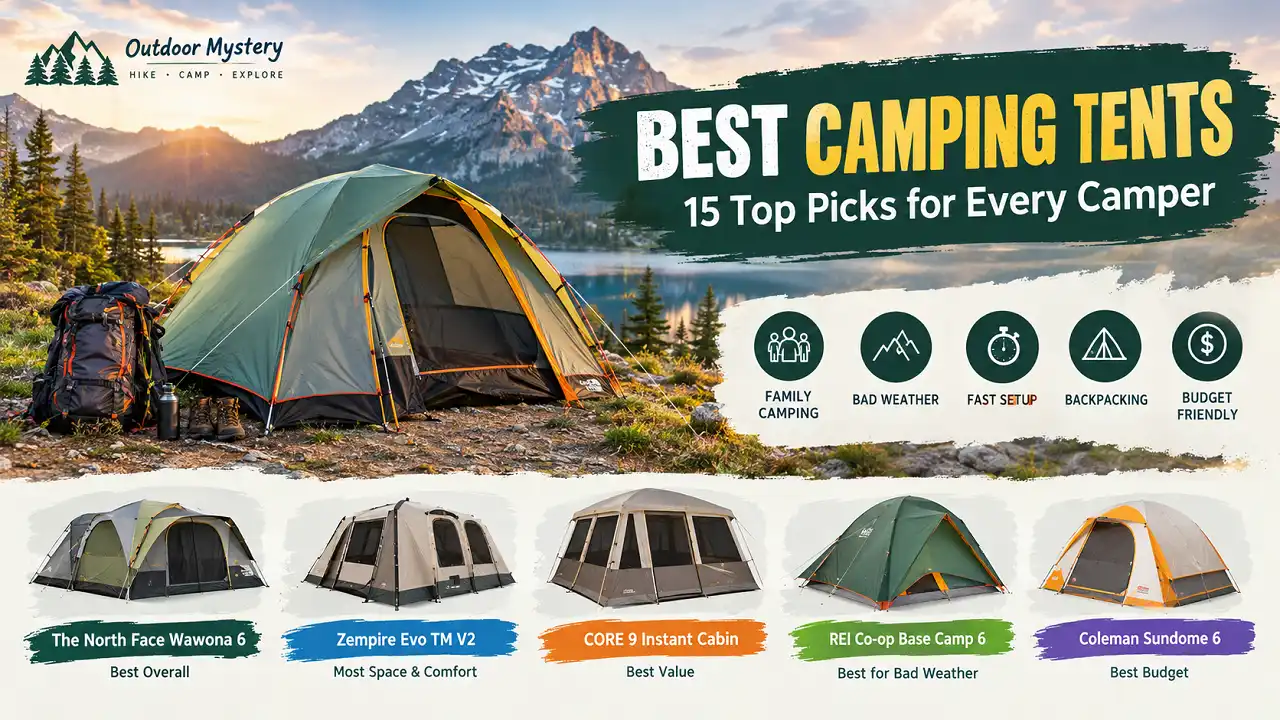
Best Camping Tents: 15 Top Picks for Every Type of Camper
Camping tents are one of those pieces of gear where you usually learn what matters after you’ve spent a night inside one.
I’ve been hiking and camping since 2018, mostly out of Bakersfield, California, and I’ve made plenty of gear mistakes along the way. I’ve worn the wrong boots, carried a backpack that was much too heavy, and headed out without paying enough attention to the weather. Those mistakes changed the way I look at outdoor gear.
A tent is no different.
The biggest or most expensive tent isn’t automatically the right one. A family spending a weekend at a drive-up campsite has very different needs from a couple traveling light. Someone camping through unpredictable weather will care about protection and stability, while a beginner may care more about how quickly the tent goes up.
That’s the approach I took with this guide. Outdoor Mystery is my personal blog, not a company, and I write the guides myself. When I recommend something I’ve personally used, I say so. When I haven’t used a particular product, I don’t pretend that I have. I research it carefully and make that distinction clear. You can learn more about that approach on Outdoor Mystery.
For this particular list, I used OutdoorGearLab’s current 2026 camping-tent testing as the primary product reference. Its team tested 16 tents and scored them across space and comfort, weather resistance, ease of setup, family friendliness, and quality.
The 15 picks below cover different types of campers, from families wanting a huge living area to beginners looking for a simple tent that won’t take forever to pitch.
The North Face Wawona 6 — Best Overall Camping Tent
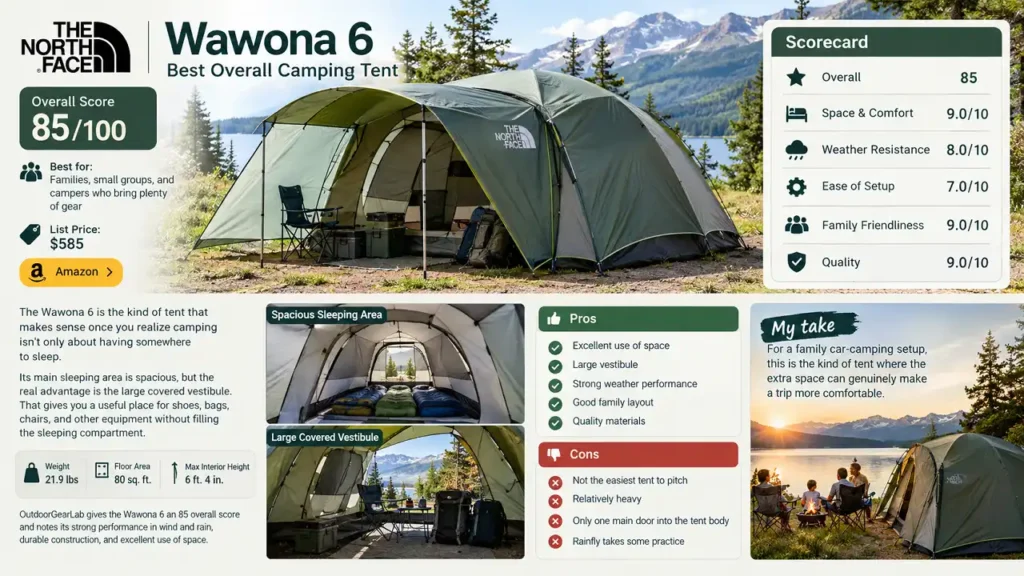
The North Face Wawona 6 combines spacious family camping comfort with a large covered vestibule.
Testing snapshot
| Category | Score |
|---|---|
| Overall | 85 |
| Space & Comfort | 9.0/10 |
| Weather Resistance | 8.0/10 |
| Ease of Setup | 7.0/10 |
| Family Friendliness | 9.0/10 |
| Quality | 9.0/10 |
The Wawona 6 is the kind of tent that makes sense once you realize that camping isn’t only about having somewhere to sleep.
Its main sleeping area is spacious, but the real advantage is the large covered vestibule. That gives you a useful place for shoes, bags, chairs, and other equipment without filling the sleeping compartment.
OutdoorGearLab gives the Wawona 6 an 85 overall score and notes its strong performance in wind and rain, durable construction, and excellent use of space. Its measured weight is 21.9 pounds, with an 80-square-foot floor area and a 6-foot-4-inch maximum interior height.
- Excellent use of space
- Large vestibule
- Strong weather performance
- Good family layout
- Quality materials
- Not the easiest tent to pitch
- Relatively heavy
- Only one main door into the tent body
- Rainfly takes some practice
For a family car-camping setup, this is the kind of tent where the extra space can genuinely make a trip more comfortable.
Zempire Evo TM V2 — Best for Space and Comfort
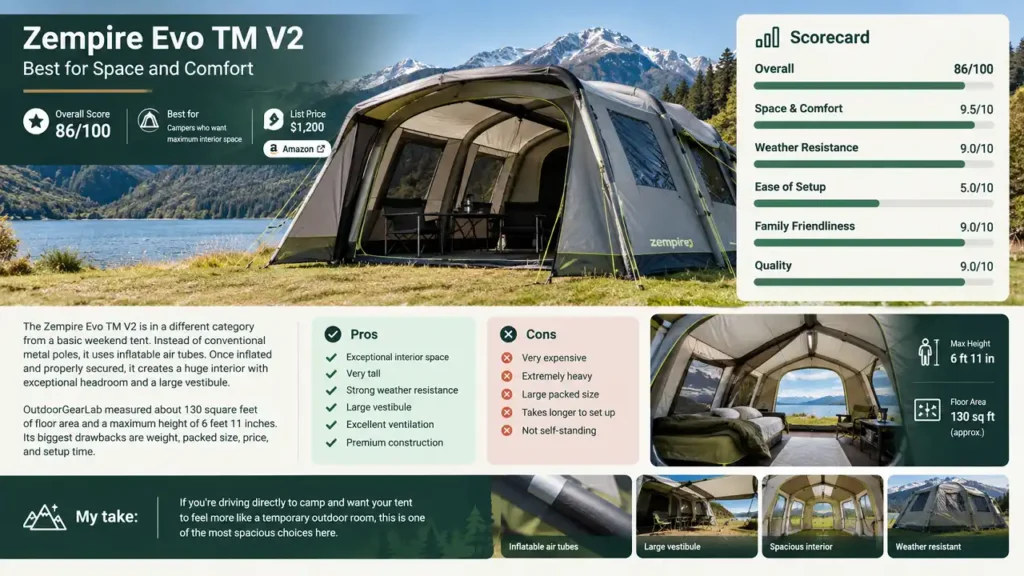
The Zempire Evo TM V2 offers exceptional interior space, impressive headroom, a large vestibule, and strong weather resistance, making it suitable for campers who prioritize comfort.
Testing snapshot
| Category | Score |
|---|---|
| Overall | 86 |
| Space & Comfort | 9.5/10 |
| Weather Resistance | 9.0/10 |
| Ease of Setup | 5.0/10 |
| Family Friendliness | 9.0/10 |
| Quality | 9.0/10 |
The Zempire Evo TM V2 is in a different category from a basic weekend tent.
Instead of conventional metal poles, it uses inflatable air tubes. Once inflated and properly secured, it creates a huge interior with exceptional headroom and a large vestibule.
OutdoorGearLab measured about 130 square feet of floor area and a maximum height of 6 feet 11 inches. Its biggest drawbacks are weight, packed size, price, and setup time.
- Exceptional interior space
- Very tall
- Strong weather resistance
- Large vestibule
- Excellent ventilation
- Premium construction
- Very expensive
- Extremely heavy
- Large packed size
- Takes longer to set up
- Not self-standing
If you’re driving directly to camp and want your tent to feel more like a temporary outdoor room, this is one of the most spacious choices here.
CORE 9 Instant Cabin — Best Value in a Bigger Tent
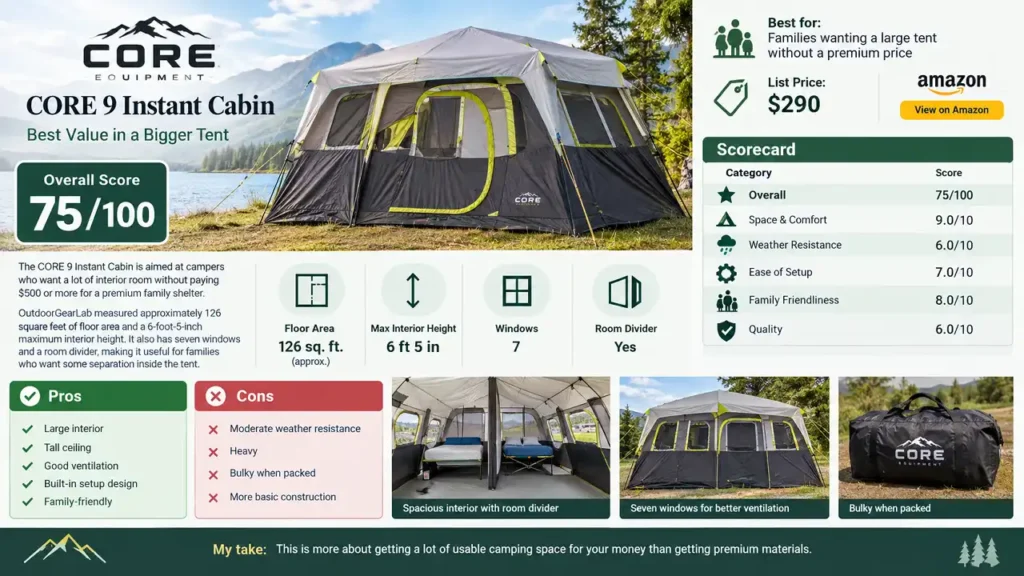
CORE 9 Instant Cabin offers a spacious family camping setup with 126 sq. ft. of floor space, a tall ceiling, seven windows, and a room divider.
Testing snapshot
| Category | Score |
|---|---|
| Overall | 75 |
| Space & Comfort | 9.0/10 |
| Weather Resistance | 6.0/10 |
| Ease of Setup | 7.0/10 |
| Family Friendliness | 8.0/10 |
| Quality | 6.0/10 |
The CORE 9 Instant Cabin is aimed at campers who want a lot of interior room without paying $500 or more for a premium family shelter.
OutdoorGearLab measured approximately 126 square feet of floor area and a 6-foot-5-inch maximum interior height. It also has seven windows and a room divider, making it useful for families who want some separation inside the tent.
- Large interior
- Tall ceiling
- Good ventilation
- Built-in setup design
- Family-friendly
- Moderate weather resistance
- Heavy
- Bulky when packed
- More basic construction
This is more about getting a lot of usable camping space for your money than getting premium materials.
Marmot Tungsten 4 — Best 4-Person Camping Tent
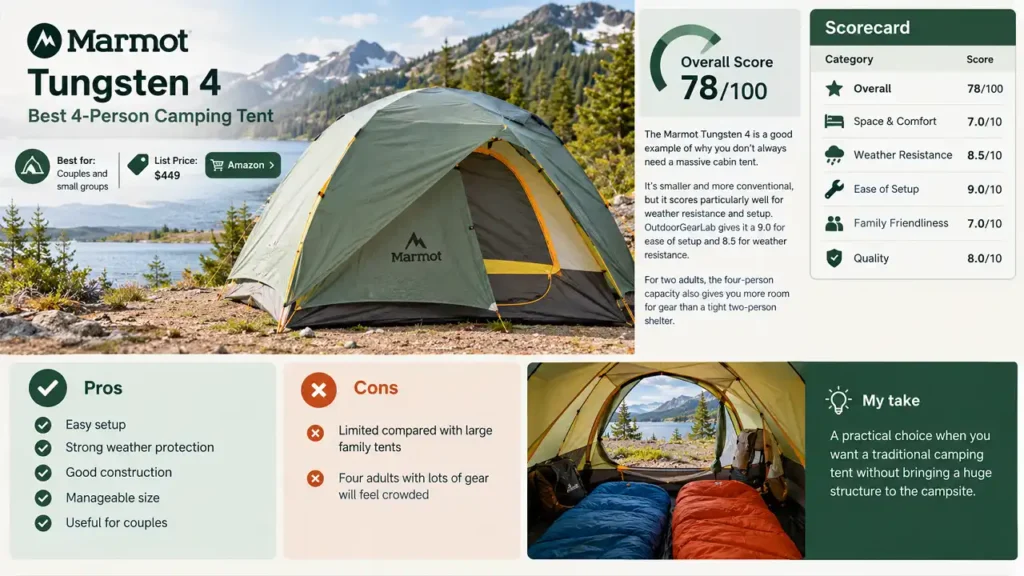
The Marmot Tungsten 4 is a practical four-person camping tent with easy setup, strong weather protection, and a manageable design for couples and small groups.
Testing snapshot
| Category | Score |
|---|---|
| Overall | 78 |
| Space & Comfort | 7.0/10 |
| Weather Resistance | 8.5/10 |
| Ease of Setup | 9.0/10 |
| Family Friendliness | 7.0/10 |
| Quality | 8.0/10 |
The Marmot Tungsten 4 is a good example of why you don’t always need a massive cabin tent.
It’s smaller and more conventional, but it scores particularly well for weather resistance and setup. OutdoorGearLab gives it a 9.0 for ease of setup and 8.5 for weather resistance.
For two adults, the four-person capacity also gives you more room for gear than a tight two-person shelter.
- Easy setup
- Strong weather protection
- Good construction
- Manageable size
- Useful for couples
- Limited compared with large family tents
- Four adults with lots of gear will feel crowded
A practical choice when you want a traditional camping tent without bringing a huge structure to the campsite.
REI Co-op Base Camp 6 — Best Camping Tent for Bad Weather
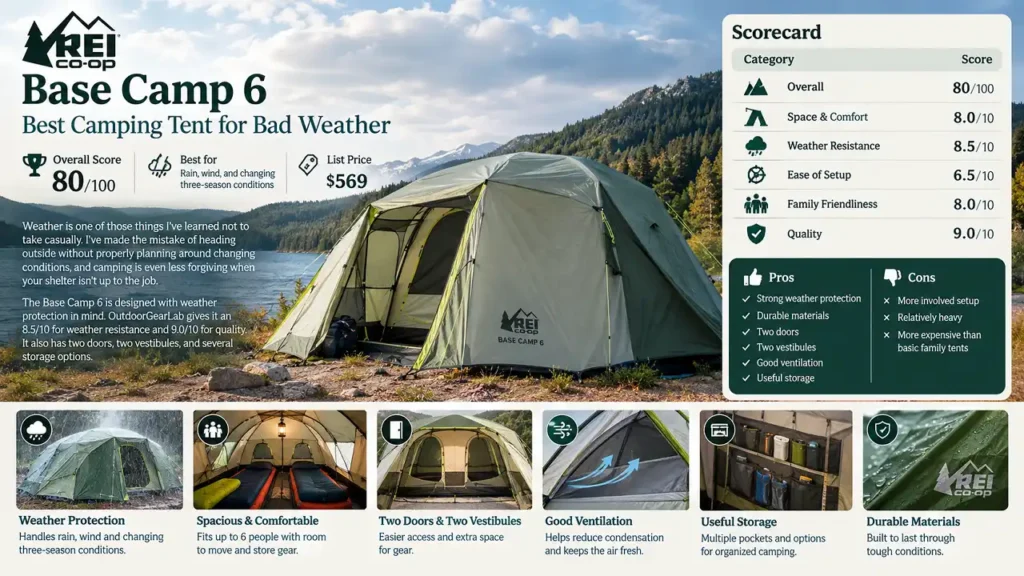
REI Co-op Base Camp 6 offers strong weather protection, durable materials, two doors, and two vestibules for changing three-season conditions.
Testing snapshot
| Category | Score |
|---|---|
| Overall | 80 |
| Space & Comfort | 8.0/10 |
| Weather Resistance | 8.5/10 |
| Ease of Setup | 6.5/10 |
| Family Friendliness | 8.0/10 |
| Quality | 9.0/10 |
Weather is one of those things I’ve learned not to take casually. I’ve made the mistake of heading outside without properly planning around changing conditions, and camping is even less forgiving when your shelter isn’t up to the job.
The Base Camp 6 is designed with weather protection in mind. OutdoorGearLab gives it an 8.5/10 for weather resistance and 9.0/10 for quality. It also has two doors, two vestibules, and several storage options.
- Strong weather protection
- Durable materials
- Two doors
- Two vestibules
- Good ventilation
- Useful storage
- More involved setup
- Relatively heavy
- More expensive than basic family tents
If weather is one of the biggest variables on your trips, this is one of the tents I’d put near the top of the list to investigate.
Fanttik Zeta C6 Pro — Best Fast-Setup Camping Tent
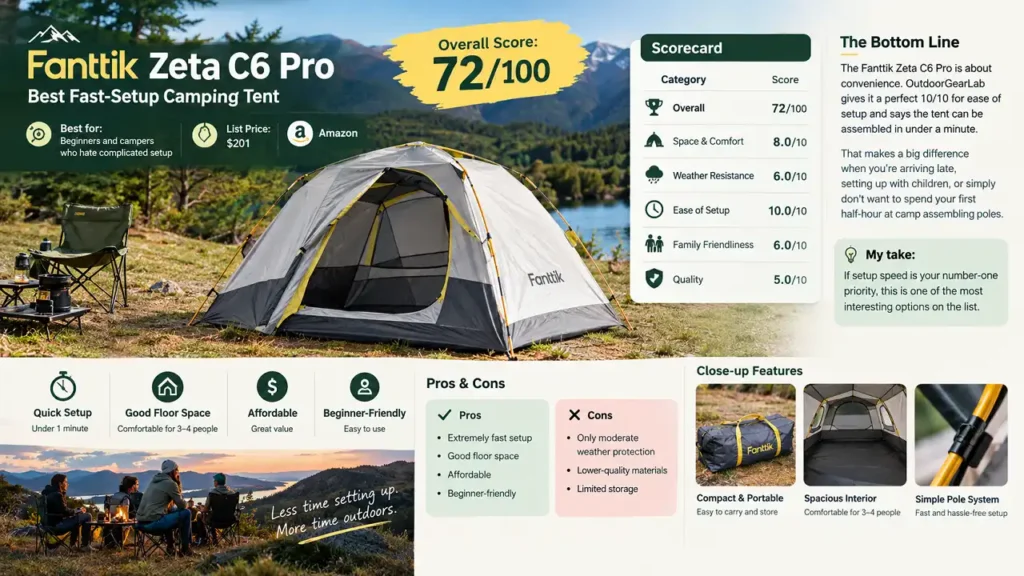
The Fanttik Zeta C6 Pro is a beginner-friendly camping tent praised for its under-one-minute setup, good floor space, and affordable price, with moderate weather protection and limited storage.
Testing snapshot
| Category | Score |
|---|---|
| Overall | 72 |
| Space & Comfort | 8.0/10 |
| Weather Resistance | 6.0/10 |
| Ease of Setup | 10.0/10 |
| Family Friendliness | 6.0/10 |
| Quality | 5.0/10 |
The Fanttik Zeta C6 Pro is about convenience.
OutdoorGearLab gives it a perfect 10/10 for ease of setup and says the tent can be assembled in under a minute. That makes a big difference when you’re arriving late, setting up with children, or simply don’t want to spend your first half-hour at camp assembling poles.
- Extremely fast setup
- Good floor space
- Affordable
- Beginner-friendly
- Only moderate weather protection
- Lower-quality materials
- Limited storage
If setup speed is your number-one priority, this is one of the most interesting options on the list.
Gazelle T4 Hub — Best Pop-Up Camping Tent
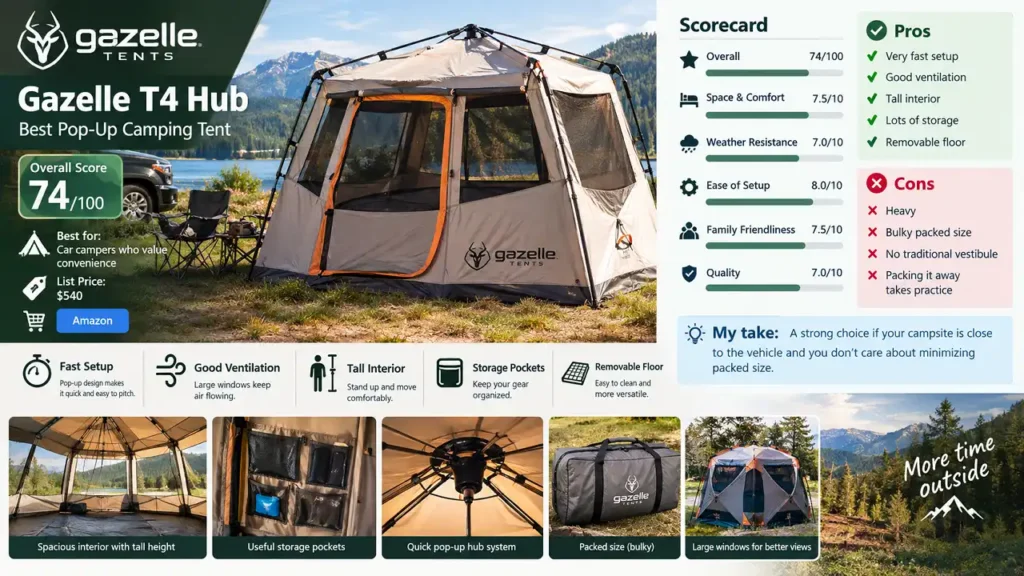
Gazelle T4 Hub — Best Pop-Up Camping Tent, rated 74/100 for convenience-focused car campers.
Testing snapshot
| Category | Score |
|---|---|
| Overall | 74 |
| Space & Comfort | 7.5/10 |
| Weather Resistance | 7.0/10 |
| Ease of Setup | 8.0/10 |
| Family Friendliness | 7.5/10 |
| Quality | 7.0/10 |
The Gazelle T4 Hub is another tent designed to make setup less of a chore.
OutdoorGearLab reports that its testers were able to pitch it very quickly—even without reading the instructions the first time. It also has large windows, useful storage pockets, good headroom, and a removable floor.
- Very fast setup
- Good ventilation
- Tall interior
- Lots of storage
- Removable floor
- Heavy
- Bulky packed size
- No traditional vestibule
- Packing it away takes practice
A strong choice if your campsite is close to the vehicle and you don’t care about minimizing packed size.
REI Westward 6 — Best Family Camping Tent
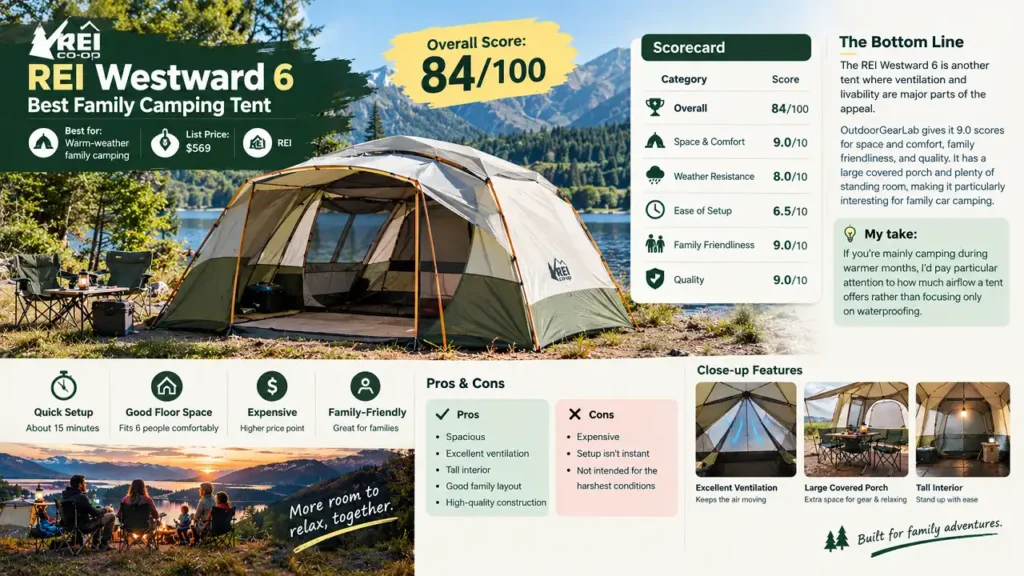
The REI Westward 6 offers a spacious, well-ventilated interior, a large covered porch, and family-friendly comfort for warm-weather camping.
Testing snapshot
| Category | Score |
|---|---|
| Overall | 84 |
| Space & Comfort | 9.0/10 |
| Weather Resistance | 8.0/10 |
| Ease of Setup | 6.5/10 |
| Family Friendliness | 9.0/10 |
| Quality | 9.0/10 |
The REI Westward 6 is another tent where ventilation and livability are major parts of the appeal.
OutdoorGearLab gives it 9.0 scores for space and comfort, family friendliness, and quality. It has a large covered porch and plenty of standing room, making it particularly interesting for family car camping.
- Spacious
- Excellent ventilation
- Tall interior
- Good family layout
- High-quality construction
- Expensive
- Setup isn’t instant
- Not intended for the harshest conditions
If you’re mainly camping during warmer months, I’d pay particular attention to how much airflow a tent offers rather than focusing only on waterproofing.
Big Agnes Bunk House 6 — Best for Family Comfort
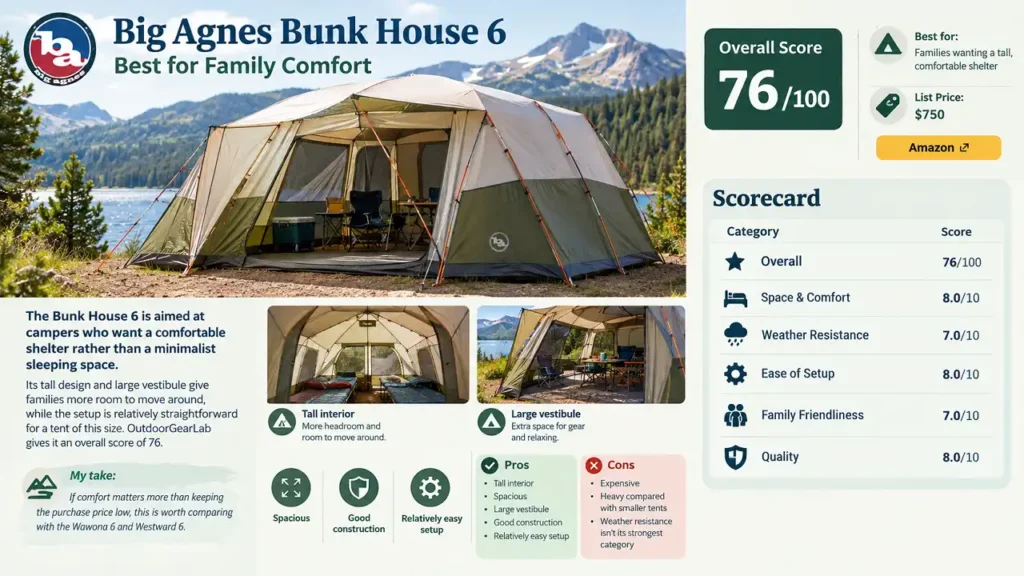
Big Agnes Bunk House 6 offers a tall interior, spacious layout, and large vestibule for comfortable family camping.
Testing snapshot
| Category | Score |
|---|---|
| Overall | 76 |
| Space & Comfort | 8.0/10 |
| Weather Resistance | 7.0/10 |
| Ease of Setup | 8.0/10 |
| Family Friendliness | 7.0/10 |
| Quality | 8.0/10 |
The Bunk House 6 is aimed at campers who want a comfortable shelter rather than a minimalist sleeping space.
Its tall design and large vestibule give families more room to move around, while the setup is relatively straightforward for a tent of this size. OutdoorGearLab gives it an overall score of 76.
- Tall interior
- Spacious
- Large vestibule
- Good construction
- Relatively easy setup
- Expensive
- Heavy compared with smaller tents
- Weather resistance isn’t its strongest category
If comfort matters more than keeping the purchase price low, this is worth comparing with the Wawona 6 and Westward 6.
Coleman Skydome XL 8 — Best Large Tent for Groups
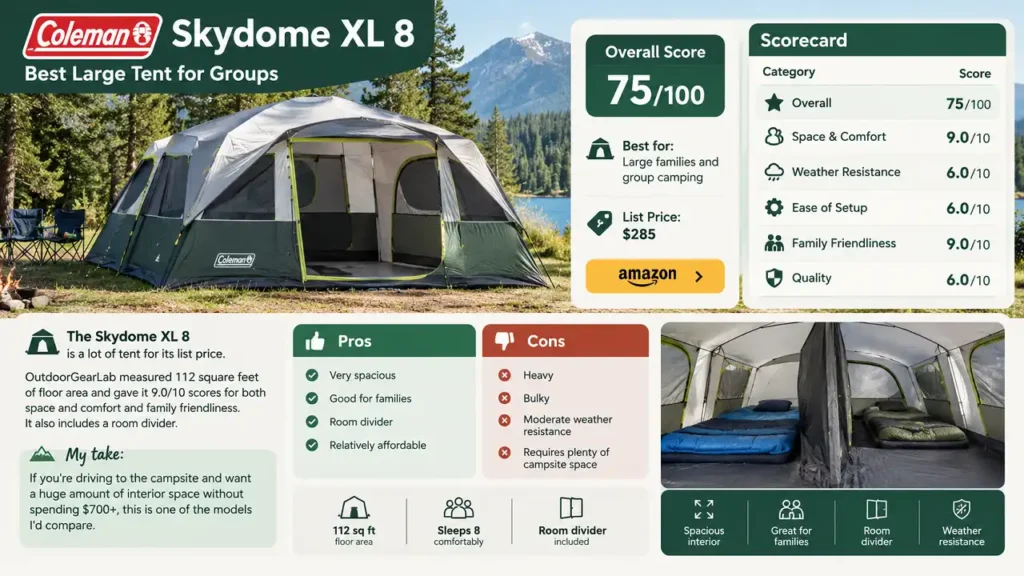
The Coleman Skydome XL 8 offers 112 square feet of floor space, a room divider, and plenty of room for family and group camping, with an overall score of 75/100.
Testing snapshot
| Category | Score |
|---|---|
| Overall | 75 |
| Space & Comfort | 9.0/10 |
| Weather Resistance | 6.0/10 |
| Ease of Setup | 6.0/10 |
| Family Friendliness | 9.0/10 |
| Quality | 6.0/10 |
Big Agnes Bunk House 6 offers a tall interior, spacious layout, and large vestibule for comfortable family camping.
The Skydome XL 8 is a lot of tent for its list price.
OutdoorGearLab measured 112 square feet of floor area and gave it 9.0/10 scores for both space and comfort and family friendliness. It also includes a room divider.
- Very spacious
- Good for families
- Room divider
- Relatively affordable
- Heavy
- Bulky
- Moderate weather resistance
- Requires plenty of campsite space
If you’re driving to the campsite and want a huge amount of interior space without spending $700+, this is one of the models I’d compare.
Marmot Limestone 4 — Best for Weather Protection
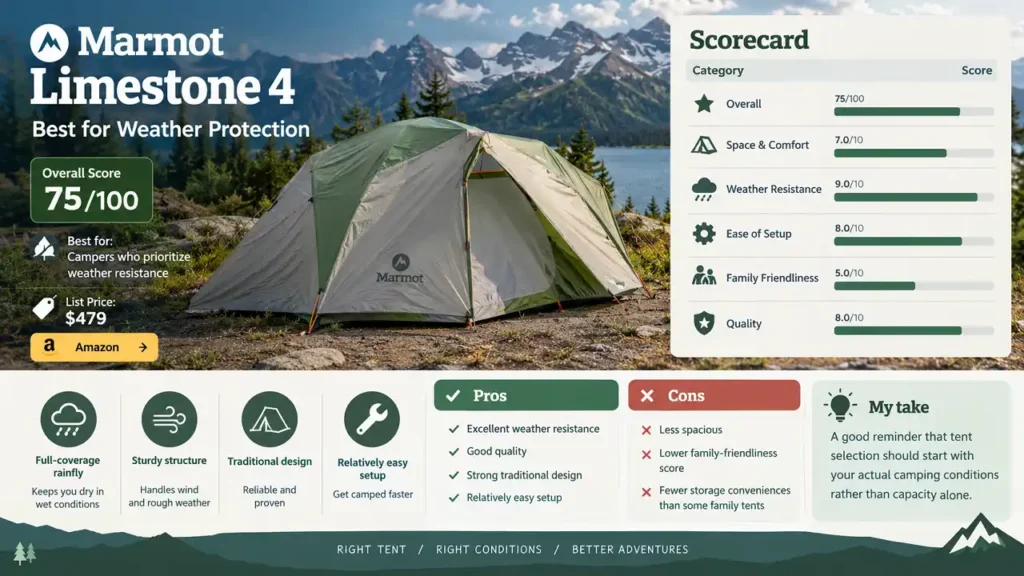
Marmot Limestone 4 Best for Weather Protection
Testing snapshot
| Category | Score |
|---|---|
| Overall | 75 |
| Space & Comfort | 7.0/10 |
| Weather Resistance | 9.0/10 |
| Ease of Setup | 8.0/10 |
| Family Friendliness | 5.0/10 |
| Quality | 8.0/10 |
The Limestone 4 doesn’t try to be a giant family cabin. Instead, it focuses more heavily on traditional tent performance.
OutdoorGearLab gives it a strong 9.0/10 for weather resistance and 8.0/10 for both setup and quality. Its full-coverage rainfly and sturdy structure make it particularly interesting for campers who expect wet or windy conditions.
- Excellent weather resistance
- Good quality
- Strong traditional design
- Relatively easy setup
- Less spacious
- Lower family-friendliness score
- Fewer storage conveniences than some family tents
A good reminder that tent selection should start with your actual camping conditions rather than capacity alone.
Snow Peak Alpha Breeze — Best Rugged Camping Tent
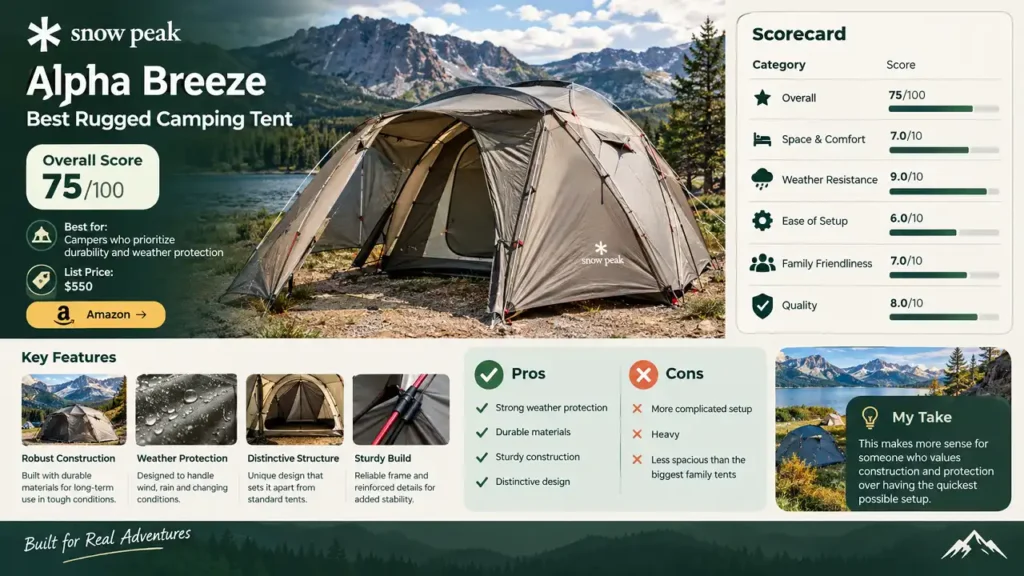
The Snow Peak Alpha Breeze is a rugged camping tent designed for campers who prioritize durable construction and weather protection over quick setup.
Testing snapshot
| Category | Score |
|---|---|
| Overall | 75 |
| Space & Comfort | 7.0/10 |
| Weather Resistance | 9.0/10 |
| Ease of Setup | 6.0/10 |
| Family Friendliness | 7.0/10 |
| Quality | 8.0/10 |
The Alpha Breeze has a distinctive structure and a reputation for robust construction.
OutdoorGearLab gives it 9.0/10 for weather resistance and 8.0/10 for quality, although setup is more involved than some of the convenience-focused tents in this guide.
- Strong weather protection
- Durable materials
- Sturdy construction
- Distinctive design
- More complicated setup
- Heavy
- Less spacious than the biggest family tents
This makes more sense for someone who values construction and protection over having the quickest possible setup.
Space Acacia Lite — Best Spacious Pop-Up Alternative
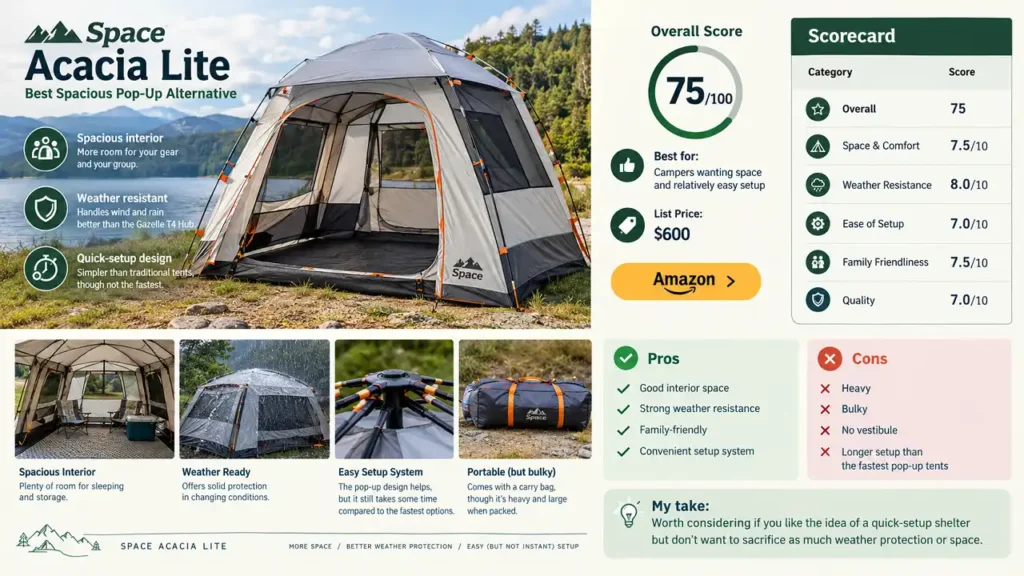
Space Acacia Lite offers generous interior space, strong weather resistance, and a convenient pop-up setup.
Testing snapshot
| Category | Score |
|---|---|
| Overall | 75 |
| Space & Comfort | 7.5/10 |
| Weather Resistance | 8.0/10 |
| Ease of Setup | 7.0/10 |
| Family Friendliness | 7.5/10 |
| Quality | 7.0/10 |
The Space Acacia Lite occupies an interesting middle ground.
OutdoorGearLab notes that it provides more floor space and stronger weather resistance than the Gazelle T4 Hub, although it takes longer to fully set up and is somewhat heavier.
- Good interior space
- Strong weather resistance
- Family-friendly
- Convenient setup system
- Heavy
- Bulky
- No vestibule
- Longer setup than the fastest pop-up tents
Worth considering if you like the idea of a quick-setup shelter but don’t want to sacrifice as much weather protection or space.
Kelty Wireless 6 — Best Value for Space
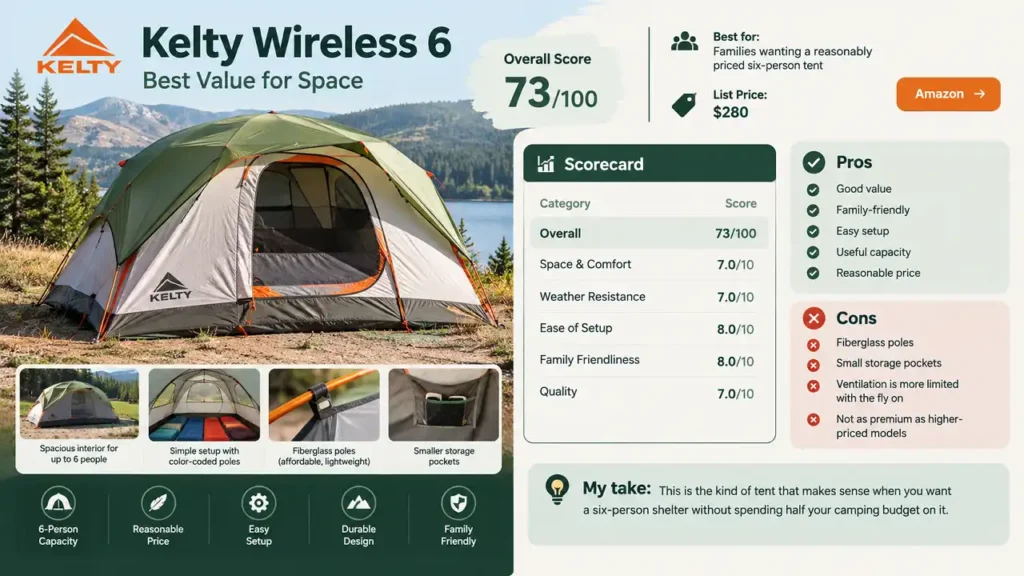
Kelty Wireless 6 offers spacious family camping comfort at a reasonable price.
Testing snapshot
| Category | Score |
|---|---|
| Overall | 73 |
| Space & Comfort | 7.0/10 |
| Weather Resistance | 7.0/10 |
| Ease of Setup | 8.0/10 |
| Family Friendliness | 8.0/10 |
| Quality | 7.0/10 |
The Kelty Wireless 6 offers a straightforward balance of space, setup convenience, and price.
OutdoorGearLab gives it an 8.0 for ease of setup and family friendliness, while noting some compromises such as fiberglass poles, smaller pockets, and reduced ventilation when the rainfly is installed.
- Good value
- Family-friendly
- Easy setup
- Useful capacity
- Reasonable price
- Fiberglass poles
- Small storage pockets
- Ventilation is more limited with the fly on
- Not as premium as higher-priced models
This is the kind of tent that makes sense when you want a six-person shelter without spending half your camping budget on it.
Coleman Sundome 6 — Best Budget Camping Tent
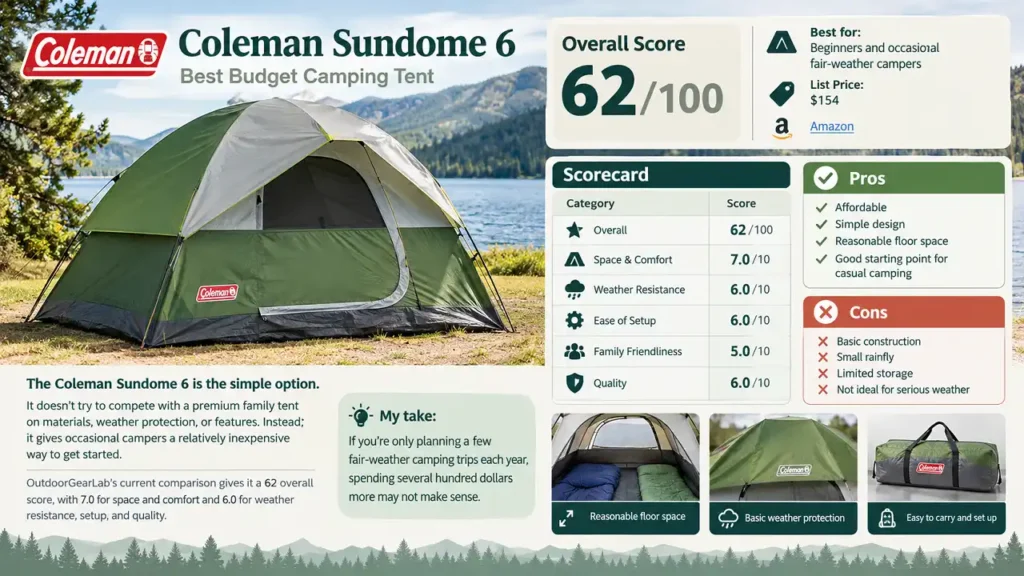
Coleman Sundome 6 a budget-friendly camping tent for beginners and occasional fair-weather trips.
Testing snapshot
| Category | Score |
|---|---|
| Overall | 62 |
| Space & Comfort | 7.0/10 |
| Weather Resistance | 6.0/10 |
| Ease of Setup | 6.0/10 |
| Family Friendliness | 5.0/10 |
| Quality | 6.0/10 |
The Coleman Sundome 6 is the simple option.
It doesn’t try to compete with a premium family tent on materials, weather protection, or features. Instead, it gives occasional campers a relatively inexpensive way to get started.
OutdoorGearLab’s current comparison gives it a 62 overall score, with 7.0 for space and comfort and 6.0 for weather resistance, setup, and quality.
- Affordable
- Simple design
- Reasonable floor space
- Good starting point for casual camping
- Basic construction
- Small rainfly
- Limited storage
- Not ideal for serious weather
If you’re only planning a few fair-weather camping trips each year, spending several hundred dollars more may not make sense.
How to Choose the Best Camping Tent
After years of making mistakes with outdoor gear, I’ve stopped asking whether something is simply “good.”
The better question is:
Good for what?
That’s especially true with tents.
Start With How You Actually Camp
If your campsite is next to your vehicle, weight matters much less than it would on a backpacking trip.
That changes what makes sense.
A 50-pound family tent might be completely reasonable when you unload it from your trunk. The same tent would be ridiculous if you’re carrying it several miles.
This is one reason I think gear decisions should start with the trip rather than the product.
If you’re also building out the rest of your hiking setup, my guide on how to choose hiking boots follows the same idea: match the gear to the conditions you’re actually going to encounter.
Think About Capacity
Tent capacity is a sleeping rating, not necessarily a comfort rating.
If you’re two adults with backpacks, a two-person tent may technically fit you, but a three- or four-person tent can be much more comfortable.
A simple starting point:
| Campers | Tent Size to Consider |
|---|---|
| 1 | 2-person |
| 2 | 3–4-person |
| 3 | 4–6-person |
| 4 | 6-person |
| 5–6 | 8-person |
| Large family | 9–10+ person |
Pay Attention to Floor Area
Two tents with the same capacity can feel completely different.
Look at:
- Floor dimensions
- Total floor area
- Peak height
- Wall angle
- Vestibule size
- Number of doors
- Storage pockets
For family camping, those details can matter more than the number printed on the packaging.
Consider the Weather
Weather planning is one of the lessons I’ve learned the hard way.
A tent for dry summer weekends doesn’t need to solve the same problems as a shelter for cold, wet, and windy trips.
For rougher conditions, pay attention to:
- Rainfly coverage
- Waterproof floor
- Seam construction
- Pole strength
- Guyline points
- Stakes
- Ventilation
OutdoorGearLab’s testing specifically considers hot, cold, wet, and windy conditions when evaluating weather resistance.
Think About Setup Time
There’s a huge difference between arriving at camp and having your shelter ready in under a minute and spending 20 minutes figuring out poles.
If setup speed matters, look at tents such as the Fanttik Zeta C6 Pro, Gazelle T4 Hub, and CORE 9 Instant Cabin.
If you’re new to camping, don’t underestimate how valuable a simple setup can be.
What Features Matter Most in a Camping Tent?
Vestibules
A vestibule gives you somewhere to put muddy shoes, backpacks, chairs, and other gear without filling the sleeping area.
The Wawona 6 is particularly good here because its vestibule adds a substantial amount of covered outdoor space.
Multiple Doors
Two doors make life easier when you’re camping with another person.
Nobody has to crawl over a sleeping bag at 2 a.m. just because the person on the outside needs to get up.
Ventilation
Good ventilation helps reduce condensation and makes warm nights more comfortable.
Look for:
- Mesh panels
- Roof vents
- Large windows
- Adjustable doors
- Airflow underneath the rainfly
Interior Height
If you’re camping for several days, being able to stand up can make a surprisingly big difference.
Tall tents such as the Zempire Evo TM V2 and several family cabin designs are much easier to live in than low-profile shelters.
Storage
Small pockets and gear lofts don’t sound important until your phone, flashlight, glasses, and other small items are all lying on the floor.
What Size Camping Tent Do You Need?
Here’s the simple version:
One camper: A 2-person tent gives you some extra room.
Two campers: A 3- or 4-person tent is usually more comfortable.
Three to four campers: A 6-person tent gives you room for gear.
Five to six campers: Consider an 8-person model.
Large family: Look at 9- or 10-person shelters.
The important thing is not to confuse maximum sleeping capacity with comfortable living space.
If you’re bringing children, pets, coolers, chairs, or lots of bags, extra space becomes much more valuable.
Are Expensive Camping Tents Worth It?
Sometimes.
I don’t think spending more money on gear automatically makes you better prepared. I’ve learned that lesson from carrying gear that was heavier than it needed to be.
The same principle applies to tents.
If you’re camping once or twice each summer in mild weather, a $150–$300 tent may be completely adequate.
If you’re camping frequently, dealing with bad weather, or spending multiple days inside your shelter, spending more can make sense.
The Zempire Evo TM V2 is a good example. Its $1,200 list price is difficult to justify for an occasional camper, but OutdoorGearLab found exceptional space, weather resistance, and construction.
The question isn’t:
“Is the expensive tent better?”
It’s:
“Will I actually benefit from what I’m paying for?”
Don’t Forget the Rest of Your Camping Gear
A tent is only one part of a camping system.
You also need to think about:
- Sleeping bag
- Sleeping pad
- Backpack or duffel
- Water
- Food
- Lighting
- First-aid supplies
- Navigation
- Weather protection
I keep coming back to that idea because it’s one of the biggest lessons I’ve learned since I started hiking and camping in 2018.
Good gear doesn’t help much if you bring too much of it or forget something important.
For a broader look at what belongs in an outdoor kit, you can read Outdoor Mystery’s 10 essentials every hiker should carry.
Tips for Setting Up Your Camping Tent
Choose Good Ground
Look for reasonably level ground and avoid depressions where rainwater can collect.
Also check overhead branches before settling in.
Use a Footprint When Appropriate
A compatible footprint can protect the bottom of your tent from abrasion.
Just make sure it doesn’t stick out beyond the tent floor. An exposed footprint can actually collect rain underneath your tent.
Stake the Tent Properly
A large tent catches more wind than a small one.
Use the included stakes and guylines, particularly when conditions are windy.
OutdoorGearLab also recommends stronger stakes for exposed campsites and emphasizes the importance of guylines for larger shelters.
Keep the Vents Open
Rain doesn’t mean you need to seal every opening.
Good airflow helps control condensation and can make a noticeable difference overnight.
Practice Before Your First Trip
If you’ve never used the tent before, set it up at home.
You’ll learn much faster in your backyard than you will in the dark, with wind blowing and everyone waiting for dinner.
Best Camping Tents: Quick Comparison
| # | Tent | Best For | Score | List Price |
|---|---|---|---|---|
| 1 | The North Face Wawona 6 | Overall | 85 | $585 |
| 2 | Zempire Evo TM V2 | Space & Comfort | 86 | $1,200 |
| 3 | CORE 9 Instant Cabin | Bigger Tent Value | 75 | $290 |
| 4 | Marmot Tungsten 4 | 4-Person Camping | 78 | $449 |
| 5 | REI Co-op Base Camp 6 | Bad Weather | 80 | $569 |
| 6 | Fanttik Zeta C6 Pro | Fast Setup | 72 | $201 |
| 7 | Gazelle T4 Hub | Pop-Up Camping | 74 | $540 |
| 8 | REI Westward 6 | Family Camping | 84 | $569 |
| 9 | Big Agnes Bunk House 6 | Family Comfort | 76 | $750 |
| 10 | Coleman Skydome XL 8 | Large Groups | 75 | $285 |
| 11 | Marmot Limestone 4 | Weather Protection | 75 | $479 |
| 12 | Snow Peak Alpha Breeze | Rugged Camping | 75 | $550 |
| 13 | Space Acacia Lite | Spacious Pop-Up | 75 | $600 |
| 14 | Kelty Wireless 6 | Value & Space | 73 | $280 |
| 15 | Coleman Sundome 6 | Budget Camping | 62 | $154 |
The scores above are the current OutdoorGearLab figures for the 15 models included here. Their 2026 comparison contains 16 tents in total.
# Pick the Tent That Fits Your Trips
After hiking and camping since 2018, I’ve learned that buying outdoor gear is less about finding the product with the longest feature list and more about understanding what you actually need.
I’ve bought the wrong boots. I’ve carried a pack that was too heavy. I’ve underestimated weather. Those mistakes taught me to start with the trip and work backward from there.
I’d approach tents the same way.
If I were planning family car-camping trips and wanted a well-rounded shelter, I’d pay close attention to the The North Face Wawona 6. Its combination of usable interior space, large vestibule, family-friendly design, and weather performance makes it a particularly versatile option. OutdoorGearLab currently scores it 85 overall and names it its Best Overall Camping Tent.
If maximum living space mattered most, the Zempire Evo TM V2 would be the obvious tent to investigate but only if its weight, size, and price made sense for the way I camp.
For a larger tent at a more accessible price, the CORE 9 Instant Cabin is worth considering. If I cared most about bad-weather performance, I’d look closely at the REI Co-op Base Camp 6 and Marmot Limestone 4.
For someone new to camping who simply wants to get to the campsite and have a tent standing quickly, the Fanttik Zeta C6 Pro is particularly interesting because of its extremely fast setup.
And if you’re not sure whether you’ll even enjoy camping yet, there’s nothing wrong with starting with something simple and affordable like the Coleman Sundome 6.
That’s probably the biggest lesson I’d leave you with:
Don’t buy the tent that looks best on paper. Buy the tent that makes sense for the trips you’re actually going to take.
Think about where you’ll camp, how many people will sleep inside, how much gear you’ll bring, what the weather is likely to do, how far you’ll carry the tent, and how often you’ll use it.
Once you answer those questions, choosing among the best camping tents becomes much easier.