Can Hiking Boots Be Used as Winter Boots? When They Work
If you already own a good pair of hiking boots, you may wonder whether you need a separate pair of winter boots. Can hiking boots be used as winter boots? In many situations, yes, but it depends on the weather, terrain, and the boots you have.
A waterproof hiking boot with good traction can work surprisingly well for cold-weather hikes, light snow, wet trails, and everyday winter activities. However, regular hiking boots are not automatically designed for freezing temperatures, deep snow, or long periods on ice.
Can Hiking Boots Be Used as Winter Boots?
Yes, in many mild to moderate winter conditions. A waterproof hiking boot with good traction can work well for cold trails, light snow, rain, and short winter outings. Deep snow, extreme cold, and prolonged exposure to ice are better handled by dedicated winter boots.
The biggest difference usually comes down to warmth, insulation, snow protection, and traction. Hiking boots are primarily designed for varied outdoor terrain, while winter boots are built with cold-weather protection as a priority.
So before using your hiking boots in winter, it is worth understanding where they work well, where they struggle, and when a dedicated winter boot makes more sense.
Can Hiking Boots Work in Winter?
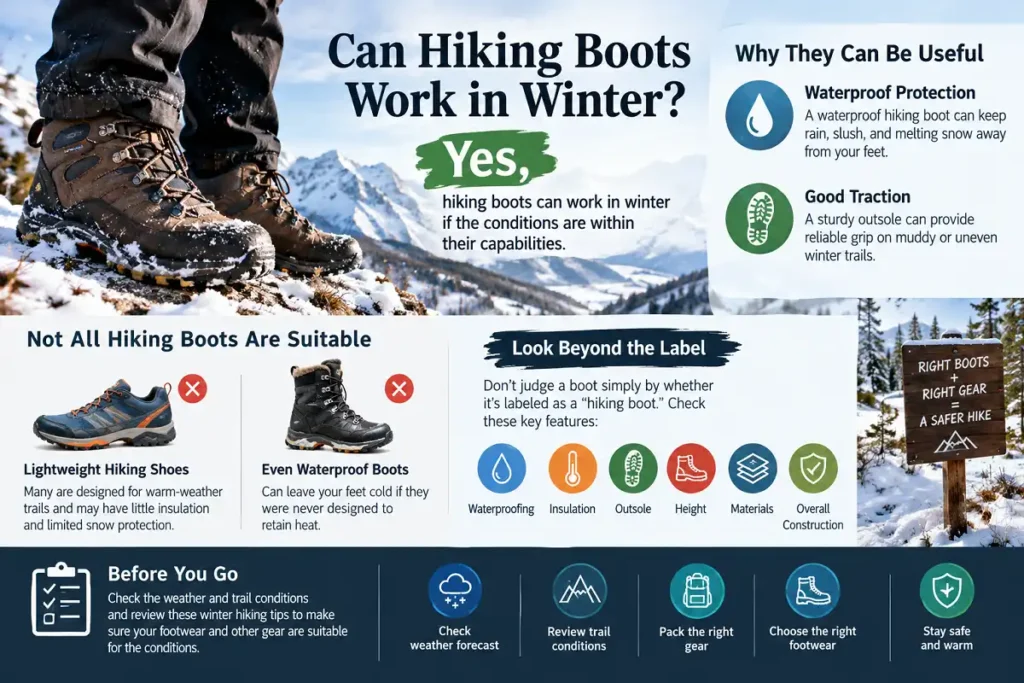
Yes, hiking boots can work in winter if the conditions are within their capabilities.
A waterproof hiking boot can be useful on cold and wet trails because it helps keep rain, slush, and melting snow away from your feet. A sturdy outsole can also provide good traction on muddy or uneven winter trails.
But not all hiking boots are suitable for winter. Lightweight hiking shoes designed for warm-weather trails may have little insulation and limited protection from snow. Even a waterproof boot can leave your feet cold if it was never designed to retain heat.
Don’t Judge a Boot by Its Label
This is why you should not judge a boot simply by whether it is labeled as a “hiking boot.” Look at its waterproofing, insulation, outsole, height, materials, and overall construction.
Before heading out, it is also worth checking the weather and trail conditions and reviewing these winter hiking tips to make sure your footwear and other gear are suitable for the conditions.
When Do Hiking Boots Work Well in Winter?
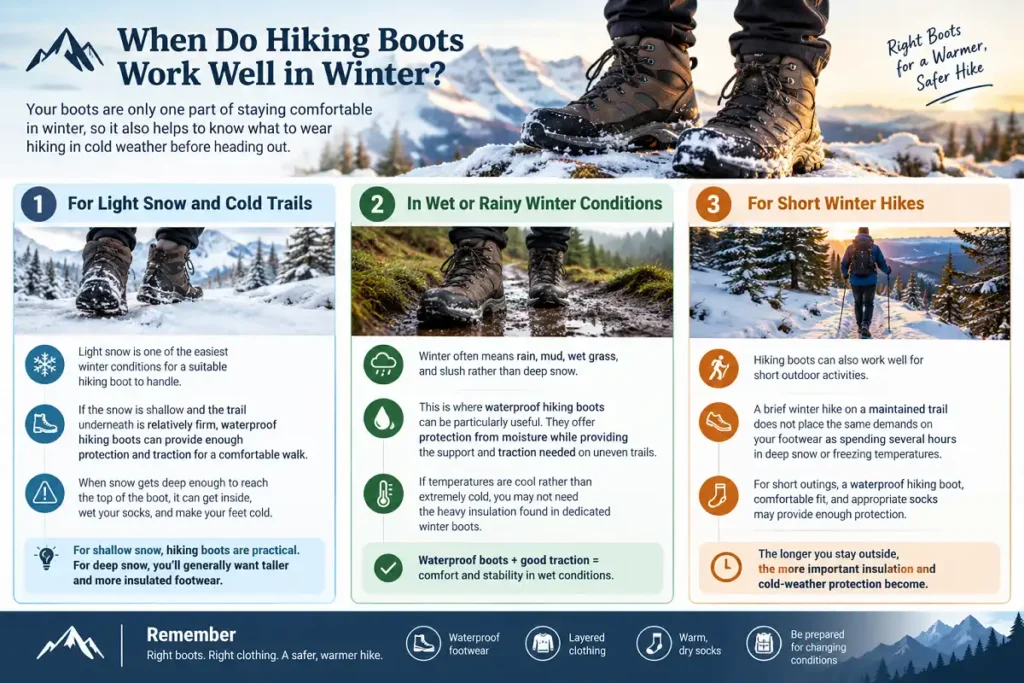
Your boots are only one part of staying comfortable in winter, so it also helps to know what to wear hiking in cold weather before heading out.
Suitable waterproof hiking boots can handle shallow snow when the underlying trail is relatively firm.
Waterproof boots are useful for rain, mud, wet grass, slush, and melting snow.
Brief winter outings generally place fewer demands on warmth and insulation than long excursions.
Hiking boots can be practical when temperatures and conditions stay within the boot’s capabilities.
For Light Snow and Cold Trails
Light snow is one of the easiest winter conditions for a suitable hiking boot to handle.
If the snow is shallow and the trail underneath is relatively firm, waterproof hiking boots can provide enough protection and traction for a comfortable walk.
The situation changes when snow becomes deep enough to reach the top of the boot. Snow can get inside, wet your socks, and make your feet cold.
For shallow snow, hiking boots can be practical. For deep snow, you will generally want taller and more insulated footwear.
In Wet or Rainy Winter Conditions
Winter often means rain, mud, wet grass, and slush rather than deep snow.
This is where waterproof hiking boots can be particularly useful. They offer protection from moisture while providing the support and traction needed on uneven trails.
If temperatures are cool rather than extremely cold, you may not need the heavy insulation found in dedicated winter boots.
For Short Winter Hikes
Hiking boots can also work well for short outdoor activities.
A brief winter hike on a maintained trail does not place the same demands on your footwear as spending several hours in deep snow or freezing temperatures.
For short outings, a waterproof hiking boot, comfortable fit, and appropriate socks may provide enough protection.
The longer you stay outside, the more important insulation and cold-weather protection become.
Benefits of Using Hiking Boots in Winter
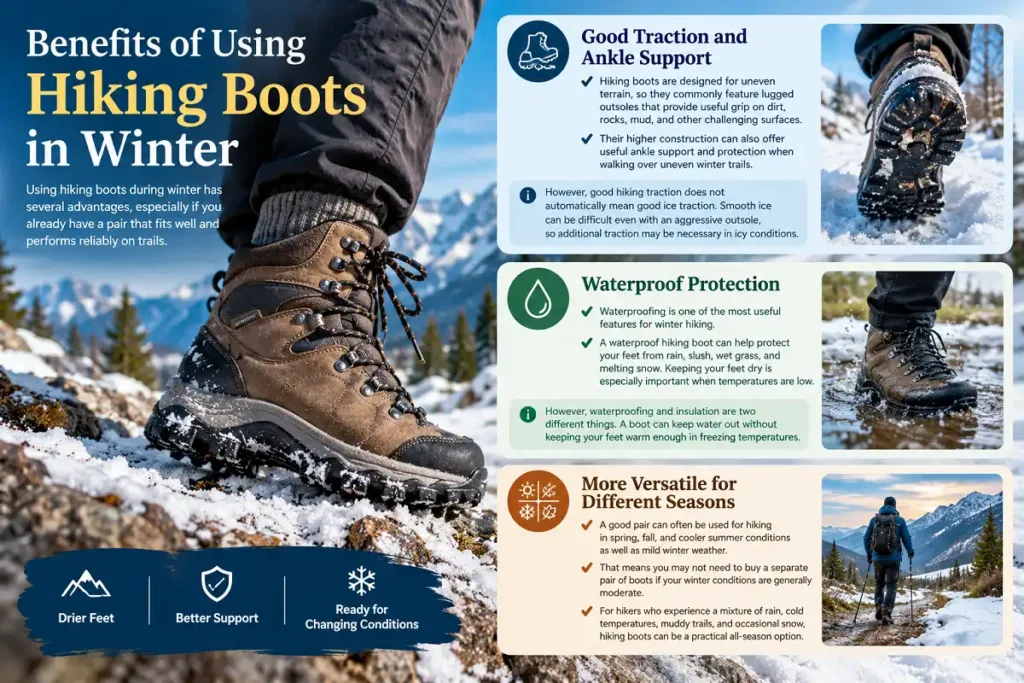
Using hiking boots during winter has several advantages, especially if you already have a pair that fits well and performs reliably on trails.
Good Traction and Ankle Support
Hiking boots are designed for uneven terrain, so they commonly feature lugged outsoles that provide useful grip on dirt, rocks, mud, and other challenging surfaces.
Their higher construction can also offer useful ankle support and protection when walking over uneven winter trails.
Waterproof Protection
Waterproofing is one of the most useful features for winter hiking. A waterproof hiking boot can help protect your feet from rain, slush, wet grass, and melting snow.
Keeping your feet dry is especially important when temperatures are low.
More Versatile for Different Seasons
One of the biggest advantages of hiking boots is versatility. A good pair can often be used for hiking in spring, fall, and cooler summer conditions as well as mild winter weather.
That means you may not need to buy a separate pair of boots if your winter conditions are generally moderate.
Hiking Traction Is Not Ice Traction
Good hiking traction does not automatically mean good ice traction. Smooth ice can be difficult even with an aggressive hiking outsole, so additional traction may be necessary in icy conditions.
For hikers who experience a mixture of rain, cold temperatures, muddy trails, and occasional snow, hiking boots can be a practical all-season option.
Problems With Using Hiking Boots as Winter Boots
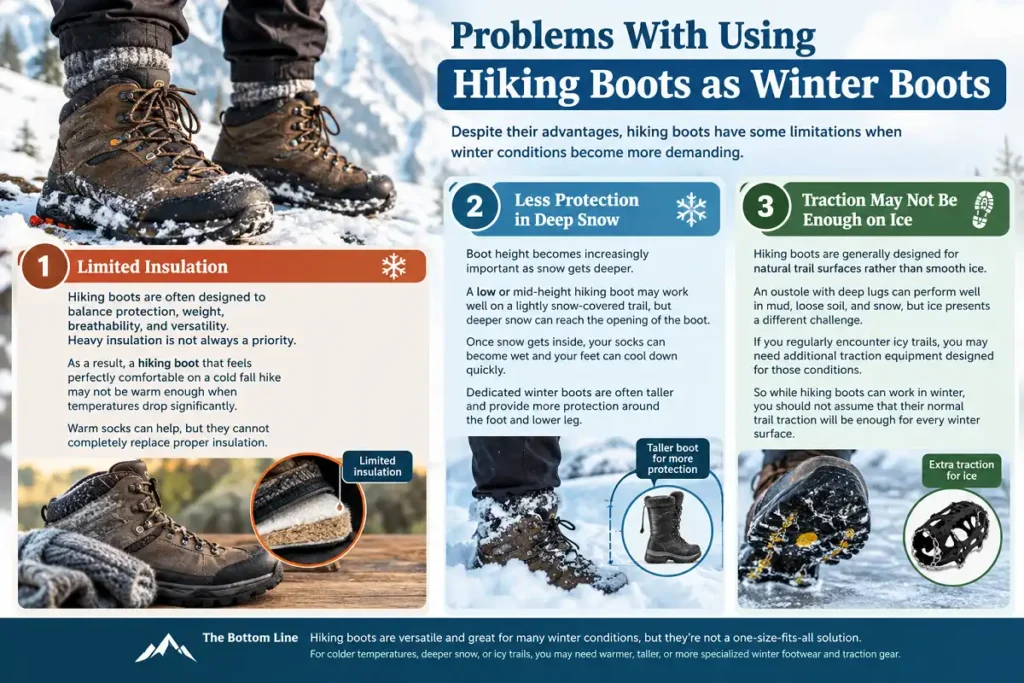
Despite their advantages, hiking boots have some limitations when winter conditions become more demanding.
The biggest issue with many regular hiking boots is insulation. Hiking boots are often designed to balance protection, weight, breathability, and versatility.
A low or mid-height hiking boot may work well on a lightly snow-covered trail, but deeper snow can reach the opening of the boot.
Hiking boots are generally designed for natural trail surfaces rather than smooth ice. Additional traction may be necessary on icy trails.
Limited Insulation
The biggest issue with many regular hiking boots is insulation.
Hiking boots are often designed to balance protection, weight, breathability, and versatility. Heavy insulation is not always a priority.
As a result, a hiking boot that feels perfectly comfortable on a cold fall hike may not be warm enough when temperatures drop significantly.
Warm socks can help, but they cannot completely replace proper insulation.
Less Protection in Deep Snow
Boot height becomes increasingly important as snow gets deeper.
A low or mid-height hiking boot may work well on a lightly snow-covered trail, but deeper snow can reach the opening of the boot.
Once snow gets inside, your socks can become wet and your feet can cool down quickly.
Dedicated winter boots are often taller and provide more protection around the foot and lower leg.
Traction May Not Be Enough on Ice
Hiking boots are generally designed for natural trail surfaces rather than smooth ice.
An outsole with deep lugs can perform well in mud, loose soil, and snow, but ice presents a different challenge.
If you regularly encounter icy trails, you may need additional traction equipment designed for those conditions.
So while hiking boots can work in winter, you should not assume that their normal trail traction will be enough for every winter surface.
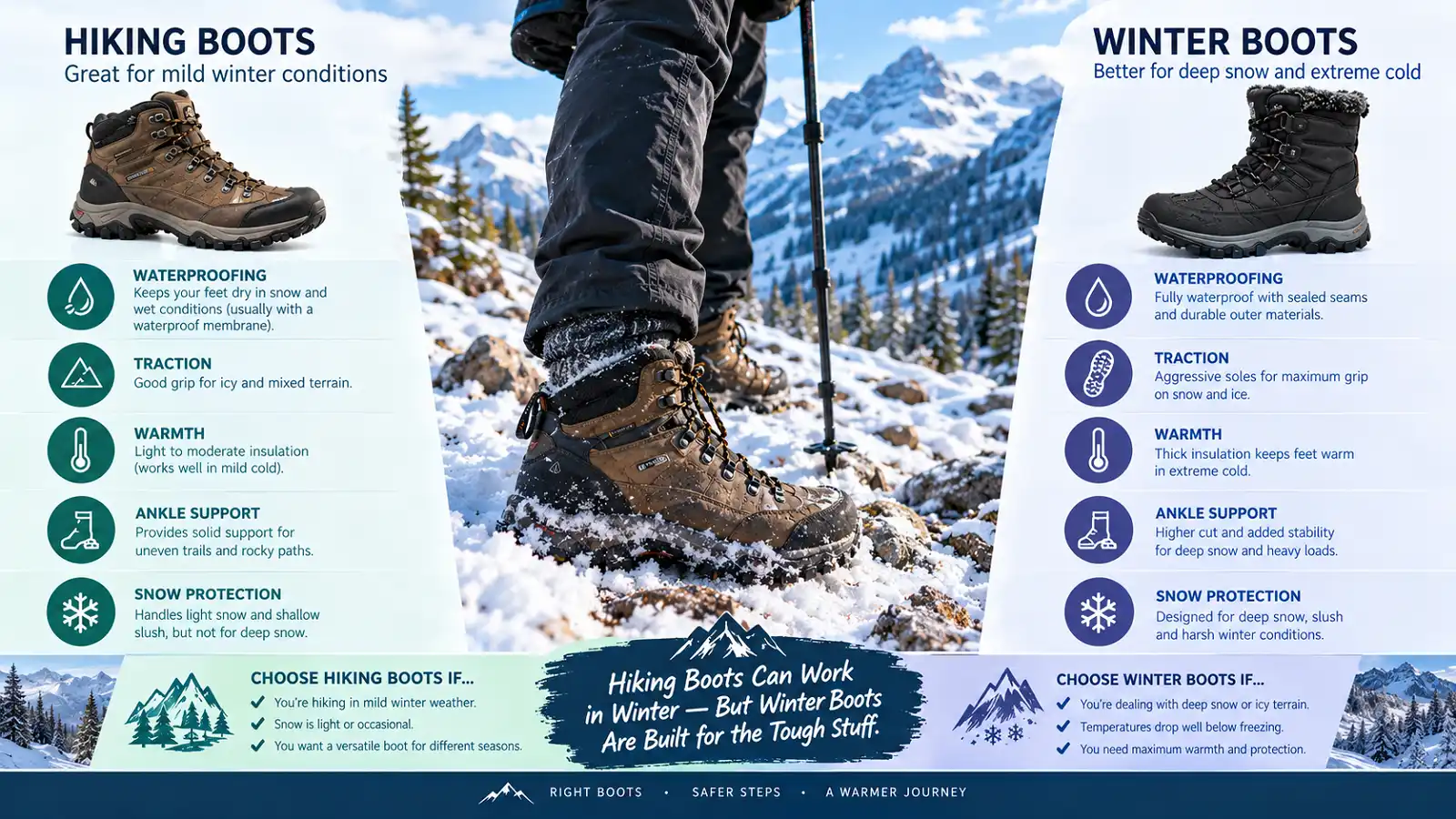
Hiking Boots vs Winter Boots
Hiking boots and winter boots are both useful outdoor footwear, but they are designed with different priorities.
Hiking Boots
- Designed for hiking and varied terrain.
- Low to moderate insulation on many models.
- Waterproofing depends on the model.
- Traction designed for varied trails.
- Limited to moderate snow protection.
- Generally good ankle support.
- Highly versatile across seasons.
Winter Boots
- Designed for cold and snowy conditions.
- Usually higher insulation.
- Waterproofing is commonly available.
- Often designed for snow and winter surfaces.
- Usually better snow protection.
- Ankle support varies by design.
- More winter-focused than all-season.
Neither Option Is Automatically Better
If you mainly hike on cold, wet trails with occasional light snow, hiking boots may be more versatile. If you spend long periods in deep snow or very low temperatures, winter boots usually have the advantage.
Neither option is automatically better. The right choice depends on the conditions you expect to encounter.
How to Choose Hiking Boots for Winter
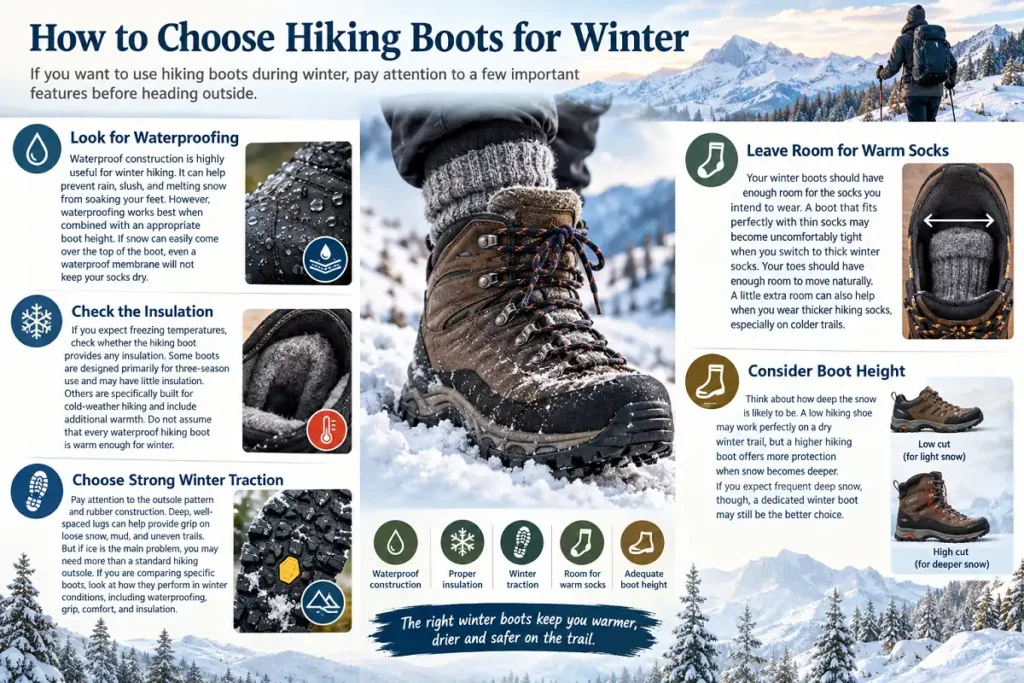
If you want to use hiking boots during winter, pay attention to a few important features before heading outside.
Look for Waterproofing
Waterproof construction is highly useful for winter hiking. It can help prevent rain, slush, and melting snow from soaking your feet.
However, waterproofing works best when combined with an appropriate boot height.
Check the Insulation
If you expect freezing temperatures, check whether the hiking boot provides any insulation.
Some hiking boots are designed primarily for three-season use and may have little insulation. Others are specifically built for cold-weather hiking and include additional warmth.
Choose Strong Winter Traction
Pay attention to the outsole pattern and rubber construction. Deep, well-spaced lugs can help provide grip on loose snow, mud, and uneven trails.
But if ice is the main problem, you may need more than a standard hiking outsole.
Leave Room for Warm Socks
Your winter boots should have enough room for the socks you intend to wear.
A boot that fits perfectly with thin socks may become uncomfortably tight when you switch to thick winter socks.
Your toes should have enough room to move naturally. Avoid choosing a fit that is so tight that thicker socks compress your feet.
Consider Boot Height
Think about how deep the snow is likely to be.
A low hiking shoe may work perfectly on a dry winter trail, but a higher hiking boot offers more protection when snow becomes deeper.
Consider the Conditions, Not Just the Season
If you expect frequent deep snow, a dedicated winter boot may still be the better choice. Your footwear should match the conditions you actually expect to encounter.
If you are comparing specific boots, it is worth looking at how hiking boots perform in winter conditions , including waterproofing, grip, comfort, and insulation.
It is also worth considering the socks you plan to wear. A little extra room can help when you wear thicker hiking socks , especially on colder trails.
When Are Winter Boots a Better Choice?
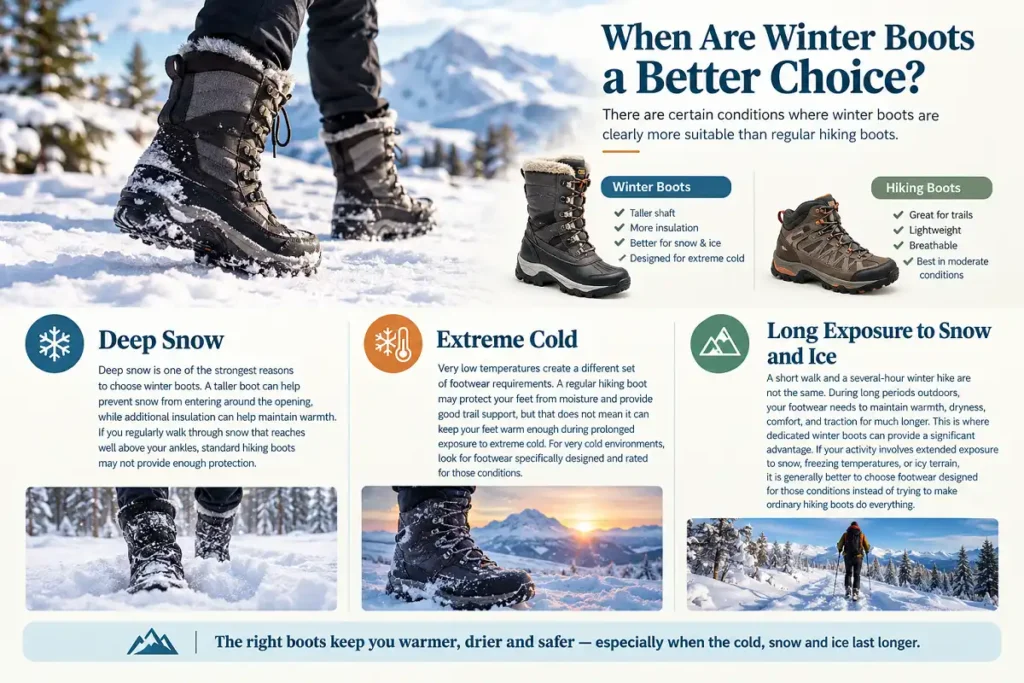
There are certain conditions where winter boots are clearly more suitable than regular hiking boots.
Taller boots and additional insulation provide better protection when snow reaches well above the ankles.
Very low temperatures create footwear requirements that many ordinary hiking boots are not designed to meet.
Several hours in snow, freezing temperatures, or icy terrain place greater demands on warmth and protection.
Deep Snow
Deep snow is one of the strongest reasons to choose winter boots.
A taller boot can help prevent snow from entering around the opening, while additional insulation can help maintain warmth.
If you regularly walk through snow that reaches well above your ankles, standard hiking boots may not provide enough protection.
Extreme Cold
Very low temperatures create a different set of footwear requirements.
A regular hiking boot may protect your feet from moisture and provide good trail support, but that does not mean it can keep your feet warm enough during prolonged exposure to extreme cold.
For very cold environments, look for footwear specifically designed and rated for those conditions.
Long Exposure to Snow and Ice
A short walk and a several-hour winter hike are not the same.
During long periods outdoors, your footwear needs to maintain warmth, dryness, comfort, and traction for much longer.
This is where dedicated winter boots can provide a significant advantage.
When in Doubt, Match the Boot to the Environment
If your activity involves extended exposure to snow, freezing temperatures, or icy terrain, it is generally better to choose footwear designed for those conditions instead of trying to make ordinary hiking boots do everything.
What You Should Know Before Choosing
So, can hiking boots be used as winter boots? Yes, but only when the conditions match what the boots are designed to handle.
Choose Based on Conditions
For cold-weather hiking, light snow, wet trails, and moderate winter conditions, a suitable hiking boot can be an excellent choice. Waterproofing, good traction, proper fit, and enough warmth can make hiking boots practical for many winter outings.
However, hiking boots are not a universal replacement for winter boots.
When conditions involve deep snow, extreme cold, frequent ice, or several hours of exposure, dedicated winter boots are usually the better option. They provide more insulation and winter-specific protection when you need it most.
The best approach is to choose footwear based on the actual conditions, not simply the season.
If your winter means cold rain and occasional light snow, your hiking boots may be perfectly capable. If it means deep snow and freezing temperatures, winter boots are likely the smarter choice.
Know What Your Boots Are Designed to Handle
Waterproofing, insulation, traction, boot height, and fit all matter. Don’t assume that a hiking boot is automatically a winter boot simply because it is waterproof.
And when evaluating any piece of outdoor gear, it is important to separate real-world experience from general product claims. If a particular boot has not been personally tested, it is better to rely on its specifications, construction, and trustworthy research than to pretend otherwise.
FAQs
Can hiking boots be used as winter boots?
Yes, hiking boots can be used as winter boots in mild to moderate conditions. They work best when they provide waterproofing, adequate traction, and enough warmth for the temperature.
Can you wear hiking boots in snow?
Yes, you can wear suitable hiking boots in light or moderate snow. Waterproofing and boot height become more important as snow gets deeper.
Are hiking boots warm enough for winter?
Some hiking boots are warm enough for mild winter conditions, but many regular hiking boots have limited insulation. For very cold temperatures, insulated winter boots are usually a better choice.
Are waterproof hiking boots good for winter?
Waterproof hiking boots can be very useful in winter because they protect against rain, slush, and melting snow. However, waterproofing alone does not make a boot suitable for extreme cold.
Are hiking boots better than winter boots?
Neither is always better. Hiking boots are generally more versatile and suitable for varied terrain, while winter boots usually provide better insulation and protection in severe winter conditions.
Can hiking boots be used on ice?
They can work on some cold or lightly icy surfaces, but standard hiking boot outsoles may not provide enough grip on smooth ice. Additional traction may be necessary for icy trails.
Do you need winter boots for hiking in snow?
Not necessarily. For light snow and moderate temperatures, suitable hiking boots may be enough. Deep snow, extreme cold, and long exposure are better handled by dedicated winter boots.
Can you wear thick socks with hiking boots in winter?
Yes, as long as the boots still fit comfortably. Thick socks should not make the boots excessively tight because restricted space can reduce comfort and make it harder to keep your feet warm.