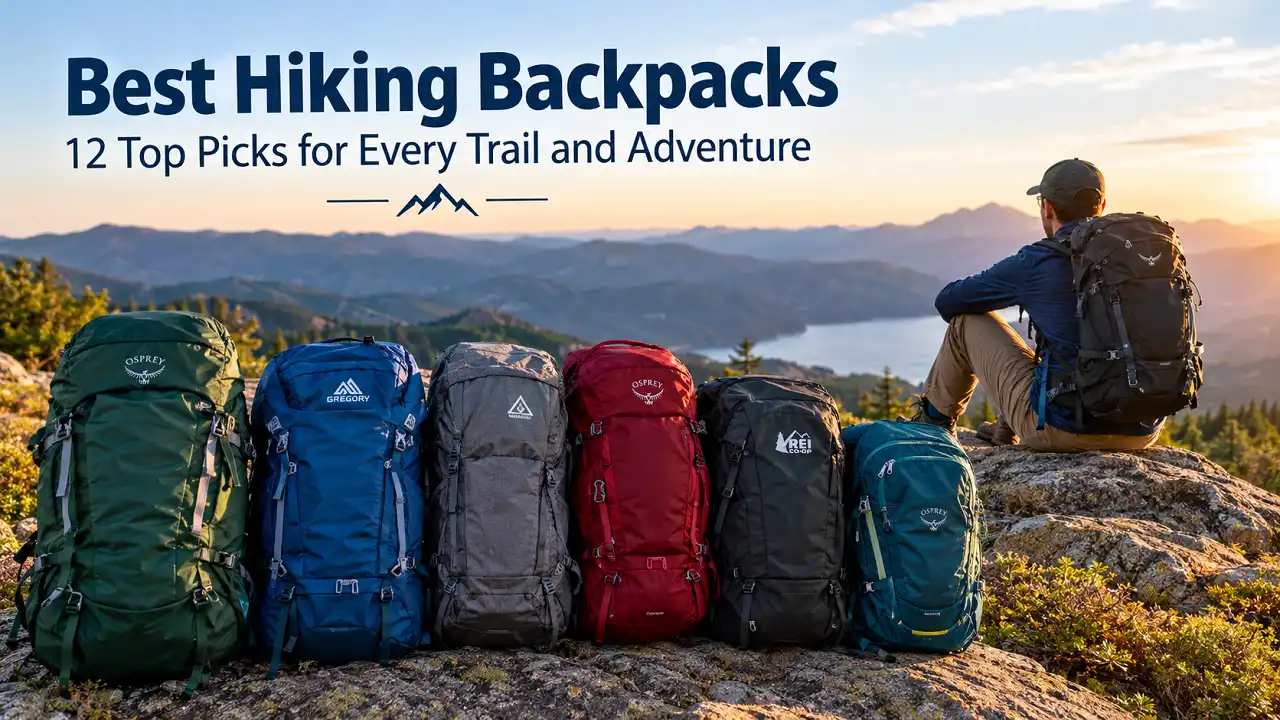
Best Hiking Backpacks: 12 Top Picks for Every Trail and Adventure
I have been hiking and camping since 2018, mostly heading out from Bakersfield, California. What started as weekend trips eventually became a habit I plan my year around. Along the way, I made plenty of rookie mistakes. I wore the wrong boots, carried a pack that was far too heavy, and headed out without properly planning for the weather.
Those mistakes taught me a lot about choosing outdoor gear.
One thing I learned quickly is that finding the best hiking backpacks is not simply about buying the most expensive pack or choosing the one with the most pockets. The right backpack depends on the kind of hiking you do, how much gear you carry, how long you will be on the trail, and how well the pack fits your body.
The best hiking backpack for a short day hike can be completely different from the right choice for a three-day backpacking trip. A lightweight pack may be fantastic when you are carrying very little, while a more supportive framed pack can make much more sense when your load gets heavier.
Outdoor Mystery is my personal blog, not a company. I write these guides myself. When I recommend gear, it is either something I have used on the trail or something I have researched carefully. I have not personally tested every backpack on this list, so I will not pretend otherwise.
With that in mind, here are my picks for the best hiking backpacks for different types of hikers and adventures.
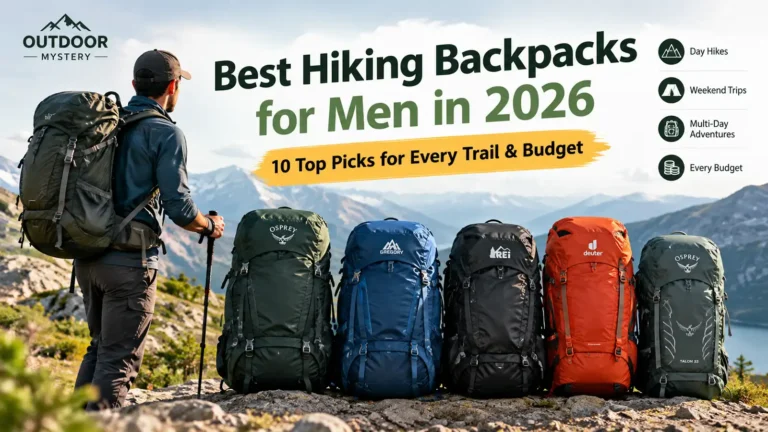
Best Hiking Backpacks at a Glance
| BackpackBest ForApprox. Capacity | ||
|---|---|---|
| Osprey Atmos AG 65 | Best Overall | 65L |
| Osprey Exos 58 | Lightweight Hiking | 58L |
| Gregory Baltoro 65 | Heavy Loads | 65L |
| Osprey Aura AG LT 50 | Comfort | 50L |
| REI Co-op Flash 55 | Value | 55L |
| Hyperlite Mountain Gear Southwest 55 | Wet Conditions | 55L |
| ULA Circuit | Long-Distance Hiking | 68L |
| Six Moon Designs Swift X | Thru-Hiking | 45L+ |
| Granite Gear Crown3 60 | Lightweight Value | 60L |
| Deuter Aircontact Core 50+10 | Adjustability | 50+10L |
| Gregory Zulu 40 | Weekend Trips | 40L |
| Osprey Talon 22 | Day Hiking | 22L |
12 Best Hiking Backpacks
1. Osprey Atmos AG 65 — Best Overall
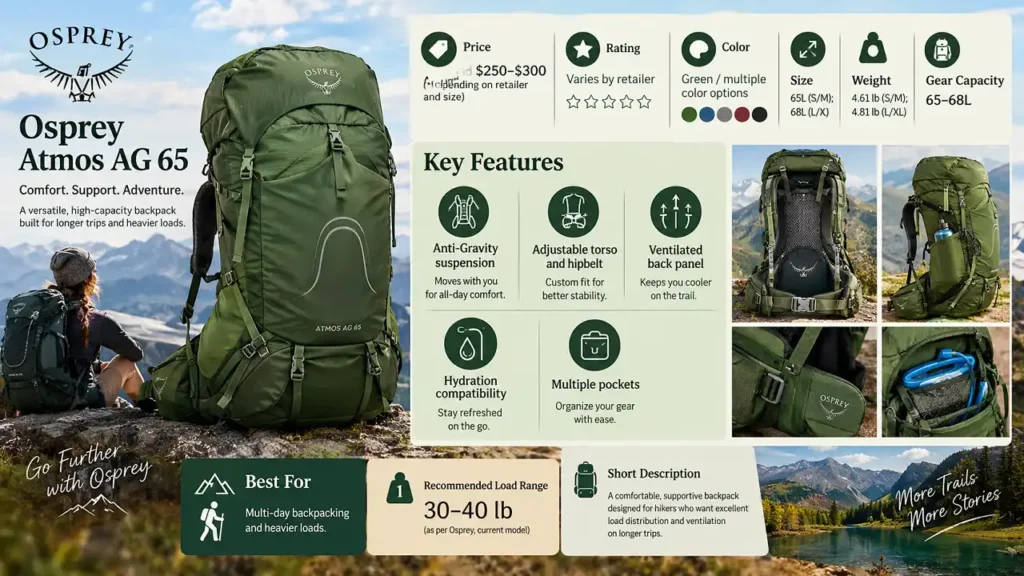
Osprey Atmos AG 65 offers comfortable support, ventilation, and 65–68L capacity for multi day backpacking.
The Osprey Atmos AG 65 is one of the first packs I would look at if I wanted one backpack that could handle a wide range of backpacking trips.
Its biggest appeal is the suspension system. The pack is designed around carrying a substantial load while maintaining a comfortable feel against your body. That makes it especially interesting for hikers who do not want to sacrifice support just to save a few ounces.
For longer trips, the 65-liter capacity gives you plenty of room for a sleeping bag, shelter, clothing, food and other essentials.
I would consider the Atmos AG 65 one of the best hiking backpacks for someone who wants comfort and carrying ability rather than an ultralight setup.
Price: Around $250–$300, depending on retailer and size
Rating: Varies by retailer
Color: Green / multiple color options
Size: 65L (S/M); 68L (L/XL)
Weight: 4.61 lb (S/M); 4.81 lb (L/XL)
Gear Capacity: 65–68L
Features: Anti-Gravity suspension, adjustable torso and hipbelt, ventilated back panel, hydration compatibility, multiple pockets
Best for: Backpackers who prioritize comfort and support.
Amazon: Check Osprey Atmos AG 65 on Amazon
2. Osprey Exos 58 — Best Lightweight Option
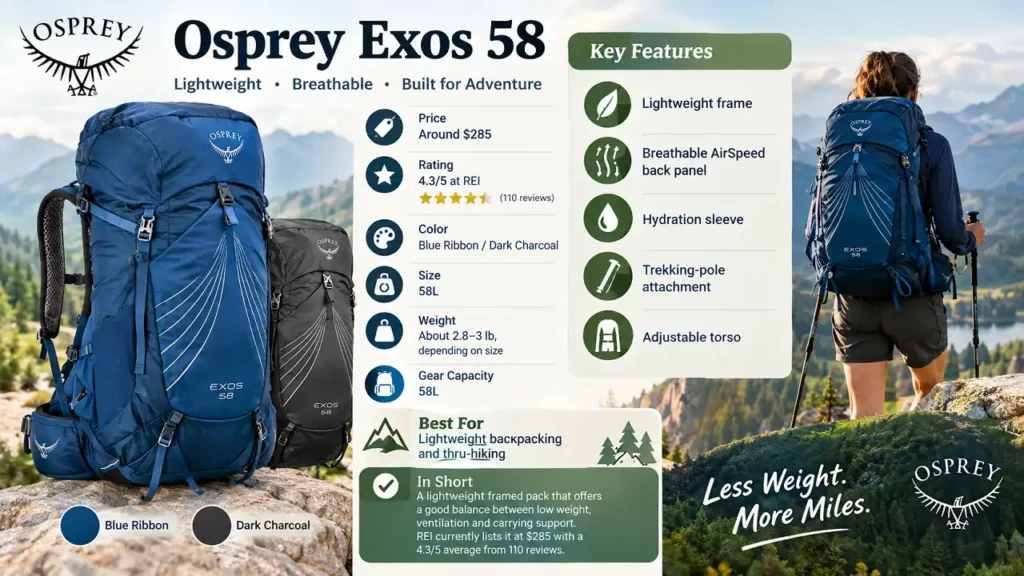
Osprey Exos 58 offers lightweight support, breathable ventilation, and 58L capacity for backpacking.
If reducing pack weight is one of your main goals, the Osprey Exos 58 deserves a close look.
The Exos line is aimed at hikers who want a lighter backpack without completely giving up the structure and support of a framed pack. That balance makes it appealing for long-distance hikers and backpackers who have already started cutting unnecessary weight from their gear.
A lightweight pack does not automatically make a hike easier, though. The rest of your equipment still matters. There is little benefit in buying a lighter backpack if you fill it with unnecessary gear.
For hikers who have already worked on their overall base weight, the Exos 58 can be one of the best hiking backpacks to consider.
Price: Around $285
Rating: 4.3/5 at REI
Color: Blue Ribbon / Dark Charcoal
Size: 58L
Weight: About 2.8–3 lb, depending on size
Gear Capacity: 58L
Features: Lightweight frame, breathable AirSpeed back panel, hydration sleeve, trekking-pole attachment, adjustable torso
Best for: Lightweight backpacking and long-distance hiking.
Amazon: Check Osprey Exos 58 on Amazon
3. Gregory Baltoro 65 — Best for Heavy Loads
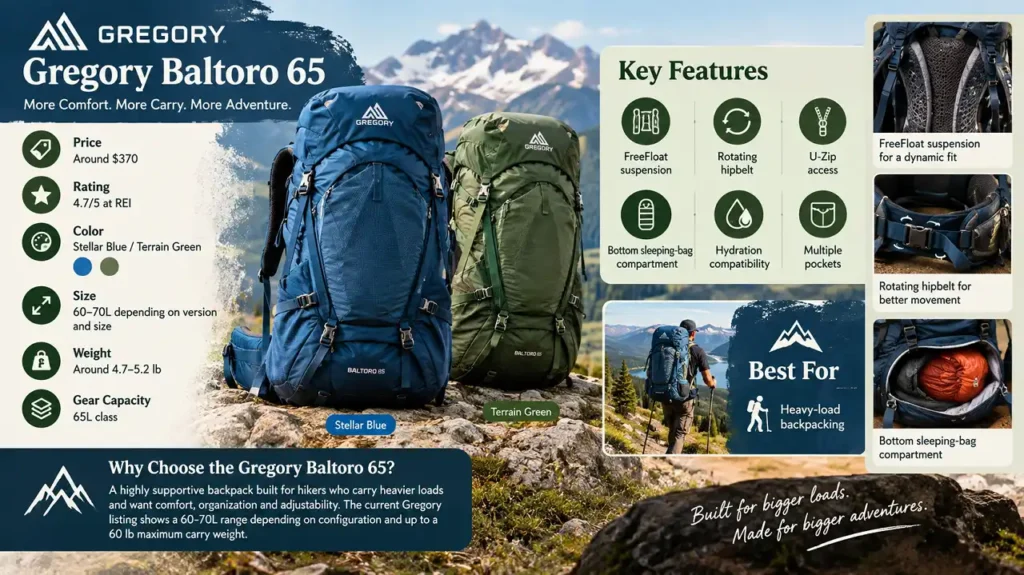
Gregory Baltoro 65 offers supportive carrying, adjustable comfort, and organized storage for heavy load backpacking.
Some hikers simply need to carry more.
Maybe you are taking extra food, camera equipment, cold-weather gear, or camping equipment. In those situations, a minimalist pack is not always the smartest option.
The Gregory Baltoro 65 is designed around carrying heavier loads with a supportive suspension system and substantial padding.
That extra structure adds weight, but this is one of those situations where saving a pound or two on the backpack may not matter as much as keeping a heavy load comfortable.
For people who regularly carry more equipment, the Baltoro 65 is among the best hiking backpacks for a supportive carry.
Price: Around $370
Rating: 4.7/5 at REI
Color: Stellar Blue / Terrain Green
Size: 60–70L depending on version and size
Weight: Around 4.7–5.2 lb
Gear Capacity: 65L class
Features: FreeFloat suspension, rotating hipbelt, U-Zip access, bottom sleeping-bag compartment, hydration compatibility, multiple pockets
Best for: Heavy loads and multi-day backpacking.
Amazon: Check Gregory Baltoro 65 on Amazon
4. Osprey Aura AG LT 50 — Best for Comfort
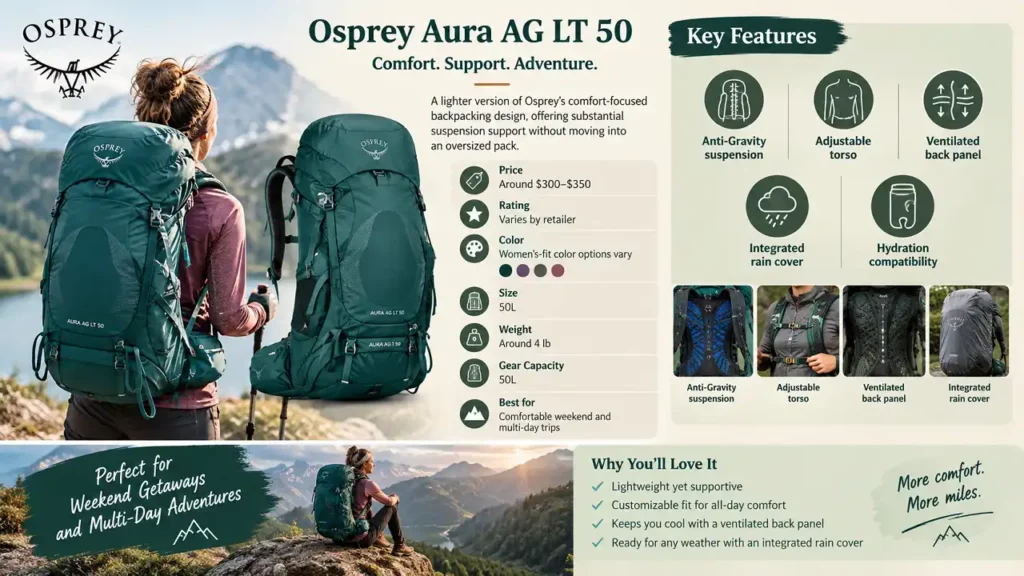
Osprey Aura AG LT 50 combines lightweight comfort, strong suspension, and 50L capacity for multi-day adventures.
The Osprey Aura AG LT 50 is worth considering if comfort is your biggest priority but you still want to keep the pack relatively manageable.
The 50-liter capacity sits in a useful middle ground. It can work for shorter backpacking trips without feeling unnecessarily huge.
The suspension design is the main attraction here. For hikers who dislike the feeling of a backpack pressing directly against their back, the ventilated suspension can be particularly appealing.
I would put the Aura AG LT 50 on the list of best hiking backpacks for hikers who want a comfortable carry without jumping into a very large pack.
Price: Around $300–$350
Rating: Varies by retailer
Color: Women’s-fit color options vary
Size: 50L
Weight: Around 4 lb
Gear Capacity: 50L
Features: Anti-Gravity suspension, adjustable torso, ventilated back panel, integrated rain cover, hydration compatibility
Best for: Comfortable weekend and multi-day trips.
Amazon: Check Osprey Aura AG LT 50 on Amazon
5. REI Co-op Flash 55 — Best Value
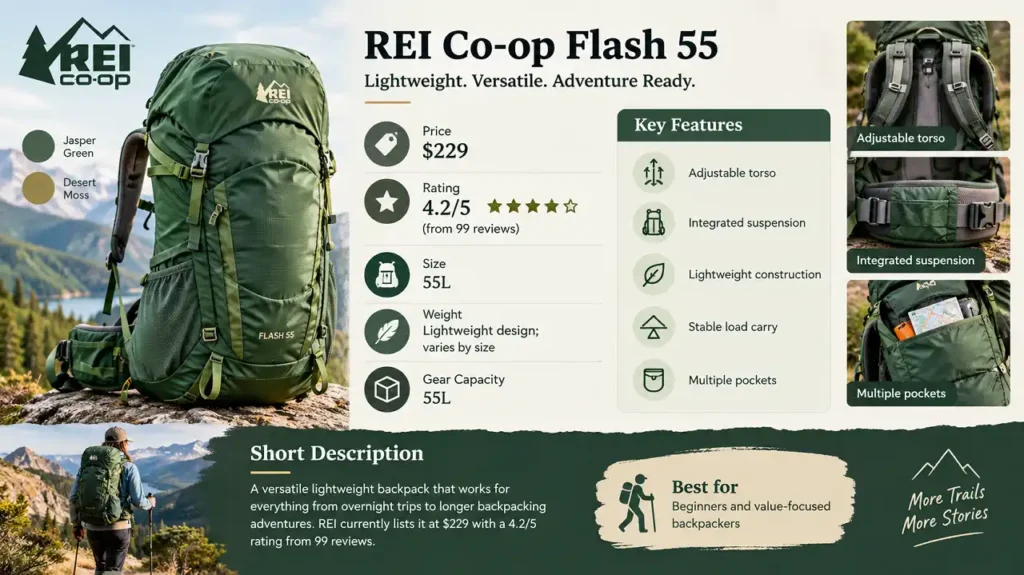
REI Co-op Flash 55 is a versatile 55L backpack designed for lightweight and beginner-friendly backpacking.
The REI Co-op Flash 55 is a strong option for someone who wants a capable backpack without immediately moving into premium-priced gear.
The 55-liter size works well for many backpacking trips, and the pack is aimed at hikers who want a lighter approach while still having useful organization and carrying support.
I particularly like the idea of this type of pack for someone building their hiking kit from scratch. You can spend a fortune on outdoor gear very quickly, but you do not need to.
For many beginners, the Flash 55 could be one of the best hiking backpacks because it offers a practical balance between weight, capacity and price.
Price: $229
Rating: 4.2/5
Color: Jasper Green / Desert Moss
Size: 55L
Weight: Lightweight design; varies by size
Gear Capacity: 55L
Features: Adjustable torso, integrated suspension, lightweight construction, stable load carry, multiple pockets
Best for: Beginners and value-focused backpackers.
Amazon: Check REI Flash 55 on Amazon
6. Hyperlite Mountain Gear Southwest 55 — Best for Wet Conditions
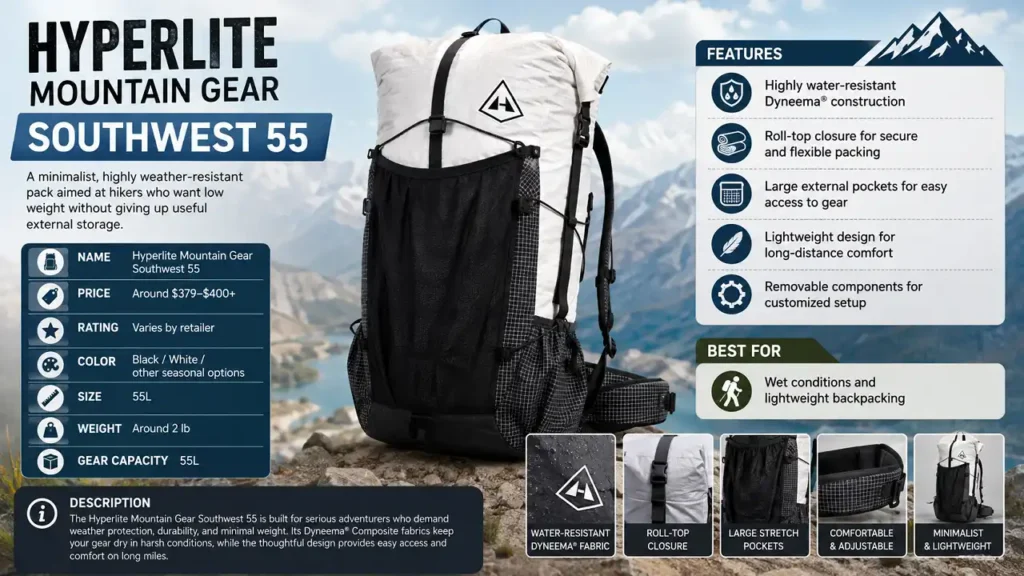
Hyperlite Mountain Gear Southwest 55 backpack with lightweight, weather-resistant features for backpacking.
Weather can completely change the way I think about hiking gear.
A backpack that works beautifully on a dry summer trail can become frustrating when you are dealing with persistent rain. That is where a weather-resistant pack such as the Hyperlite Mountain Gear Southwest 55 becomes interesting.
The Southwest uses a highly water-resistant construction and focuses on keeping the overall system relatively simple.
Remember that water resistance is not the same thing as making every item inside your pack completely waterproof. I still recommend using appropriate dry bags or waterproof liners for anything that absolutely cannot get wet.
For hikers who frequently encounter rain, the Southwest 55 is one of the best hiking backpacks to investigate.
Price: Around $379–$400+
Rating: Varies by retailer
Color: Black / White / other seasonal options
Size: 55L
Weight: Around 2 lb
Gear Capacity: 55L
Features: Highly water-resistant Dyneema construction, roll-top closure, large external pockets, lightweight design, removable components
Best for: Wet climates and hikers who prioritize weather resistance.
Amazon: Check Hyperlite Southwest 55 on Amazon
7. ULA Circuit — Best for Long-Distance Hiking
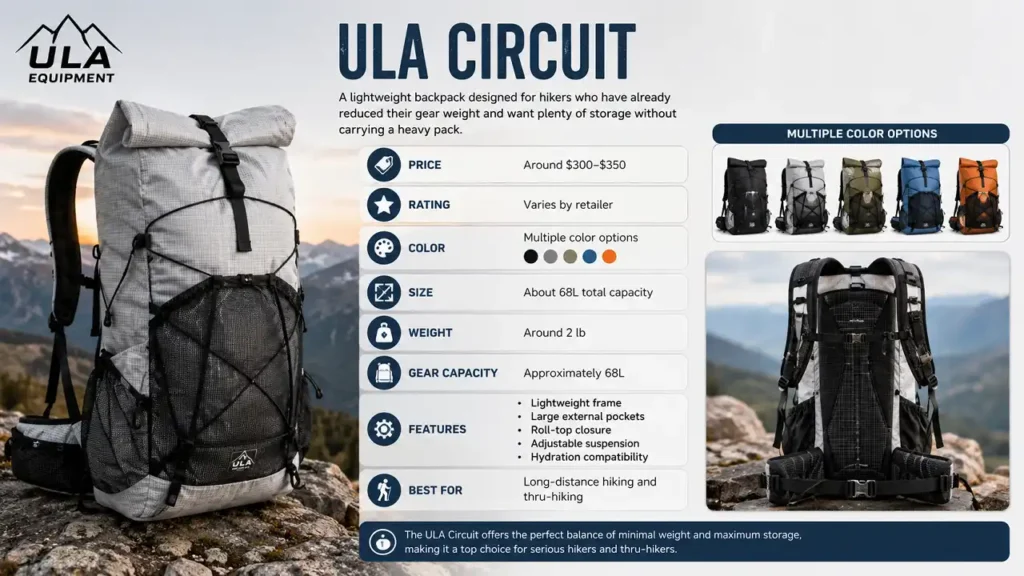
ULA Circuit lightweight 68L backpack designed for long distance hiking and thru hiking.
The ULA Circuit has become a well-known option among lightweight and long-distance hikers.
Its appeal comes from the combination of relatively low weight, generous storage and a design that works particularly well for hikers who have already learned how to keep their gear load under control.
That last part matters.
A lightweight backpack is not necessarily the right choice for everyone. If you routinely carry a heavy load, you may be more comfortable with a more structured backpack.
But if your equipment is relatively light, the ULA Circuit can be a very interesting choice for long trail days.
For that reason, I would include it among the best hiking backpacks for experienced hikers and long-distance adventures.
Price: Around $300–$350
Rating: Varies by retailer
Color: Multiple color options
Size: About 68L total capacity
Weight: Around 2 lb
Gear Capacity: Approximately 68L
Features: Lightweight frame, large external pockets, roll-top closure, adjustable suspension, hydration compatibility
Best for: Long-distance hiking and lightweight backpacking.
Amazon: Check ULA Circuit on Amazon
8. Six Moon Designs Swift X — Best for Thru-Hiking
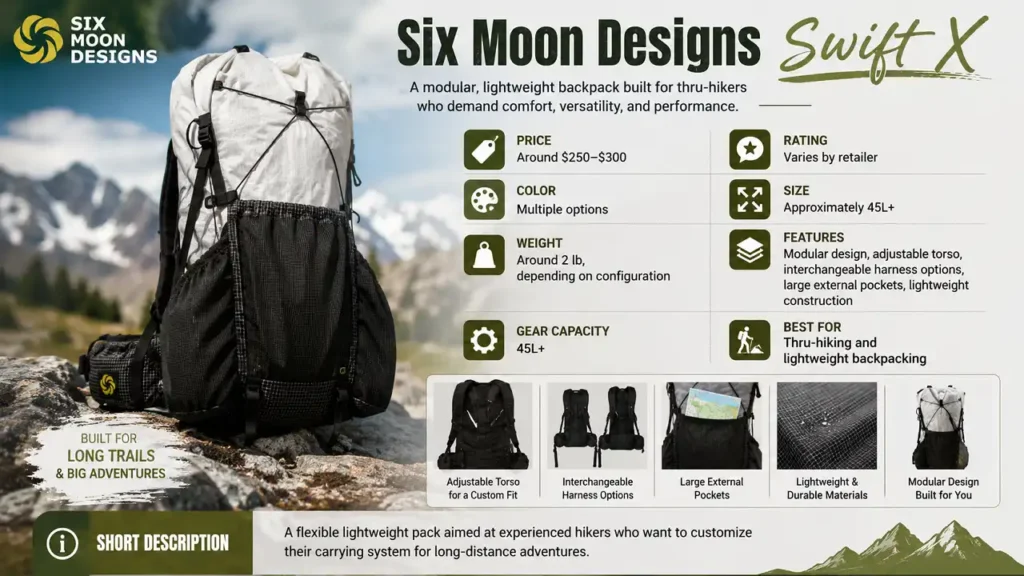
Six Moon Designs Swift X is a modular lightweight backpack designed for thru hiking and long distance adventures.
The Six Moon Designs Swift X is another pack aimed at hikers who want to keep things lighter.
It offers a flexible design and is particularly appealing for thru-hikers and backpackers who have already developed a lightweight packing strategy.
One thing I would emphasize here is that lightweight gear works best when you understand your own system. If you are still figuring out what you actually need on a backpacking trip, a highly minimalist pack may not be the easiest starting point.
But for an experienced lightweight hiker, the Swift X deserves consideration when comparing the best hiking backpacks for long-distance trips.
Price: Around $250–$300
Rating: Varies by retailer
Color: Multiple options
Size: Approximately 45L+
Weight: Around 2 lb, depending on configuration
Gear Capacity: 45L+
Features: Modular design, adjustable torso, interchangeable harness options, large external pockets, lightweight construction
Best for: Thru-hikers and experienced lightweight backpackers.
Amazon: Search Six Moon Designs Swift X on Amazon
9. Granite Gear Crown3 60 — Best Lightweight Value
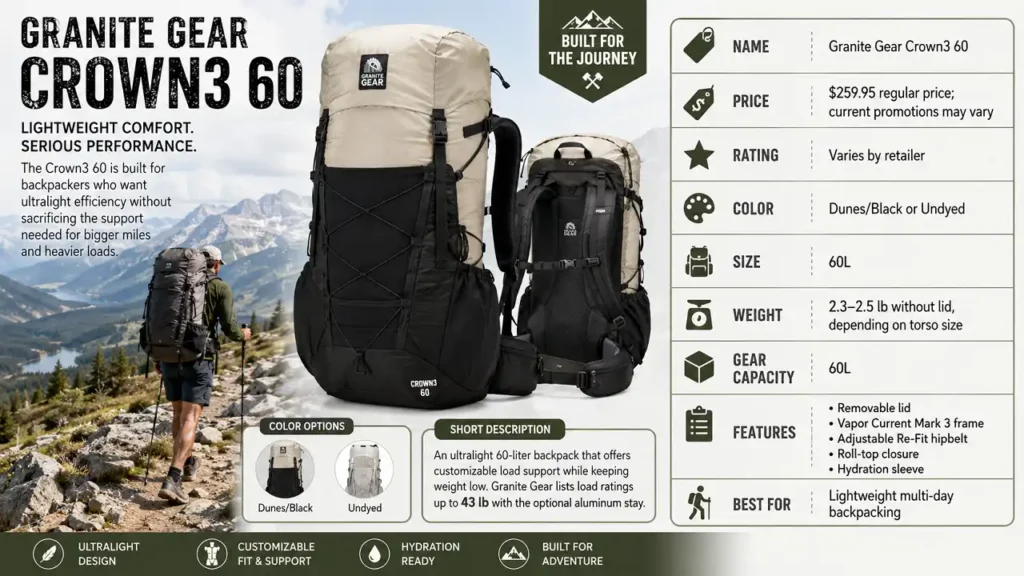
Granite Gear Crown3 60 ultralight backpack with key specifications and features
The Granite Gear Crown3 60 is an interesting middle-ground option.
You get a generous 60-liter capacity while keeping the overall design focused on reducing unnecessary weight. That combination makes it attractive to hikers who want to move toward lightweight backpacking without spending as much as they might on some premium ultralight packs.
The removable components also allow hikers to customize the pack according to their preferences.
For someone who wants plenty of space but still cares about keeping the backpack relatively light, the Crown3 60 is one of the best hiking backpacks worth considering.
Price: $259.95 regular price; current promotions may vary
Rating: Varies by retailer
Color: Dunes/Black or Undyed
Size: 60L
Weight: 2.3–2.5 lb without lid, depending on torso size
Gear Capacity: 60L
Features: Removable lid, Vapor Current Mark 3 frame, adjustable Re-Fit hipbelt, roll-top closure, hydration sleeve
Best for: Lightweight backpacking on a budget.
Amazon: Check Granite Gear Crown3 60 on Amazon
10. Deuter Aircontact Core 50+10 — Best for Adjustability
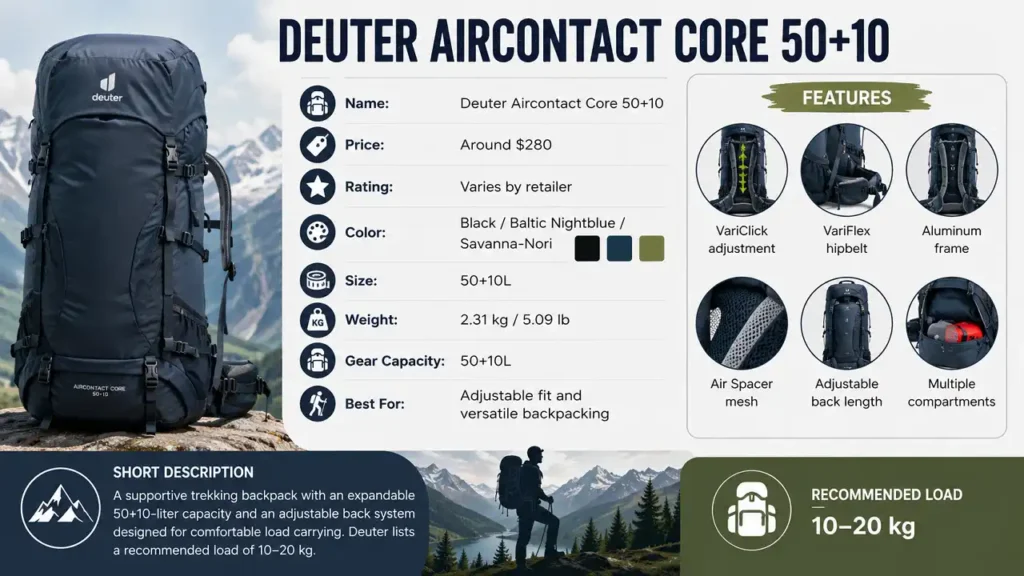
Deuter Aircontact Core 50+10 trekking backpack with adjustable fit and 50+10L capacity.
The Deuter Aircontact Core 50+10 is designed for hikers who appreciate adjustability and carrying support.
The expandable capacity is useful because you can use the pack differently depending on the trip. You do not always need the full amount of space, but having additional capacity available can be helpful when you need to carry extra layers, food or equipment.
This type of flexibility can be particularly useful for hikers who take different kinds of trips throughout the year.
If you want one pack that can adapt to several hiking situations, the Aircontact Core 50+10 deserves a place among the best hiking backpacks.
Price: Around $280
Rating: Varies by retailer
Color: Black / Baltic Nightblue / Savanna-Nori
Size: 50+10L
Weight: 2.31 kg / 5.09 lb
Gear Capacity: 50+10L
Features: VariClick adjustment, VariFlex hipbelt, aluminum frame, Air Spacer mesh, adjustable back length, multiple compartments
Best for: Adjustable fit and versatile backpacking.
Amazon: Check Deuter Aircontact Core 50+10 on Amazon
11. Gregory Zulu 40 — Best for Weekend Trips
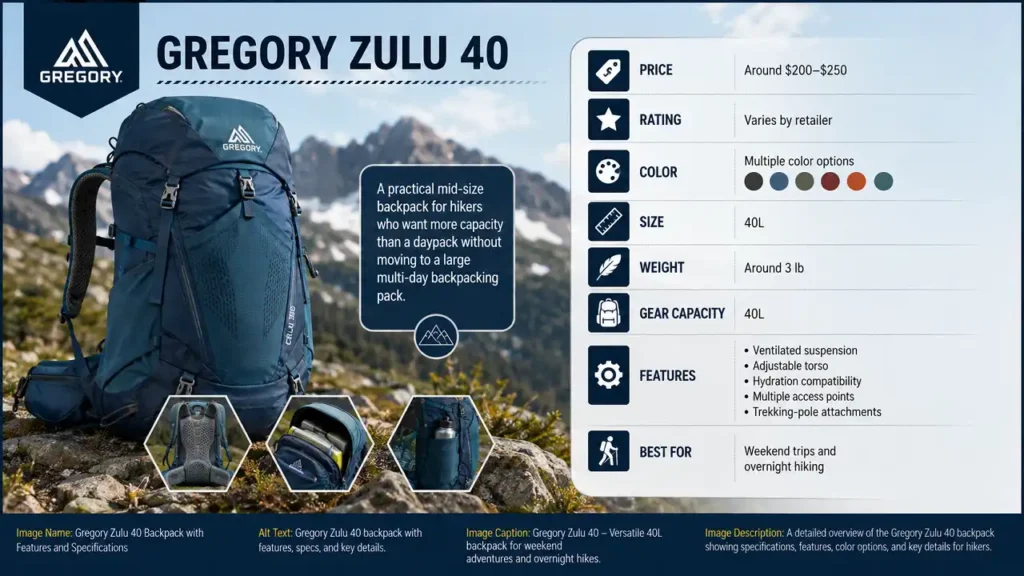
Gregory Zulu 40 versatile 40L backpack for weekend adventures and overnight hikes
Not every hiking trip requires a massive backpack.
For shorter overnight adventures and weekend trips, a 40-liter pack can provide a useful balance between carrying capacity and manageable size.
The Gregory Zulu 40 is designed for hikers who want a supportive pack without moving into the larger 60- to 70-liter category.
This is the type of backpack I would consider when the trip is short and I am confident that I can keep my gear list under control.
For weekend adventures, the Zulu 40 is one of the best hiking backpacks to look at.
Price: Around $200–$250
Rating: Varies by retailer
Color: Multiple color options
Size: 40L
Weight: Around 3 lb
Gear Capacity: 40L
Features: Ventilated suspension, adjustable torso, hydration compatibility, multiple access points, trekking-pole attachments
Best for: Weekend backpacking and overnight trips.
Amazon: Check Gregory Zulu 40 on Amazon
12. Osprey Talon 22 — Best for Day Hiking
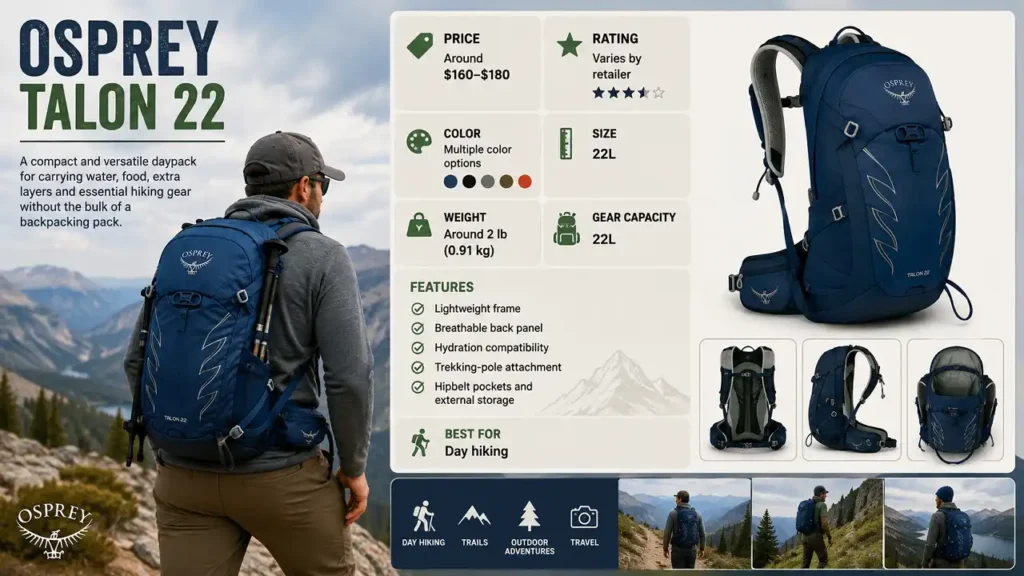
Osprey Talon 22 compact daypack with lightweight design and hiking features
For a normal day hike, I would not automatically reach for a 60-liter backpack.
A smaller daypack is usually more practical when you only need water, food, an extra layer, first-aid supplies and a few emergency items.
The Osprey Talon 22 is a popular example of this type of pack. Its smaller capacity keeps it compact while still giving you enough space for the essentials on many day hikes.
If most of your adventures are day hikes rather than overnight backpacking trips, this type of pack makes much more sense.
The Talon 22 is therefore one of my picks among the best hiking backpacks for day hikers.
Price: Around $160–$180
Rating: Varies by retailer
Color: Multiple color options
Size: 22L
Weight: Around 2 lb
Gear Capacity: 22L
Features: Lightweight frame, breathable back panel, hydration compatibility, trekking-pole attachment, hipbelt pockets and external storage
Best for: Day hikes and short outdoor adventures.
Amazon: Check Osprey Talon 22 on Amazon
How to Choose the Best Hiking Backpack
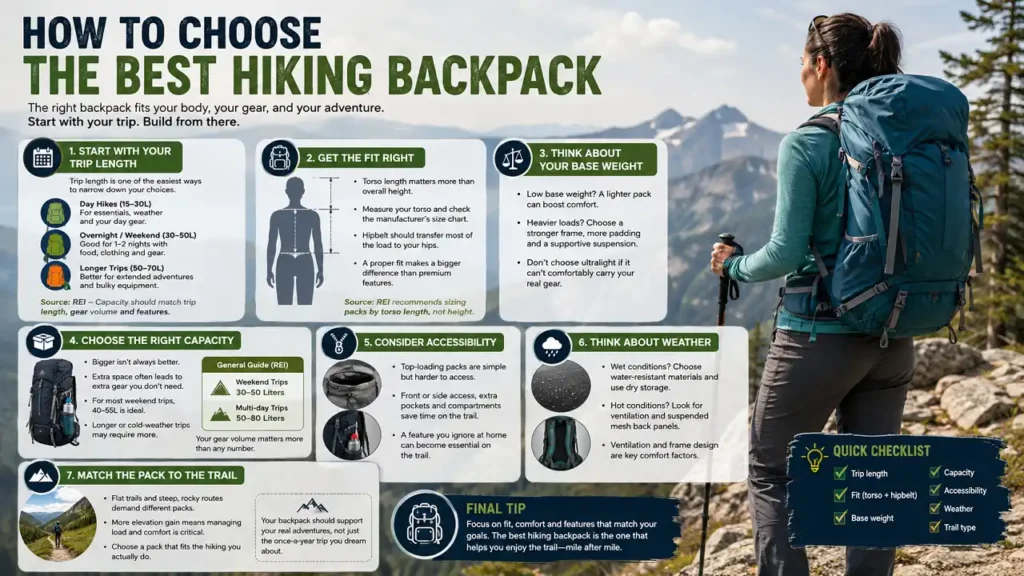
A practical guide to choosing the right hiking backpack for your trip, fit, gear, weather, and trail.
After looking at all these options, you might still be wondering how to choose the right one.
That is completely understandable.
There is no single backpack that is perfect for every hiker. When I compare hiking packs, I start with the trip itself rather than the brand name.
Start With Your Trip Length
The length of your trip is one of the easiest ways to narrow down your choices.
For day hikes, something around 15–30 liters may be enough depending on your equipment and weather.
For overnight or weekend trips, around 30–50 liters is a useful starting range.
For longer trips, 50–70 liters may make more sense, especially if you need additional food, clothing or camping equipment.
REI also notes that backpack capacity should be considered alongside trip length, gear volume and features.
The best hiking backpacks are not necessarily the largest ones. Buying a bigger pack often makes it tempting to carry more stuff.
Get the Fit Right
This is probably the most important part.
I learned through experience that a backpack can look fantastic on paper and still feel terrible if it does not fit you correctly.
Your torso length matters more than your overall height when choosing a backpack size. Your hip measurement is also important because the hipbelt should comfortably transfer much of the load to your hips. REI specifically recommends sizing backpacks by torso length rather than height.
If you are unsure about sizing, measure your torso before buying and check the manufacturer’s sizing chart.
You can also read the REI official backpack fitting guide for detailed instructions on measuring torso length and adjusting the major straps.
A properly fitted backpack can make a bigger difference than adding another premium feature.
Think About Your Base Weight
Before choosing between a lightweight backpack and a heavy-duty model, think about how much you normally carry.
If your base weight is low, a lightweight pack can make a lot of sense.
If you carry a heavier load, you may benefit from a stronger frame, more padding and a supportive suspension system.
I would not choose an ultralight backpack simply because it weighs less. If it does not comfortably carry your actual gear, the weight savings are not worth much.
Choose the Right Capacity
Capacity is another area where hikers often go too big.
A large backpack might feel useful because you have plenty of space, but extra space can encourage you to pack things you do not need.
For many weekend trips, 40–55 liters can be enough. Longer trips or cold-weather adventures may require more space.
REI’s current general guidance puts many weekend packs in the 30–50-liter range and multiday packs around 50–80 liters, although your individual gear volume matters more than simply following a number.
Consider Accessibility
Think about how you actually use your gear.
A traditional top-loading backpack keeps the design relatively simple, but it can be frustrating when the item you need is buried at the bottom.
Some packs offer front or side access, additional compartments or external pockets.
For me, this is one of those features that can seem unnecessary until you are standing on a trail trying to find your rain jacket.
Think About Weather
Weather should influence your backpack choice.
If you frequently hike in wet conditions, consider a pack with water-resistant materials and use waterproof storage for sensitive gear.
If you hike in hot weather, ventilation can become more important.
Suspended mesh systems can create additional airflow between your back and the pack, while simpler designs may place the pack closer to your body. REI identifies ventilation and frame design as important backpack considerations.
Match the Pack to the Trail
The trail itself matters too.
A comfortable pack for a flat forest trail might not feel the same on a steep, rocky route.
If you regularly hike routes with significant elevation gain, keeping your load under control becomes especially important. I have written more about how much elevation gain is a lot hiking if you want to think about that side of trail difficulty as well.
Your backpack should support the kind of hiking you actually do, not the kind of adventure you imagine taking once a year.
Hiking Backpack Size Guide
Here is a simple starting point:
| Pack SizeTypical Use | |
|---|---|
| 10–20L | Short hikes and minimal day trips |
| 20–30L | Full-day hikes |
| 30–50L | Overnight and weekend trips |
| 50–65L | Multi-day backpacking |
| 65L+ | Longer trips, bulky equipment or winter conditions |
These are general ranges rather than strict rules.
A lightweight summer backpacker might fit everything into a smaller pack, while someone hiking in cold weather may need considerably more room for insulation and other equipment.
The best hiking backpack size is ultimately the one that holds your necessary equipment without encouraging you to carry unnecessary weight.
What Weight Should a Hiking Backpack Be?
There is no single perfect backpack weight for everyone.
The backpack itself is only part of your total carried weight. Your shelter, sleeping system, cooking equipment, food, water and clothing all contribute.
One of the best lessons I learned from carrying an unnecessarily heavy pack is that every little item eventually adds up.
Instead of obsessing over the weight of the backpack alone, look at your entire system.
If your overall load is already heavy, saving weight on the backpack may help. But if you need strong load support, a slightly heavier framed backpack could actually make the hike more comfortable.
Are Bigger Hiking Backpacks Better?
Not necessarily.
A bigger backpack gives you more capacity, but that does not automatically make it a better backpack.
If you mostly take day hikes, a 60-liter pack is excessive. If you regularly go on five-day backpacking trips, a 20-liter daypack is obviously not going to work.
The best hiking backpacks are the ones that match your actual gear and trip length.
I would rather have a well-fitted 40-liter backpack that is comfortably full than a huge 70-liter pack with room for things I do not need.
Backpack Comfort Matters More Than Extra Features
It is easy to get distracted by pockets, zippers and accessories when shopping for a hiking backpack.
Those things can be useful, but I would put fit and carrying comfort ahead of almost everything else.
If the pack fits poorly, extra pockets will not save the hike.
The same principle applies to the rest of your hiking gear. For example, choosing the right footwear can make a major difference in comfort, which is why I have also covered whether hiking boots are good for walking for hikers trying to choose the right footwear.
And if your feet tend to develop hot spots during longer hikes, my guide on how to avoid blisters while hiking covers some practical ways to reduce that problem.
Which Hiking Backpack Should You Buy?
If I were narrowing this list down by hiking style, I would look at it this way:
For an all-around backpack: Osprey Atmos AG 65
For lightweight backpacking: Osprey Exos 58
For heavy loads: Gregory Baltoro 65
For comfort: Osprey Aura AG LT 50
For value: REI Co-op Flash 55
For wet conditions: Hyperlite Mountain Gear Southwest 55
For long-distance hiking: ULA Circuit
For thru-hiking: Six Moon Designs Swift X
For lightweight value: Granite Gear Crown3 60
For adjustability: Deuter Aircontact Core 50+10
For weekend trips: Gregory Zulu 40
For day hiking: Osprey Talon 22
The important thing is not to treat one of these as universally superior. The best hiking backpacks depend on your body, your gear, your trail and the type of trip you take.
If you are new to backpacking, I would prioritize fit and comfort first. Once you understand how much equipment you actually carry, you can start worrying more about shaving ounces or adding specialized features.
FAQs
What size backpack is best for hiking?
For day hikes, a 20–30-liter pack is often enough for water, food, layers and basic emergency equipment. Overnight and weekend trips commonly require around 30–50 liters, while longer trips may need 50–70 liters or more. The best hiking backpacks are sized around your actual gear rather than simply choosing the largest available option.
How much should a hiking backpack weigh?
There is no universal ideal weight. Your total carried weight matters more than the backpack alone. If you are carrying a lightweight gear setup, a lightweight backpack can make sense. If your load is heavier, a more supportive frame may be worth the additional weight.
What is the best hiking backpack for beginners?
For beginners, I would focus on fit, comfort, durability and reasonable capacity rather than buying the lightest possible backpack. The REI Co-op Flash 55 is worth considering for value, while the Osprey Atmos AG 65 is a stronger option if comfort and load support are more important.
Is a 40L or 60L backpack better for hiking?
It depends on the trip. A 40-liter backpack can be excellent for day hikes, overnight trips and lightweight weekends. A 60-liter pack gives you more room for multi-day trips, bulky gear and additional food. If you are unsure, look at the gear you already own and estimate how much space it actually takes.
How should a hiking backpack fit?
The backpack should fit your torso length and hip size rather than being selected based only on your height. The hipbelt should sit securely around your hips, while the shoulder straps should feel supportive without carrying most of the load. REI recommends using torso length as the key measurement when determining backpack size.
Is a waterproof hiking backpack necessary?
Not always. A water-resistant or weather-resistant backpack can be useful in wet conditions, but I would still protect sleeping bags, electronics, clothing and other sensitive gear with waterproof storage. A fully waterproof backpack can also involve tradeoffs in weight, access and cost.
What are the best hiking backpacks for long-distance trails?
For long-distance hiking, I would look closely at lightweight models such as the Osprey Exos 58, ULA Circuit, Six Moon Designs Swift X and Granite Gear Crown3 60. Your preferred option will depend heavily on your base weight and how much support you need.
Should I buy a hiking backpack online or try it on first?
If possible, I strongly prefer trying a backpack on before buying it. Small differences in torso length, hipbelt shape and shoulder-strap placement can have a noticeable effect after several hours on the trail. If you buy online, check the manufacturer’s sizing information carefully and make sure the retailer has a reasonable return policy.
The best hiking backpacks are ultimately the ones that fit your body, carry your gear comfortably and match the kind of trails you actually hike. You do not need the most expensive pack or the newest model. You need a pack that works for you.