Do I Need Hiking Poles? A Simple Guide for Beginners
If you’re new to hiking, you may have noticed that many hikers carry trekking poles and wondered whether you need a pair yourself. Do I Need Hiking Poles? The short answer is no not for every hike.
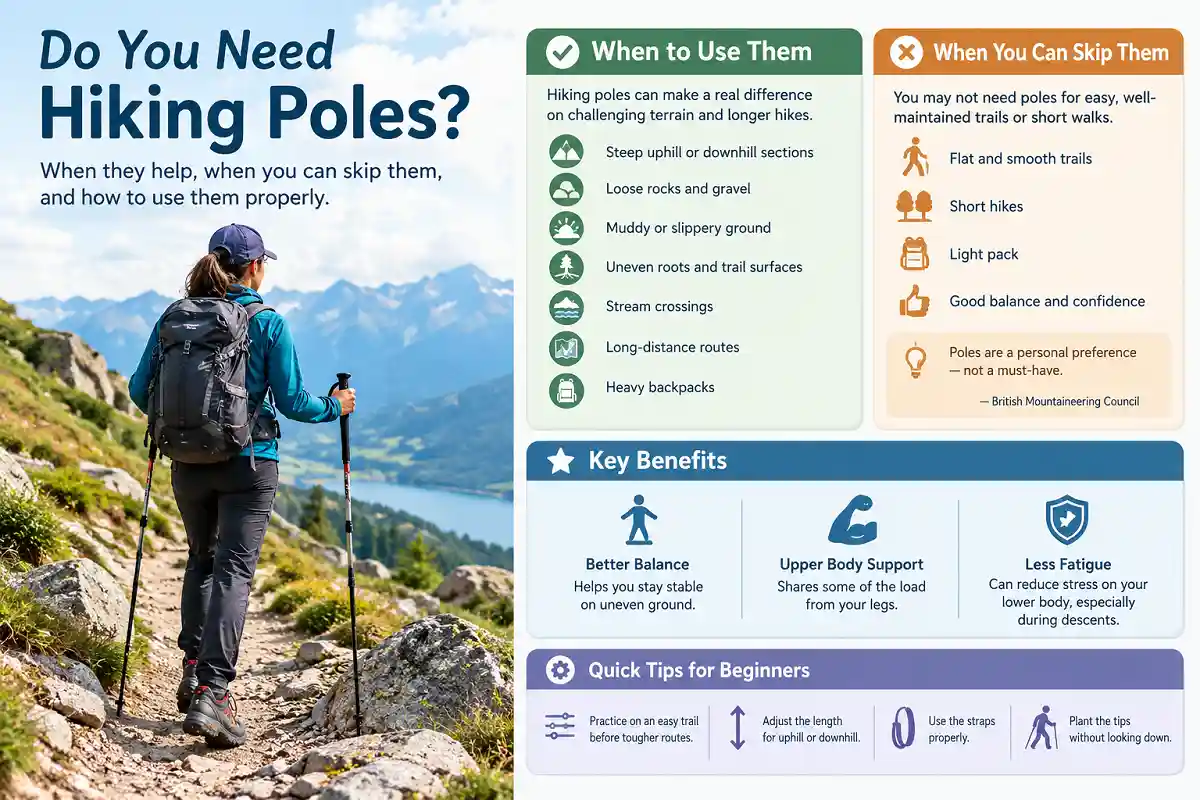
Hiking poles are optional gear, but they can be genuinely useful when a trail is steep, rocky, muddy, uneven, or involves long descents. On a short, flat, well-maintained trail, you may be perfectly comfortable without them.
The best choice depends on the trail, your experience, the weight you’re carrying, and how comfortable you feel while walking. This guide will help you understand when poles are useful, when you can leave them behind, and how to use them properly.
Do you really need hiking poles?
No—not for every hike. They’re most useful on steep, rocky, muddy, uneven, or long routes, while short and easy trails usually don’t require them.
Usually no poles needed.
Extra support can help.
Useful for stability and load transfer.
Helpful on rocks, roots, and mud.
Can provide additional support.
Do You Really Need Hiking Poles?
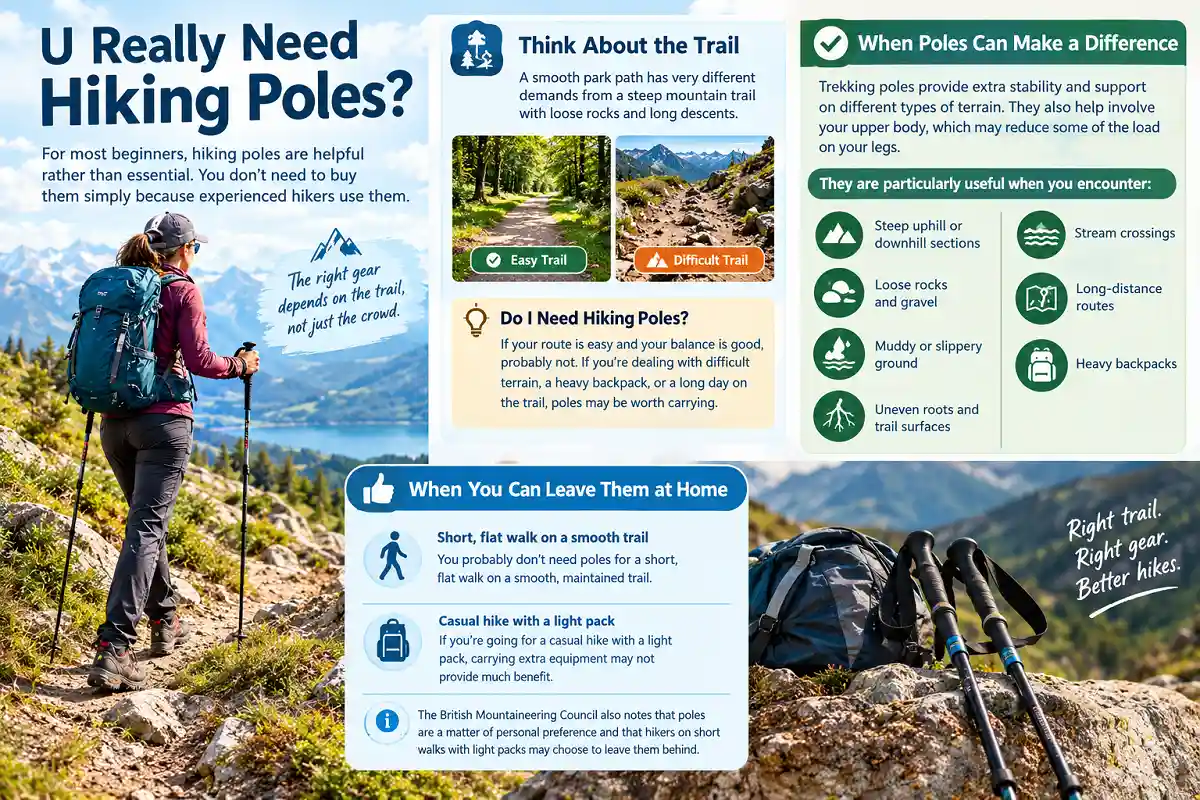
For most beginners, hiking poles are helpful rather than essential. You don’t need to buy them simply because experienced hikers use them.
Think about the trail you’re actually going to hike. A smooth park path has very different demands from a steep mountain trail with loose rocks and long descents.
Do I Need Hiking Poles? If your route is easy and your balance is good, probably not. If you’re dealing with difficult terrain, a heavy backpack, or a long day on the trail, poles may be worth carrying.
When Poles Can Make a Difference
Trekking poles can provide extra stability and support on different types of terrain. They can also help involve your upper body while walking, which may reduce some of the load on your legs.
Steep uphill or downhill sections
Poles can provide additional contact and support when elevation changes become demanding.
Loose rocks and gravel
Extra points of contact can make unpredictable surfaces feel more controlled.
Muddy or slippery ground
Poles can help with balance when footing becomes less predictable.
Heavy backpacks
They can help distribute some of the physical effort across your upper body.
When You Can Leave Them at Home
You probably don’t need poles for a short, flat walk on a smooth, maintained trail.
If you’re going for a casual hike with a light pack, carrying extra equipment may not provide much benefit. The British Mountaineering Council also notes that poles are a matter of personal preference and that hikers on short walks with light packs may choose to leave them behind.
What Are Hiking Poles Actually Used For?
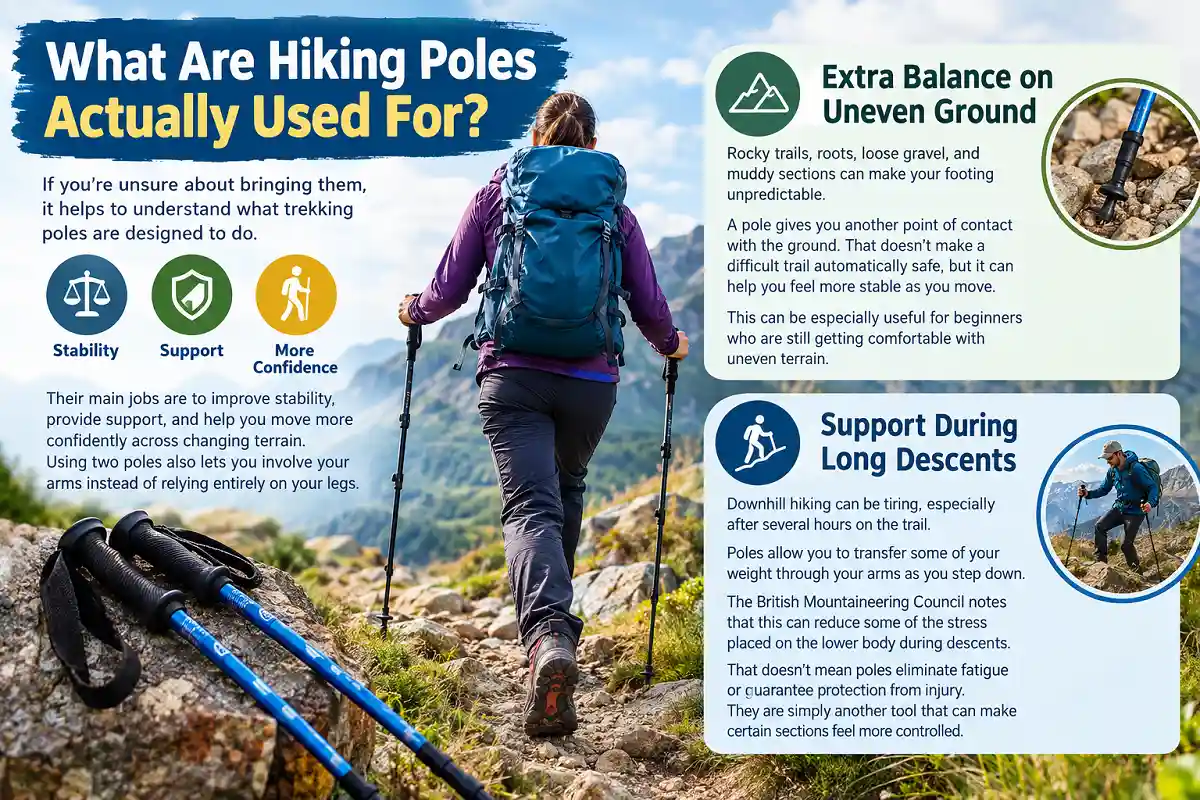
If you’re unsure about bringing them, it helps to understand what trekking poles are designed to do.
Their main jobs are to improve stability, provide support, and help you move more confidently across changing terrain. Using two poles also lets you involve your arms instead of relying entirely on your legs.
Extra Balance on Uneven Ground
Rocky trails, roots, loose gravel, and muddy sections can make your footing unpredictable.
A pole gives you another point of contact with the ground. That doesn’t make a difficult trail automatically safe, but it can help you feel more stable as you move.
This can be especially useful for beginners who are still getting comfortable with uneven terrain.
Support During Long Descents
Downhill hiking can be tiring, especially after several hours on the trail.
Poles allow you to transfer some of your weight through your arms as you step down. The British Mountaineering Council notes that this can reduce some of the stress placed on the lower body during descents.
That doesn’t mean poles eliminate fatigue or guarantee protection from injury. They are simply another tool that can make certain sections feel more controlled.
When Are Hiking Poles Most Useful?
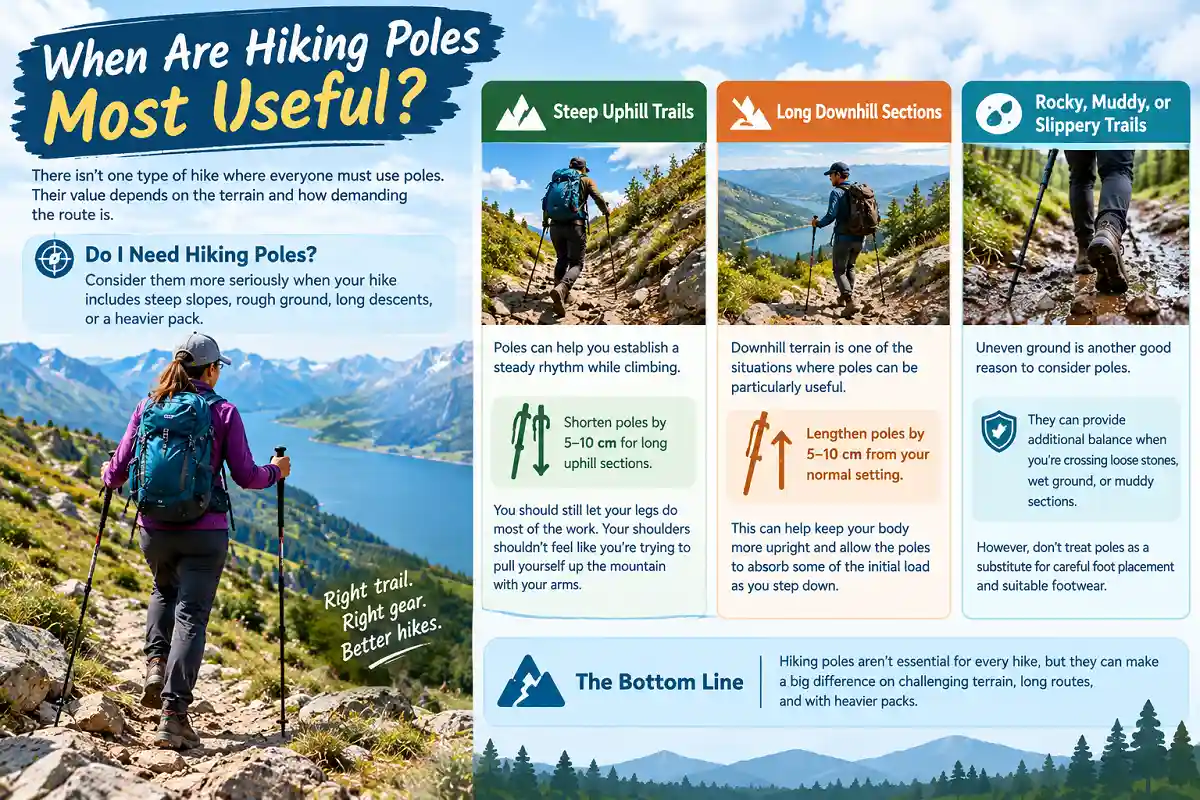
There isn’t one type of hike where everyone must use poles. Their value depends on the terrain and how demanding the route is.
Do I Need Hiking Poles? Consider them more seriously when your hike includes steep slopes, rough ground, long descents, or a heavier pack.
Steep Uphill Trails
Poles can help you establish a steady rhythm while climbing.
On a long uphill section, shortening adjustable poles slightly can provide better leverage and allow you to plant them securely. REI recommends shortening poles by around 5–10 cm for long uphill sections.
You should still let your legs do most of the work. Your shoulders shouldn’t feel like you’re trying to pull yourself up the mountain with your arms.
Long Downhill Sections
Downhill terrain is one of the situations where poles can be particularly useful.
For long descents, REI recommends lengthening poles by roughly 5–10 cm from your normal setting. This can help keep your body more upright and allow the poles to absorb some of the initial load as you step down.
Rocky, Muddy, or Slippery Trails
Uneven ground is another good reason to consider poles.
They can provide additional balance when you’re crossing loose stones, wet ground, or muddy sections. However, don’t treat poles as a substitute for careful foot placement and suitable footwear.
Should Beginners Use Hiking Poles?
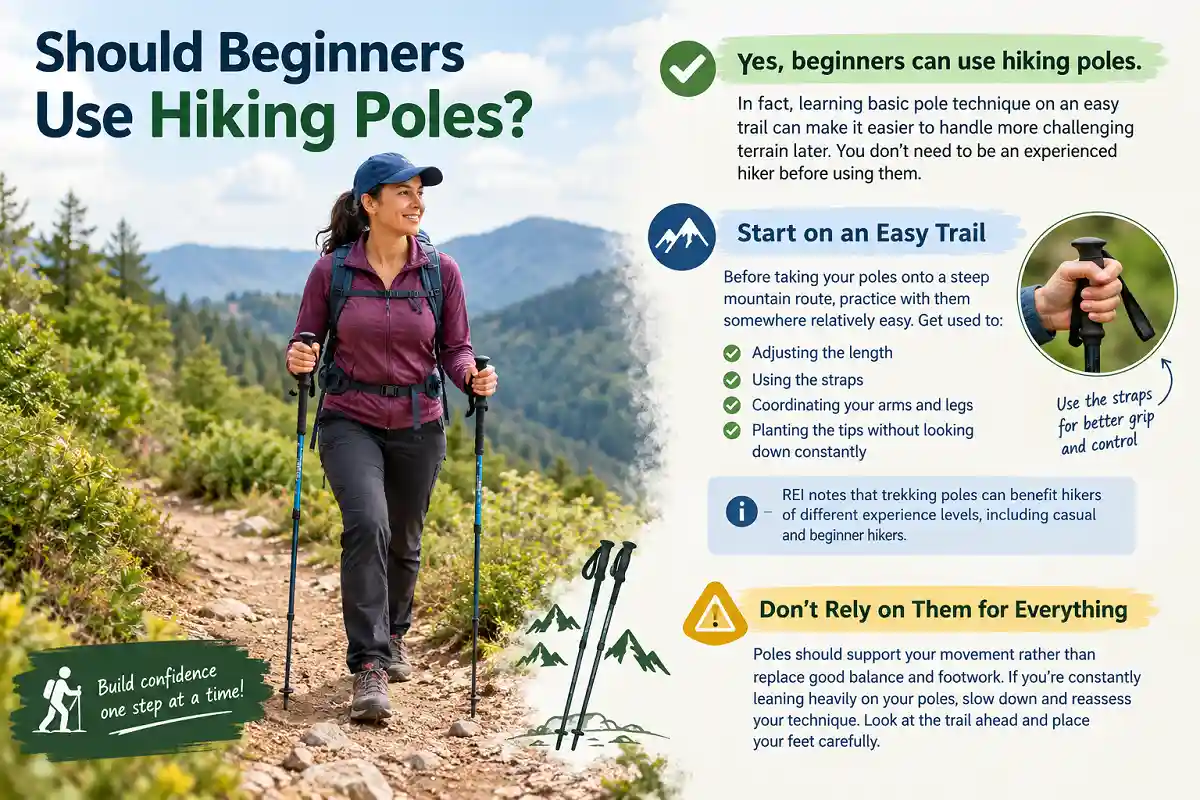
Yes, beginners can use hiking poles. In fact, learning basic pole technique on an easy trail can make it easier to handle more challenging terrain later.
You don’t need to be an experienced hiker before using them.
Start on an Easy Trail
Before taking your poles onto a steep mountain route, practice with them somewhere relatively easy.
Get used to adjusting the length, using the straps, coordinating your arms and legs, and planting the tips without looking down constantly.
REI notes that trekking poles can benefit hikers of different experience levels, including casual and beginner hikers.
Don’t Rely on Them for Everything
Poles should support your movement rather than replace good balance and footwork.
If you’re constantly leaning heavily on your poles, slow down and reassess your technique. Look at the trail ahead and place your feet carefully.
How to Use Hiking Poles Correctly
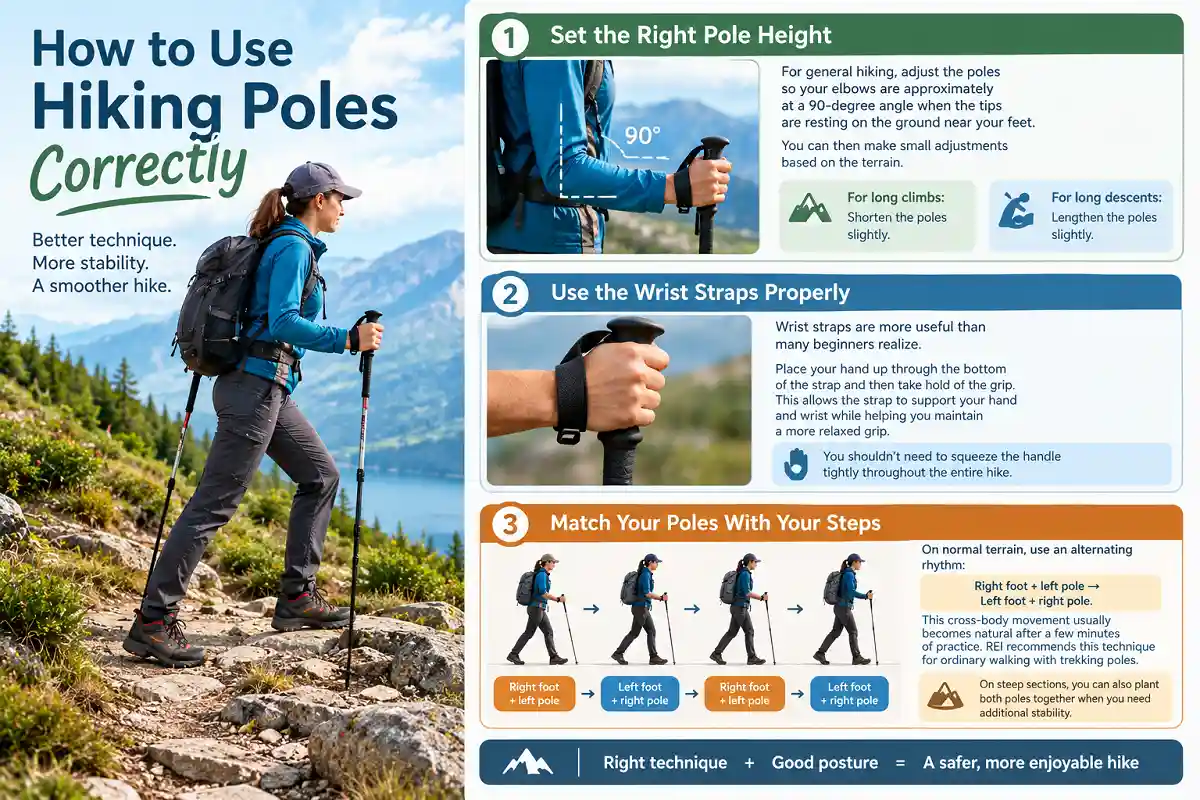
Once you’ve decided to use poles, proper technique makes a noticeable difference.
The good news is that there’s not a huge learning curve. After a little practice, the movement should feel natural.
Start with your elbows approximately at a 90-degree angle.
Let the straps support your hands instead of gripping tightly.
Use an alternating cross-body rhythm on normal terrain.
Set the Right Pole Height
For general hiking, a good starting point is to adjust the poles so your elbows are approximately at a 90-degree angle when the tips are resting on the ground near your feet.
You can then make small adjustments based on the terrain.
For long climbs, shorten the poles slightly. For long descents, lengthen them slightly.
Use the Wrist Straps Properly
Wrist straps are more useful than many beginners realize.
REI recommends placing your hand up through the bottom of the strap and then taking hold of the grip. This allows the strap to support your hand and wrist while helping you maintain a more relaxed grip.
You shouldn’t need to squeeze the handle tightly throughout the entire hike.
Match Your Poles With Your Steps
On normal terrain, use an alternating rhythm:
Right foot + left pole → left foot + right pole
This cross-body movement usually becomes natural after a few minutes of practice.
REI recommends this technique for ordinary walking with trekking poles.
On particularly steep sections, you can also plant both poles together when you need additional stability.
One Pole or Two: Which Is Better?
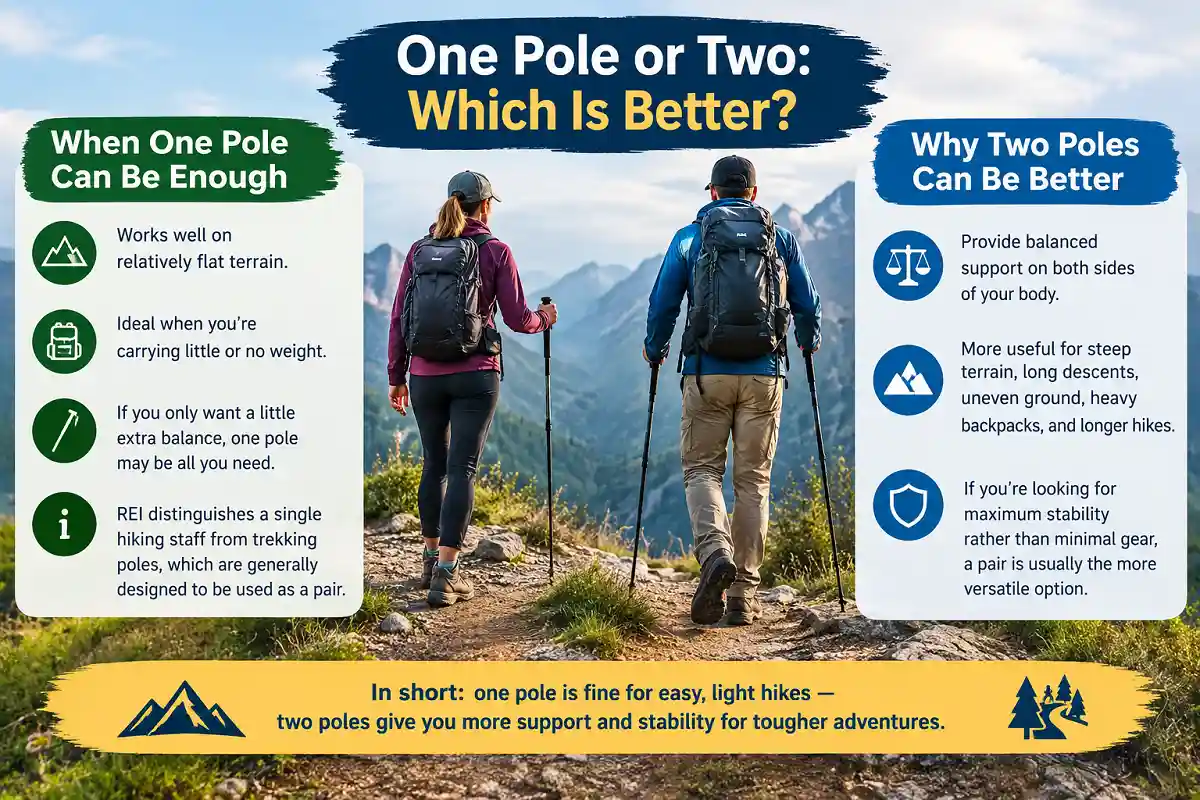
Another common beginner question is whether you actually need a pair.
The answer depends on the type of hiking you do.
One Pole
- Works well on relatively flat terrain
- Useful for a little extra balance
- Convenient with light or no weight
- Minimal gear to carry
Two Poles
- Balanced support on both sides
- Better suited to steep terrain
- Useful on long descents
- More versatile for demanding hikes
When One Pole Can Be Enough
A single hiking staff can work well on relatively flat terrain, particularly when you’re carrying little or no weight.
If you only want a little extra balance, one pole may be all you need. REI distinguishes a single hiking staff from trekking poles, which are generally designed to be used as a pair.
Why Two Poles Can Be Better
Two poles provide balanced support on both sides of your body.
They’re generally more useful for steep terrain, long descents, uneven ground, heavy backpacks, and longer hikes.
If you’re looking for maximum stability rather than minimal gear, a pair is usually the more versatile option.
Choosing Hiking Poles for Beginners
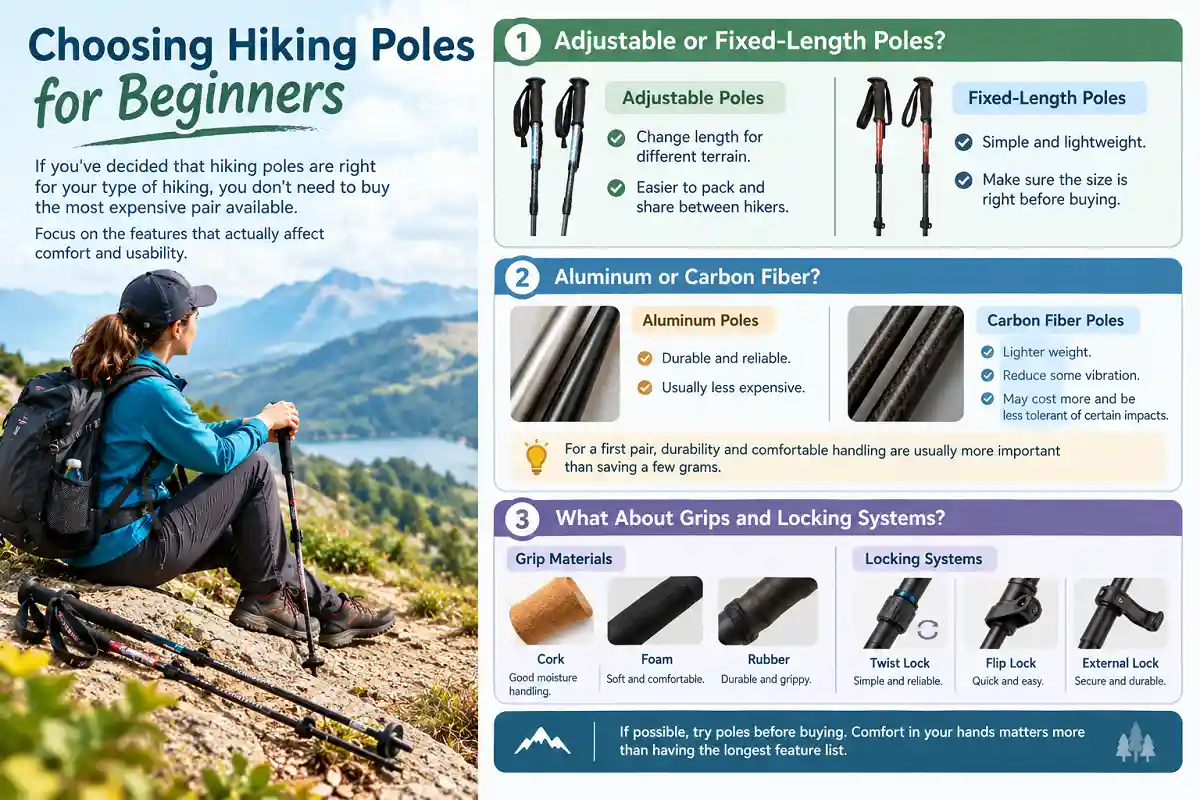
If you’ve decided that Do I Need Hiking Poles? has a “yes” answer for your type of hiking, you don’t need to buy the most expensive pair available.
Focus on the features that actually affect comfort and usability.
Adjustable or Fixed-Length Poles?
Adjustable poles are convenient because you can change their length for different terrain.
They’re also easier to pack and share between hikers of different heights.
Fixed-length poles can be simple and lightweight, but you’ll need to make sure the size is right before buying.
Aluminum or Carbon Fiber?
Aluminum poles are generally durable and tend to be less expensive, while carbon-composite options can be lighter and reduce some vibration but may cost more and be less tolerant of certain impacts.
For a first pair, durability and comfortable handling are usually more important than saving a few grams.
What About Grips and Locking Systems?
Pole grips can be made from materials such as cork, foam, or rubber, each with different comfort and moisture-handling characteristics. Locking systems also vary, especially on adjustable poles.
If possible, try poles before buying them. Comfort in your hands matters more than having the longest feature list.
Common Hiking Pole Mistakes to Avoid
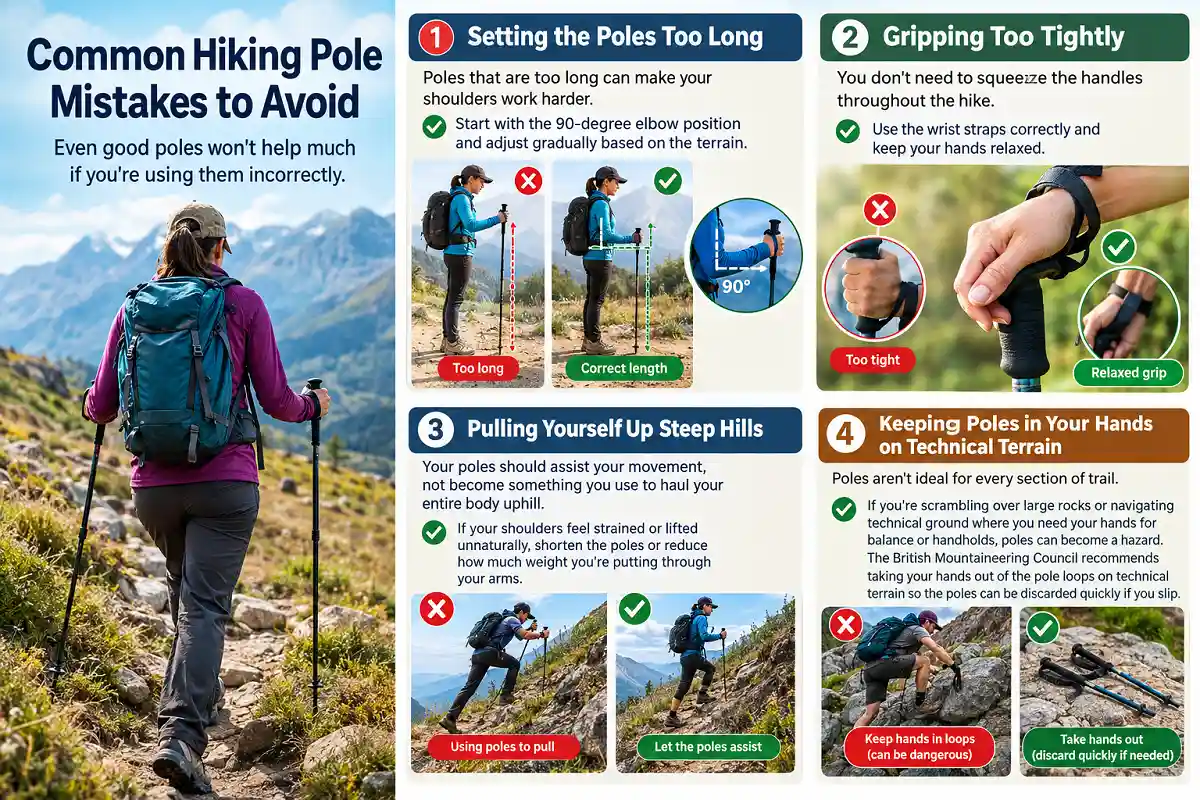
Even good poles won’t help much if you’re using them incorrectly.
Poles that are too long can make your shoulders work harder. Start with the 90-degree elbow position and adjust gradually based on the terrain.
You don’t need to squeeze the handles throughout the hike. Use the wrist straps correctly and keep your hands relaxed.
Your poles should assist your movement, not become something you use to haul your entire body uphill.
Poles aren’t ideal for every section of trail. Technical ground may require your hands for balance or handholds.
Setting the Poles Too Long
Poles that are too long can make your shoulders work harder.
Start with the 90-degree elbow position and adjust gradually based on the terrain.
Gripping Too Tightly
You don’t need to squeeze the handles throughout the hike.
Use the wrist straps correctly and keep your hands relaxed.
Pulling Yourself Up Steep Hills
Your poles should assist your movement, not become something you use to haul your entire body uphill.
If your shoulders feel strained or lifted unnaturally, shorten the poles or reduce how much weight you’re putting through your arms.
Keeping Poles in Your Hands on Technical Terrain
Poles aren’t ideal for every section of trail.
If you’re scrambling over large rocks or navigating technical ground where you need your hands for balance or handholds, poles can become a hazard. The British Mountaineering Council recommends taking your hands out of the pole loops on technical terrain so the poles can be discarded quickly if you slip.
When You Can Hike Without Poles
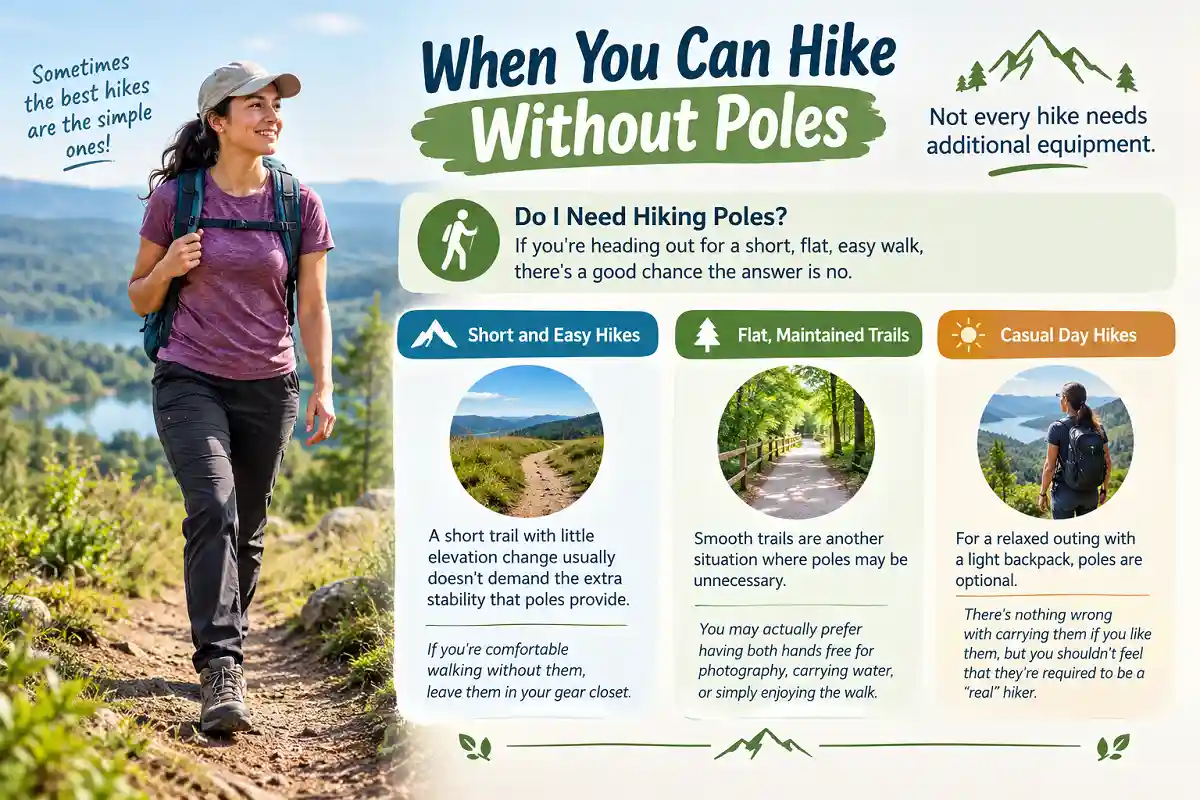
Not every hike needs additional equipment.
Easy trail? You probably don’t need them.
Do I Need Hiking Poles? If you’re heading out for a short, flat, easy walk, there’s a good chance the answer is no.
Short and Easy Hikes
A short trail with little elevation change usually doesn’t demand the extra stability that poles provide.
If you’re comfortable walking without them, leave them in your gear closet.
Flat, Maintained Trails
Smooth trails are another situation where poles may be unnecessary.
You may actually prefer having both hands free for photography, carrying water, or simply enjoying the walk.
Casual Day Hikes
For a relaxed outing with a light backpack, poles are optional.
There’s nothing wrong with carrying them if you like them, but you shouldn’t feel that they’re required to be a “real” hiker.
How Do You Know If Poles Are Right for You?
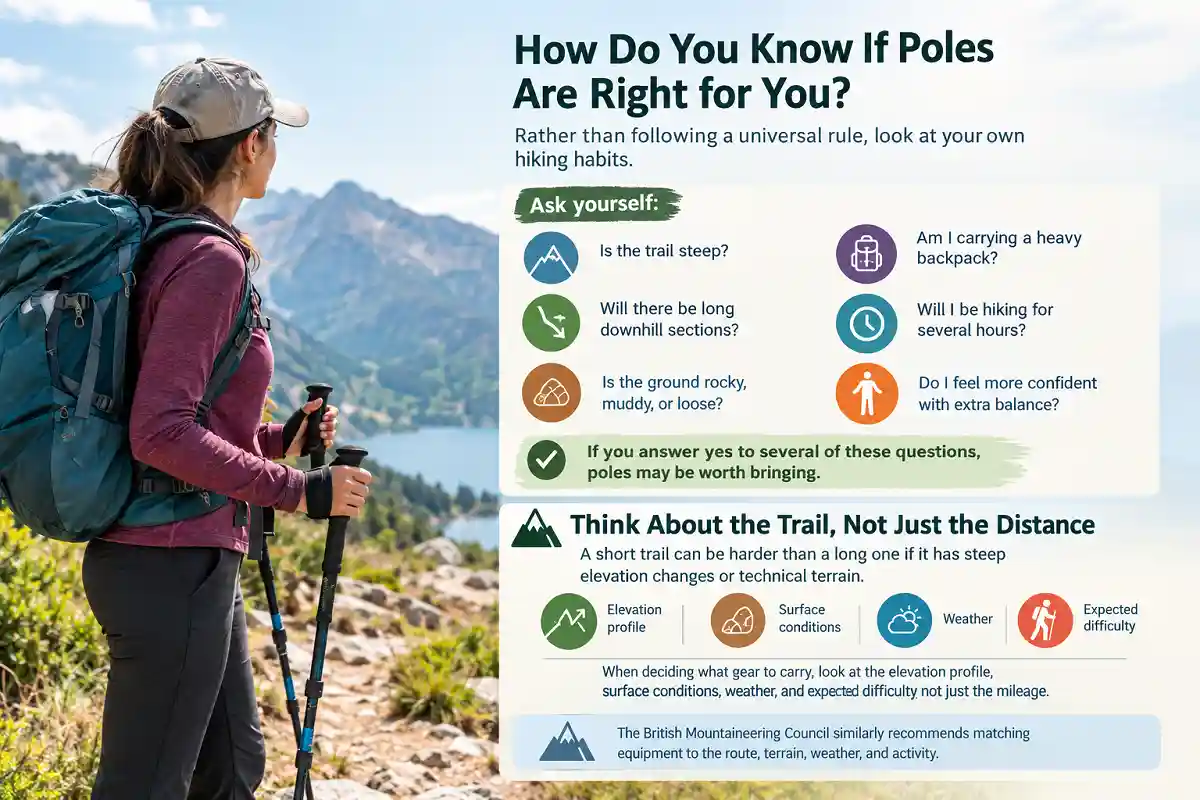
Rather than following a universal rule, look at your own hiking habits.
Ask yourself:
If you answer yes to several of these questions, poles may be worth bringing.
Think About the Trail, Not Just the Distance
A short trail can be harder than a long one if it has steep elevation changes or technical terrain.
When deciding what gear to carry, look at the elevation profile, surface conditions, weather, and expected difficulty not just the mileage.
The British Mountaineering Council similarly recommends matching equipment to the route, terrain, weather, and activity.
Do I Need Hiking Poles?
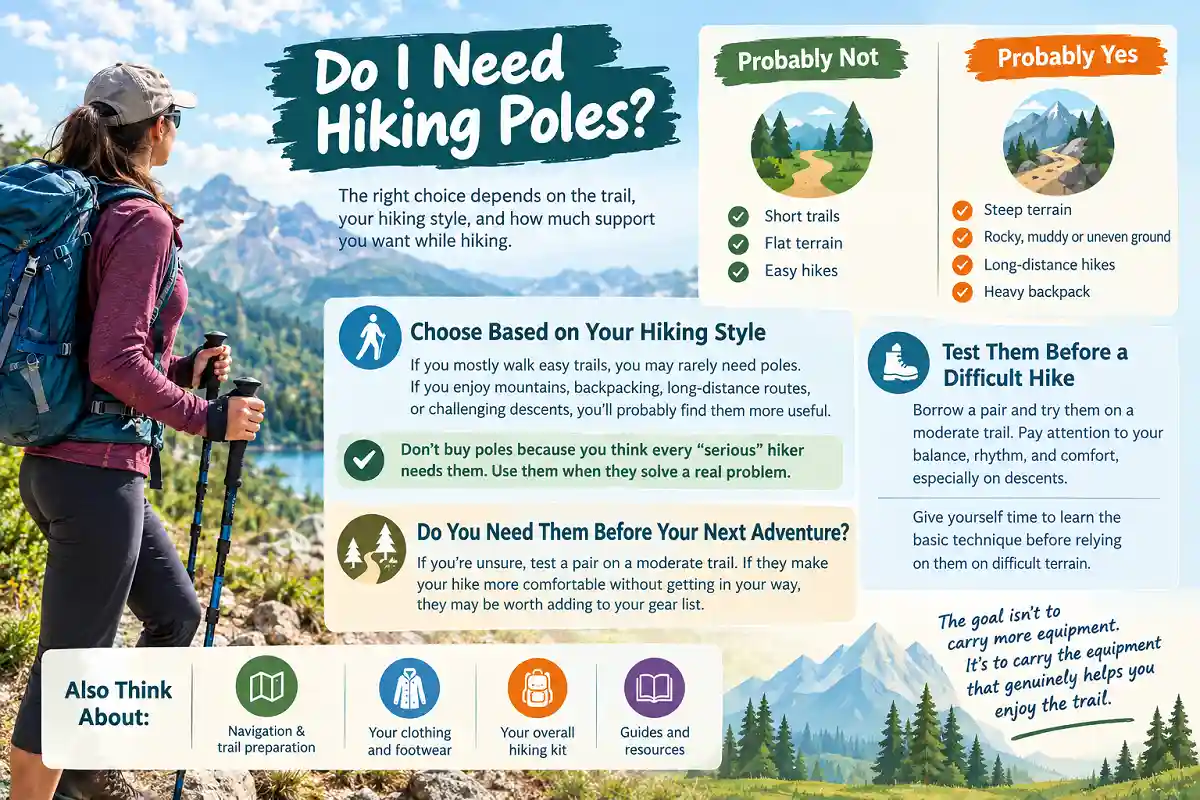
Hiking poles are useful, but they’re not mandatory.
Use them when they solve a real problem: steep terrain, rough surfaces, long descents, heavy packs, or when you simply feel more stable with them.
So, Do I Need Hiking Poles?
If you’re hiking a short, flat, easy trail, probably not. If you’re heading onto steep, rocky, muddy, uneven, or long-distance terrain, they can be a very useful addition to your gear. The right choice ultimately depends on the trail and how much support you want while hiking.
The smartest approach is to match your equipment to your hike. If you’re building your hiking kit from scratch, our guide to the 10 essentials every hiker should carry is a useful place to start.
Don’t buy poles because you think every “serious” hiker needs them. And don’t avoid them because you think using poles means you’re inexperienced.
Use them when they solve a real problem.
The goal isn’t to carry more equipment. It’s to carry the equipment that genuinely helps you enjoy the trail.
Choose Based on Your Hiking Style
If you mostly walk easy trails, you may rarely need poles. If you enjoy mountains, backpacking, long-distance routes, or challenging descents, you’ll probably find them more useful.
If you’re still unsure, our guide Are Hiking Poles Worth It? A Practical Guide for Beginners goes deeper into when poles genuinely help, when you can skip them, and what to look for when choosing a pair.
Your other gear matters, too. If you’re deciding what to wear on different types of trails, you can also check out Are Blundstones Good for Hiking? for a practical look at when casual footwear works and when you need something more trail-focused.
Do You Need Hiking Poles Before Your Next Adventure?
If you’re unsure, borrow a pair and test them on a moderate trail.
Pay attention to how your balance, rhythm, and legs feel especially on descents. If the poles make the hike more comfortable without getting in your way, they may be worth adding to your regular gear list.
Before heading out, it’s also worth thinking about navigation and trail preparation. Our guide on How to Avoid Getting Lost While Hiking covers simple habits that can help you stay on route.
For a visual reference, you can also browse the Trekking Poles category on Wikimedia Commons to see different types and designs. The collection includes trekking-pole images and identifies them as hiking equipment used for activities such as hiking, mountaineering, trekking, and Nordic walking.
The goal isn’t to carry more equipment. It’s to carry the equipment that genuinely helps you enjoy the trail.
Test Them Before a Difficult Hike
Take a pair on a moderate trail and pay attention to how they affect your balance, rhythm, and comfort.
Give yourself time to learn the basic technique before relying on them on difficult terrain.
The goal isn’t to carry more equipment. It’s to carry the equipment that genuinely helps you enjoy the trail.
FAQs
Do Beginners Need Hiking Poles?
No. Beginners can hike without poles, especially on easy trails. However, poles can be helpful on steep, uneven, slippery, or long routes.
Are Hiking Poles Good for Downhill Hiking?
Yes. Poles can provide additional stability and allow you to transfer some load through your arms during descents.
Is One Hiking Pole Enough?
It can be. A single hiking staff can work well on relatively flat terrain, while two trekking poles generally provide more balanced support on challenging trails.
What Height Should Hiking Poles Be?
For general hiking, adjust them so your elbow is around a 90-degree angle when the pole tip touches the ground near your foot. Shorten them for long climbs and lengthen them for long descents as needed.
Can You Hike Without Trekking Poles?
Absolutely. Poles are optional gear. Many hikers prefer to leave them behind on short, flat, easy trails.
Are Trekking Poles and Hiking Staffs the Same?
Not exactly. Trekking poles are generally used as a pair, while a hiking staff is a single pole. A staff is particularly suited to relatively flat terrain and lighter loads.